When Does an Enterprise Actually Need MoE?
The first article in this series was about system reality: latency, memory, concurrency, and deployment constraints. This second article…
When Does an Enterprise Actually Need MoE?
Photo by Paul Hanaoka on Unsplash
The first article in this series was about system reality: latency, memory, concurrency, and deployment constraints. This second article moves one layer deeper, from serving decisions to model architecture.
That shift matters because teams often start asking architecture questions too late and in the wrong order. Once terms like RAG, fine-tuning, agents, and MoE enter the room, it becomes easy to feel that serious design work has already started. In many cases, it has not.
One question comes up especially quickly: if a single model seems to struggle across very different tasks, should the next step be Mixture-of-Experts?
At first glance, the idea is easy to like. Instead of forcing every input through the same path, you divide work across specialists. The intuition is clean. Different problems may deserve different computation. That sounds efficient, and often sophisticated.
But that intuition hides the hard part.
A useful analogy is a medical clinic. If every patient is first routed to the right doctor, specialization improves both quality and efficiency. But if triage keeps sending stomach cases to dermatology, more specialists do not help. And if nearly every patient ends up with the same doctor, the clinic may look specialized on paper while operating like a bottleneck in practice.
That is the real subject of this article.
Most public writing on MoE treats it as an advanced model class. Much less attention goes to the more practical question: under what conditions is an enterprise actually justified in taking on the training cost, inference complexity, and operational overhead that come with this architecture?
MoE does not become useful simply because it has more experts. It becomes useful when a single shared path is no longer enough, the router can separate inputs reliably, and the expert set remains healthy enough to preserve real division of labor.
MoE is not “more experts, therefore more power.” It is a specialist system that depends on competent triage and healthy traffic distribution.
The small experiments in this article all push on the same question: if you move from “everything goes through one path” to “different inputs go to different specialists,” what must you prove first so that the added complexity is actually justified?
1. Start with the comparison that matters: the ordinary LLM path
A surprising number of MoE discussions begin by comparing one expert-based design to another. That is usually not the comparison that matters.
For most teams, the real reference point is the standard dense large language model they already know. In that setup, an input enters the model and is processed by the same main body of computation. There is no front-end decision layer that chooses which specialist should handle the request. In practical terms, every input travels through one shared path.
That is what I mean here by the dense baseline: the ordinary, non-MoE starting point with no expert routing and no conditional specialist activation. Later in the article I simply refer to it as the single-path model.
This is where the reasoning has to begin. If that shared path is already doing the job well, then adding expert modules does not solve a real problem. It just makes the system harder to understand, train, and serve.
Think about a more concrete example. Suppose one system has to summarize sales meetings and also structure legal documents. If both tasks are forced through one shared computation path, the model may end up compromising between them. That is the first real signal that task-specific specialization might be justified.
So the dense baseline is not there to make MoE look impressive. It is there to answer a prior question: has the shared path started to compromise across structurally different tasks?
If the answer is no, MoE is too early. If the answer is yes, specialization finally has a legitimate opening.
The practical implication is simple. The right first question is not “Is MoE powerful?” It is “Is the shared path now dragging down more than one task class?” If not, MoE is probably introducing complexity ahead of need.
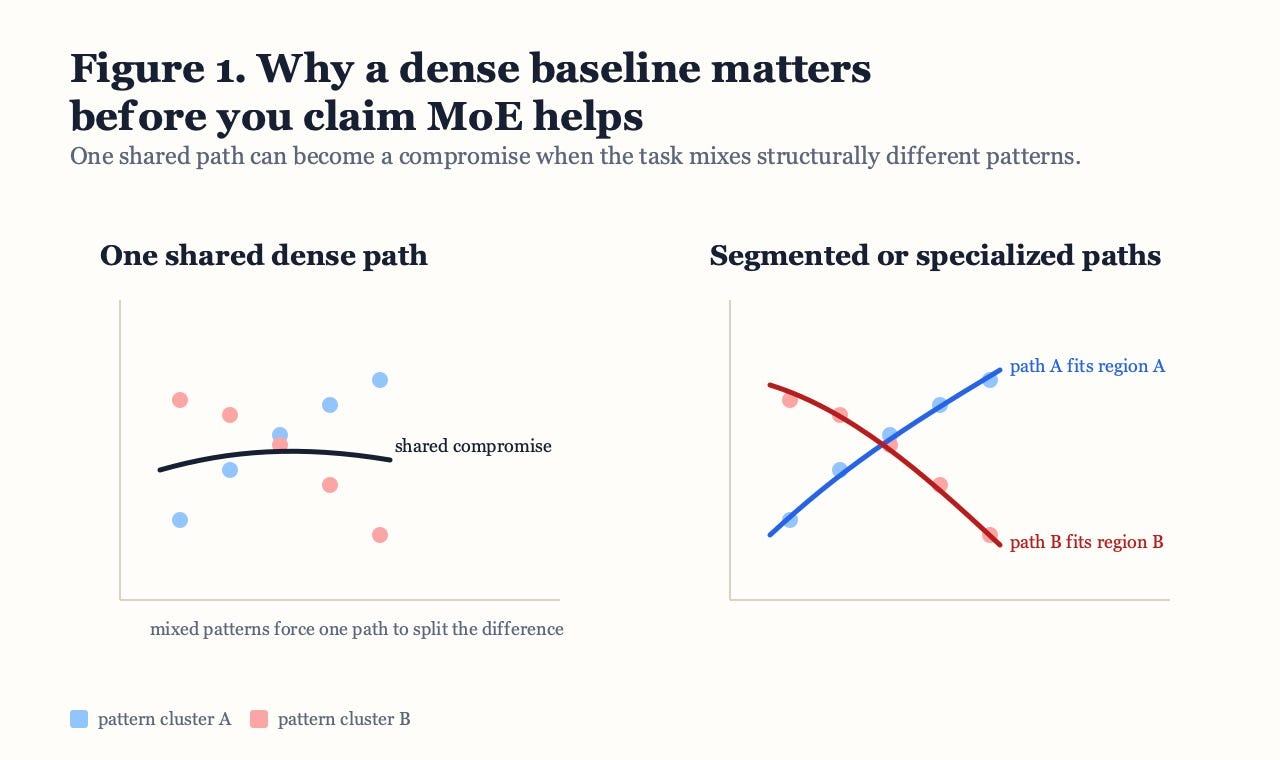
MoE should not be your first move. It only becomes meaningful after you can show that a single shared path is structurally compromising across different patterns.
This step is easy to skip because it is less glamorous than the architecture itself. But it is where the discipline begins. Complexity earns its place only when it resolves a structural problem the shared path can no longer handle cleanly.
2. What problem does MoE solve, and why does routing matter so much?
Before going further, it helps to define MoE in practical terms. The simplest explanation is that the full model does not work on every input every time. Instead, a routing layer first decides what kind of problem the input resembles, and only part of the model is activated to handle it.
That is a major departure from the ordinary dense model. A dense model is like a single senior generalist taking every case: legal, financial, coding, summarization, all through the same body of parameters. MoE takes a different stance. If task types diverge enough, it may be better not to force one shared path to do all the work.
The attraction is obvious. First, you can increase total model capacity without activating the whole system on every token. Second, you create room for specialists to become better at different task families. Third, from an engineering perspective, MoE offers a way to push capability upward without letting inference cost explode in a fully linear way.
That is why so many teams pursue MoE. Usually it is not because they are unable to build a dense model. It is because they are trying to manage a different tradeoff: more total capacity, more room for specialization, and a more controlled per-request compute cost.
But the logic works only if the front-end routing decision is reliable. The moment the architecture says “not everyone works on every request,” routing stops being a detail and becomes the center of the design.
The clearest lesson across these experiments was this: strong experts do not rescue a weak router.
That may sound obvious, but it is more important than many summaries make it seem. MoE is not only a specialist system. It is also a decision system. If the decision layer cannot reliably separate inputs, the specialist layer behind it cannot produce stable value.
This pattern showed up clearly even in a deliberately simplified setup. Clean routing preserved the benefit of specialization. Noisy routing degraded quality quickly. Once routing nearly collapsed, the architecture started to behave like a broken imitation of a dense system.
I made the experiment small on purpose. In large systems, too many variables move together and it becomes difficult to say whether the problem came from the experts, the router, or the data itself. The smaller setup made it easier to isolate what mattered most: MoE is often most fragile not at the expert layer, but at the routing decision right before it.
That is why I no longer think “more experts” is the best mental model for MoE. The better model is conditional computation with a routing control layer. The routing layer is not a supporting character. It is the control center.

This is the core MoE lesson in one chart: as routing quality degrades, end-to-end error rises quickly. Expert quality alone does not rescue a weak router.
Once MoE is viewed this way, much of the hype becomes easier to filter. The architecture is not useful because it can name more experts. It is useful only when routing is accurate enough to preserve real separation. In practice, that means you should never evaluate MoE only by the final score. You also need to inspect how inputs were assigned and whether that assignment remained stable.
3. Imbalance begins before the system visibly fails
Another lesson was that expert imbalance becomes dangerous well before the system reaches obvious failure.
If one expert begins to absorb too much traffic, the others lose learning opportunity. Over time, the architecture drifts toward a regime where multiple routes exist on paper, but one route is doing most of the meaningful work.
That is why expert utilization matters. The goal is not perfect symmetry. The goal is to avoid a concentration pattern that quietly hollows out the value of specialization from the inside.
There is an important nuance here. Uneven traffic is not automatically a problem. Real tasks are rarely symmetrical, so healthy systems can still show skew. The more important distinction is between natural skew and pathological concentration.

Uneven traffic is not automatically a failure mode. The real problem begins when one expert absorbs so much traffic that the others stop learning in a meaningful way.
That distinction matters because teams can easily overcorrect. If all imbalance is treated as failure, the optimization target drifts toward cosmetic symmetry rather than learning quality. The real question is not “Is traffic equal?” It is “Is traffic healthy enough to preserve learning across the expert set?”
4. Shared experts help only when there is truly shared structure
Another useful question in these experiments was whether some computation should be shared rather than relearned by every routed expert independently.
That is the real point of shared experts. Not to prove that they create a dramatic leap, but to test whether a common path can absorb structure that truly appears across many inputs.
The toy setup made that question clean on purpose. Each sample contained both a broad pattern shared across inputs and a more local pattern specific to a narrower region. That made it possible to ask a concrete question: if some structure is genuinely common, should every routed expert really have to relearn it from scratch?
The answer was helpful, but restrained. One shared expert improved the result a little. A second shared expert added very little.
That is the kind of result I trust most. It does not promise magic. It reveals a real mechanism, and it shows where the gain starts flattening.

Shared structure can justify a shared path, but the gains flatten quickly. In this toy setup, the first shared expert helped a little; the second barely changed the result.
The practical lesson is not “add shared experts.” It is “look for truly shared structure, test it directly, and stop when the marginal gain starts flattening.”
5. Finer-grained experts are not automatically better experts
This was one of the clearest corrections to a common intuition.
In the granularity experiments, “large,” “medium,” and “small” were not universal categories. They were local labels used to compare different ways of packaging roughly the same active compute capacity.
The real question was whether a given compute budget should be expressed as a few larger experts or many smaller ones.
The result was clear. Coarse experts were too blunt. Medium-grain experts worked best. Ultra-fine experts did not keep improving and started to degrade slightly.
That matters because it pushes back against another lazy heuristic: more experts is not automatically more elegant. Finer granularity helps only when it matches the structure of the task. Beyond that point, fragmentation adds coordination cost without adding meaningful specialization.

Expert granularity has a sweet spot. Coarse experts were too blunt, medium-grain experts were best, and ultra-fine experts started fragmenting the problem too aggressively.
This is easy to miss if you only look at the abstract diagram. Expert size is not an aesthetic choice. It has to correspond to the real structure of the work. If you decide to specialize, the goal is not to split as finely as possible. It is to split only as far as the task actually justifies.
6. Balancing matters, but it comes with a price
Once the expert structure is in place, the next problem appears immediately: how do you stop traffic from becoming unhealthy?
The naive answer is aggressive balancing. The better answer is that balancing helps, but only up to a point. Push it too hard and the system starts pulling routing away from what the task naturally wants.
That is what made the balancing experiments useful. Moderate balancing improved traffic health. Strong balancing started to damage the main objective. Routing bias, by contrast, offered a lower-interference way to nudge traffic without forcing the main loss to do all the regulatory work by itself.

Balancing helps until it starts interfering with what the task naturally wants. Moderate balancing improved traffic health; aggressive balancing hurt task fit; routing bias offered a lower-interference alternative.
At this point, MoE stops looking like a neat architecture diagram and starts looking like what it really is: a control problem layered on top of specialization. That is why balancing matters so much. Many people assume the hard part of MoE is building experts. In practice, one of the harder parts is keeping the specialist system healthy without damaging the task itself.
7. What these experiments changed in my view of MoE
Before running these experiments, it was easy to think about MoE in abstract architectural terms: more total capacity, fewer active parameters per token, more scalable specialization.
After running them, the picture feels much less abstract and much more conditional.
MoE helps when the single shared path is genuinely compromising across task structure, routing is strong enough to preserve separation, expert utilization remains healthy enough to avoid collapse, and the resulting system still makes sense to train and serve.
That is a narrower claim than the promotional version of MoE. It is also much more useful.
The main lesson, at least for me, is that MoE should not be treated as a shortcut. It is not a free-performance story. It is a system whose value depends on several constraints lining up at once.
If you are a researcher, that means it is not enough to show that you built a model with many experts. You need to show why you believe real specialization emerged. If you are an enterprise decision-maker, it means you should not stop at demos or benchmark headlines. You should ask where the shared path is failing, how routing quality is validated, and how expert health is monitored over time.
This is where I land on MoE
The most important conclusion is not that MoE is powerful. It is that MoE is only worth it under specific conditions.
At the center of the argument is a simple point. MoE does not become strong just because you add more expert modules. It becomes worthwhile when three things are true at the same time: the original shared path is no longer enough, routing can actually separate different problem types, and the expert set remains meaningfully alive rather than collapsing into one dominant path.
If the shared path is not clearly failing, MoE is premature. If routing is weak, the expert layer cannot save you. If traffic collapses onto a few modules, much of the promised specialization disappears. And if the operational burden outweighs the practical gain, then the architecture may win on paper while losing in production.
For enterprises, that means MoE is not just a model upgrade. It is a decision to introduce a new specialization logic, a new training dynamic, and a new control problem into the stack. For researchers, it means the burden of proof is higher than “we used experts.” You need to demonstrate that the task needed specialization, the router preserved it, and the system remained healthy enough for the design to matter.
If I had to reduce the article to one line, it would be this: MoE is not free performance. It is a system design that is worth carrying only when specialization is necessary, routing is reliable, and traffic remains healthy.
메타데이터
- post_id
- d65680b012aa
- slug
- when-does-an-enterprise-actually-need-moe-d65680b012aa
- url
- https://medium.com/jk-random-walk/when-does-an-enterprise-actually-need-moe-d65680b012aa
- canonical_url
- https://medium.com/jk-random-walk/when-does-an-enterprise-actually-need-moe-d65680b012aa
- author_url
- https://medium.com/@at12885
- status
- ok
- fetched_at
- 2026-08-16 09:32:46




