Addressable Synaptic Memory: The PKMζ-KIBRA Complex and the Emergence of Awareness
In 1984, Francis Crick posed a mystery that continues to echo through neuroscience: how do memories persist for decades, when the molecules…
Addressable Synaptic Memory: The PKMζ-KIBRA Complex and the Emergence of Awareness
In 1984, Francis Crick posed a mystery that continues to echo through neuroscience: how do memories persist for decades, when the molecules that comprise the brain turnover in mere days or weeks? Recent research (1) into the interaction between two brain proteins, PKMζ and KIBRA, offers a compelling biochemical answer — one with far-reaching implications for our understanding of consciousness, awareness, and even computing.
Molecular Memory as Addressable Storage PKMζ and KIBRA form a persistent molecular bond at activated synapses, acting as a form of long-term memory stabilization. Rather than encoding memory in the molecule itself, this system encodes memory in the location of the bond — at the synapse where learning occurred. This effectively creates an addressable memory system at the biochemical level.
KIBRA functions as a scaffolding protein, anchoring PKMζ at specific synapses. As synaptic proteins degrade, new ones take their place, preserving the address and the bond. The result is a form of synaptic tagging that maintains high-probability signaling at specific locations in the cortex.
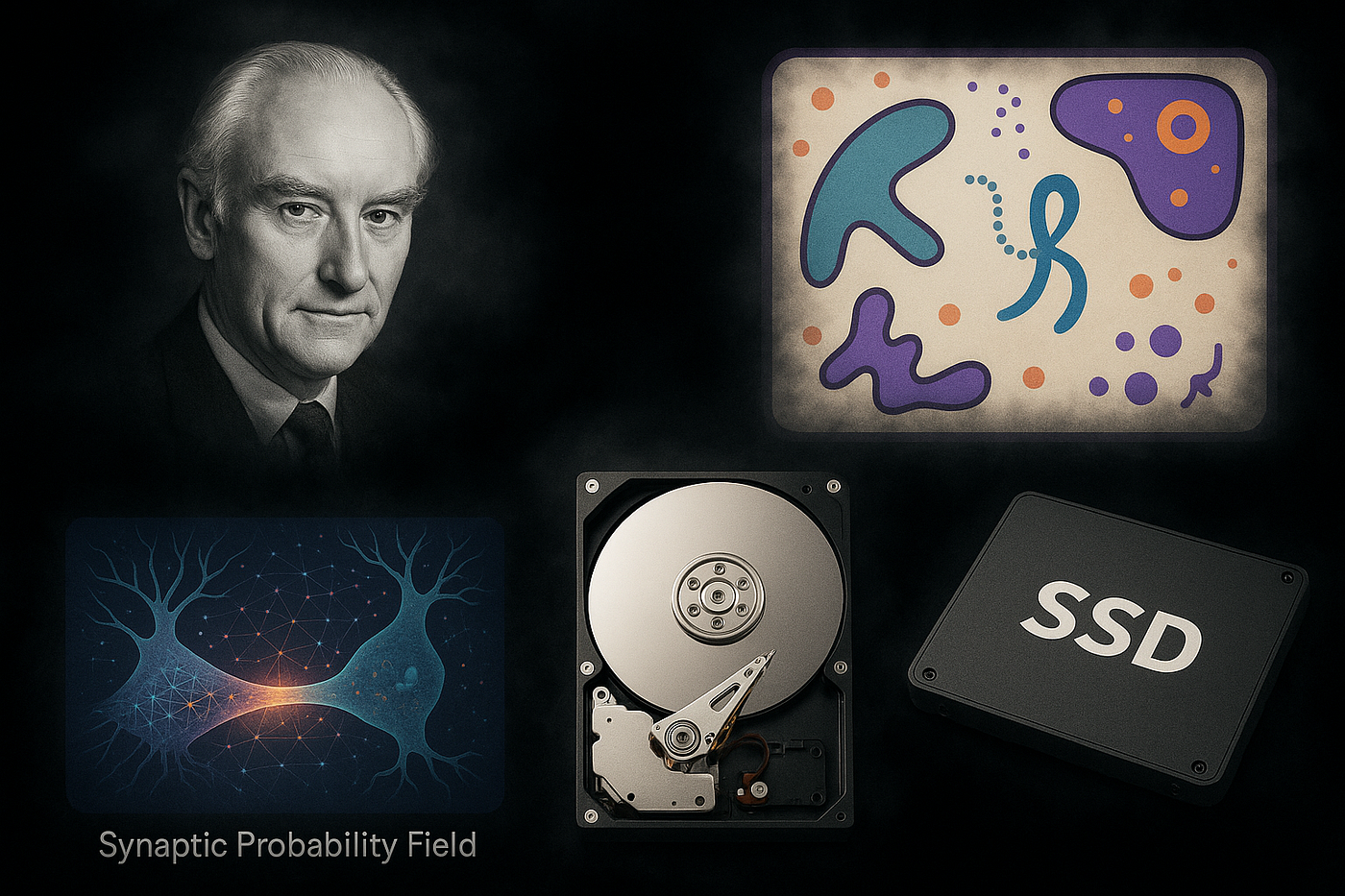
Synaptic Probability Fields (2) In the framework of the Synaptic Probability Field (SPF), synapses are not binary switches but probabilistic gates. Each synapse contributes to a dynamic field of probabilistic potentials. The PKMζ-KIBRA complex locally stabilizes probability values, turning potential into lasting influence. These persistent probabilistic biases are the traces of memory.
The Thalamus as an Entropic Selector Enter the thalamus. It operates not as a passive relay, but as an active selector — an entropy pump that reduces degrees of freedom in the SPF. By selecting from among the vast field of potential signals, the thalamus produces structured, meaningful configurations from probabilistic substrates. In this way, it metes out the awareness construct.
Awareness, in this model, is not the accumulation of firing, but the selection of potential: the thalamus highlights structured memory encoded in PKMζ-KIBRA-tagged synapses by suppressing noise and enhancing signal.
From Synapses to Systems This layered system — PKMζ-KIBRA at the molecular level, SPF at the cortical level, and entropic selection by the thalamus — forms a vertically integrated architecture for cognition:
— Biochemical: PKMζ-KIBRA = persistent, addressable memory tags — Cortical: SPF = probabilistic field of potential experience — Thalamic: Entropic gating = selection of potential into awareness
A Curious Analogy: Hard Drives and SSDs This biological model evokes a fascinating technological parallel. The PKMζ-KIBRA complex functions like the read/write heads of a traditional hard drive, which access specific sectors to store or retrieve data. Meanwhile, the thalamus functions like a solid-state drive controller, selectively accessing addressable blocks without moving parts. The cortex becomes a massive probabilistic substrate — a kind of biological solid-state memory system, tagged with meaning.
Where silicon uses voltage, biology uses protein structure. Where computers use logic gates, the brain uses probability fields. But both systems rely on targeting, addressing, and persistence — and both evolve toward greater efficiency in selecting and maintaining meaningful data.
Conclusion Crick’s dilemma finds its answer not in a single molecule, but in a persistent relationship between proteins that tag locations in a probability field. This addressable memory system gives rise to structured information. With the thalamus acting as a selector of potential, the cortical probability field becomes the stage upon which awareness emerges.
Memory, in this view, is not stored like a file in a drawer. It is a weighted potential in a structured probability space, tagged by proteins and rendered meaningful by entropy. And from this cascade — molecular tagging, probabilistic encoding, and entropic reduction — emerges the miracle of awareness.
Cited Sources:
-
Halilovic, A. (2025). How the Binding of Two Brain Molecules Creates Memories That Last a Lifetime. Quanta Magazine.
-
Reynolds, C. (2025). Synaptic Probability Field Theory (SPFT). Medium
메타데이터
- post_id
- d658334450ee
- slug
- addressable-synaptic-memory-the-pkmζ-kibra-complex-and-the-emergence-of-awareness-d658334450ee
- url
- https://medium.com/@reych369/addressable-synaptic-memory-the-pkm%CE%B6-kibra-complex-and-the-emergence-of-awareness-d658334450ee
- canonical_url
- https://medium.com/@reych369/addressable-synaptic-memory-the-pkm%CE%B6-kibra-complex-and-the-emergence-of-awareness-d658334450ee
- author_url
- https://medium.com/@reych369
- status
- ok
- fetched_at
- 2026-07-19 02:51:08