DOOM: Path Tracing and Bechmarks
DOOM: The Dark Ages finally brought together all my computer hobbies: rendering tech, benchmarking, and killing monsters. The game at…
DOOM: Path Tracing and Bechmarks
DOOM: The Dark Ages finally brought together all my computer hobbies: rendering tech, benchmarking, and killing monsters. The game at launch was very interesting already as some of the first AAA titles to adopt Ray Tracing exclusively: no pure-Raster option, the game doesn’t boot in a GPU without RT Cores. This is still controversial, but if we think of consoles everyone accepts that new hardware is followed by “next-gen exclusives”. Many users celebrate new games that fully embrace new capabilities and can be more optimized for the new platform.
This dynamic works well with consoles for various reasons — the platform is cheap(ish), updated only each 7 years or so, each generational jump in rendering quality is very significant — but the PC is not too different if you wait long enough! RT has been around since 2018, that’s a full “console generation” behind 2025. To be fair RT evolved incrementally and perhaps Turing GPUs were not good enough for AAA games to go all-in with RT; I will investigate here how far you can go back with acceptable results.
As for performance, each generation resets the baseline. A pure-Raster DOOM TDA might do 4K native at 120fps+ on midrange GPUs of today; but nobody was playing any bleeding-edge Raster game at 4K 120fps in 2018. Then-new, top-dog RTX 2080 Ti could barely hit 60fps in RDR2 at 4K High. DOOM TDA scores those 60fps today in an RTX 5080, not the current halo, plus DLSS4/Q is much faster with really zero sacrifice in image quality.
Having said that… Path Tracing is the true next-gen rendering tech today, but my analogy with consoles would only apply to PT if some reasonably mainstream GPU could run that well. DOOM TDA is the ideal test: a rare game that (a) implements PT, (b) has very dynamic action — see below why, and (c) is praised for excellent optimization — at least for regular RT.
Built-in Benchmarks
The June PC Update includes new built-in benchmarks, they will be my primary oracle into RT & PT performance. It’s 7 benchmarks, each a ~2min fly-over of a different level. These tests are a great selection of the game’s environments including some monster action.

What’s missing is the Slayer and his attacks and consequences: monsters exploding, burning, in shock, ricocheting nails. The intense visual effects for combat are only partially represented by enemy projectiles; I don’t understand why developers don’t simply use replays of normal action.
OK, I do understand: developers want the benchmarks to double as demos that show how cool the game is with well-directed camera paths, enemy parades, gazing at skyboxes. Can everyone please stop? Benchmarks and demos have different purposes. A benchmark must represent the full game and have a focus on performance: levels, player, AIs, combat. In DOOM TDA I want to see parries and glory kills, I want very fast camera turns that are frequent in real gameplay and may cause stutters or denoiser / upscaler failures because of the large disocclusions.
Having said that, TDA’s built-in benchmarks are good enough that I doubt anyone can make manual tests that are better for scoring. They certainly run circles around some “walk in the park” benchmarks that consist in running through some fixed path and doing almost nothing, and I don’t care if it’s a bustling city or dense forest that’s hardest to render. Despite DOOM’s deterministic AI spawning, combat is just too chaotic that a tough encounter can be repeated with enough consistency for precise ranking. Some reviewers did that for TDA but the footage I saw clearly shows a low difficulty setting (I will explain why this matters). To be fair these reviews were the best possible at launch, and manual tests are still useful for some purposes since the built-in benchs don’t test combat even half-well.
Built-in benchmarks: Scoring
The main score is the traditional Average FPS, that’s OK. But I’m not sure if the Min/Max values are any good. These seem to be single-frame extremes, but outliers are not useful results. If I compare to any popular third-party performance logging / monitoring tool, the built-in Min score is usually lower than even the 0.1pct-Low which is already of questionable utility.

Even when I watch the whole benchmark, eyes fixed on the FPS value that’s apparently instant / single-frame, I can never observe values that are even close to the reported Min or Max scores. Then again, an outlier that flashes on-screen for a single frame is missed easily. Please id fix this, just do the standard P1 (1pct-Low) instead of Min and the P95 instead of Max. See also my rant about processing frame times.
Ray Tracing
Let’s start with the “regular” rendering, which does intense use of Ray Tracing but not Path Tracing, available since launch. Test is 4K, Ultra Nightmare settings, Quality upscaling (DLSS 4.0 / FSR 3.1) but no FG.
In all my charts, the “DOOM” score is the geometric mean of the 7 tests.
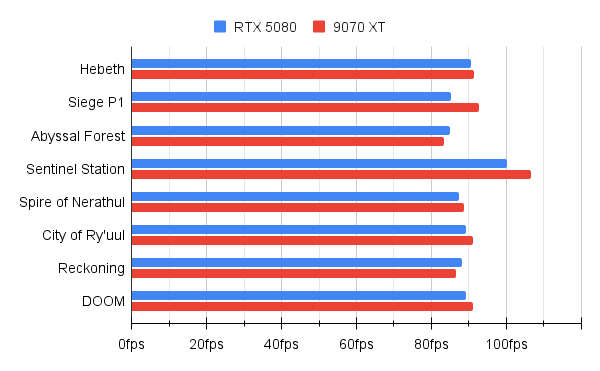
And the first winner is… wait, what? My 9070 XT takes this home even if by a hair of +2% averaging all 7 benchmarks. Technically a tie, but that's a big win when one GPU is a lot more affordable. And that gap widens to +10% at lower resolutions / higher upscaling factors, but we can chalk that down to FSR 3.1 being more lightweight than DLSS 4.0.
This result is surprising; there’s no other game I know of with this high level of Ray Tracing (but no PT) where the 9070 XT competes with the RTX 5080, its best match with NVIDIA is normally the RTX 5070 Ti.
Even the 9070 XT is a latest-gen, $600+ GPUs so does it scale to the low end, all way back to the first RT-capable GPUs? This review / promo makes a case for how good DLSS 4 is because an RTX 2060 can run TDA at 1080p Low with DLSS/Performance. For my taste the rendering resolution of 540p is too low, even the latest DLSS is not magic so the result is often a blurry mess in action. Above my test: 1080p DLSS/P, RT, Ultra Nightmare settings. I set the cut-off for a good experience with this game at an RTX 3070 or RX 6800, for 1080p DLSS/Q or equivalent. That makes the RT-only engine limit the game to GPUs that were midrange 5 years ago.
RT versus Path Tracing: RTX 5080
The June update adds a Path Tracing option. I’m happy that the game sticks with that designation, even in NVIDIA’s promo, instead of the marketoid “Full RT” that’s a lie — and will become obsolete once the next wave of GPUs is upon us and they start promoting “Ultra Full RT Plus”.
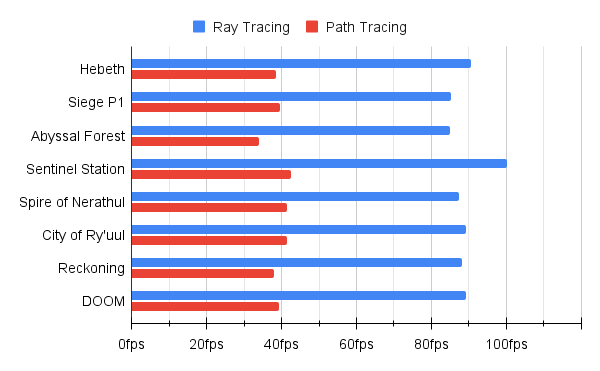
With my RTX 5080 as the standard-bearer, TDA’s PT costs -56% in framerate compared to RT at max settings. Inverting the comparison, “Normie-RT” (my own, trademarked marketoid designation) is 127% faster / 2.27X framerate.
Paraphrasing Douglas Adams, id added even more RT to TDA and this has made a lot of people very angry and been widely regarded as a bad move. Path Tracing in TDA is sometimes much nicer but often not, you may forget it’s on in levels that are low-tech or very open. When even Digital Foundry tells you that PT vs RT are often hard to tell, must I elaborate?
Again, in some places the improvement is very noticeable but mostly when “sightseeing”. My rule for DOOM: if you notice the improved reflections on wet floors during combat you’re not playing at your correct difficulty level. While I appreciate the extra eye candy, it’s quite inconsistent while the performance cost is a consistent -56% everywhere and all the time.
Because idtech is awesome, you can bind hotkeys to enable / disable PT while playing. Open the console (~) and type for example: bind F5 r_pathtracingEnabled 0 bind F6 r_pathtracingEnabled 1 Then find a calm place without monsters to instantly switch PT on/off and check the differences. You can do the same for upscaling level and other settings; try autocompleting r_dlss or r_amdfsr. Type those variable names alone to see a description and list of valid values.
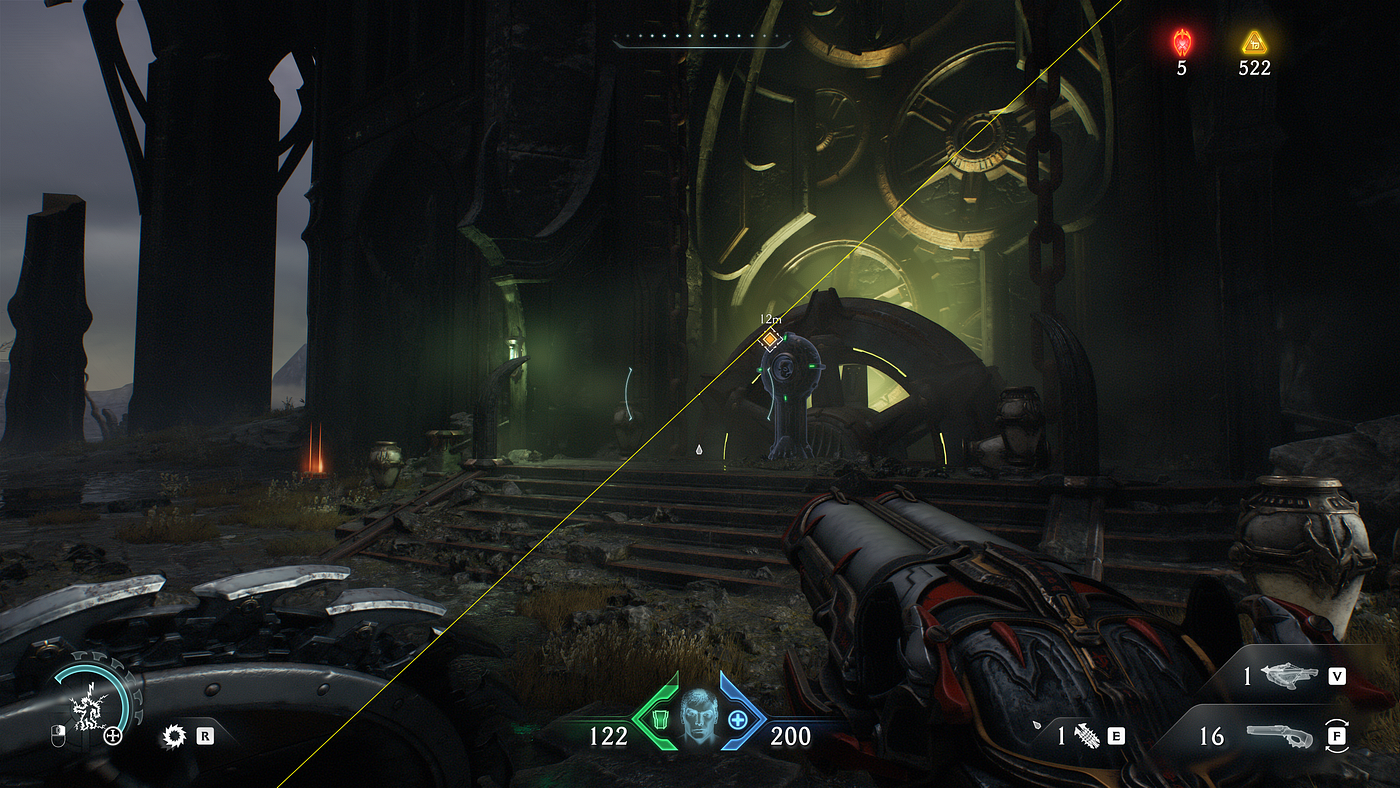
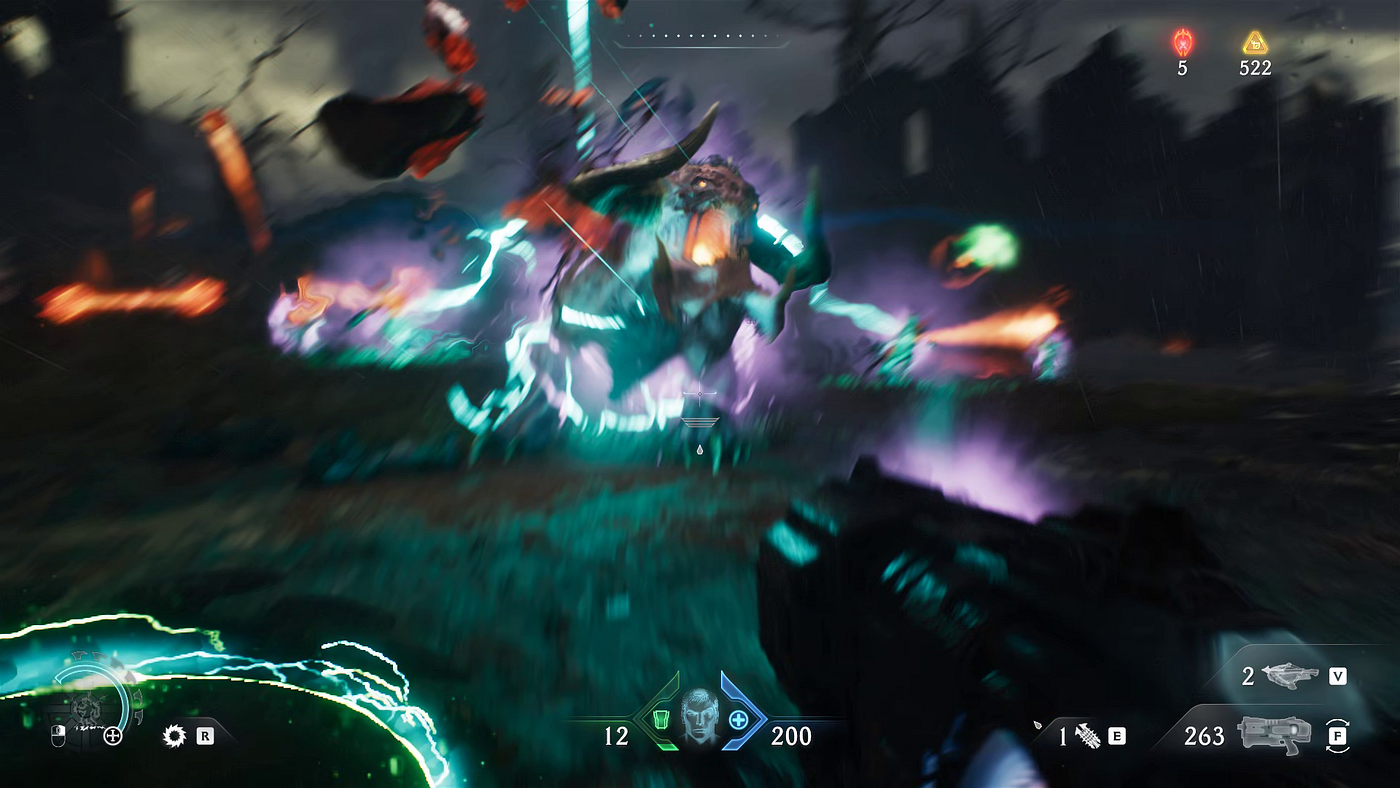
Above, an example of “medium impact” (the most common case): RT = left, PT = right; see how those gears look nicer with PT. On the other hand, see also how the Slayer’s shield is too dark with PT because of the realistic illumination in this very dark scene — more correct is not always better. Don’t forget to have a performance overlay while doing that A/B test; in the frame above (DLSS/Performance both sides) I got RT = 110fps / PT = 60fps.
Those next-gen costs are always secondary to absolute performance: if my GPU could do PT at a locked >100fps I wouldn’t care if I could get 300fps without PT. But we just saw that at 4K my RTX 5080 needed DLSS/P to make 60fps in a simple, static scene. Let’s play with resolutions and upscaling level so we can find the sweet spot.
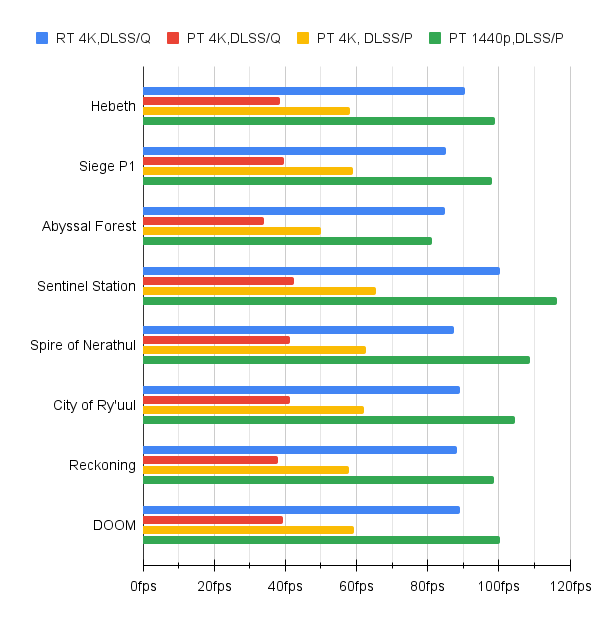
4K with DLSS/Performance goes even lower than 60fps, the Abyssal Forest level scores only 50fps. And those are just averages in a calm walkthrough; the dips in heavy fights (from manual testing) can get my last-gen $1K NVIDIA GPU down to the low-30’s. There’s Frame Generation, but only the forces of Hell will tell you to use FG with a baseline below locked 60fps. And remember, if you enable 2X FG and the new framerate is anything below a locked 120fps then you don’t have that locked 60fps pre-FG anymore.
Our only hope is reducing render resolution further. With 1440p + DLSS/P I get much better averages; I still have dips into the 50’s but it’s rare enough to call it OK, very playable. Visually it’s also OK… I wouldn’t mind it on a 16" gaming laptop. But on my 32" monitor the loss of detail is very noticeable, constantly, even in action. Lowering rendering resolution so much — 720p — to accommodate PT is a much smaller net win for image quality than just adding PT, so the tradeoff with framerate is worse.
Compared to other PT games TDA ranks in the top in average framerates. See for example the tests from DSOGaming and PCGH for the same GPU (ignore titles like Half-Life 2 RTX that have massively less geometry detail). TDA’s dips / 1pct-Low can be worse, but none of those other PT games have comparable action. If anything, the poor equation of performance loss X quality gain against RT shows **how good its regular RT is. **And I think that's in part because of the “forced RT”. Without a Raster mode every line of code, every piece of level design, mesh, texture — everything is built and tested and optimized for RT first & RT only, and it shows.
I am convinced this is a new trend: we will have more “RT-only” games hitting a great sweet spot of visual fidelity + performance and making the Path Tracing option look silly— until new GPUs are fast enough in PT.
RT versus Path Tracing: RX 9070 XT
With my high-end XFX Mercury 9070 XT as a champion of RDNA 4, we can ask if DOOM TDA is the first Path Traced game that can run OK on Radeon. The TLDR is… almost; AMD got really close this time, but not there yet.
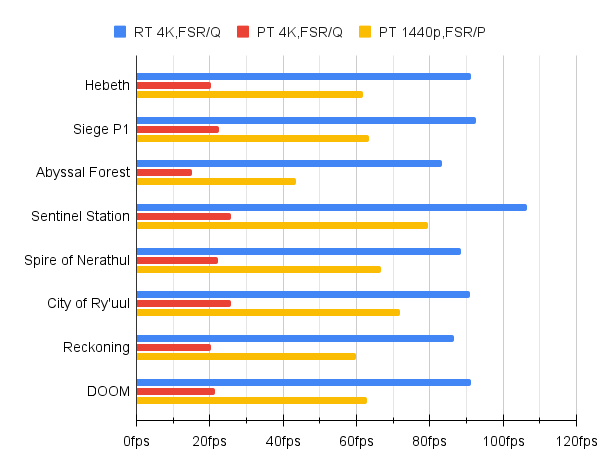
At 4K FSR/Quality the framerate gap to regular RT is -76%, a much bigger hit than for NVIDIA. Worst-case is again the Abyssal Forest with -82%. Abundant foliage is always hard for Path Tracing, even on RTX GPUs but Radeon lacks special optimizations for this. AMD announced their Dense Geometry Format together with RDNA 4, it’s specifically targeted at RT/PT, there’s an SDK available, but this technology is not ready yet and AMD has not confirmed if it will work on RDNA 4 or only future GPUs.
4K FSR/Q is way too ambitious but at 1440p with FSR/Performance I mostly score 60fps. It looks awful; if upscaling from 720p was already a noticeable sacrifice for DLSS 4, it’s much worse for FSR 3.1. FSR 4.0 will be eventually available, that will look better but won’t perform any better. The framerate still dips into the low-30’s in the thick of combat in any level, and in the Abyssal Forest I get low-40’s of average even with no action.
Conclusions
DOOM: The Dark Ages is a great showcase of forward-looking rendering. But the Path Tracing option is still very “forward”, as in “for the next GPUs”. To be far on high-end NVIDIA GPUs it’s already viable for games that have a calmer pace, like Alan Wake II or Indiana Jones and The Great Circle — the latter also with an idtech-based engine and RT-only. In both games, also because of dense jungle levels, my RTX 5080 only sustains good framerates at 1440p DLSS/Performance. At least those games don’t dip way below 60fps in action because, well there’s no action compared to DOOM. I also find that in those two games, 4K with DLSS/Performance + FG is also OK since the latency from the real framerate (mid-40’s for both) is playable because, you guessed, action is mild at best. And I could have written the same blog one year before if I had all those games and an RTX 4080 Super, but Blackwell so far is a “lost generation” for real progress in RT & PT.
Meanwhile on the red team, RDNA 4 was a mix of great progress — with big generational gains in Ray Tracing and with FSR 4 — and the realization that the gap was great and there’s more work to do especially for PT: SER, dense geometry, OMM, AI-driven denoising. All that stuff is coming: some in the FSR Redstone release later this year, some only in the next generation since features like SER require more acceleration. One could argue that “normal” RT is already efficient enough that in some games it competes well with NVIDIA — just don’t click that “Path Tracing” box yet.
메타데이터
- post_id
- d676939976e8
- slug
- doom-path-tracing-and-bechmarks-d676939976e8
- url
- https://medium.com/@opinali/doom-path-tracing-and-bechmarks-d676939976e8
- canonical_url
- https://medium.com/@opinali/doom-path-tracing-and-bechmarks-d676939976e8
- author_url
- https://medium.com/@opinali
- status
- ok
- fetched_at
- 2026-06-25 12:15:08