The Best Practices of Being Ignorant of Best Practices.
Or, The Surprising Benefits of Being From a Creative Nowhere.
The Best Practices of Being Ignorant of Best Practices.
Or, The Surprising Benefits of Being From a Creative Nowhere.

Evil Clippy the Destructor and his minions, various Windows XP icons, turned zombies in a developer apocalypse. Yes it happened.
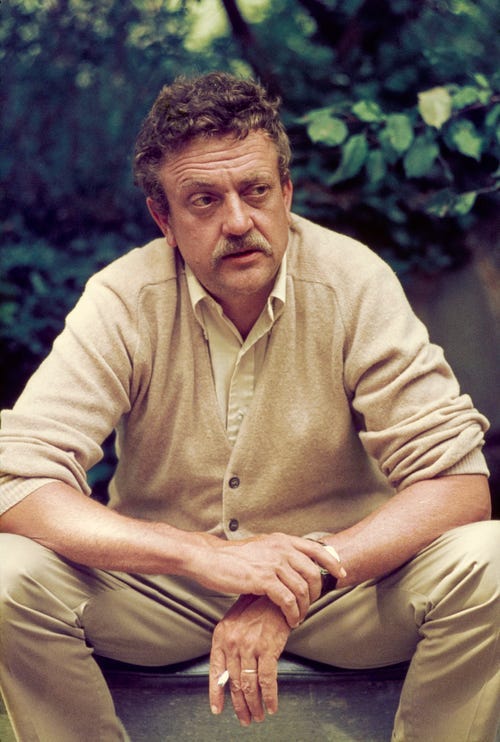
In Breakfast of Champions, Kurt Vonnegut once called Midland City, an obvious proxy for the City of Indianapolis, “the asshole of the universe.” But he also said, in 1986, “All my jokes are Indianapolis. All my attitudes are Indianapolis. My adenoids are Indianapolis. If I ever severed myself from Indianapolis, I would be out of business. What people like about me is Indianapolis.”
Indianapolis-ness creates a cockeyed view of the world in the people who grow up there. It can make you both highly pragmatic, and yet still allow completely loony ideas to get a pragmatic airing.
I think that’s partly because it’s a town where nobody has ever been so successful that the way they did things has to be the only way to do things. So the city has a noble history of weird personalities who created entertaining curiosities in the name of promotion.
Over a century ago, Indianapolis Motor Speedway founder Carl Fisher flew a Stoddard-Dayton automobile over the city, suspended under a gigantic balloon, to promote his auto dealership.

Stunt Advertising, October 30, 1908.
Yup. It happened. Ah, for the days before general liability. Also, ah, for the days when a photograph was proof.
Then there was John Tomlinson Brush, who baseball fans might remember as the owner of the Indianapolis Hoosiers baseball team — but only if they exceedingly old baseball fans — promoted his repeatedly-delayed retail store opening by running full-page ads in the newspapers that were mostly blank, except for the word ‘WHEN’ centered on them, with no other explanation. But he knew everyone in the city would know what he was talking about. Because he knew everyone was thinking about that almost-but-never-quite finished department store building downtown, and making up their own stories about why it was so delayed and arguing about it over drinks. And that was just fine with John Tomlinson Brush.
Think of it. At a time when newspapers and broadsheets were wall-to-wall ink and Victorian flourish, this guy did the opposite. Inventing white space. Something the ad industry wouldn’t really catch up to until the 1960s. And he did it in Indianapolis of all places.
When the WHEN building did open, to attract shoppers, he put a brass band, not in front of the building, but on top of the building, predating both the retail Muzak concept and the Beatles’ Let It Be concert.
Hoosiers (and I was one for nearly half a century) are part of a long tradition of doing things that do not seem to entirely make sense in order to make lots of sense. Indiana has never had the advantages of big-market mass audiences or local access to big-budget production. So sometimes we’d have to think crazy. Always have. But it’s done a good job of preparing us for a world where those big market advantages matter less. Like now. When you have to make your own media. And draw your own attention.
And so, the idea that you can solve a communication problem by building a literal, working arcade game seems counterintuitive to people in our industry who grew up best-practiced, well-funded and believing a TV spot can solve everything.
But drawing public attention without a big media budget has always been a more stimulating risk-reward proposition. Like dangling a car off a bridge. Skywriting in code. Filling a public pool with mint Jello. Making entire city skylines out of cans of soup. Dressing up in a wearable desk and walking around in it at Grand Central Station. (Okay, two of those we actually did. You get to guess which two.)
So, here’s what happened. And by the way, to those of you in the biz who think business-to-business work means second class creative assignments, that need not be the case.
Developers who were supporting websites for Internet Explorer 6 and Windows XP spent a lot of their time patching code and tracking down bugs to keep their creations running on software that was rapidly becoming antique. By blowing the final whistle on that tech and sunsetting XP (as they say in the Redmond lingo), devs would be free to spend those hours creating new and more interesting things that could take advantage of modern HTML5 browsers. Which, of course, we also happened to be promoting.
Our client at Microsoft had asked us to create something that would do two things. First, it should show off the power of a modern web browser; the introduction of HTML5 meant web pages could now run pretty robust applications in a web page — like a game — without tricky third party layers like Macromedia Flash. Second, it had to get developers talking and sharing without feeling like they were being sold — and boy, do developers hate being sold.
We were pretty sure this specific audience would love to play and share a retro-classic side-scroller with a giant, Evil Clippy as the final boss. So our team built an arcade game you could never win.

Our dev team built a fully playable side-scroller that was fun to play, and impossible to win.
Just like in their actual jobs, devs could fight and fight to keep XP safe, but a zombie army of app-icons, viruses and bugs would always eventually defeat you as giant Clippy, the evil Office assistant everyone already loved to hate, vaporized the city. Devs compared high scores. Posted screenshots. Had fun.
Think about that. This was Microsoft. Doing something people didn’t think Microsoft would do. Being humble about their history. And giving the devs a gift, one they could share. And we were right. They loved it, and shared it among their peers.
And then we were wrong.
Because it turned out, it became popular with a far wider audience than we expected. The press picked up on it as a more general tribute to the end of Windows XP, and game mentions increased even more.
By the end of launch day — literally 9 hours in— we’d been covered by Adweek, CNET, Gizmodo and *Time*. By the end of the week, our game had over a million unique page views. Many of these news outlets could have been counted on to grumble and mourn the end of a successful and venerable operating system.
But they didn’t. With Escape From XP, they celebrated a negative.
All this happened well over a decade ago, and promotional games come and go. Marketing websites are retired and server space is constantly freed up for the next big thing. But somebody liked it so much the stole the code, and all these years laters you can still play it, as of this writing, here.
I like to think of this whole thing as being a lot like the WHEN building story. People had a lot of ideas about why the store was delayed. The one-word notices in the paper put the brand, and this is crucial, on the same side as the consumer in their shared frustration. And when you have a big negative and can put yourself on the same side as your audience, it doesn’t get more positive.
Maybe it’s also like Carl’s balloon-car. Sometimes it just pays to do something big and stupid.
Expanded from Twenty-Five Years of Bradley and Montgomery (BaM): Death by Clippy

A book about a tiny agency that does unusual things for big brands.
메타데이터
- post_id
- d68cce50f20d
- slug
- the-best-practices-of-being-ignorant-of-best-practices-d68cce50f20d
- url
- https://medium.com/age-of-awareness/the-best-practices-of-being-ignorant-of-best-practices-d68cce50f20d
- canonical_url
- https://medium.com/age-of-awareness/the-best-practices-of-being-ignorant-of-best-practices-d68cce50f20d
- author_url
- https://medium.com/@scottmontgomery237
- status
- ok
- fetched_at
- 2026-07-13 16:06:16