Series: Digital Dharma
Episode 3: The Veil of Maya (The Philosophy of Digital Illusions)
Series: Digital Dharma
Episode 3: The Veil of Maya (The Philosophy of Digital Illusions)
Digital Dharma: Series Introduction
Most of us perceive philosophy as an ancient science that resides only in textbooks. At the same time, cybersecurity comes across as something that belongs solely to our modern technological age. However, if one removes all the technical terms, one can notice that the core struggle involved in such activities as border protection, identity validation, and cybersecurity incident management today is exactly the same as the one faced by great philosophers of the past millennia. This weekly column is dedicated to Digital Dharma, which implies the application of principles from the world of ancient Hindu philosophy to the realm of modern cybersecurity to make the latter understandable, intuitive, and exciting to anyone from a tech student to a completely non-tech person.
Episode 3: The Veil of Maya (The Philosophy of Digital Illusions)
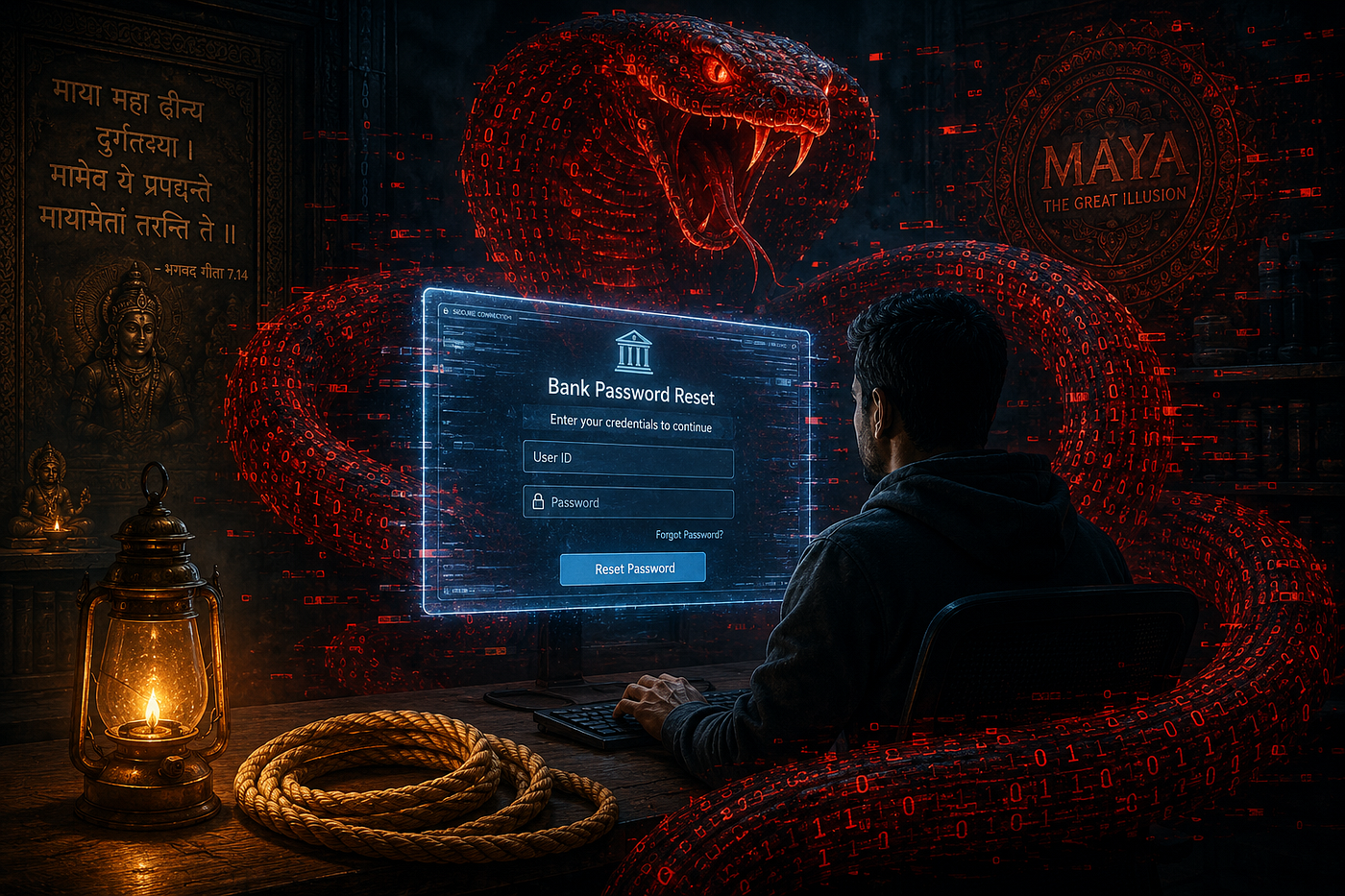
There is a well-known analogy from ancient Hindu philosophy that describes the ways our mind can completely fool us.
Let’s assume that you are walking down a dark lane one night when suddenly you notice a winding creature lying on the floor. Instantly, your blood pressure rises, and you take off into a cold sweat because you believe you are face-to-face with a vicious snake.
However, after someone moves a lantern closer, the light exposes the reality — no snake there. It’s just an abandoned rope.
While the snake never existed, your anxiety, increased blood pressure, and your instant reaction did happen. You’ve created an illusion of danger and responded to it accordingly.
According to the Sanatan philosophy, this process is known as Maya, or the cosmic veil of illusions. Maya is the power responsible for the distortion of reality making the transient permanent and the harmful seem harmless.
Several millennia have passed since then, but today this particular philosophical theory is the very thing that forms the basis of the most lethal weapon in the modern hacker’s arsenal.
1. Hacking Perception, Not Machines
When we think of cyber attacks, we imagine complex mathematics, brute-force password cracking, and millions of lines of glowing green code. We assume that if a system gets hacked, it’s because the technology was weak.
But the truth is, modern enterprise security systems are incredibly strong. Hacking a well-configured server is exhausting, expensive, and loud.
So, hackers stopped trying to hack the computers. They started hacking us.
This is the art of Social Engineering, and it is the ultimate digital manifestation of Maya. Hackers know that human beings are wired to trust their senses and react to emotions. Instead of writing a virus to break into your bank account, they simply send you a text message that says: “URGENT: Your account has been locked due to suspicious activity. Click here to verify your identity immediately.”
They paint a digital snake on the ground. They trigger your panic, your fear, or your sense of urgency. And in that brief moment of emotional hijacking, the illusion works. You click the link. You hand over your password. You bypass your own security walls because Maya convinced you that the fake reality was true.
2. The Evolving Mirage (Deepfakes and Synthetic Reality)
The digital veil of Maya has, for many years now, been relatively easy to detect. There have been ways to look out for misspellings in emails, strange cropping on logos, or peculiar senders’ addresses.
However, with technological advancements like Artificial Intelligence, the Maya effect is now terrifyingly seamless. It is the age of Deepfakes and Audio Cloning. All it takes for an attacker to perfectly imitate anyone’s voice is three seconds of audio recorded from Instagram stories or YouTube videos.
Picture yourself receiving a phone call, only to be greeted by a precise imitation of your own mother’s or dear friend’s voice, desperately telling you to wire money right away because something terrible had happened to them.
The voice sounds genuine. The accent is correct. The tone is just like theirs. Your mind will not question what it hears and feels. In the digital era, Maya does not merely fake emails but even mimics those closest to us.
3. Piercing the Veil (The Power of Viveka)
If illusions have become this sophisticated, how can we protect ourselves against them?
Fortunately, once again, the wisdom of the ancients offers us the necessary framework. The way to overcome Maya is through Viveka, which can be defined as the faculty of profound discernment. This means being able to intellectually distinguish between reality and illusion, to stop reacting emotionally and understand what the rope really is.
In the field of cybersecurity, this becomes a mindset that we call Zero Trust.
Zero Trust is not simply a technical construct for computers, but it is also a psychological defense mechanism. This means that in the cyber world, you need to start by assuming skepticism, because anything that causes fear, urgency, or money is bound to be an illusion.
How can you implement digital Viveka in your everyday activities?
- Debunk the Urgency: The trickery of maya lies in its ability to create haste. Hacker tactics aim at making you take actions without thinking first. In case an email, a text, or a phone message requests instant response from you, take a deep breath and do nothing.
- Check Out of Band: Should your “manager” text you requesting gift cards, or your “bank” sends you an email to log in somewhere, don’t respond. Reveal the rope. Go to a different web page or type in the official banking site by yourself, or make a separate call to confirm whether it actually happened.
The Bottom Line
The biggest weak point in today’s technology world is neither the firewall nor the router or some software. The biggest weakness is the human mind.
As long as we engage with screens, Maya will continue its trickery on us, conjuring up illusions that try to fool us and exploit our sense of trust. But by knowing what Maya is all about, we learn the art of modern Viveka.
Go slow. Think about why things seem urgent. Most importantly, don’t let the illusion get the best of you. Just because you see a snake in your screen doesn’t necessarily mean it exists.
What ancient philosophy or epic should we break down digitally next Tuesday? Leave your suggestions in the comment section 👇
메타데이터
- post_id
- d6a0b7c54f64
- slug
- series-digital-dharma-d6a0b7c54f64
- url
- https://medium.com/@ShwetWrites/series-digital-dharma-d6a0b7c54f64
- canonical_url
- https://medium.com/@ShwetWrites/series-digital-dharma-d6a0b7c54f64
- author_url
- https://medium.com/@ShwetWrites
- status
- ok
- fetched_at
- 2026-06-09 15:37:30