“Sleeping Beauty of Palermo” : The Girl in the Glass Coffin
A Petrarchan Sonnet | In Eternal Remembrance
WRITING PROMPT | TALES IN TIME
“Sleeping Beauty of Palermo” : The Girl in the Glass Coffin
A Petrarchan Sonnet | In Eternal Remembrance
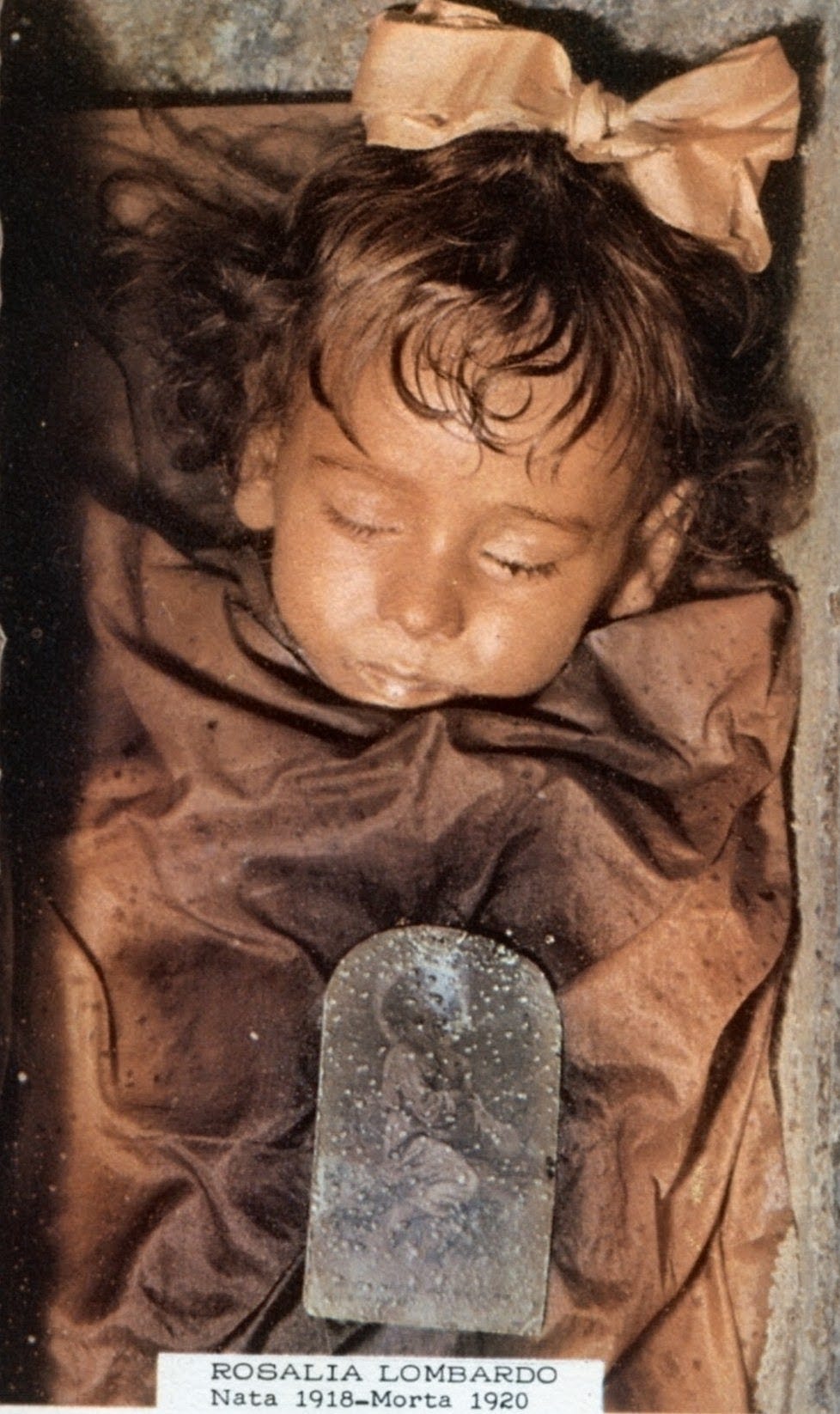
Image credit: Wikimedia Commons — The “Sleeping Beauty of Palermo”
Will you live forever, my dear? Setting fire to the world in which you are no more, feeling horribly forlorn Swept away by a raging storm, in a tide of grief our hearts are torn Oh my dear, we can’t live without you here In the safe harbor of your gaze, your soulful eyes lit up the ebony sky, so clear The blonde in the curls of your golden hair still glisten, since you were born Your porcelain skin catches the light like a translucent pearl, beauty adorn The cruelty of life, a silent selection of who will live and who will die, that we must fear Marking each day with the silence of your absence, with a heavy stillness that is left behind When will our souls eclipse again? Into the restless abyss, an anchor sinking deep, surrendering to the quiet waters, with a feeling of being lost at sea Our melancholic suffering is a quiet ache of acceptance, I do now find The heavens weep, and tears stream like rhythmic fury of Autumnal rain Sleeping beauty, in our hearts you will remain and eternally be.
Author’s Notes
In 1920 Rosalia Lombardo was one week away from her second birthday before she died of pneumonia due to the Spanish Flu.
Her father’s profound heartbreak for her led to him instructing an embalmer to preserve her to “live forever”. A Sicilian professor named Alfredo Salafia, perfectly mummified the child.
The little girl lies in a glass-topped casket in the catacombs beneath the Capuchin convent in Palermo, Sicily along with the burials of more than 8,000 other mummies.
After the catacombs were made public to visitors, she became known as the “Sleeping Beauty of Palermo.”

Image credit: Wikimedia Commons — Rosalia Lombardo in the catacombs beneath the Capuchin convent, Sicily

Image credit: Wikimedia Commons — The other mummies in the Capuchin catacombs, Palermo
The Petrarchan sonnet, commonly known also as the Italian sonnet, was named after the Italian poet Francesco Petrarca.
The Italian sonnet form consists of fourteen lines divided into two parts, an eight-line stanza (octave) rhyming ABBAABBA and a six-line stanza (sestet) rhyming CDCDCD or CDECDE.
An Italian sonnet also traditionally uses a volta (a “turn”) occurring in the eighth and ninth lines acting as a dramatic transition in thought or emotion in the poem.
I transformed the agonizing weight of profound loss of a heartbroken father into a poem.
I wrote this yesterday before I became a daughter who lost her dearest, bestest father.
I found myself walking through an empty barren land.
Coming home to the heavy silence of loss defined by the quiet echo of an empty space his warmth once embraced.
And on Father’s Day I reach for a hand that can reach no more.
Thank you for reading.
Thank you Amalia for the writing prompt and many thanks to Willow for helping to refine and perfect the sonnet. ☺️
메타데이터
- post_id
- d6ac5e2ec11c
- slug
- sleeping-beauty-of-palermo-the-girl-in-the-glass-coffin-d6ac5e2ec11c
- url
- https://medium.com/my-fair-lighthouse/sleeping-beauty-of-palermo-the-girl-in-the-glass-coffin-d6ac5e2ec11c
- canonical_url
- https://medium.com/my-fair-lighthouse/sleeping-beauty-of-palermo-the-girl-in-the-glass-coffin-d6ac5e2ec11c
- author_url
- https://medium.com/@homerah.b
- status
- ok
- fetched_at
- 2026-06-29 22:44:20