Exoplanets: How We Find Habitable Worlds and Search for Life
How scientists detect exoplanets, map habitable zones, analyze atmospheres for biosignatures, and narrow the search for life in space.
Exoplanets: How We Find Habitable Worlds and Search for Life
For most of human history, planets beyond the Solar System were matters of speculation. Astronomers suspected that other stars might have worlds of their own, but those planets were too small, faint and distant to see with the available technology.
That changed in 1992, when astronomers announced two planets orbiting a pulsar — the rapidly spinning remnant of a dead star. In 1995, the discovery of 51 Pegasi b provided the first confirmed example of a planet orbiting a Sun-like star. The result proved that planetary systems were not unique to the Sun and launched the modern search for other worlds.
The field has grown quickly. As of July 16, 2026, the NASA Exoplanet Archive listed 6,324 confirmed exoplanets. Of those, 4,667 were discovered primarily through transits and 1,195 through radial-velocity measurements. Smaller numbers were found through direct imaging, gravitational microlensing, astrometry and several forms of timing analysis.
Finding a planet, however, is only the beginning. Astronomers must then determine what it is made of, whether it has an atmosphere, what conditions exist on its surface, and whether any of its features could have been produced by life.
How Do We Find a Planet We Cannot See?
Most exoplanets are not photographed directly. Instead, astronomers detect the effects they have on their host stars. A planet may dim its star, pull it slightly from side to side, or alter the timing of a repeating astronomical signal.
Each method reveals different information. Used together, they can turn a faint signal into a surprisingly detailed picture of a distant world.
The Transit Method: Watching a Star Dim
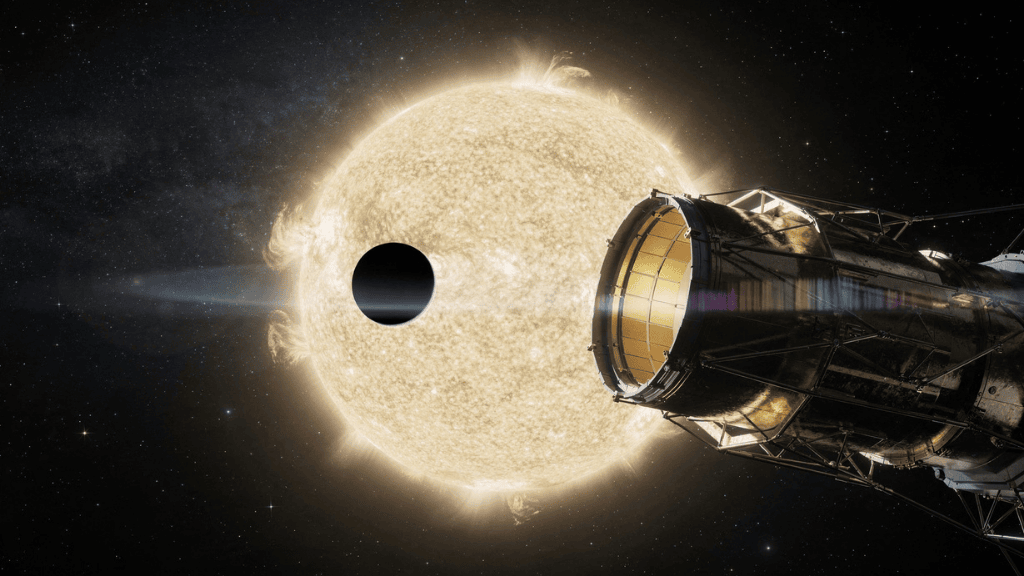
The most productive planet-hunting technique is the transit method. A transit occurs when a planet passes between its star and our telescope, blocking a small fraction of the starlight.
The amount of dimming reveals the planet’s size relative to the star. A large planet blocks more light than a small one. The interval between repeated transits tells astronomers how long the planet takes to complete an orbit — its year.
The signal is often very faint. For example, when a planet the size of Earth passes in front of a star like our Sun, the star’s brightness drops by just 0.01 percent. To spot such a small change, astronomers need very precise tools and must observe the star many times.
The transit method also relies on luck. A planet’s orbit has to line up just right with our view from Earth. In most cases, planetary systems are tilted in ways that keep their planets from passing in front of their stars as seen from here.
Because of this, transit surveys tend to find big planets that orbit close to their stars. These planets block more light, pass in front of their stars more often, and are more likely to be lined up in a way we can see. Smaller planets with longer orbits are much harder to spot, since astronomers might have to watch a star for years before seeing enough transits to confirm a pattern.
Radial Velocity: Measuring a Star’s Wobble
A planet does not orbit a perfectly stationary star. The planet and star both move around their shared center of mass. As a result, the planet’s gravity causes the star to wobble slightly toward and away from Earth.
The radial-velocity method tracks a star’s movement using the Doppler effect. If the star moves closer, its light shifts a bit toward shorter, bluer wavelengths. If it moves farther away, the light shifts toward longer, redder wavelengths.
By looking at when these shifts happen, astronomers can figure out the planet’s orbital period. The amount of shifting helps them estimate its mass. Without knowing the orbit’s angle, this method usually gives only a minimum mass, not the exact value.
This method is even more useful when paired with transit observations. A transit shows the planet’s radius, and radial velocity gives its mass. With both, astronomers can work out the planet’s average density and start to tell if it is mostly rocky, icy, or gaseous.
The difficulty is that stars are active objects. Starspots, magnetic activity, surface motion and stellar oscillations can produce signals that resemble the pull of a planet. Detecting a small world in a long orbit requires both extremely sensitive instruments and a detailed understanding of the star itself.
Direct Imaging: Separating a Planet from Its Star
Direct imaging aims to collect light from the planet itself. The challenge is not simply that exoplanets are distant. It is that they appear extremely close to stars that can be billions of times brighter.
Astronomers use instruments called coronagraphs to block or reshape starlight so that faint nearby objects become visible. Another proposed approach, the starshade, would place a separate flower-shaped spacecraft far in front of a telescope to stop most of a star’s light before it entered the instrument.
Current direct-imaging techniques work best with young, massive planets in wide orbits. These planets are still hot from their formation and glow strongly in infrared light. Small, cool planets near Sun-like stars are far more difficult to separate from the glare.
Direct imaging has a major advantage: it captures light from the planet. When that light is divided into a spectrum, it can reveal atmospheric gases, clouds, temperature, and other physical properties without requiring the planet to transit its star.
Gravitational Microlensing: Using Gravity as a Lens
Gravitational microlensing happens when gravity bends light. If a star moves in front of another, more distant star, the closer star works like a magnifying glass and makes the background star look brighter for a short time.
If there is a planet orbiting the closer star, it can add its own effect to the brightening pattern. The main brightening can last days or weeks, but the planet’s effect might only show up for a few hours.
Microlensing helps find planets that are hard to detect with other methods, like cold planets far from their stars or rogue planets that do not orbit any star. The main challenge is that the alignment only happens once and cannot be repeated, so astronomers usually have just one short chance to gather their data.
Astrometry and Timing
Astrometry searches for a star’s tiny side-to-side movement across the sky. Radial velocity measures motion toward and away from Earth; astrometry measures motion in the plane of the sky. It can be especially useful for finding massive planets in relatively wide orbits.
Timing methods can be even more precise. The first confirmed exoplanets were discovered because their gravity changed the arrival times of radio pulses from a pulsar.
Astronomers also measure transit-timing variations. Planets in the same system tug on one another, sometimes causing a transit to occur slightly earlier or later than expected. Those changes can reveal planets that do not transit and help researchers estimate the masses of interacting worlds.
A Candidate Must Survive Careful Testing
A dip in starlight is not automatically evidence of a planet. An eclipsing binary star in the background can imitate a transit. A neighboring star can blend with the target and make an orbiting object appear smaller than it really is. Starspots and other forms of stellar activity can also create repeating signals.
Astronomers confirm candidates by looking for repeated transits, making sure the signal is from the right star, taking detailed images of the area, and measuring the star’s movement using radial velocity.
Some planets are confirmed by directly measuring their gravitational effects. Others are validated when researchers show that other explanations are very unlikely. The NASA Exoplanet Archive only includes planets backed by published research and uses clear criteria before adding them to its confirmed list.
This cautious process is essential. Exoplanet signals are often close to the limits of what instruments can measure, and even a convincing result may change when better observations become available.
“Habitable” Does Not Mean “Inhabited”
A planet described as potentially habitable is not necessarily warm, wet, or alive. Usually, the term means that the planet orbits within its star’s habitable zone — the range of distances where liquid water might remain on the surface if the planet has a suitable atmosphere.
The habitable zone is a useful filter, not a verdict.
Its location depends on the star’s brightness and temperature. A cool red dwarf has a habitable zone much closer to the star than the Sun’s. A hotter, brighter star has one farther away.
A planet’s atmosphere can make a big difference. Greenhouse gases might keep a faraway planet warm, while bright clouds could cool a planet that gets a lot of starlight. Atmospheric pressure also changes the temperatures at which liquid water can exist.
Even if a planet is in the habitable zone, it could still be an airless rock, a frozen desert, a deep ocean under heavy pressure, or a hot world with a runaway greenhouse effect. Venus and Mars are good examples. Both are close to or inside the Sun’s habitable zone, but neither has Earth-like conditions today.
Astronomers therefore study the entire planetary system, including:
· The planet’s size, mass and likely composition
· The pressure and chemistry of its atmosphere
· The amount and type of radiation produced by its star
· The shape and stability of its orbit
· The presence of clouds, oceans or ice
· The planet’s geological activity and climate history
· The age and long-term behavior of the host star
A promising distance from the star is only the first item on a much longer checklist.
The Host Star Can Make or Break Habitability
A star supplies the light and heat that make surface life possible, but it can also bombard a planet with ultraviolet radiation, X-rays, charged particles, and powerful flares.
This is especially important for planets around red dwarfs. These stars are smaller, cooler and far more common than stars like the Sun. Their size makes planetary transits easier to detect, and their habitable zones are close enough for planets to complete frequent orbits.
That proximity creates problems. Young red dwarfs can be highly active, potentially eroding or chemically transforming the atmospheres of nearby planets. Many habitable-zone planets around these stars are also expected to be tidally locked, with one side permanently facing the star.
Tidal locking does not always mean a planet cannot support life. If the planet has a thick atmosphere or a large ocean, heat can move from the side facing the star to the side in darkness. Whether the planet is habitable depends on things like atmospheric pressure, how air moves, cloud cover, and how much energy the planet gets from its star.
Turning a Detection into a Physical World
Once astronomers know that a planet exists, they try to work out what it is actually like.
Mass and radius provide a useful starting point. A small planet with a high density is likely to contain large amounts of rock and metal. A low-density planet probably has a significant layer of gas, ice or water.
The result is rarely a simple answer. The same mass and radius can sometimes fit several interior structures. A planet might have a rocky core beneath a thick hydrogen atmosphere, a large amount of high-pressure water or a mixture of rock, ice and gas.
Labels can also be misleading. A super-Earth is simply a planet larger or more massive than Earth but smaller than Neptune. The name does not mean that the planet is an improved or enlarged version of Earth. Some super-Earths may be rocky, while others are more like mini-Neptunes with deep atmospheres and no accessible solid surface.
Reading an Atmosphere with Spectroscopy
During a transit, a small amount of starlight passes through the planet’s atmosphere before reaching the telescope. Molecules absorb particular wavelengths, leaving patterns in the spectrum. This technique is called transmission spectroscopy.
Astronomers can also measure a planet as it passes behind its star. By comparing the combined light of the star and planet with the star’s light alone, they can estimate the heat or reflected light coming from the planet. This is known as a secondary eclipse.
Observations made throughout an orbit can produce a phase curve, showing how the planet’s brightness changes as different parts of its day and night sides rotate into view. These measurements help researchers study temperature differences, clouds and the movement of heat through the atmosphere.
Atmospheric measurements are difficult to interpret. Clouds and hazes can hide molecular features. Activity on the star can contaminate the spectrum. Instruments may also detect only a few broad absorption features, allowing several different atmospheric compositions to fit the same data.
What Counts as a Sign of Life?
A biosignature is a substance, structure, or pattern that may have been produced by living organisms. On distant exoplanets, the most accessible biosignatures are likely to be gases in the atmosphere or unusual features in reflected light.
Water vapor is important, but it is not a sign of life. It is a potential indicator of habitability because liquid water is required by every known organism on Earth.
Oxygen and ozone receive considerable attention because most of the oxygen in Earth’s atmosphere is maintained by photosynthetic life. Methane is another candidate because living organisms produce large amounts of it on Earth. Nitrous oxide, organic hazes, seasonal atmospheric changes, and surface pigments resembling the reflective edge of terrestrial vegetation have also been proposed as possible biosignatures.
Finding a mix of gases can be more convincing than spotting just one type. For instance, oxygen and methane react with each other, so they should not both stay plentiful unless something keeps adding them. If we detect both, it could mean there is an active source keeping this chemical imbalance.
Even then, biology would not be the only possible explanation.
Ultraviolet radiation can split water molecules, allowing hydrogen to escape and leaving oxygen behind. Geological reactions can produce methane. Volcanic activity, impacts and atmospheric loss can also create chemistry that looks unusual from a distance.
False negatives are another problem. Earth supported life for billions of years before oxygen became abundant in its atmosphere. A living planet dominated by microorganisms, hidden beneath an ocean or covered by thick clouds, might show no obvious signal to a distant telescope.
Biosignatures must therefore be interpreted in context. Scientists need to understand the star, atmospheric chemistry, surface conditions, climate and geology before deciding whether life is the most likely explanation.
Why One Exciting Molecule Would Not Be Proof
A credible claim of extraterrestrial life would require far more than a single feature in a spectrum.
Researchers would first need to show that the signal was strong enough to be statistically meaningful. They would then test whether it could have been created by the telescope, the data-processing method, contamination from the star or an unrelated chemical process.
The observation would need to be repeated, ideally with different instruments and research teams. Scientists would also compare the results with atmospheric, geological and climate models designed to reproduce the signal without life.
The argument would be more convincing if several independent clues lined up, such as having the right surface conditions, a stable atmosphere, multiple possible biosignatures, ongoing chemical imbalance, and no strong nonbiological explanation.
Even then, the conclusion would probably be expressed as a level of confidence rather than an immediate declaration that life had been discovered. A potential biosignature is evidence that deserves further investigation — not proof by itself.
What Webb and Recent Observations Are Revealing
The James Webb Space Telescope is examining exoplanet atmospheres in infrared light with greater sensitivity than previous space telescopes. Much of its early work has focused on large gaseous planets, whose extended atmospheres produce stronger signals, but it is also studying smaller rocky worlds.
The TRAPPIST-1 system is one of Webb’s most important rocky-planet targets. It contains seven roughly Earth-sized planets orbiting a nearby red dwarf. Reported Webb results have found no evidence of thick atmospheres on the two innermost planets, TRAPPIST-1 b and c. Observations of the more temperate planets d and e have ruled out thick hydrogen-dominated atmospheres, but have not yet established whether either world has a thinner secondary atmosphere.
Webb has also found strong evidence for a thick, volatile-rich atmosphere around TOI-561 b. That planet is a rocky super-Earth with a global magma ocean and a year lasting less than 11 hours. It is far too hot to be habitable, but the observation shows that some intensely irradiated rocky planets can retain atmospheres under conditions once thought likely to strip them away.
In July 2026, researchers made a breakthrough when they found helium escaping from LHS 1140 b, a rocky super-Earth in the habitable zone of a red dwarf about 48 light-years from Earth. This was the first time scientists detected an atmosphere around a rocky planet in a star’s habitable zone.
The discovery shows that LHS 1140 b still has an atmosphere, but it does not prove the planet has an ocean, Earth-like conditions, or life. The helium was found in the upper atmosphere, and scientists are still unsure about the deeper atmosphere’s composition and pressure.
So far, no exoplanet observation has given confirmed evidence of life beyond Earth.
The Next Generation of Planet Hunters
Several upcoming missions will expand the search from individual discoveries to detailed comparisons of entire planetary populations.
NASA plans to launch the Nancy Grace Roman Space Telescope on August 30, 2026. This telescope will use gravitational microlensing to look for planets near the center of the Milky Way. It is especially good at finding cold planets in wide orbits and free-floating worlds that other surveys often miss. The Roman telescope will also have a coronagraph to test new technology for future missions that aim to directly image smaller, older planets.
The European Space Agency plans to launch the Plato mission in March 2027. Plato will use 26 cameras to watch over 200,000 stars, looking for Earth-like planets in orbits that could support life around stars like our Sun. It will also measure the properties and ages of these stars, which will help astronomers learn how planetary systems develop and change over time.
ESA’s Ariel mission, scheduled for 2031, will survey the atmospheres of about 1,000 exoplanets. Its targets will range from rocky planets to gas giants. By comparing such a large sample, researchers hope to learn how atmospheric composition, clouds and weather depend on a planet’s size, temperature, host star and formation history.
Farther ahead, NASA is developing the Habitable Worlds Observatory, a proposed ultraviolet, visible and infrared space telescope intended for the 2040s. Its central goal is to directly image and characterize 25 potentially habitable planets around nearby stars, then examine their atmospheres for possible biosignatures such as oxygen and methane. The mission remains in development, and its design and capabilities may change before launch.
What We May Learn Before We Find Life
The search for life is likely to produce many important results before it produces a biosignature.
Astronomers may learn how often Earth-sized planets keep their atmospheres, whether oceans are common, which stars provide stable environments, and how frequently apparently promising worlds become dry, frozen, or overheated.
A planet does not have to be inhabited to be useful. An airless world teaches researchers about atmospheric loss. A cloudy mini-Neptune helps clarify the boundary between rocky and gaseous planets. Several planets around the same star provide a natural experiment in which worlds with a shared origin can be compared.
Exoplanet science has already answered one ancient question: planets are common. The harder questions now concern their environments. How many have stable climates? How many contain liquid water? How many develop the chemistry needed for life — and how often does life actually begin?
The first convincing evidence might not come as a clear photo of a blue planet. Instead, it could show up as a faint pattern in a spectrum, leading to years of repeated observations, different explanations, and careful testing.
Being careful is not a barrier to discovery. It is what makes the answer trustworthy.
메타데이터
- post_id
- d6acb6e7cb52
- slug
- exoplanets-how-we-find-habitable-worlds-and-search-for-life-d6acb6e7cb52
- url
- https://medium.com/@QuarkAndCode/exoplanets-how-we-find-habitable-worlds-and-search-for-life-d6acb6e7cb52
- canonical_url
- https://medium.com/@QuarkAndCode/exoplanets-how-we-find-habitable-worlds-and-search-for-life-d6acb6e7cb52
- author_url
- https://medium.com/@QuarkAndCode
- status
- ok
- fetched_at
- 2026-07-31 16:09:40