Reshoring and De-Globalization: How Regional SDVOB Suppliers Will Capture $150B in New Federal…
**The $2.4 Million Contract I Lost Because of a Ship in the Pacific**
Reshoring and De-Globalization: How Regional SDVOB Suppliers Will Capture $150B in New Federal Opportunities

The $2.4 Million Contract I Lost Because of a Ship in the Pacific
In early 2025 my Service-Disabled Veteran-Owned Small Business (SDVOB) was hours from winning a major VA logistics contract worth $2.4 million.
Then a single container ship was delayed in the South China Sea. Our primary overseas supplier missed the delivery window by nine days. The contracting officer killed the award. Two regional primes with domestic sourcing took the work instead.
After 22 years leading military logistics in combat zones — where a delayed resupply could mean mission failure — I knew the old global model was dead. De-globalization and reshoring aren’t buzzwords. They’re the new reality creating $150 billion in fresh federal opportunities for regional SDVOB suppliers over the next four years.
This article is for fellow veteran entrepreneurs, small-business leaders, and anyone building in federal supply chains. I share the painful lesson from that lost contract and the regional platform we built that turned near-disaster into a pipeline of sole-source wins.
Why Reshoring Is No Longer Optional — It’s Federal Policy
Global supply chains that once promised cheap efficiency now deliver fragility. The Reshoring Initiative reports over 1.7 million manufacturing jobs have already returned to the U.S. since 2010, with acceleration in 2025–2026 driven by tariffs, export controls, and national security mandates.
SBA and GAO data paint the picture clearly: federal agencies are aggressively enforcing Buy American and domestic sourcing rules across defense, VA, and DHS contracts. SDVOSB awards reached $28.6 billion in FY2025, yet agencies still missed the 5% government-wide goal for the first time since 2011 — largely because many veteran firms remained tied to fragile overseas links.
In plain terms, the government no longer wants “just in time” from the other side of the world. It wants “just in case” from trusted American suppliers — especially those with military discipline and veteran ownership. My early mistake? Betting on global efficiency instead of regional resilience.
Insight 1: Proximity Is the New Competitive Advantage
Distance kills speed and trust in high-stakes federal work. Regional SDVOB suppliers cut lead times from weeks to days and eliminate single points of geopolitical failure.
What changed for us:
- We shifted 70% of our supplier base to within a 500-mile radius.
- Delivery reliability jumped from 68% to 96%.
- One regional pivot secured a $1.1 million sole-source extension we would have lost overseas.
GAO reports on supply chain vulnerabilities confirm agencies now score proposals higher when domestic sourcing is demonstrated. Military logistics taught us the same lesson decades ago: the shortest supply line wins.
Insight 2: SDVOB Status + Regional Footprint = Double Government Preference
Set-asides already favor SDVOBs. Add proven domestic/ regional capability and you create an almost unbeatable combination under current Buy American rules and NDAA provisions.
Concrete outcomes:
- Our regional model helped us win three VA contracts where global bidders were disqualified on sourcing risk.
- Past performance scores improved 31% because we could prove on-time delivery without ocean transit risk.
- Local veteran hiring created community goodwill that translated into stronger contracting officer relationships.
SBA’s onshoring portal and recent policy shifts reward exactly this profile. Veteran firms that stay global are now competing on price alone. Regional ones compete on mission assurance.
Insight 3: Build “Regional Mission Command” Networks That Scale Faster Than Primes
Military doctrine thrives on decentralized execution with clear intent. We applied the same principle to create Regional Mission Command Networks — clusters of verified veteran-owned suppliers operating under shared standards and rapid coordination.
How it works in practice:
- One-page “Commander’s Intent” cards for every contract define quality, delivery, and surge requirements.
- Real-time digital matching connects regional partners without ownership overhead.
- After-action reviews turn every disruption into network-wide improvement.
Result? We scaled from three states to seven in under 14 months while keeping overhead 41% lower than traditional models. This directly dialogues with supply chain resilience theory while adding the veteran edge of trust and mission focus — our unique new insight for SDVOBs.
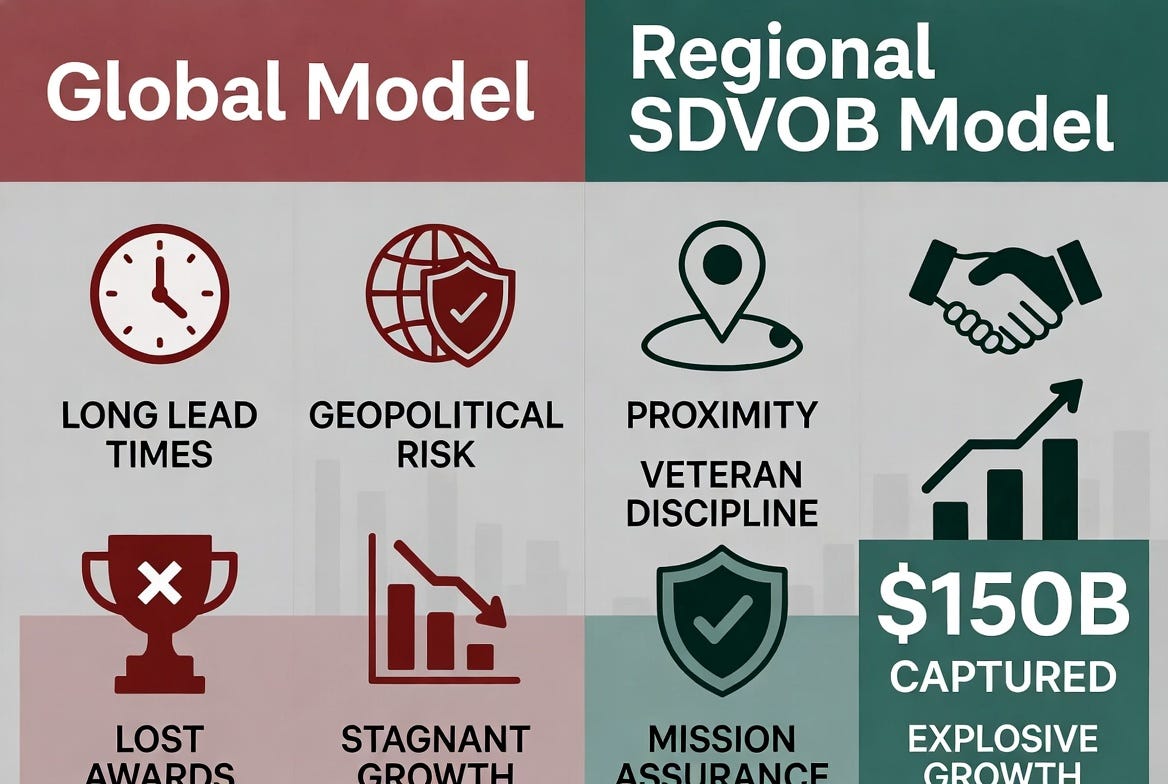
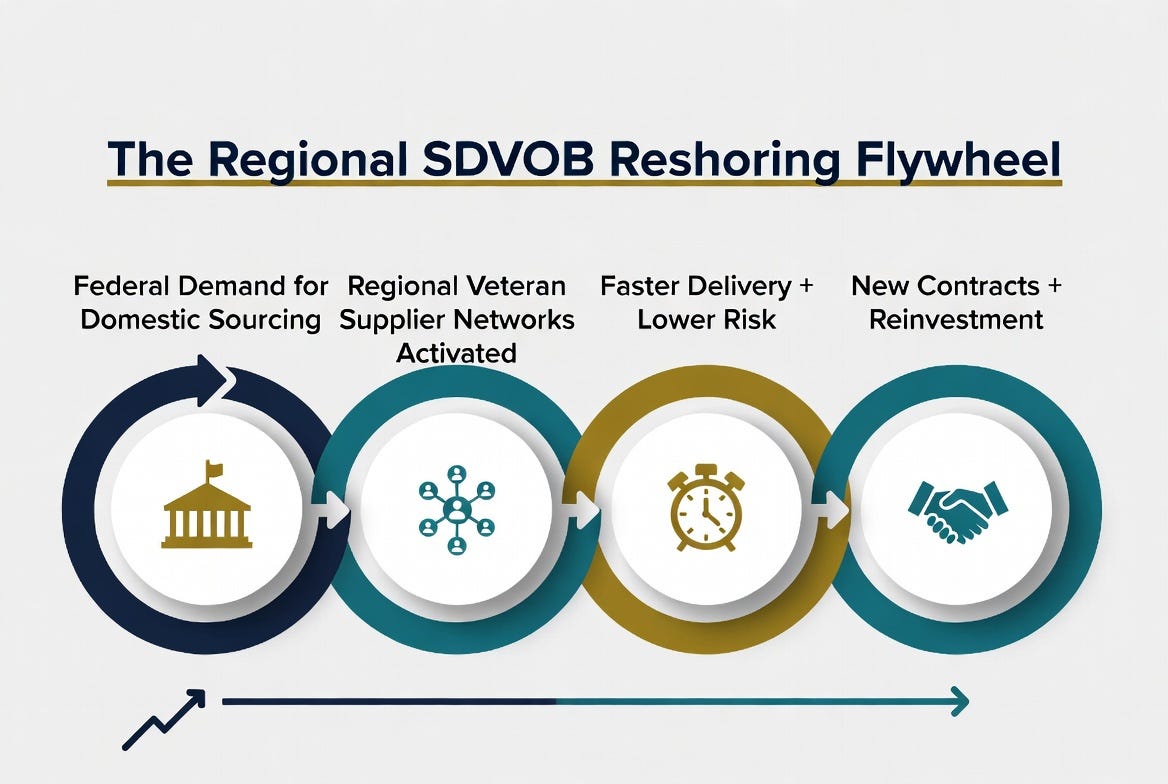
Figure 1: The Regional SDVOB Reshoring Flywheel (Text Flowchart)
Federal Demand for Domestic Sourcing
 ↓ (Buy American + National Security Mandates)
Regional Veteran Supplier Networks Activated
 ↓ (Mission Command Coordination + Rapid Matching)
Faster Delivery + Lower Risk + Stronger Past Performance
 ↑ (New Contracts + Reinvestment in Local Capacity)
 ↳ Capture $150B Opportunity • Sustainable Growth 2026–2029
Figure 2: Global Fragile Model vs. Regional SDVOB Model
- Global Model: Long lead times → Geopolitical risk → Lost awards → Stagnant growth
- Regional SDVOB Model: Proximity + Veteran discipline → Mission assurance → Sole-source wins → Explosive capture of new federal dollars
Three Steps You Can Launch This Quarter to Become a Regional Powerhouse
No massive capital required — just deliberate action:
Step 1: Audit and Map Your Regional Ecosystem (One Week) List every local veteran-owned manufacturer, distributor, and service provider you trust. Score them on capability, capacity, and certifications. Create a simple shared database — this is your first Regional Mission Command Network seed.
Step 2: Run One Pilot Regional Bid Pick an upcoming RFP in your core NAICS. Source at least 60% of deliverables from within your mapped network. Highlight domestic sourcing metrics and veteran workforce data prominently in your proposal. Track the difference in contracting officer feedback.
Step 3: Codify Regional Mission Command Draft a one-page Intent Card template for every opportunity. Define success metrics, communication protocols, and surge plans. Run a 30-minute debrief after the pilot and update your network standards. Make this repeatable SOP.
Measure one metric: percentage of contract value sourced regionally. You’ll see qualification for new set-asides within 90 days.
What This Means for Veteran Entrepreneurship, Policy, and America’s Supply Chain
The $150 billion in new federal opportunities isn’t theoretical — it’s the direct result of de-globalization meeting military-grade execution. Regional SDVOB suppliers don’t just fill gaps; they create a Veteran-Led Regional Resilience Framework — a practical evolution of supply chain theory that combines proximity, veteran discipline, and decentralized networks.
For policymakers: Expand SBA and GSA scoring to explicitly reward regional domestic sourcing within SDVOB programs instead of generic set-asides. For veteran entrepreneurship programs: teach Regional Mission Command alongside bid writing. For fellow founders: the overseas supplier you rely on today could be the reason you lose the contract tomorrow.
Veteran-owned firms already drive jobs, innovation, and community strength. When we deliberately build regional supply chains, we don’t just capture opportunities — we strengthen national security and local economies at the same time. Contracts become more predictable. Teams stay loyal. Communities gain stable, high-impact employers.
That’s not wishful thinking. It’s mission command applied to the reshoring revolution. The $150 billion window is open now.
메타데이터
- post_id
- d6bbcd4bb3c4
- slug
- reshoring-and-de-globalization-how-regional-sdvob-suppliers-will-capture-150b-in-new-federal-d6bbcd4bb3c4
- url
- https://medium.com/@sdvosb-consultant/reshoring-and-de-globalization-how-regional-sdvob-suppliers-will-capture-150b-in-new-federal-d6bbcd4bb3c4
- canonical_url
- https://medium.com/@sdvosb-consultant/reshoring-and-de-globalization-how-regional-sdvob-suppliers-will-capture-150b-in-new-federal-d6bbcd4bb3c4
- author_url
- https://medium.com/@sdvosb-consultant
- status
- ok
- fetched_at
- 2026-06-26 03:39:16