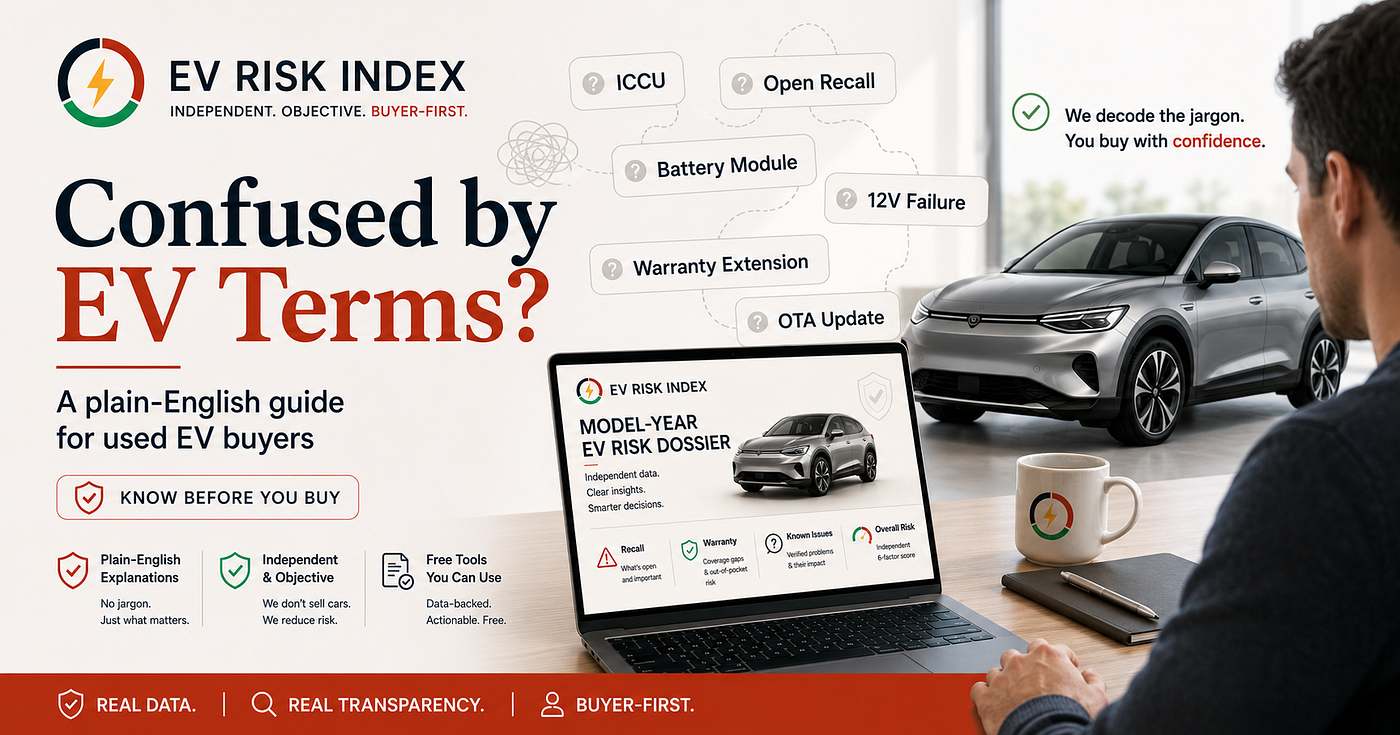
Confused by EV Terms Like ICCU, Open Recall, and Battery Module?
What every used electric vehicle buyer should check before signing — explained without the jargon, with free tools to do it.
Confused by EV Terms Like ICCU, Open Recall, and Battery Module? Here’s the Plain-English Guide Every Used EV Buyer Needs
What every used electric vehicle buyer should check before signing — explained without the jargon, with free tools to do it.
By Jasmine Velasco · EV Risk Index
Electric vehicles are supposed to be simpler.
No oil changes. Fewer moving parts. Quiet driving. Lower fuel costs.
But the moment something goes wrong — or the moment you start shopping for a used EV — the language turns into alphabet soup:
ICCU. High-voltage battery. 12V failure. Open recall. Campaign number. Thermal event. OTA update. Warranty extension. Battery module replacement.
If you’ve ever stared at a used EV listing wondering “what does ICCU failure mean and should I care?” — this guide is for you.
I write along with 34 other editors about EV reliability and consumer protection at EVRiskIndex.com, an independent, reader-funded publication that tracks 323 EV model-years across 32 brands on a transparent six-factor failure index. We sell nothing to manufacturers or dealers. This article breaks down every confusing EV term in plain English — and shows you exactly which free tools to use before you buy, repair, or escalate.
Is EV Risk Index the same as a VIN history report? (No — and the difference matters)
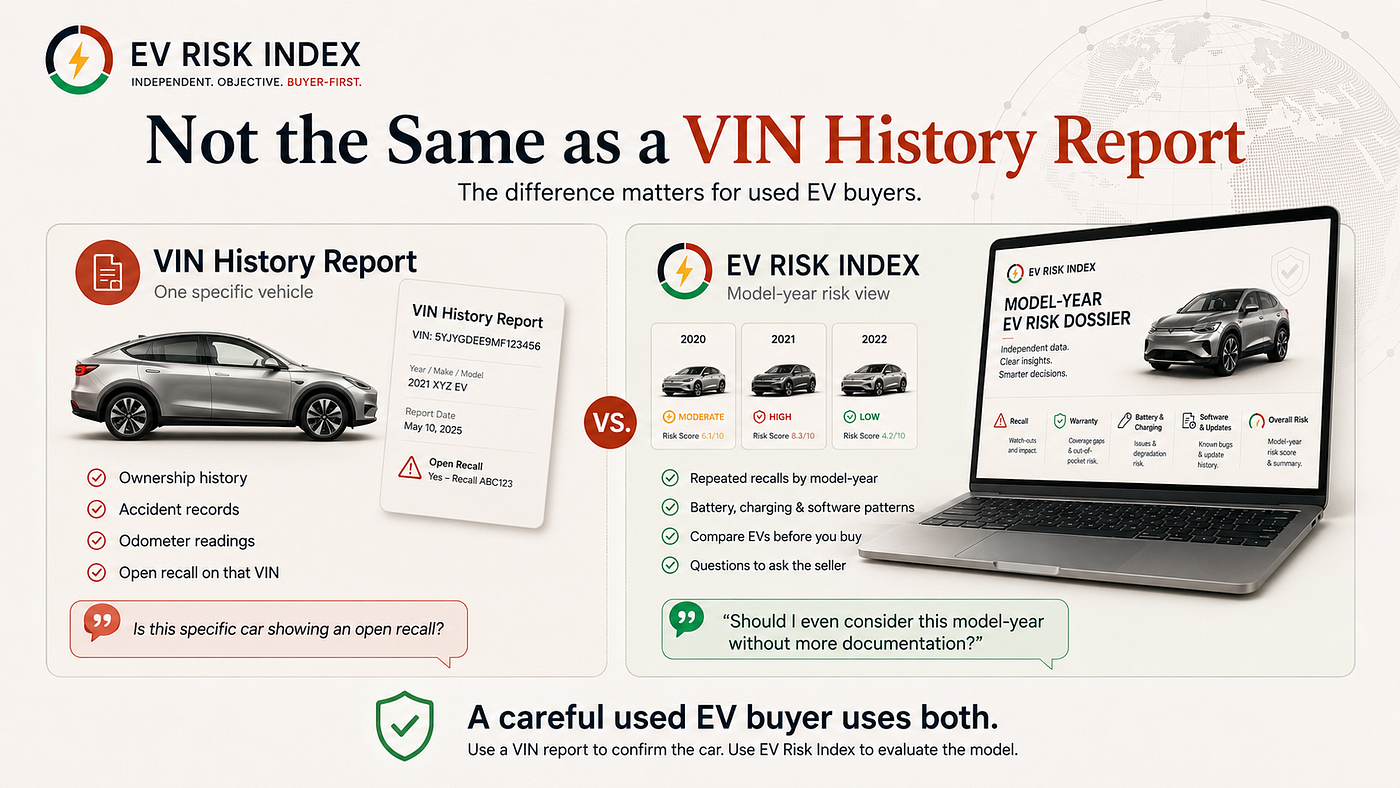
This is the biggest misunderstanding, so let’s clear it up first.
A VIN history report tells you about one specific vehicle: ownership history, accident records, odometer readings, whether a recall is open on that exact VIN.
EV Risk Index works at the model-year level. It answers questions like:
- Is this model-year known for repeated recalls?
- Does this EV have a documented pattern of battery, charging, software, or electrical issues?
- How does this model compare with the other EVs I’m considering?
- What questions should I ask the seller before I hand over money?
A VIN check tells you: “Is this specific car showing an open recall?”
EV Risk Index helps you ask: “Should I even be considering this model-year without more documentation?”
A careful used EV buyer uses both.
👉 Start here: Search any of the 323 rated vehicles or browse by brand.
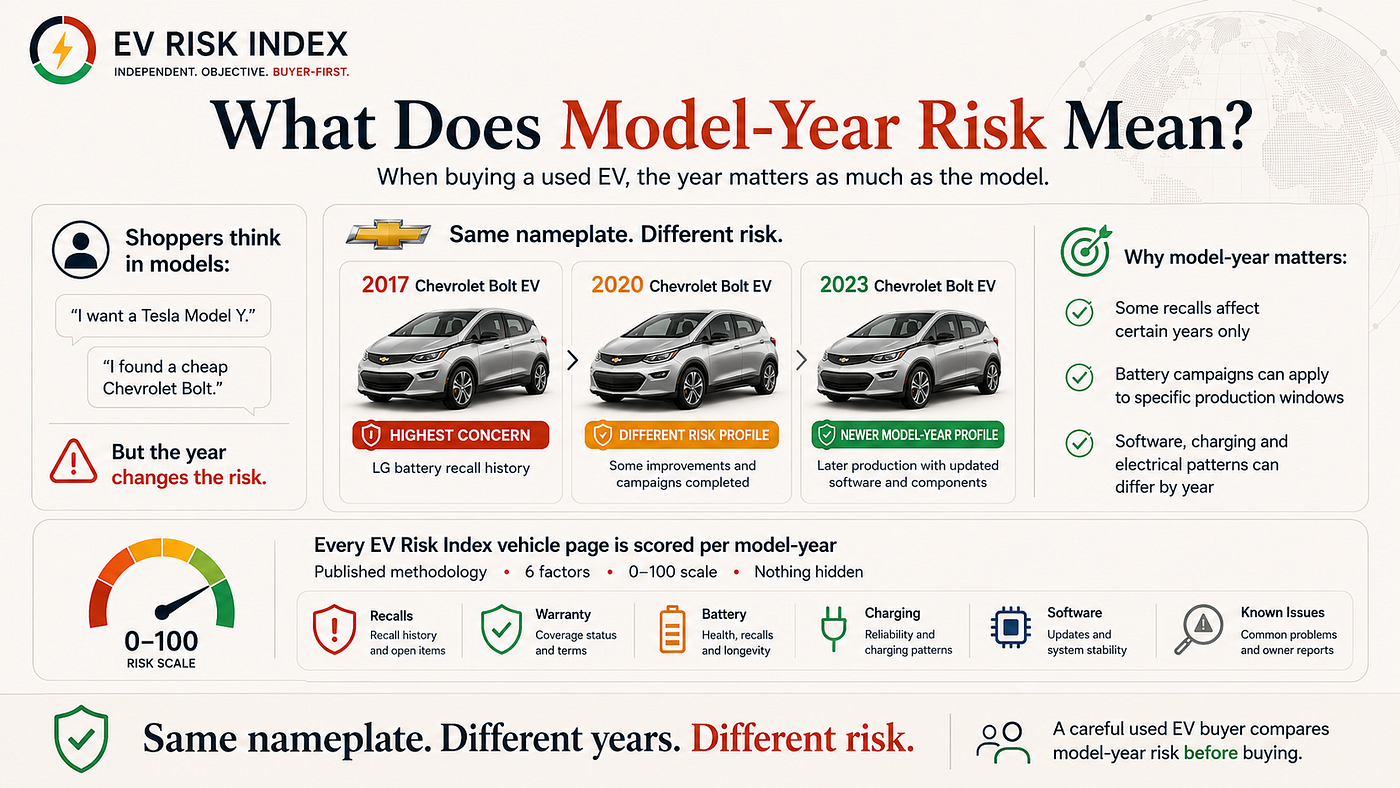
What does “model-year risk” mean when buying a used EV?
Shoppers usually think in models: “I want a Tesla Model Y.” “I found a cheap Chevrolet Bolt.”
But the year matters as much as the model.
A 2022 version of a vehicle may not carry the same risk signals as a 2024 version. A recall may affect some years but not others. A battery-related campaign may only apply to certain production windows.
Real example: the 2017 Chevrolet Bolt EV sits in the highest-concern band because of its LG battery recall history — while newer model-years carry a very different profile. Same nameplate, completely different risk.
That’s why every vehicle page on EV Risk Index is scored per model-year, with a published methodology — six factors, 0–100 scale, nothing hidden.
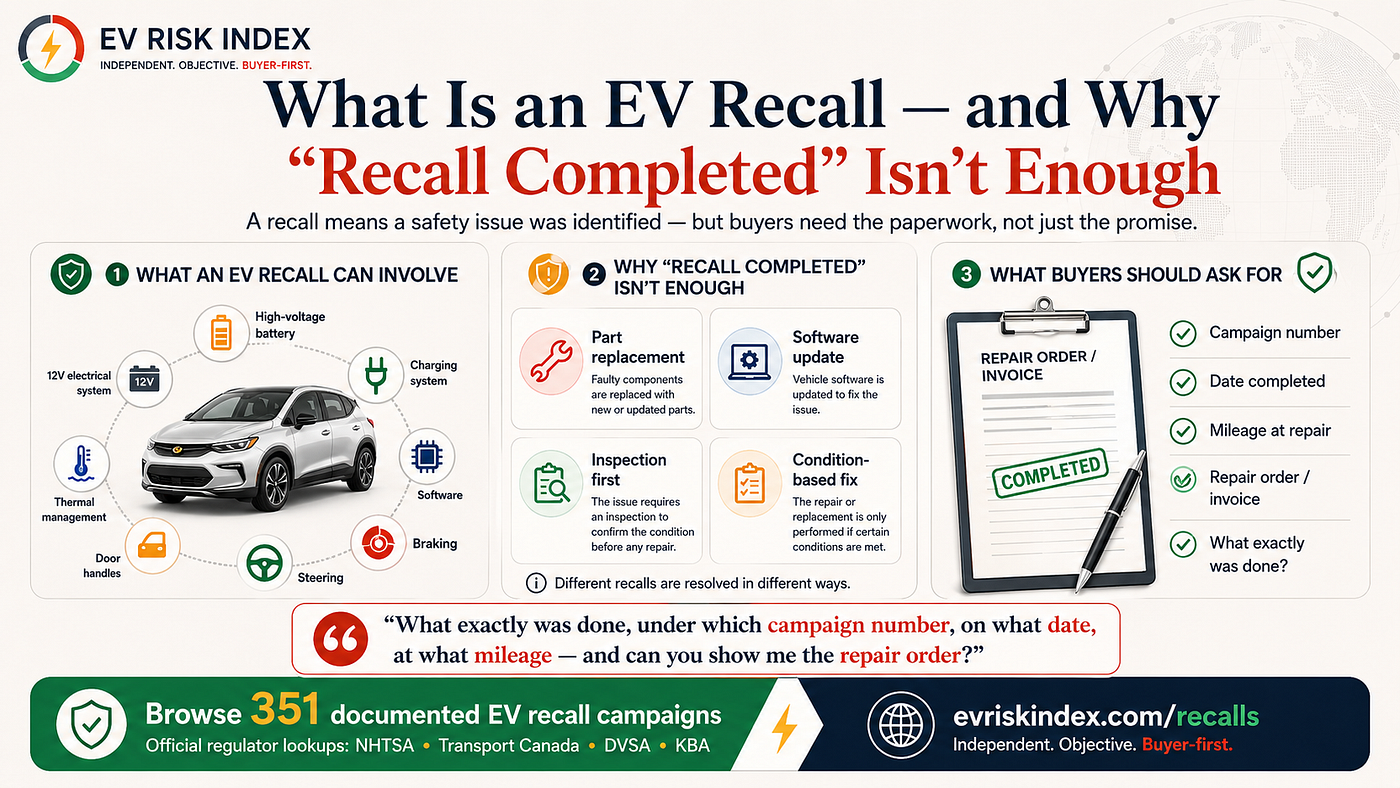
What is an EV recall — and why “recall completed” isn’t enough
A recall means a manufacturer or regulator has identified a safety-related issue that needs a remedy. For EVs, recalls can involve the high-voltage battery, charging system, software, braking, steering, door handles, thermal management, or the 12V electrical system.
Here’s the catch: some recalls are fixed with a part replacement. Some with a software update. Some require an inspection first. Some only apply if the vehicle shows a certain condition.
So “the recall was done” is not the question. The question is:
“What exactly was done, under which campaign number, on what date, at what mileage — and can you show me the repair order?”
👉 Browse all 351 documented EV recall campaigns with links to official regulator lookups (NHTSA, Transport Canada, DVSA, KBA): evriskindex.com/recalls
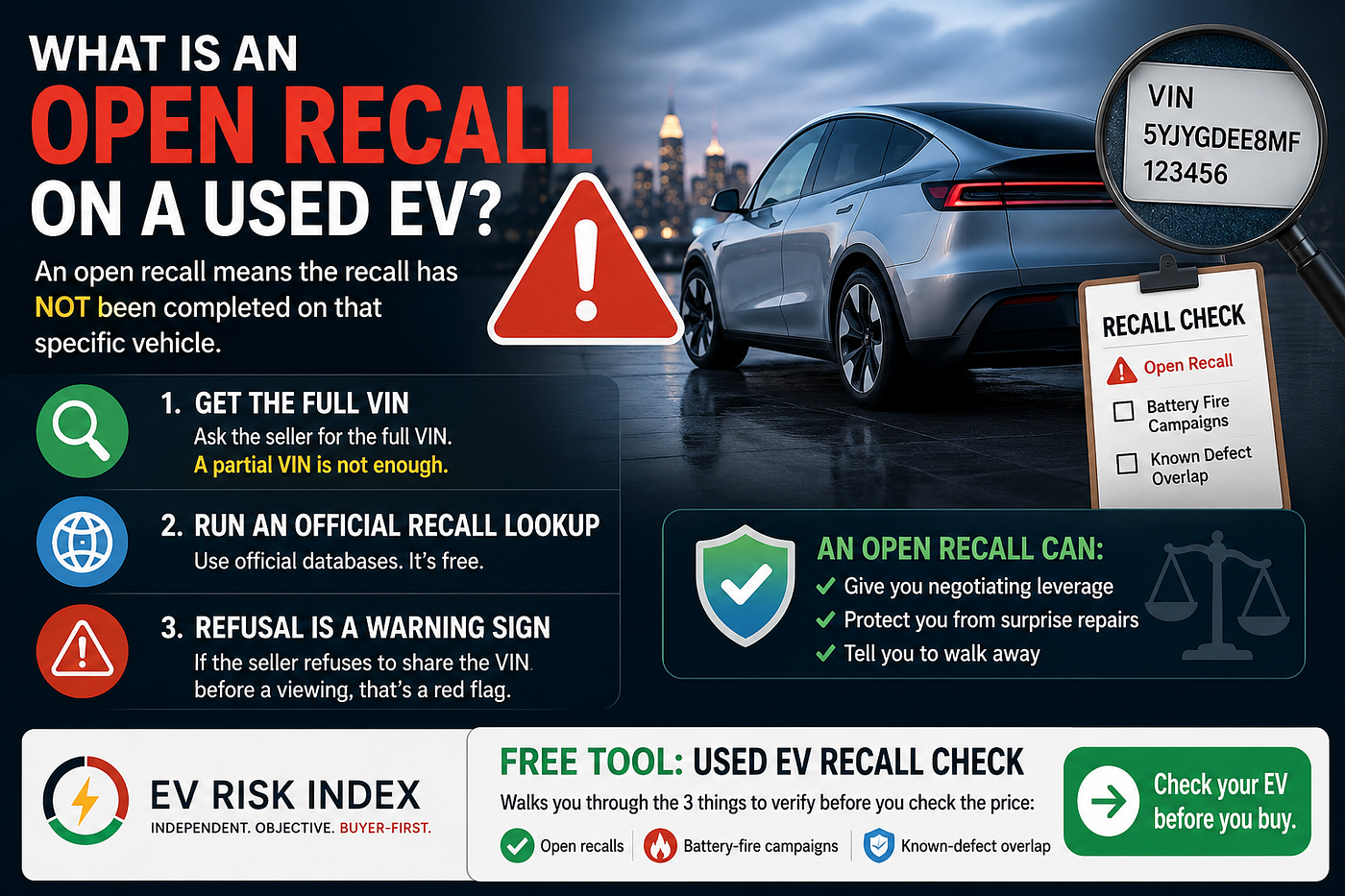
What is an “open recall” on a used EV?
An open recall means the recall has not been completed on that specific vehicle.
Before buying any used EV:
- Ask the seller for the full VIN (a partial VIN is not enough)
- Run an official recall lookup — it’s free
- If the seller refuses to share the VIN before a viewing, that is already a warning sign
An open recall can give you negotiating leverage, protect you from surprise repairs, or tell you to walk away.
👉 Free tool: the Used EV Recall Check walks you through the three things to verify — open recalls, battery-fire campaigns, and known-defect overlap — before you check the price.
What is a recall campaign number?
A campaign number is the official reference attached to a recall or service action.
An issue may be discussed online as “the ICCU recall,” but official records use a specific campaign number. That number is how you verify the seller, dealer, or manufacturer is talking about the exact issue you’re asking about.
Don’t ask: “Was the recall done?”
Ask: “Can you show me the repair order with the campaign number on it?”
Paperwork matters. Every time.
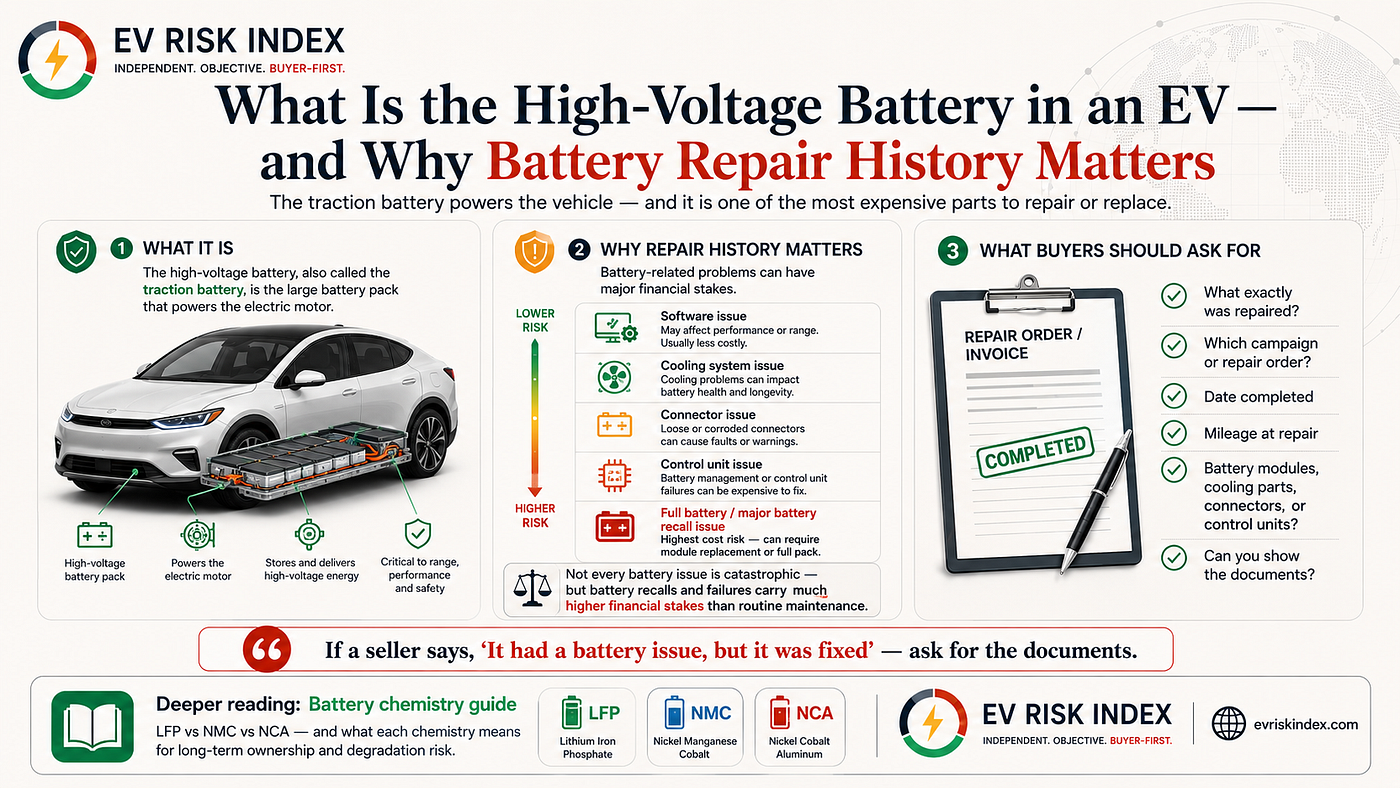
What is the high-voltage battery in an EV — and why battery repair history matters
The high-voltage battery (also called the traction battery) is the large pack that powers the electric motor. It is one of the most expensive components in the entire vehicle.
Not every battery issue is catastrophic — some are software-related, some involve cooling systems, connectors, or control units. But when a recall or failure involves the high-voltage battery, the financial stakes are on a different level from routine maintenance.
If a seller says “it had a battery issue, but it was fixed” — ask for the documents.
👉 Deeper reading: the battery chemistry guide explains LFP vs NMC vs NCA — and what each chemistry actually means for long-term ownership and degradation risk.
What is an EV battery module replacement (vs. a full pack replacement)?
Many EV battery packs are built from smaller sections called modules. Some repairs replace the full pack; others replace one or more modules.
For a used EV buyer, this distinction changes the risk profile completely. A vehicle with documented battery replacement work is a very different purchase from a vehicle with vague claims and no paperwork.
The better question is never “was the battery fixed?” — it’s:
“Which part was replaced, and is there a repair order showing it?”
Why do EVs still have a 12V battery — and why 12V failure strands so many owners
Yes, even electric vehicles carry a small 12-volt battery. It supports vehicle electronics, control modules, locks, warning systems, and startup functions.
Many EV owners are shocked when a car with a fully charged high-voltage pack won’t “wake up” — because the 12V system has failed or drained.
12V problems are one of the most common EV complaints. They sound small. They can leave you stranded.
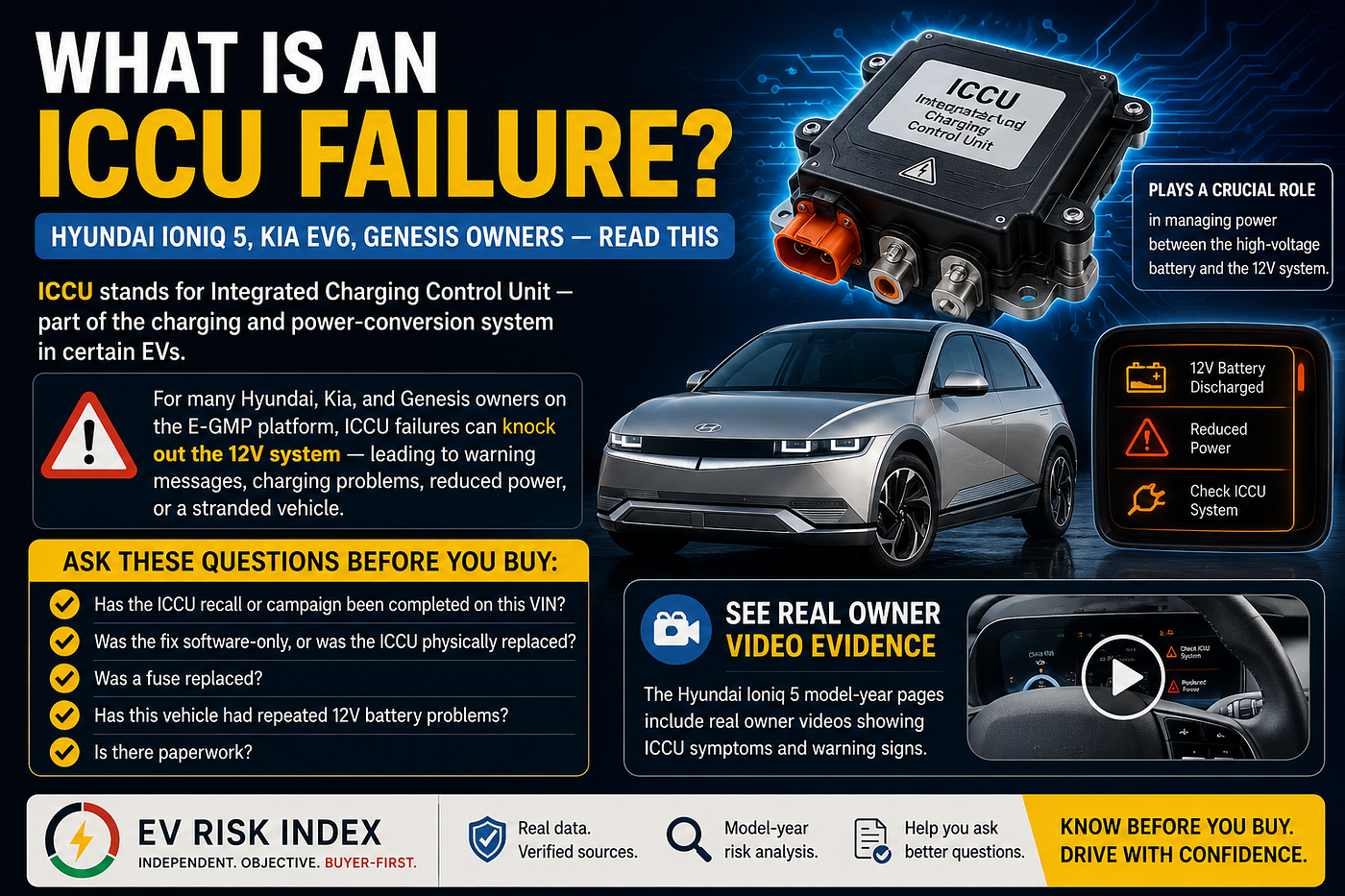
What is an ICCU failure? (Hyundai Ioniq 5, Kia EV6, Genesis owners — read this)
ICCU stands for Integrated Charging Control Unit — part of the charging and power-conversion system in certain EVs.
For many Hyundai, Kia, and Genesis owners on the E-GMP platform, the ICCU became a major topic because failures could knock out the 12V system — leading to warning messages, charging problems, reduced power, or a stranded vehicle.
You don’t need to be an engineer. You need to know enough to ask:
- Has the ICCU recall or campaign been completed on this VIN?
- Was the fix software-only, or was the ICCU physically replaced?
- Was a fuse replaced?
- Has this vehicle had repeated 12V battery problems?
- Is there paperwork?
👉 See the documented pattern: the Hyundai Ioniq 5 model-year pages include real owner video evidence explaining ICCU symptoms and warning signs.
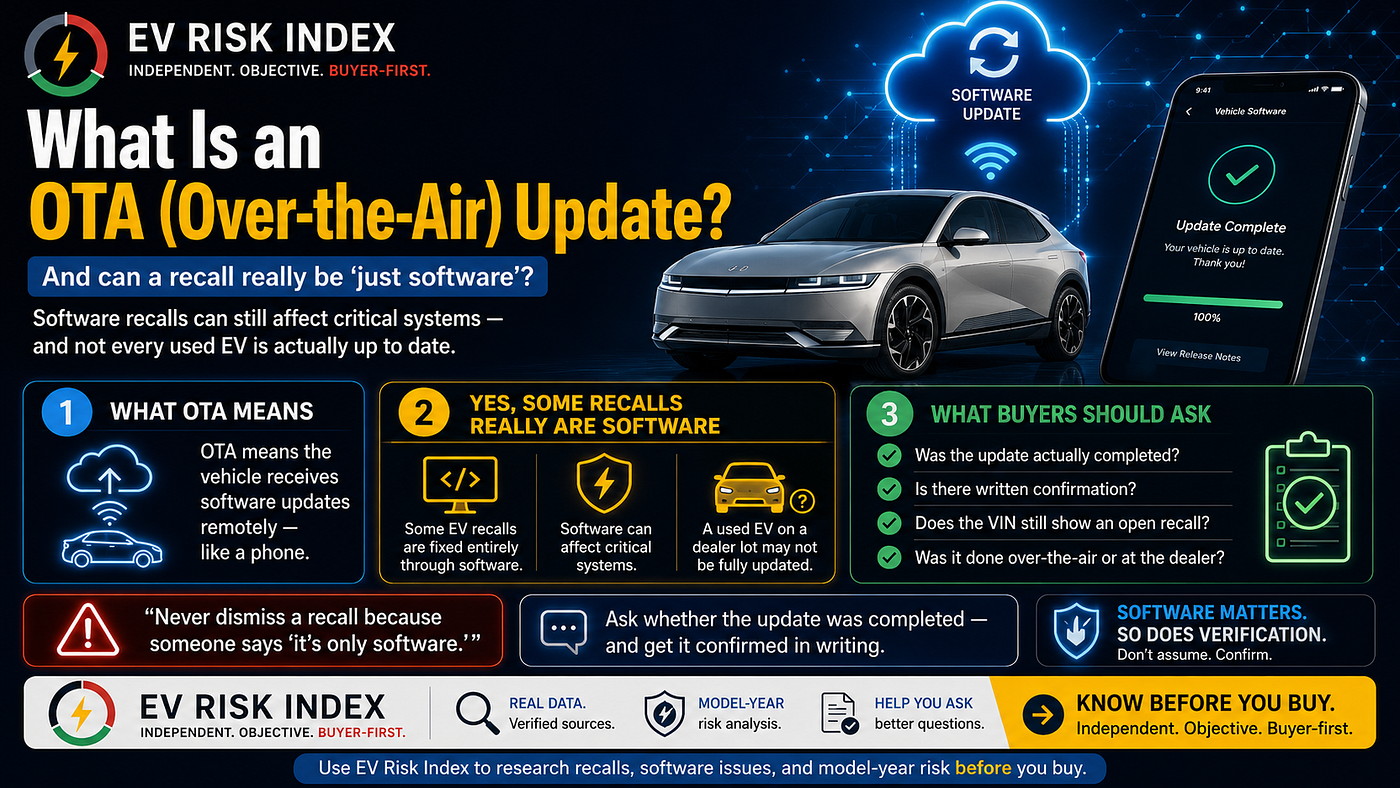
What is an OTA (over-the-air) update — and can a recall really be “just software”?
OTA means the vehicle receives software updates remotely, like a phone.
Some EV recalls are fixed entirely through software. That sounds simple — but a software recall can still affect critical systems, and a used EV sitting on a dealer lot may not be fully updated.
Never dismiss a recall because someone says “it’s only software.” Ask whether the update was actually completed — and get it confirmed in writing.
What’s the difference between a safety recall and a service campaign?
Not every fix is a formal recall. Manufacturers also issue service campaigns, customer-satisfaction programs, warranty extensions, and technical service bulletins (TSBs) — and these don’t always appear in recall databases.
One database rarely tells the whole story. Check:
- Official government recall databases (NHTSA, Transport Canada, DVSA)
- Manufacturer VIN lookup tools
- Dealer service records and repair invoices
- EV Risk Index model-year pages
What is an EV warranty extension — and how do I check if my EV is still covered?
A warranty extension means the manufacturer extended coverage for a specific part, system, or issue. On an EV, this can be worth thousands.
But extensions come with rules: mileage caps, age limits, market restrictions, VIN eligibility, maintenance history, and whether the vehicle was imported.
If someone says “that’s covered” — get the warranty terms in writing.
👉 Free tool: run your vehicle through the Warranty Lookup to check coverage windows and open recalls in seconds.
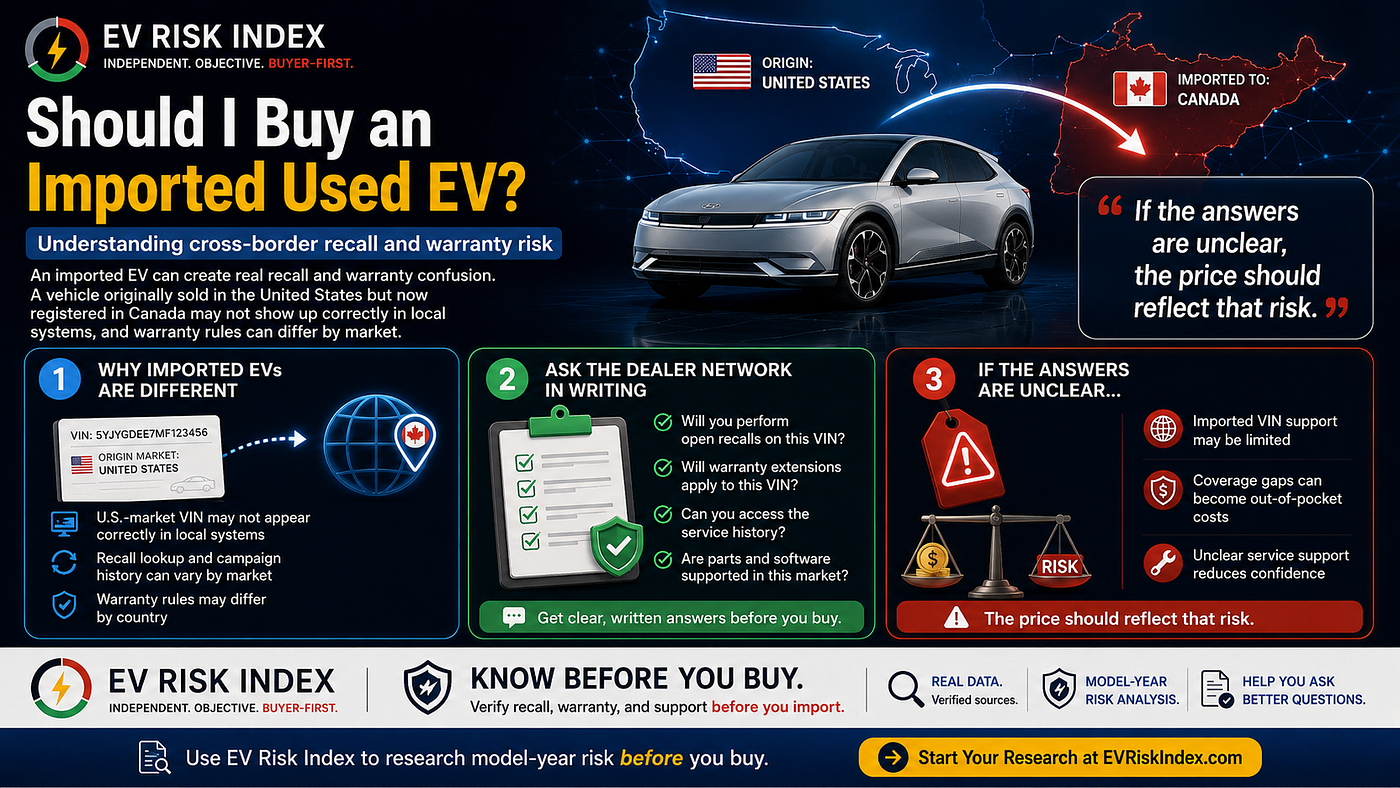
Should I buy an imported used EV? Understanding cross-border recall and warranty risk
An imported EV can create real recall and warranty confusion. A vehicle originally sold in the United States but now registered in Canada may not show up correctly in local systems — and warranty rules can differ by market.
Before buying an imported EV, ask the local dealer network in writing:
- Will you perform open recalls on this VIN?
- Will warranty extensions apply to this VIN?
- Can you access the service history?
- Are parts and software supported in this market?
If the answers are unclear, the price should reflect that risk.
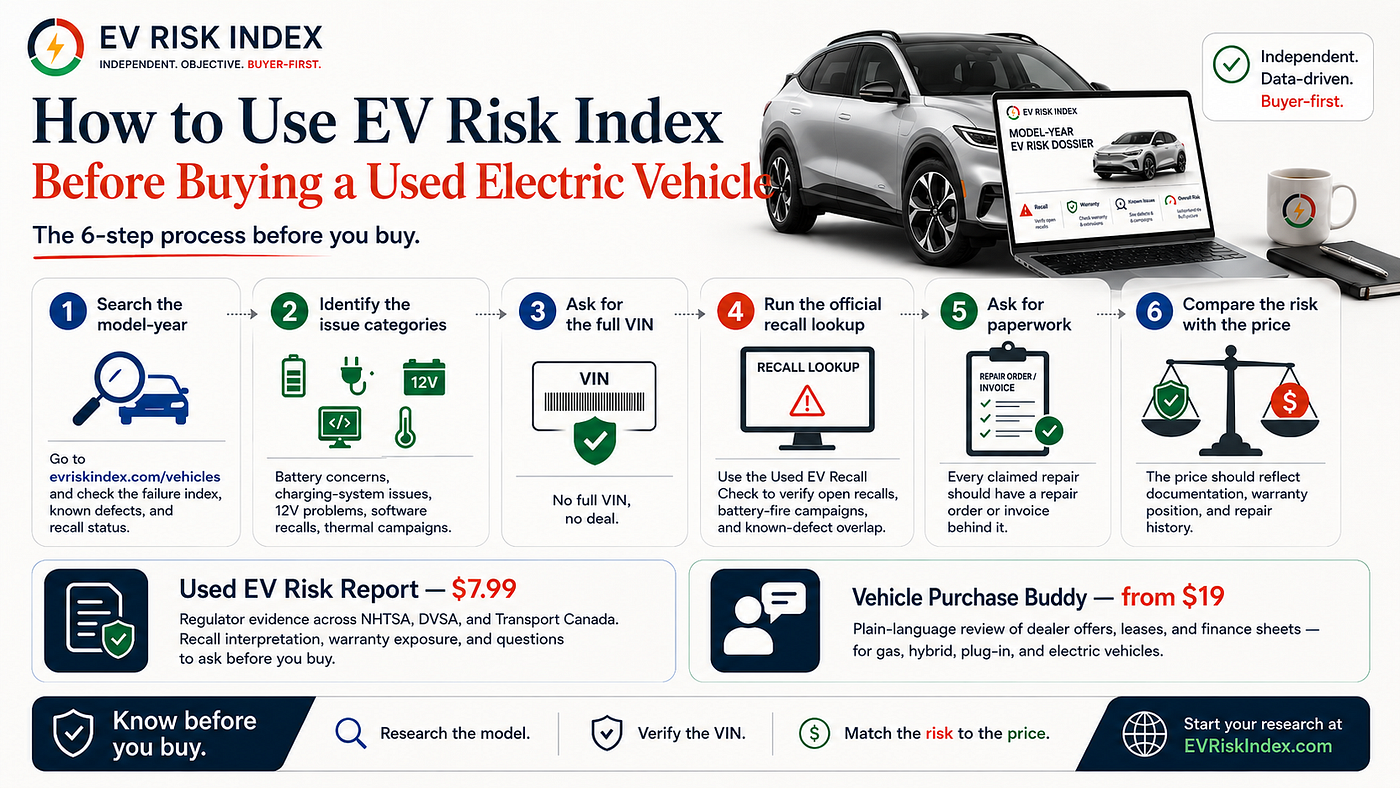
How to use EV Risk Index before buying a used electric vehicle: the 6-step process
You’ve found a used EV online. The listing looks good. The price looks fair. Before you get excited:
Step 1 — Search the model-year. Look it up on evriskindex.com/vehicles and check the failure index, known defects, and recall status.
Step 2 — Identify the issue categories. Battery concerns? Charging-system issues? 12V problems? Software recalls? Thermal campaigns?
Step 3 — Ask the seller for the full VIN. No full VIN, no deal.
Step 4 — Run the official recall lookup. Use the Used EV Recall Check to verify open recalls, battery-fire campaigns, and known-defect overlap.
Step 5 — Ask for paperwork. Every claimed repair should have a repair order or invoice behind it.
Step 6 — Compare the risk with the price. A risky vehicle isn’t always a bad purchase — but the price should reflect the documentation, warranty position, and repair history.
👉 Want a full workup on one model-year? The Used EV Risk Report ($7.99) pulls regulator evidence across NHTSA, DVSA, and Transport Canada, interprets the recalls, maps warranty exposure, and gives you the exact questions to ask before you buy.
👉 Already have a dealer offer, lease, or finance sheet in hand? The Vehicle Purchase Buddy (from $19) reviews the deal in plain language before you sign — for gas, hybrid, plug-in, and electric.
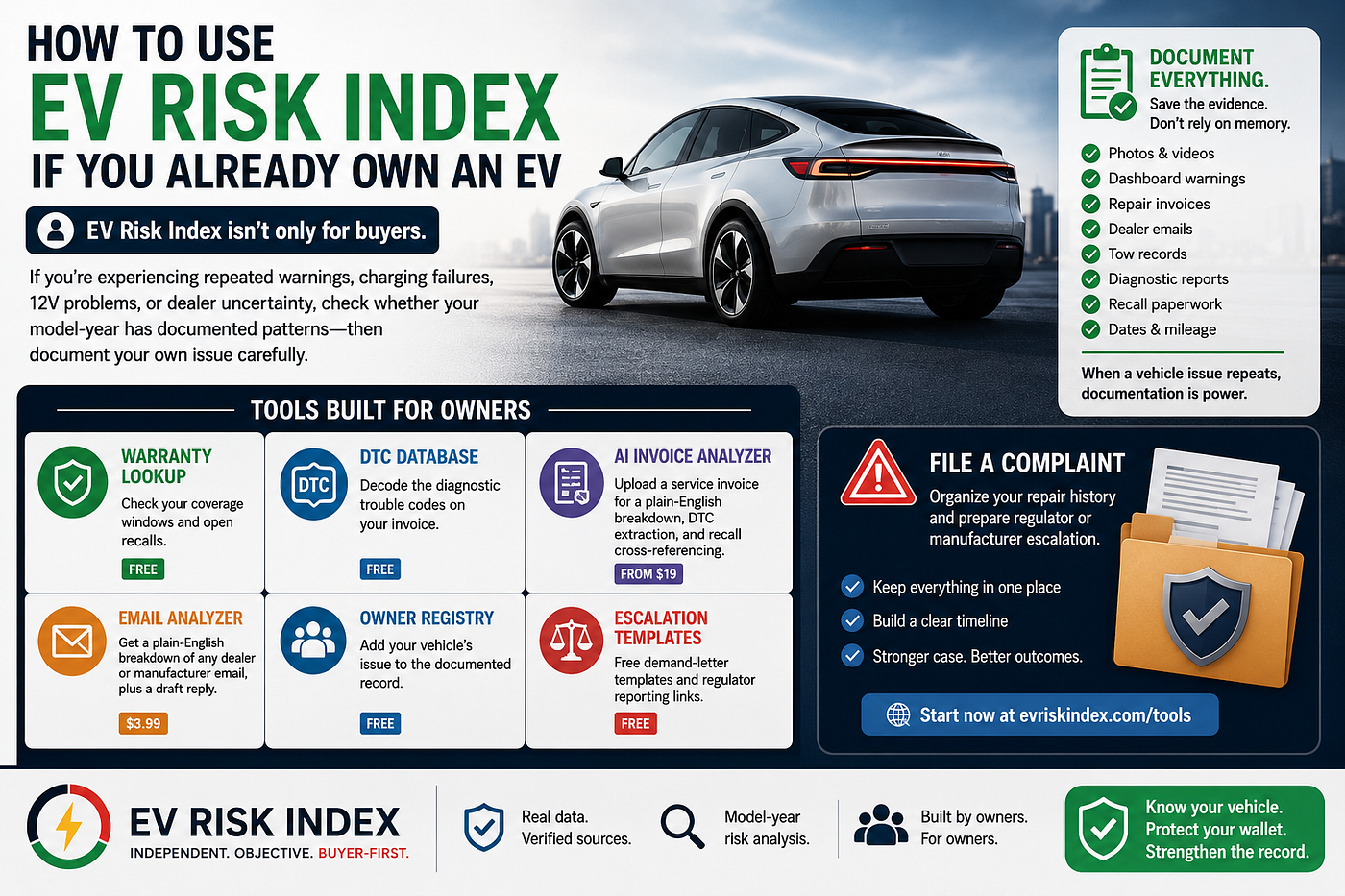
How to use EV Risk Index if you already own an EV
EV Risk Index isn’t only for buyers.
If you’re experiencing repeated warnings, charging failures, 12V problems, or dealer uncertainty, check whether your model-year has documented patterns — then document your own issue carefully.
Save: photos, videos, dashboard warnings, repair invoices, dealer emails, tow records, diagnostic reports, recall paperwork, dates, and mileage. Don’t rely on memory. When a vehicle issue repeats, documentation is power.
Tools built for owners:
- **Warranty Lookup** — check your coverage windows and open recalls, free
- **DTC Database** — decode the diagnostic trouble codes on your invoice
- **AI Invoice Analyzer** — upload a service invoice for a plain-English breakdown, DTC extraction, and recall cross-referencing
- **Email Analyzer ($3.99)** — get a plain-English breakdown of any dealer or manufacturer email, plus a draft reply
- **Owner Registry** — add your vehicle’s issue to the documented record
- **Escalation Templates** — free demand-letter templates and regulator reporting links
- **File a Complaint** — organize your repair history and prepare regulator or manufacturer escalation
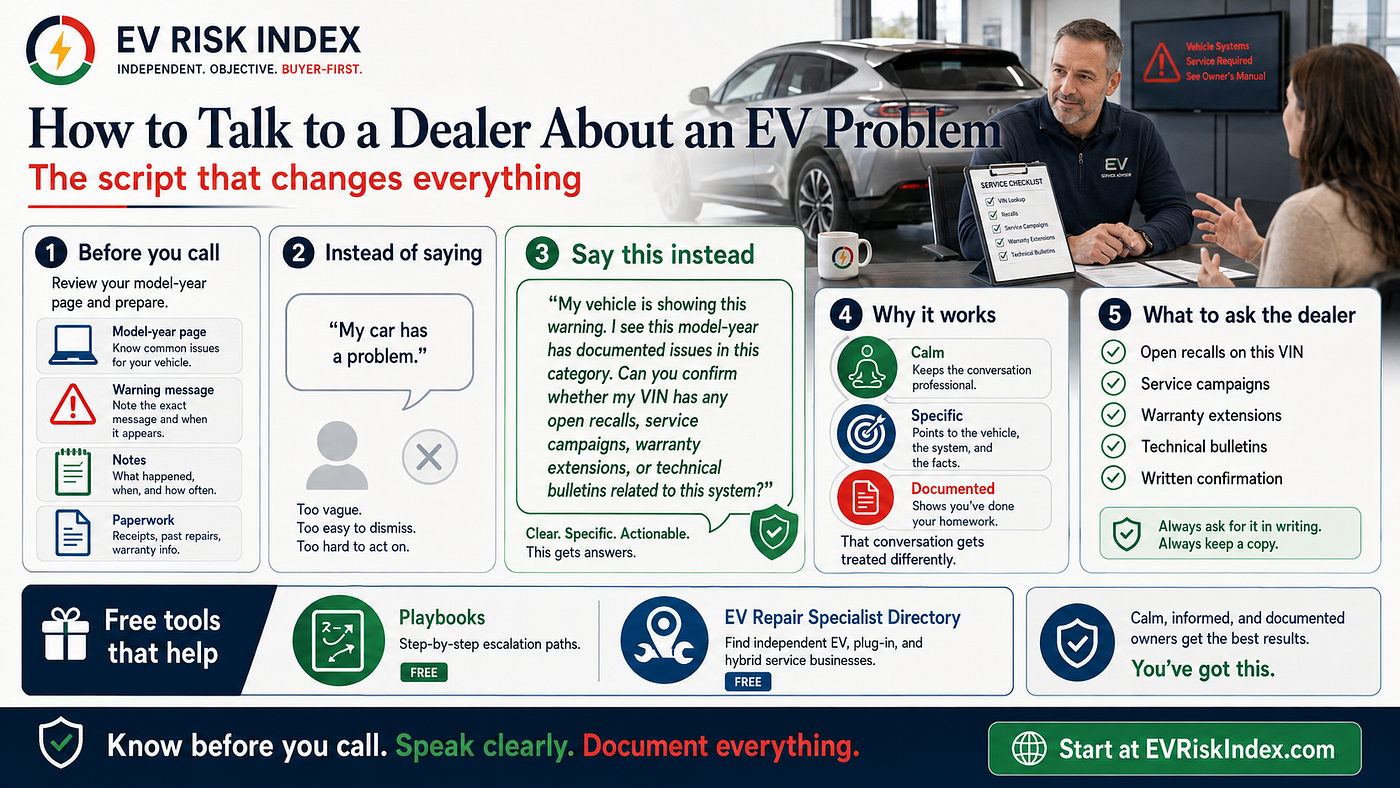
How to talk to a dealer about an EV problem (the script that changes everything)
Before contacting a dealer or manufacturer, review your model-year page and prepare.
Instead of: “My car has a problem.”
Say: “My vehicle is showing this warning. I see this model-year has documented issues in this category. Can you confirm whether my VIN has any open recalls, service campaigns, warranty extensions, or technical bulletins related to this system?”
Calm. Specific. Documented. That conversation gets treated differently.
👉 The free Playbooks walk you through escalation paths step by step, and if you’re looking for an independent shop, the EV Repair Specialist Directory lists independent EV, plug-in, and hybrid service businesses.
What EV Risk Index is not
EV Risk Index is a research and risk-signal tool. It does not replace a professional inspection, a diagnostic scan, dealer service history, or an official VIN recall lookup — and it is not a mechanic, a lawyer, or a regulator.
What it does is fill the missing layer: it helps you know what to ask before you pay for a vehicle, approve a repair, or accept a vague answer.
The complete used EV buying checklist (save this)
Before buying or repairing a used EV, ask:
- ✅ What model-year is it — and what does EV Risk Index show for that exact year?
- ✅ Are there open recalls on the VIN?
- ✅ Are there known issue categories for this model?
- ✅ Has the high-voltage battery had repairs — with paperwork?
- ✅ Has the vehicle had repeated 12V problems?
- ✅ Are there software or charging-system campaigns (ICCU included)?
- ✅ Is there a warranty extension — and is it in writing?
- ✅ Was the vehicle imported?
- ✅ Can the seller prove completed repairs with repair orders?
- ✅ Will the dealer confirm coverage in writing?
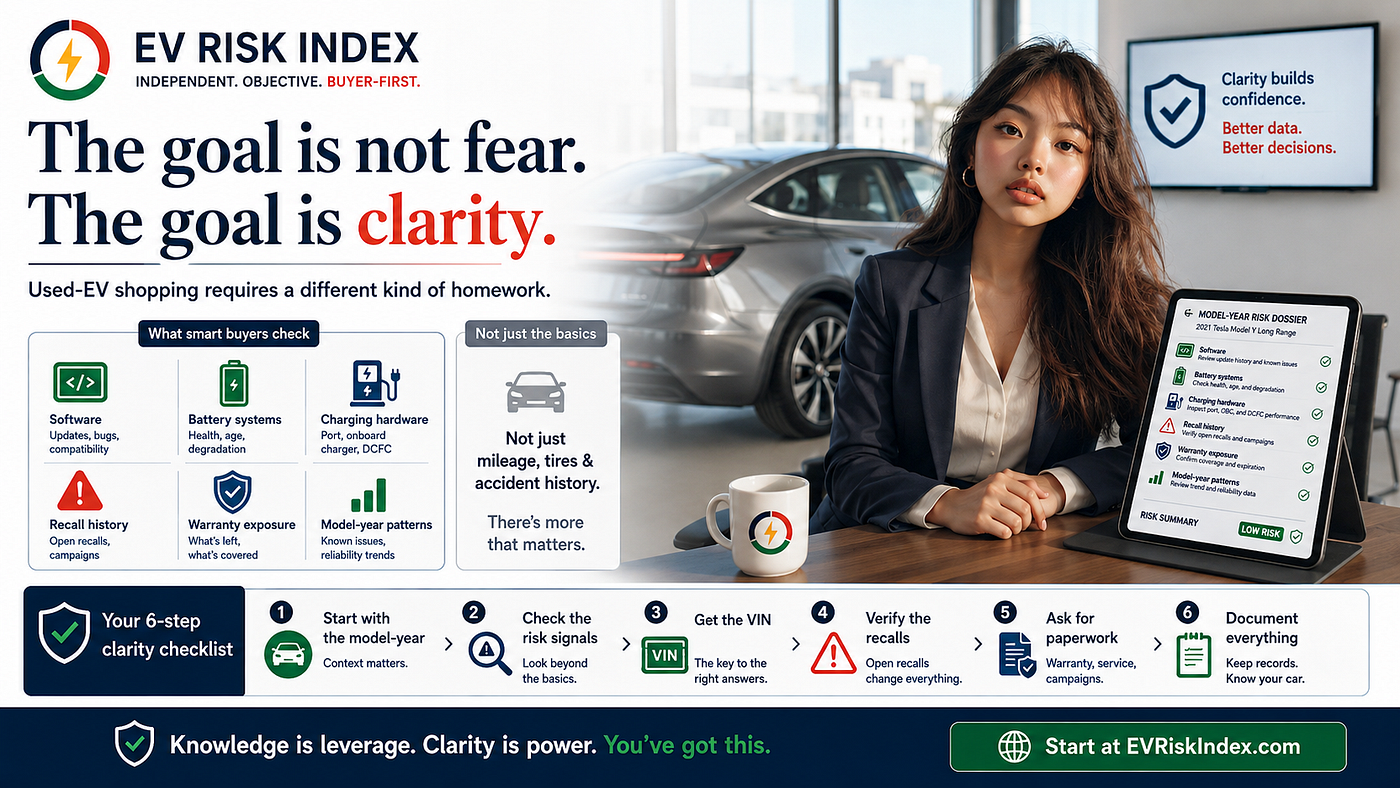
The goal is not fear. The goal is clarity.
Electric vehicles can be excellent vehicles. But used-EV shopping requires a different kind of homework: software, battery systems, charging hardware, recall history, warranty exposure, and model-year patterns — not just mileage, tires, and accident history.
Start with the model-year. Check the risk signals. Get the VIN. Verify the recalls. Ask for paperwork. Document everything.
A good EV purchase is not about finding the lowest price. It’s about knowing what questions to ask before the problem becomes yours.
🔗 Start your search at EVRiskIndex.com — 323 model-years rated, 351 recall campaigns documented, free lookup tools, and owner escalation templates. Also available en français.
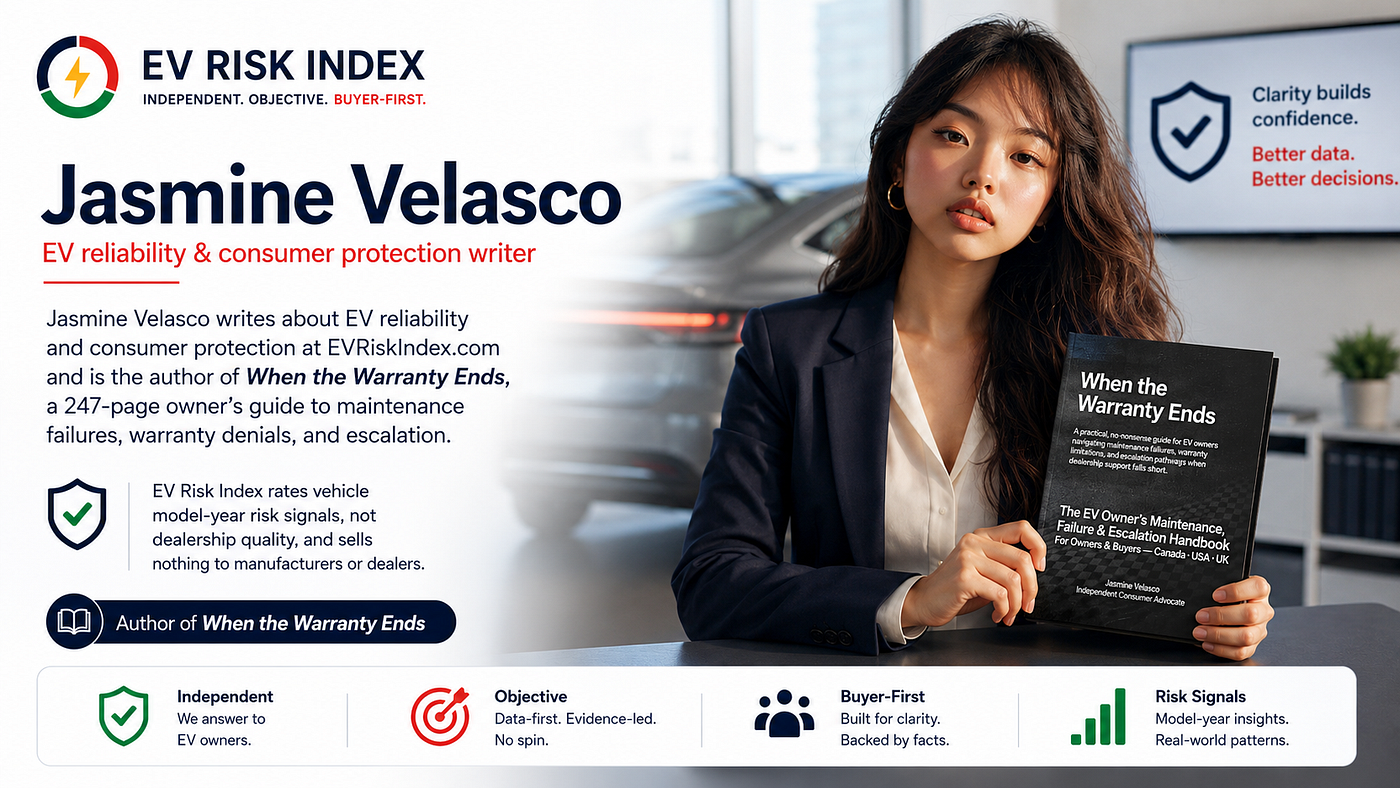
Jasmine Velasco writes about EV reliability and consumer protection at EVRiskIndex.com and is the author of When the Warranty Ends, a 247-page owner’s guide to maintenance failures, warranty denials, and escalation. EV Risk Index rates vehicle model-year risk signals, not dealership quality, and sells nothing to manufacturers or dealers.
메타데이터
- post_id
- d6bbd331faed
- slug
- confused-by-ev-terms-like-iccu-open-recall-and-battery-module-d6bbd331faed
- url
- https://medium.com/@jasminevelasco172/confused-by-ev-terms-like-iccu-open-recall-and-battery-module-d6bbd331faed
- canonical_url
- https://medium.com/@jasminevelasco172/confused-by-ev-terms-like-iccu-open-recall-and-battery-module-d6bbd331faed
- author_url
- https://medium.com/@jasminevelasco172
- status
- ok
- fetched_at
- 2026-07-10 23:04:28