Our Generation’s Nutcracker Task
Dismanteling Family Dynamics of Service, Self-sacrifice and Entitlement
Our Generation’s Nutcracker Task
Dismanteling Family Dynamics of Service, Self-sacrifice and Entitlement
For years, I have been brooding on a topic that is tricky to bring up in conversation, let alone tackle in a blog: the unspoken expectations of relatives as they age. It is a sensitive subject, and I was stalling. Last week, however, I read a Substack post by Imelda Almqvist, about an encounter with an elderly couple in her neighbourhood, to which I posted a long, spontaneous and uncensored reply. Writing it, I felt this should probably be a post in its own right. So I decided it was time.
(Disclaimer: my perspective is that of someone working and living in Belgium, a country which, admittedly, has a very high-performing health care system, but where the focus of that health-care system and its budget are mainly on technical innovation and enhancing longevity, and much less on actual care or quality of life.)
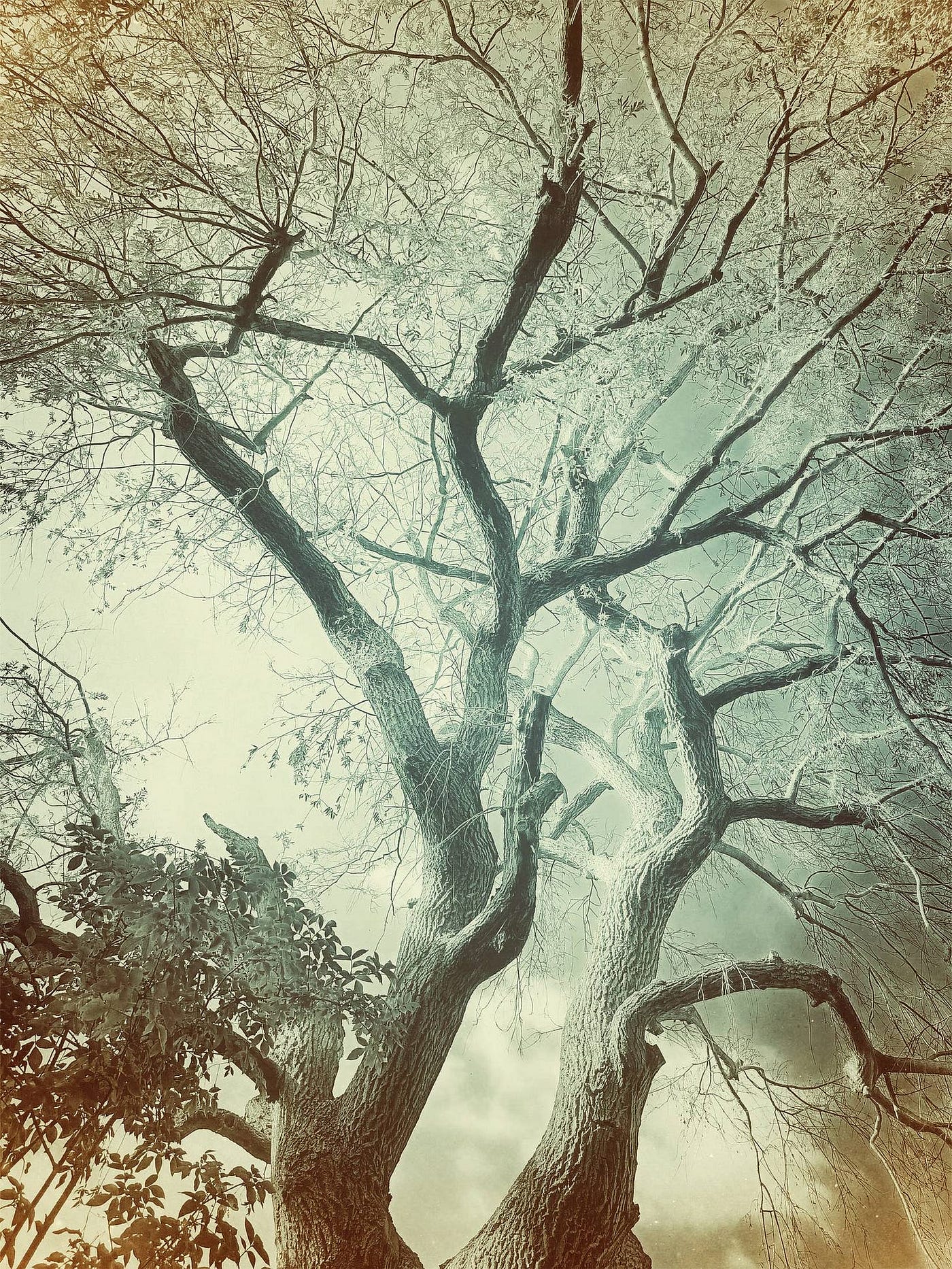
When the magnificent weeping willow in our garden was dying due to drought and climate change, I documented some of his final stages © Inaya photography
The notion that we help elderly relatives and loved ones when they become less capable of tending to their needs is so self-evident that to suggest there are sometimes also other, unhealthy dynamics at play, sounds heartless or calculating almost by default. I am neither. I do feel, however, that we need to lift the lid off some old, unspoken dynamics that are becoming untenable in this rapidly changing world. So here goes.
There is a tendency I have been observing in elderly people in Western society. Not in all of them, to be sure, but it is present in many families. More specifically this: a sense of entitlement to be taken care of, unconditionally and limitlessly, even when it comes at the expense of the caregivers (or society at large).
People have been taking care of their elderly throughout history. This is a beautiful act of service and human connection, and often a necessary one, too. I am not suggesting we give it up, or that we leave our elderly to fend for themselves while we go out and throw a party. But there are a number of developments that are making the simple perpetuation of the old ways impossible.
We live much longer lives now. The cohort of elderly people in the West is a staggering uphill graph, with ever less younger, active population to take care of them. Instead of working until we die, like we did when life expectancy was around sixty at best, our eldely now often have two or more healthy decades ahead of them after they stop contributing to society in a professional way. Those of us in the younger generations feel this pressure keenly. Not only are we full-time working and full-time parenting our (often young) children, when the necessity arises to care for elderly relatives, we are faced with several complications at once.
Distance is one of them. We are no longer living in close proximity to our relatives, with several generations under one roof, or in one close-knit town. Due to a dramatic lack of nursing staff and other aspects of professional care (again: less younger active population — more elderly people to take care of), in my country (Belgium) you have to be nearly dying, in a severe stage of dementia or extremely physically incapacitated to be allowed residency in a nursing home. This means that in all other stages, it’s the informal care network that somehow needs to take on the care. Ever larger responsibilities are delegated to us for ever longer stretches of time — across the distance. The situation in which the elderly person is in active need of support (and supervision) from relatives and community members can easily run for over a decade. And while there is still a measure of professional care that comes around at home to support an elderly person and these caregivers are doing their very best, it is not nearly enough to relieve the actual need.
This combination of factors makes for a problematic mix in any situation. We love our parents, yet this is all but ideal. That’s when things turn even more difficult when the elderly person displays a firm (and often emotionally charged) sense of entitlement about the attention, care and services that they feel are their rightful due.
One of my core life mottos is that everyone is doing their best at all times. However poor that ‘best’ may look, we very rarely intend to hurt others. On the other hand, I am convinced that this sense of entitlement is part of a deep and old dynamic of lack, over-giving and covert compensation that is now coming up for review.

© Inaya photography
Many of the old social structures in the villages of ‘the good old days’ were built on a network of mutual support, this much is true. But they were also built on unequal power dynamics (within families, between genders and in society as a whole) and sacrifice (that good old Christian dogma!). This created a family system in which care was often steeped in obligation, silent resentment and the unspoken expectation to be somehow ‘rewarded’ or ‘repaid’ for those sacrifices when one’s own time came. It was a baton of grief, grudges, self-eroding service, and silent expectation, passed down from generation to generation.
Let me stress that this is not a blanket statement about how I perceive all our elderly. There are certainly very conscious and wise Elders among us, who stand out in many ways, but unfortunately they are currently quite rare. Also, I don’t mean to imply that the (grand)parents, aunts and uncles I am referring to here don’t have good intentions, or don’t love their (grand)children. They certainly do, but loving doesn’t necessarily equal living consciously, or being able to talk openly.
Living consciously is the hallmark of a true Elder. True Elders are aware of their place in the ecosystem of all things. They know life has changed for everyone. They see the burdens that are weighing down on the younger generations today and don’t add to them. They do this mostly by taking responsibility for their own lives. In ideal circumstances, this goes beyond the stage when they are still in good health. They enjoy the moment and savour their friendships and family bonds, but they also think and plan ahead. On board with their own mortality, they contemplate their options and wishes for the future and pro-actively put their affairs in order. They face the embrace of the Long Night of elderhood with grace, and prepare to leave with the Dawn, their hearts light and their wordly matters settled (as much as possible).
In such a scenario, children and community members are often all too willing to help, to the best of their ability, for these Elders remain inspiring presences despite whatever ailments they suffer. They continue to give to society without even knowing it, often through their kindness, patience and capacity to listen, and through their genuine gratefulness for all the help they receive.
All of this, however, requires a consciousness of mind and heart, and above all: an acceptance of the fact that one is going to die.
The fear of death is HUGE in our society today, and denial is the main coping mechanism. This results in ostrich-like scenarios where people carry on living life on their own terms way beyond the point where the situation is still safe or even barely comfortable. (Until disaster hits and then the whole existence is upended.)
On top of this come all the layers of self-denial, sacrifice and unfulfilled craving. The elderly in Western society might be materially well-off, but many are emotionally stunted and psychologically underfed. This can usually be traced back to what they themselves got handed down from their own parents, whose focus was mostly on material survival in a war-shredded world. And neither of these generations did do a bad job at all: the fact that we now do have the psychological capacity and bandwidth to analyse this dynamic is also thanks to everything that they have provided for us.
But unfortunaltely, it doesn’t always mean that they have evolved along with us on every front. And with the much-dreaded end in sight, we find ourselves confronted with a myriad of unexpressed needs, resentments and expectations crawling out of the woodwork. Having catered to the whims of others for a lot of their lives, often at their own expense like they were taught to do, our elder generations now expect to be on the receiving end of that dynamic, and pass the baton down to us.
But their demands have become impossible to comply with. Remember the demographic graph? You cannot catch the ocean in a paper cup. It’s deeply stressful for those of us who feel that we cannot go the full distance in living up to the expectations, and it’s a very tough encounter with reality for the elderly.
In healthy two-way relationships between mature Elders and their adult children, a lot can be discussed and decided with mutual respect and appreciation, and with the best for all parties as a shared and heart-felt intention. The quality of both life and relationship is the priority. Sometimes, tough calls might need to be made. We can’t fix the shortage of nursing care or the challenges of illness with a magic wand, but we can work together in making life worthwile for everyone in this process. Remember, it can take as long as a decade.
In this way, the Elder’s transition years become a collaboration of soul energy, love and acceptance, in which beautiful and deep experiences can be shared at the precipice of human life as we know it. But in relationships that still function along the unspoken narratives of self-sacrifice, entitlement and projected expectations, fuelled by a deep fear of death, much of this sense of connection is lacking. Therefore, it is the younger generations’ ungrateful task to initiate a change.

© Inaya photography
Don’t we risk disappointing a whole lot of people, then? That might be exactly what we do. But that doesn’t mean it’s wrong. In a changing world, we are all invited, even forced, to change. This goes for everyone, including our elders.
The position our elderly hold in today’s society is incomparable to anyone’s in history. In calculations about the future, next generations are expected to be less well-off. Our parents’ generation will be the one to have had the longest, healthiest lives of all, in a mostly war-free world, and with the best work-life balance ever. They get to be older than anyone before them. Some of them will actually be retired longer than they have contributed to society through professional work. So excuse me for being blunt, but you cannot now go back and refer to societal standards of the nineteen seventies or eighties as a manual for how you want to be treated in your old age. That world is truly gone. The population proportions have changed drastically, and the younger generations are drowning in work, burn-out and depression. We also know that much of what was (and is) at the disposal of our elderly, will no longer be available when we have reached age. This is the moment when a parent’s emotional entitlement starts to feel not only like a stranglehold, but also as pretty f*cking unfair.
At the risk of sounding even more disrespectful, some of our elderly today are among the most immature people I know. What else can we call it when someone fails to see their own impact on the system they are living in, has big expectations of others (with the distant past as a golden standard) and reacts little better than a child when they do not get what they want or what they feel they are entitled to?
This might sound like I would prefer people to just die. The sooner, the better — way more convenient! Of course, this is not true. Even those of us who feel that humanity might be overstretching its limits where life-span and use of resources are concerned, love our parents dearly. We don’t want them living crappy remnants of lives riddled with disease or loneliness. But we also want to be seen in our predicament. In the face of death, the ugly truth is that many of our elderly cannot come to terms with their own mortality and a primitive sort of selfishness takes over.
So this is our generation’s nutcracker task: not to accept the baton of sacrifice, resentment and entitlement from those who came before us, however much they might want to push it into our hands and judge us for not taking it.
We are not doing it because we don’t love them. We are doing it because we love: them, ourselves and our children. We are the generation who is learning that loving others doesn’t have to mean abandoning yourself and then guilt-tripping the next generation into doing the same. We are breaking the cycle of self-sacrifice and entitlement.
We are not expecting anything from our elderly in this process. We know exactly how that feels, and we don’t wish it upon anyone. But we sure hope they will help us do it. We want the last leg of our journey together, imperfect and challenging as it might be, to also be the most meaningful, in whatever way we can make it so.
Wouldn’t that be a legacy to pass on?

© Inaya photography
메타데이터
- post_id
- d6e35fff3ba3
- slug
- our-generations-nutcracker-task-d6e35fff3ba3
- url
- https://medium.com/the-story-hall/our-generations-nutcracker-task-d6e35fff3ba3
- canonical_url
- https://medium.com/the-story-hall/our-generations-nutcracker-task-d6e35fff3ba3
- author_url
- https://medium.com/@kirstinvanlierde
- status
- ok
- fetched_at
- 2026-08-01 22:07:34