Regulatory Clarity Meets Real-World Payments — May 2026
Background
Regulatory Clarity Meets Real-World Payments — May 2026
Background
April 2026 marked a turning point for the stablecoin industry: the U.S. GENIUS Act (signed into law in July 2025) entered its active implementation phase, with three major federal agencies releasing proposed rules within a single week. At the same time, real-world payment adoption accelerated sharply, with enterprise B2B use cases emerging as the dominant growth driver. This report covers key developments from April 2026 and outlines what they mean for the stablecoin ecosystem entering May 2026.
Current State of the Market
Market Size and Composition
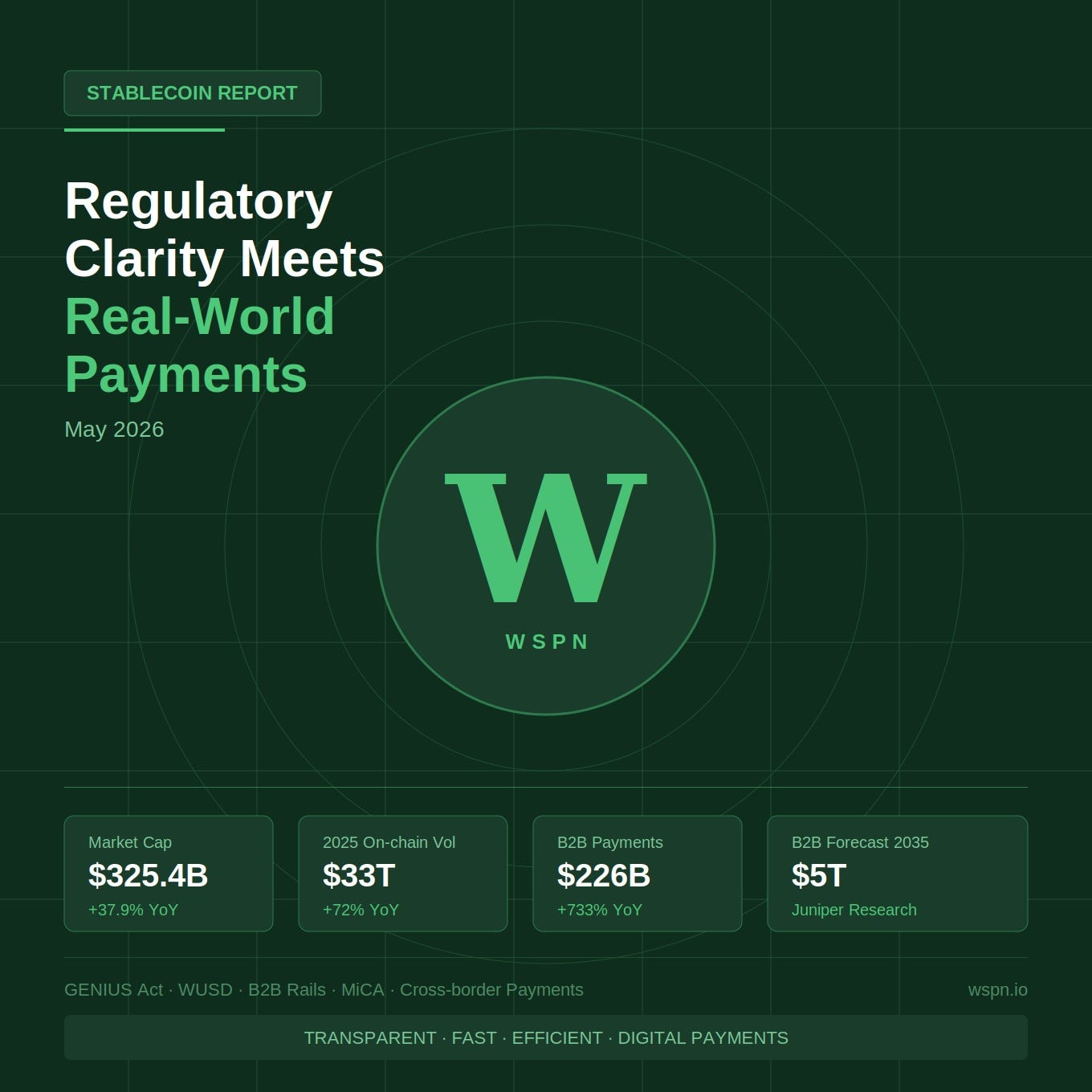
As of April 2026, the global stablecoin market capitalization reached approximately $325.4 billion, up 37.9% year-over-year from $236.0 billion in April 2025.¹ The market remains highly concentrated:
- USDT (Tether): ~$189.8 billion, 58.33% market share¹
- USDC (Circle): ~$77.7 billion, 23.87% market share¹
- USDT + USDC combined: 82.20% of total supply¹
- All other stablecoins: 17.80%¹
The Herfindahl-Hirschman Index (HHI) for market concentration stands at 3,995 — classified as “highly concentrated” by competition analysis standards.¹
Transaction Volumes
Stablecoin transaction activity has crossed a threshold where it can no longer be dismissed as niche:
- 2025 total on-chain stablecoin volume: $33 trillion (up ~72% YoY)²
- 2025 adjusted “real payment” volume: ~$390 billion (more than double 2024 levels)²³
- January 2026 alone: over $10 trillion in on-chain transfers — approximately 60% of Visa’s entire FY2025 payment volume²
- B2B stablecoin payments (2025): ~$226 billion, accounting for ~60% of all real payment activity, up 733% YoY³
- Monthly B2B volume (mid-2025): over $6 billion³
The data increasingly shows that stablecoins are functioning as programmable corporate cash — not speculative assets.
Top Regulatory Developments: The GENIUS Act Implementation Sprint
Three Agencies, One Week — April 2026 Compliance Inflection
In a remarkable coordinated push, three U.S. federal agencies issued proposed rules during the first two weeks of April 2026, translating the GENIUS Act’s statutory framework into enforceable operational standards:⁴

Key requirements under these proposed rules:⁴
- 1:1 Reserve Backing — Reserves must be held in U.S. currency, FDIC-insured deposits, or short-term U.S. Treasuries. No corporate bonds, no crypto collateral. Reserves must be segregated from corporate operational funds.
- T+2 Redemption — All redemption requests must be honored within 2 business days. If daily redemptions exceed 10% of total supply, mandatory notification to federal regulators is triggered.
- Monthly Public Attestations — Independently audited reserve reports disclosing composition by asset class, custodian, and maturity — every month.
- AML/KYC at Bank-Grade Standards — Full Bank Secrecy Act compliance, suspicious activity reporting to FinCEN, real-time OFAC sanctions screening on all transfers.
- Dual-Track by Size — Issuers below $10 billion may operate under state regulation (if deemed “substantially similar”). Issuers above $10 billion must transition to federal oversight within 18 months.
- Capital Requirements — Minimum $5 million capital floor for independent issuers in their first three years, plus a 12-month operating expense liquidity buffer.
- US-Based Compliance Officer — Mandatory personal liability for AML failures, mirroring traditional banking requirements.
- No Yield to Holders — Passive yield from simply holding stablecoins remains prohibited under the GENIUS Act.
All public comment periods are open through June 2026, with final rules expected by September–October 2026. The GENIUS Act’s effective date is January 18, 2027.⁵
The CLARITY Act Compromise
In parallel, the U.S. Senate advanced the Digital Asset Market Clarity (CLARITY) Act with a bipartisan compromise on the stablecoin yield question: passive yield from holding stablecoins stays banned, but activity-based rewards (tied to payments, transfers, or platform activity) are permitted. This clears the path for Coinbase USDC rewards programs and similar models.⁴
The Tether Problem: Foreign Issuer Gap
A critical regulatory blind spot remains: Tether (USDT), dominating ~60% of the stablecoin market from its El Salvador headquarters, sits entirely outside GENIUS Act audit and reserve requirements. Senator Jack Reed’s Foreign Stablecoin Transparency Act (S.3907) would require foreign-issued stablecoins with material U.S. market presence to submit to full reserve audits as a condition of U.S. exchange access. If enacted and Tether refuses compliance, forced USDT delisting from U.S.-regulated exchanges could trigger significant market dislocations.⁴
Global Regulatory Alignment
- EU (MiCA): Transition periods for crypto firms are ending; full MiCA authorization now required. The EU is actively pushing EUR-denominated stablecoins to counter further dollar-denomination of the digital economy.⁶
- UK: New stablecoin regime (under FSMA 2026 Cryptoassets Regulations) coming into force in stages; FCA authorization window opens late 2026 through early 2027, with full implementation by October 2027.⁶
- BIS Warning: BIS General Manager Pablo Hernández de Cos called for global cooperation, warning that divergent national regimes could produce harmful regulatory arbitrage — a tension that will define 2026–2027.⁶
Key Case Studies
Case 1: Paystand Launches USDb — B2B Stablecoin Purpose-Built for Enterprise Finance (April 27, 2026)
Paystand, a blockchain-powered B2B payments network processing $20+ billion in volume for over 1 million businesses across North America and Latin America, launched USDb — the first stablecoin purpose-built for commercial-scale enterprise finance.⁷
Unlike USDT or USDC, which serve trading and crypto liquidity needs, USDb is engineered specifically for:
- Accounts receivable (AR) and accounts payable (AP) workflows
- Cross-border payroll and vendor payments
- Treasury management and ERP system integration
- AI-driven, machine-to-machine financial operations
Built on Bitcoin infrastructure (Rootstock and Blockstream’s Liquid Network), USDb is backed 1:1 by USD reserves. At launch, it immediately reached 90,000 workers and 4,500 businesses in ~200 countries through Paystand’s 2025 acquisition of Bitwage.⁷
USDb launches with a GENIUS Act-compliant strategy for U.S. adoption and full compliance targeted by end of 2026.
Why it matters: USDb represents the convergence of stablecoins with enterprise workflows. As Jeremy Almond (CEO, Paystand) stated: “AI is eating labor. Bitcoin is eating capital. Stablecoins are eating financial services. USDb is where those three forces converge.”⁷
Case 2: MoneyGram × Stellar Expand Stablecoin Utility Across Latin America (April 22, 2026)
MoneyGram and the Stellar Development Foundation (SDF) announced a multi-year partnership extension, expanding USDC-powered stablecoin features across Latin America. After strong adoption in Colombia, the service has launched in El Salvador, with broader Central and South American markets expected throughout 2026.⁸
The service (powered by Stellar, Crossmint, and Circle’s USDC) enables users to:
- Instantly receive funds into a USD-denominated stablecoin balance
- Hold stable digital dollars
- Cash out at nearly 500,000 MoneyGram retail locations across 200+ countries
This is a pivotal model for financial inclusion: connecting blockchain-native digital dollars to physical cash-out infrastructure for the billions who depend on remittances.
Case 3: Visa Stablecoin Settlement Hits $4.6B Annualized Run Rate (Q1 FY2026)
Visa disclosed on its Q1 FY2026 earnings call that stablecoin settlement on its network had reached a $4.6 billion annualized run rate — still small relative to Visa’s $14.2T FY2025 total payment volume, but confirming a repeatable production flow with institutional counterparties.⁹ Stablecoin card issuance expanded to over 50 markets, and USDC settlement capabilities were extended to U.S. banks and fintechs.
Visa specifically cited cross-border payments, remittances, B2B, and disbursements as the strongest product-market-fit zones.
Case 4: Juniper Research — Cross-Border B2B Stablecoins to Reach $5 Trillion by 2035
A new Juniper Research study (April 27, 2026) projects that cross-border B2B stablecoin transactions will grow from $13.4 billion in 2026 to $5 trillion by 2035 — a 37,000%+ increase.¹⁰ By 2035, B2B is expected to represent 85% of total stablecoin transaction value, as the technology shifts from a speculative asset to foundational institutional payment infrastructure disrupting correspondent banking.
Data Snapshot

Conclusions
April 2026 validated two parallel truths about the stablecoin industry:
Truth 1: Regulatory clarity is arriving — but unevenly. The GENIUS Act implementation sprint gave institutional players the certainty they needed to commit capital and build compliant stablecoin infrastructure. The rules are strict — 1:1 reserves, monthly audits, bank-grade AML — but they are clear. Circle (USDC) is well-positioned to benefit. Tether (USDT) faces existential ambiguity about its U.S. access. Smaller issuers face consolidation pressure from the compliance cost moat.
Truth 2: Real-world payment adoption is no longer theoretical. B2B payments grew 733% in 2025.³ Visa has live institutional settlement.⁹ Paystand launched a billion-dollar network on stablecoin rails.⁷ MoneyGram is pushing USDC to emerging markets.⁸ The question has shifted from “will stablecoins be used?” to “who builds the dominant payment rails?”
The companies that win in 2026–2027 will be those that combine regulatory compliance with genuine payment utility — exactly the space where established payment infrastructure companies (and well-funded newcomers) are racing to establish beachheads.
Opportunity Points
- Compliance-as-moat for USD stablecoin issuers: GENIUS Act compliance creates a durable competitive barrier. Well-capitalized, US-regulated stablecoin issuers (Circle, PayPal) stand to capture market share as non-compliant actors face restrictions.
- Enterprise B2B payment rails: B2B stablecoin payments are growing 700%+ annually.³ Building treasury, payroll, and supply-chain settlement infrastructure on stablecoin rails addresses a multi-trillion dollar market with structural cost and speed advantages.
- Emerging market financial inclusion: Latin America, Southeast Asia, and South Asia represent massive corridors where stablecoin rails are already outperforming traditional remittance infrastructure on cost and speed. MoneyGram/Stellar is the model.⁸
- AI-native payment infrastructure: As agentic AI systems take over financial operations, stablecoins with ERP/API-native integrations and programmable settlement are uniquely positioned to become the default payment layer for machine-to-machine transactions.
- EUR and non-USD stablecoins: MiCA enforcement creates regulated demand for EUR-denominated stablecoins as a strategic counterweight to dollar dominance in European financial infrastructure.⁶
Risk Points
- Tether systemic risk: USDT controls 58%+ of the stablecoin market but remains outside GENIUS Act compliance.¹ If the Foreign Stablecoin Transparency Act (S.3907) passes and Tether faces U.S. delistings, market-wide volatility and derivatives market disruptions are highly probable.
- Regulatory fragmentation: Divergent rules between the U.S. (GENIUS Act), EU (MiCA), UK, and Asia could produce regulatory arbitrage, compliance complexity, and liquidity fragmentation across jurisdictions.⁶
- Implementation execution risk: Six federal agencies are promulgating GENIUS Act rules simultaneously. Coordination failures or delays could compress the timeline for industry preparation ahead of the January 2027 effective date.⁴⁵
- Concentration risk: The HHI of 3,995 signals extreme market concentration.¹ A reserve failure, regulatory action, or technology exploit at Tether or Circle would have systemic consequences at this scale.
- Compliance cost barrier to entry: $5M minimum capital requirements, monthly independent audits, US-based compliance officers, and bank-grade AML/KYC infrastructure could price smaller innovators out of the U.S. market, reducing competitive diversity and potentially slowing product innovation.⁴
Sources
¹: StablecoinBeat — “Global Stablecoin Market Report: April 2026.” https://stablecoinbeat.com/reports/april-2026
²: Artemis Analytics — “On-Chain Stablecoin Volume Dashboard.” https://app.artemis.xyz/stablecoins
³: McKinsey & Company / Artemis Analytics — “B2B Stablecoin Payments: 2025 Annual Review.” https://www.mckinsey.com/industries/financial-services/our-insights/stablecoin-payments-2025
⁴: U.S. Department of Treasury / FDIC / FinCEN / OFAC — GENIUS Act Proposed Implementation Rules, April 2026. https://home.treasury.gov/news/press-releases/genius-act-proposed-rules-april-2026
⁵: U.S. Federal Register — GENIUS Act Final Rule Filing and Comment Period Notice. https://www.federalregister.gov/documents/2026/genius-act
⁶: Bank for International Settlements (BIS) — “Global Stablecoin Regulatory Landscape: 2026 Mid-Year Update.” https://www.bis.org/publ/work_stablecoin_2026.htm
⁷: Paystand — “Paystand Launches USDb: The First Enterprise-Grade B2B Stablecoin” (April 27, 2026). https://www.paystand.com/blog/usdb-launch
⁸: MoneyGram / Stellar Development Foundation — “MoneyGram and Stellar Expand USDC Partnership Across Latin America” (April 22, 2026). https://www.stellar.org/press/moneygram-stellar-latam-expansion-2026
⁹: Visa Inc. — Q1 FY2026 Earnings Call Transcript and Investor Presentation. https://investor.visa.com/news/news-details/2026/Visa-Q1-FY2026-Earnings/default.aspx
¹⁰: Juniper Research — “Cross-Border B2B Stablecoin Transactions: 2026–2035 Forecast Report” (April 27, 2026). https://www.juniperresearch.com/research/fintech-payments/stablecoin-b2b-payments-forecast-2026
메타데이터
- post_id
- d6e54f788e2a
- slug
- regulatory-clarity-meets-real-world-payments-may-2026-d6e54f788e2a
- url
- https://medium.com/@WSPN/regulatory-clarity-meets-real-world-payments-may-2026-d6e54f788e2a
- canonical_url
- https://medium.com/@WSPN/regulatory-clarity-meets-real-world-payments-may-2026-d6e54f788e2a
- author_url
- https://medium.com/@WSPN
- status
- ok
- fetched_at
- 2026-07-16 13:31:25