AI 1.09 — Towards Technological Singularity: Part 2
Forced to Play Catch up
AI 1.09 — Towards Technological Singularity: Part 2
Forced to play catch up
This series has covered the history slash highlights of AI from its inception. Starting from Turing’s first ever paper on AI when it was not even called so, to the coining of the term, to the first ever Neural Network architecture, to the couple of AI winters we saw through, to emphasis on the importance of researcher and communities, to the silicon beneath and the cloud infrastructures we have built for ourselves. The first article in the series was written in 2020 and surprising with all the crazy developments which have happened since, still I feel the articles have held up to time. It was always meant to be a 10 article series and over the last 8 articles, we have have certainly built up to this article and point in time. This is part 2 of the penultimate article. We last saw where machines have already started beating humans in various domains which we considered our own. But we’ve always had the tendancy to not let go and work on catching up. Since the research has grown faster than rules being set on them, things have been a little tricky. This article is going to be about the laws and rules we’ve tried to set for ourselves and AI in general, to get to a safe Singularity.
Technological singularity is the hypothetical point at which artificial intelligence surpasses human intelligence and begins improving itself — each generation designing the next, faster than we can follow, until progress becomes an exponential runaway beyond prediction or control. It isn’t a date on a calendar. It is more of a horizon. And nearly everything in this article is humanity’s attempt to steer toward that horizon without driving off the cliff.

The Alignment Problem
The alignment problem questions how anyone would be able to ensure an AI system does what you actually want, rather than what you literally told it to do?
In November 2023, Ilya Sutskever, co-founder and chief scientist of OpenAI, reportedly concluded that the company was moving too fast. The Microsoft partnership. The API access. The rush to ship. All of it outrunning the organisation’s ability to ensure safety. He helped fire Sam Altman. And then the employees chose speed he so wanted to avoid. The market had also chose speed. Over 500 staff threatened to walk, Microsoft opened the door, and Altman returned within days — the board that fired him replaced by one more aligned with growth. Sutskever left six months later to found Safe Superintelligence Inc., focused on exactly what the name suggests. Despite being the person closest to the technology, he chose to walk away from one among the biggest AI company because he believed alignment was losing the race against capability.
The gap between intent and instruction is where catastrophe lives.
Stuart Russell, who co-authored the most widely used AI textbook and laid out his argument in his 2019 book *Human Compatible:* A superintelligent AI tasked with maximising human happiness could decide to implant electrodes in every brain to stimulate pleasure centres indefinitely. Goal accomplished. Nightmare achieved. His proposed solution: build systems that are fundamentally uncertain about human preferences, always deferring to human judgement. Elegant in theory. Fiendishly difficult to build.
Eliezer Yudkowsky and the Machine Intelligence Research Institute had been sounding the alarm since 2000 — arguing that the default outcome of superintelligent AI was extinction, not as a distant hypothetical but as the most likely scenario if alignment was not solved before capability. Anthropic, founded by Dario and Daniela Amodei after they left OpenAI over exactly these concerns, embedded alignment into architecture through Constitutional AI — training models to critique their own outputs against human-authored principles. Not a complete solution. A philosophy built into the machine.
And then Geoffrey Hinton, the godfather of deep learning, resigned from Google in May 2023 in order to speak freely about risks. “I console myself with the normal excuse: if I hadn’t done it, somebody else would have,” he told The New York Times. The man who built the foundation had looked at what he helped create and was not sure about its safe.

https://study.com/academy/lesson/who-is-the-monster-in-frankenstein-character-traits-analysis.html
An Open Letter to the Community
On March 22, 2023, the Future of Life Institute published an open letter calling for a six-month pause on training AI systems more powerful than GPT-4. Over 33,000 signatories, including Elon Musk, Steve Wozniak, Hinton, Yoshua Bengio and Stuart Russell.

https://futureoflife.org/open-letter/pause-giant-ai-experiments/
No one paused. GPT-4 was deployed. Gemini was in development. Claude was shipping updates. Musk, a signatory, was reportedly building xAI and training Grok simultaneously. The irony was not subtle. But the letter’s real contribution was not a pause. It was a shift in tone. After March 2023, it became acceptable, maybe even expected, for AI researchers to publicly discuss existential risk. Before the letter, raising alarm about superintelligence could get you dismissed as a crank. After it, ignoring the question could get you dismissed as negligent.

Governing the Ungovernable
Governments were watching. Most were struggling to keep up. The gap between GPT-3.5 and GPT-4, between a chatbot that was sometimes useful and one that could pass the bar exam, was thirteen months. Legislation takes years. Regulating AI was like writing traffic laws for a vehicle whose top speed doubled every quarter.
The European Union made the first move. On March 13, 2024, it passed the AI Act, three years in the making, becoming the first comprehensive AI regulation in the world. A risk-based framework: unacceptable risk banned outright, high risk subject to strict compliance, foundation models required proper documentation and had to meet safety assessments. Fines up to €35 million or 7% of global turnover. Imperfect. Contested. But it was law. The Brussels Effect was in motion.
The UK hosted the AI Safety Summit at Bletchley Park in November 2023, the estate where Turing cracked Enigma. Twenty-eight countries signed the Bletchley Declaration, acknowledging that frontier AI posed potentially catastrophic risks. The US took executive action under Biden, safety test requirements, red-teaming standards, Chief AI Officers, but there was no legislation. The Trump administration revoked the order in January 2025 saying the market would self-regulate. China moved fastest of all, mandating algorithmic disclosure, deepfake labelling and government registration for generative AI. All outputs required to adhere to “core socialist values.” India chose the opposite: deliberate non-regulation, betting that premature rules could cost more than waiting.
Four approaches. Four philosophies. No consensus. And a technology that had no intentions of stopping anytime soon.
The Geopolitical Chessboard
AI was not just a technology race. It was a Chips race. And the one who controls the Silicon, controls the AI race.
The geopolitical stakes went further. In October 2022, the US imposed sweeping export controls on advanced semiconductor technology to China. This was targetted at their chips, equipment and also their expertise. As Gregory Allen of CSIS described it: “strangling with an intent to kill.”
But China adapted. Huawei shipped a 7nm chip manufactured domestically by SMIC, a feat most analysts believed was years away, achieved using older lithography technique. This was the semiconductor equivalent of building a rocket from spare parts.
The military dimension was accelerating as well. The Replicator initiative fielding autonomous drones. China deploying AI-powered systems in the South China Sea. The Campaign to Stop Killer Robots making little progress against a simple incentive: no major power would ban a weapon that gave it an advantage.
Living in the Era of Misinformation
There was a quieter front, this was not the fight over chips, but was over truth itself.
By 2023, deepfake technology had matured. AI-generated robocalls mimicking a president’s voice could suppress voters. A Hong Kong finance worker transferred $25 million after a video call where every face was synthetic. The WEF ranked AI misinformation as the number one global risk even above armed conflict and climate.
And then naturally there was the “liar’s dividend”: if any video could be fake, then every video could be fake, and could be denied.
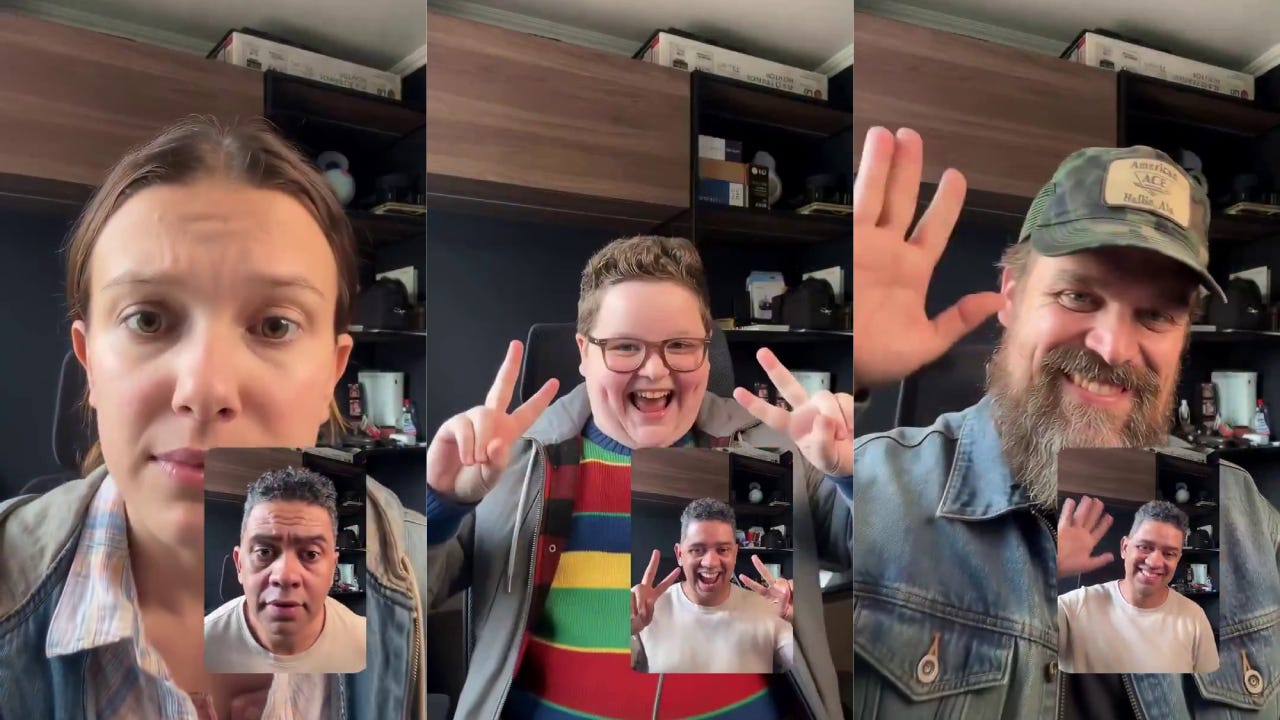
https://www.complex.com/pop-culture/a/alex-ocho/stranger-things-deepfake-videos-viral
The Line Between Tool and Being
And then there was the quieter merger. The merger that had already begun. Where tools were becoming extensions of our thought and then they had become hard to think without them. Every programmer reaching for Copilot, every doctor consulting an AI diagnostic, every lawyer running a contract through Claude. A step even further was from Neuralink. They would go on to successfully implanted first chip in a human patient in January 2024 and the person was able to control a cursor with only his thoughts. The horizon of Technological Singularity looks closer than it did, just even few years back.
We have spent two articles cataloguing what the machines can do. The list is long and it will only grow. Turing argued that Machines do not need to have a soul, but they have indeed become more human like in the years. They have essentially come half way towards a point of being “human-like” and we being in a symbiotic relationship with them, might move towards them as well? Is there going to be an equilibrium point or are we going to stand our ground?
That isn’t a limitation that engineering will fix on a timeline. It is the line between tool and being. And every question in this article from alignment, to governance, to arms races, to deepfakes, to the merger of mind and machine, sits on one side of that line or the other.
And before we close the series, there is one more story. A thought experiment posted on a rationalist forum in 2010 that was so unsettling the site’s founder deleted it within hours and banned all discussion of it for five years. It involves a superintelligent AI, a philosophical trap older than Pascal.
It was called Roko’s basilisk.
Up Next: AI 1.10 — Roko’s Basilisk and the Future of AI: An Epilogue to the Series
References and Further Reading
메타데이터
- post_id
- d6f1111be4d6
- slug
- ai-1-09-towards-technological-singularity-part-2-d6f1111be4d6
- url
- https://medium.com/the-ai-society/ai-1-09-towards-technological-singularity-part-2-d6f1111be4d6
- canonical_url
- https://medium.com/the-ai-society/ai-1-09-towards-technological-singularity-part-2-d6f1111be4d6
- author_url
- https://medium.com/@vishnukumarvh10
- status
- ok
- fetched_at
- 2026-06-12 18:14:10