When Microbes Aren’t So Micro
Written by Nicole Shteynberg
When Microbes Aren’t So Micro
Written by Nicole Shteynberg
What’s the first thing that comes to mind upon hearing the word “microbe”? Tiny, minute, microscopic — it’s in the name, after all. Ever since our elementary school lab experiments or demanding AP Biology high school courses, we’ve been ingrained with the idea that microbes are just that — microscopic. Yet, one discovery rattled this belief to its core: the bacterium Thiomargarita magnifica.
T. magnifica was discovered in 2022 by scientists studying mangrove ecosystems in Guadeloupe. These white, thread-like filaments were found on decaying mangrove leaves, and initially led scientists to believe they were simply an unassuming fungus or some multicellular organism, given their size (Conroy, 2022). Little did they know these bacteria would challenge long-standing assumptions about the limits to a bacterium’s size.
Most bacteria are 1–5 micrometers long. T. magnifica grows up to a whopping 1 centimeter, meaning it is thousands of times larger than typical bacteria and visible to the naked eye; in fact, it can grow to be as long as an eyelash. And despite its length, T. magnifica is still just one single bacterial cell (Volland & Gonzalez-Rizzo, 2022).
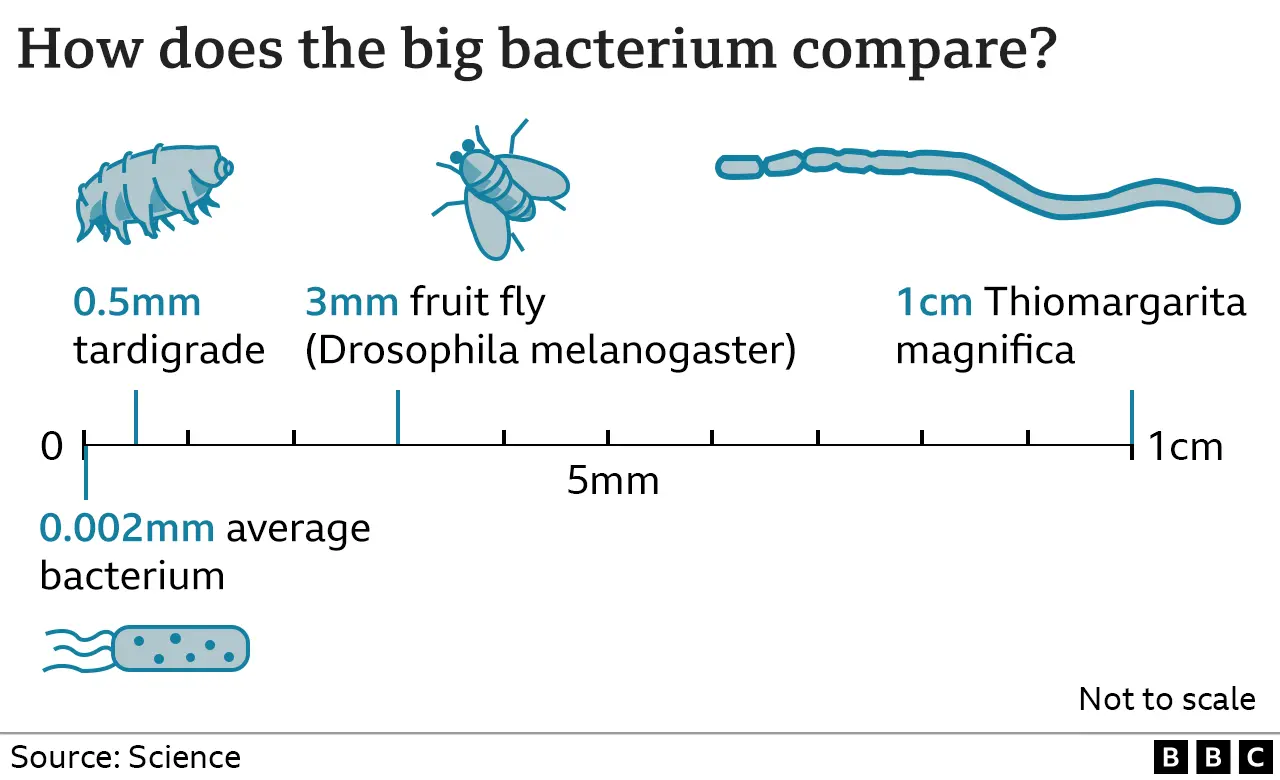
Not only is its length an outlier, but its structure is as well. Most bacteria tend to be simple cells where DNA floats freely inside the cytoplasm without any membrane-bound organelles. T. magnifica, however, is unusual given that its DNA is stored in membrane-bound compartments called “pepins” (Ashworth & Woyke, 2022). These pepins help organize the cell’s genetic material and play a role in allowing it to grow to such an extraordinary size.
The cell also contains a large internal vacuole that takes up most of the cell (Gamillo, 2022). This revolutionary structure is the solution to the problem that normally limits bacterial size. T. magnifica, our revolutionary hero, is a scientist in itself!
T. magnifica is extremely picky when it comes to its dwellings. This bacterium doesn’t use sunlight for nutrients; instead, it utilizes chemosynthesis (the process of oxidizing inorganic chemicals to create sugars), making it extremely specialized when it comes to housing choices.
Commonly found in shallow tropical marine mangrove swamps in Guadeloupe, it thrives on the surface of organic-rich, dark, reduced mud sediments that are devoid of oxygen. These chemosynthetic bacteria rely on an environment that provides a constant supply of sulfur compounds for energy, as they oxidize toxic sulfur compounds (such as hydrogen sulfide) to produce their everyday meal of carbohydrates (Ashworth & Woyke, 2022).
But in every dinner it consumes, T. magnifica is crucial to nutrient-cycling in mangrove ecosystems, especially in its speciality, the sulfur cycle. Acting as a natural chemical recycler, it stabilizes the ecosystem by converting toxic sulfur into safer compounds.
For centuries, scientists assumed bacteria had to be tiny and simple to survive. The discovery of T. magnifica shows that life remains unpredictable and can break the rules we thought were steadfast and unwavering. After all, even the smallest forms of life can still surprise us in the biggest ways.
References:
- Ashworth, J., & Woyke, T. (2022, June 23). The world’s largest bacteria are visible to the naked eye. Natural History Museum. Retrieved March 12, 2026, from https://www.nhm.ac.uk/discover/news/2022/june/worlds-largest-bacteria-are-visible-naked-eye.html
- Conroy, G. (2022, June 23). Largest-known bacterium found in mangrove — and you can see it without a microscope. ABC. Retrieved March 13, 2026, from https://www.abc.net.au/news/science/2022-06-24/largest-known-bacterium-discovered-caribbean-mangrove-swamp/101170176
- Erin, N., Mishra, S., Volland, J., & Tyml, T. (2022, June 23). Biggest bacterium ever discovered shakes our view of the single-celled world. National Geographic. Retrieved March 15, 2026, from https://www.nationalgeographic.com/science/article/biggest-bacterium-ever-discovered-shakes-our-view-of-the-single-celled-world
- Gamillo, E. (2022, June 24). World’s Largest Bacterium Discovered in Caribbean Mangrove Swamps. Smithsonian Magazine. Retrieved March 13, 2026, from https://www.smithsonianmag.com/smart-news/worlds-largest-bacterium-discovered-in-caribbean-mangrove-swamps-180980309/
- Sanderson, K. K. (2022, June 23). Largest bacterium ever found is surprisingly complex. Nature. Retrieved March 11, 2026, from https://www.nature.com/articles/d41586-022-01757-1
- Volland, J.-M., & Gonzalez-Rizzo, S. (2022, June 23). A centimeter-long bacterium with DNA contained in metabolically active, membrane-bound organelles. Science. Retrieved March 13, 2026, from A centimeter-long bacterium with DNA contained in metabolically active, membrane-bound organelles
메타데이터
- post_id
- d6f6a7c99ec7
- slug
- when-microbes-arent-so-micro-d6f6a7c99ec7
- url
- https://medium.com/@harvardmicrosociety/when-microbes-arent-so-micro-d6f6a7c99ec7
- canonical_url
- https://medium.com/@harvardmicrosociety/when-microbes-arent-so-micro-d6f6a7c99ec7
- author_url
- https://medium.com/@harvardmicrosociety
- status
- ok
- fetched_at
- 2026-06-09 15:37:30