A Night for the Children
A factual reimagining of wartime Topeka and the council meeting that saved Halloween.
A Night for the Children
A factual reimagining of wartime Topeka and the council meeting that saved Halloween.
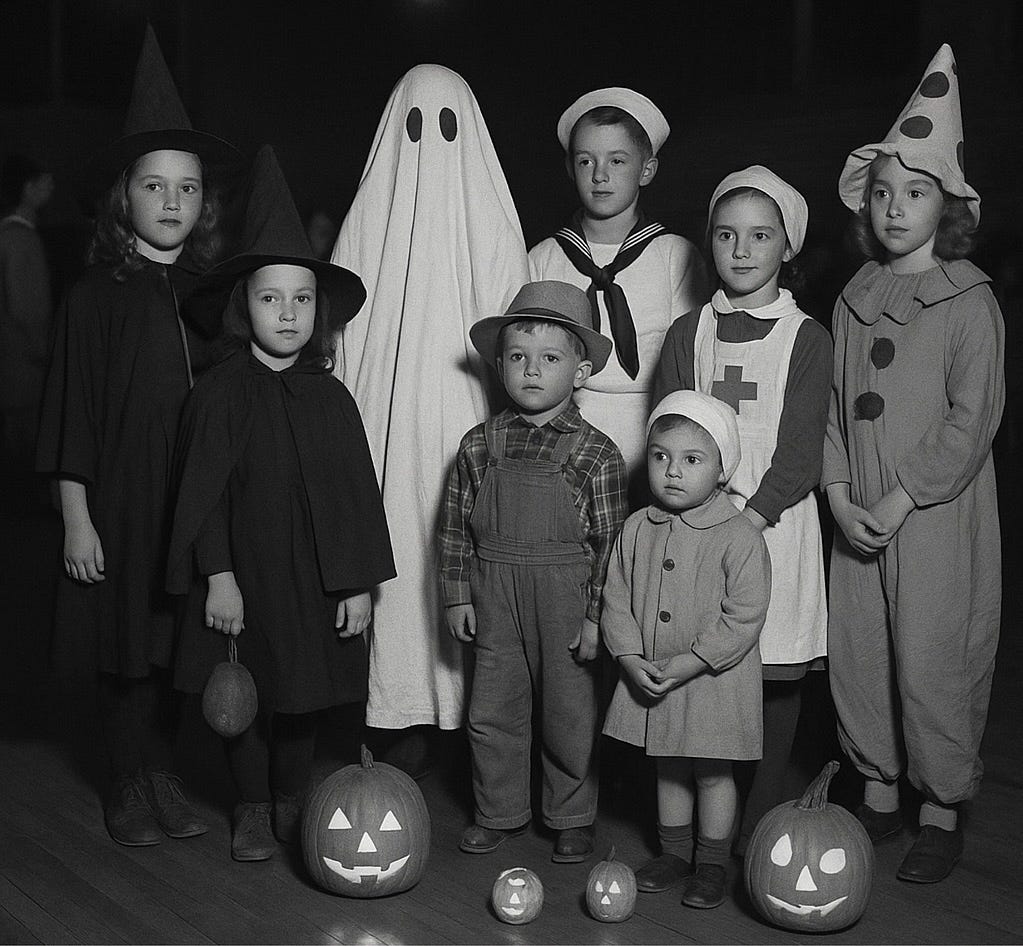
Halloween Children in Kansas, 1943, image by AI
Topeka, Kansas — October 1943
In the autumn of 1943, with the war’s shadow lying heavy across Kansas, one small city faced a question that touched both its conscience and its heart: should the children still be allowed to celebrate Halloween?
⸻
The City in Wartime
By October, Topeka, Kansas had the weary look of a city living under rationing and telegrams. The Santa Fe Railway yard never slept anymore — troop trains clattering through at every hour, whistles echoing off the stone front of the State Capitol. In the day’s last light the air shimmered with coal dust and prairie wind, the kind that whips old newspapers down Kansas Avenue like ghosts.
Gasoline and sugar were rationed, tires patched until the cords showed through, and everyone had a dog-eared ration book in a kitchen drawer. Housewives saved bacon grease in jars marked “for munitions.” Children collected tin foil, old keys, even flattened toothpaste tubes for scrap drives.
The Topeka Daily Capital printed lists every week under the headline “Our Boys in Service.” The roll of the dead and missing grew longer: Pvt. Henry Schlesinger, killed in Sicily. Sgt. Leonard Wise, missing in the Solomons. Lt. Robert McGinnis, presumed lost in the Pacific.
On Washburn Avenue, gold stars began to replace blue in the windows. At Highland Park High School, three desks sat empty with photographs taped on them — boys who’d gone straight from school to the Army and never come home.
The war’s presence was everywhere. The drone of planes from Forbes Field — B-29 bombers roamed the flat Kansas sky, dark wings glinting like iron bats in the fading light. The city’s streetlights were dimmed for blackouts. At radio hour, people gathered around Philco sets to hear Edward R. Murrow’s grave voice from London.
And yet, even in the middle of all that solemnity, another question had grabbed the city’s mind — an oddly small one, but fiercely debated:
Should Topeka allow Halloween?
It began with a letter published in the Topeka Daily Capital on October 15, signed only “A War Mother.” It read, in part: “Sir — my son lies in Tunisia. I cannot abide the waste of food and the mischief that mark Halloween. Let the children pray for peace instead of roaming the streets. The times demand sobriety.”
Within days, the paper was flooded with opinions. Some agreed. “We are at war,” they wrote. “Sugar should go to soldiers, not to children’s teeth.”
Others argued the opposite. “Our children live in fear already,” one teacher wrote. “If we deny them this small bit of joy, what have we left?”
The debate climbed from the kitchen tables to the churches, from the barbershops to the radio station on Tenth Street. Finally, Mayor Ralph Crandall, weary from ration-board hearings and war-bond campaigns, called a special City Council meeting for Friday, October 22, to decide the matter once and for all.
⸻
The Meeting at City Hall
That night the Kansas wind blew cold and dry off the Flint Hills. Coal smoke hung low over the river. Inside City Hall, the council chamber filled beyond capacity — mothers, preachers, soldiers’ widows, teachers, and a handful of restless boys who’d come just to see a fight.
The radiator hissed. The mayor’s gavel struck the table. Behind him hung a service flag with fifty-seven blue stars and nine gold. Someone had tied a black ribbon for Captain Edward Langley, a councilman’s son shot down over the Adriatic that spring.
Mayor Crandall put down his cherished fancy carved meerschaum pipe and coughed to clear his throat then spoke, “Friends, we are here to decide whether Halloween shall be permitted this year. You all know what’s at stake. The war has cost us dearly. Our resources are limited, our manpower stretched thin. We can’t risk vandalism, waste, or disorder. Now, let’s hear your thoughts.”
The first speaker was Mrs. Alma Drayton, whose son, Harry, was fighting with the 36th Infantry in Italy. Her voice shook, and her hands trembled as she spoke, her words barely above a whisper. “If Harry could see boys throwing eggs and soaping windows while he’s sleeping in a foxhole, he’d be ashamed of this town. I say we call off Halloween. Let the children stay home and pray for peace.”
A few murmurs of “Amen” rippled through the crowd.
Fire Chief Wallace Bixby stood next. “Last year we had two fires — a big barn and a trash heap behind the filling station. We can’t spare the trucks or men this year. Half the volunteers are at Camp Funston.”
Then came Reverend Luke Caffey of First Baptist — a tall man with a booming voice, clutching a heavy leather-bound Bible whose cover was softened and scored by years of use. “This so-called Halloween is a pagan relic!” he thundered. “A night of witchcraft, born in heathen Europe, where Druids danced around fires and called up spirits. No Christian city at war with evil should encourage such a thing. It is the Devil’s holiday!”
Applause followed. Even the mayor nodded gravely.
From the old Methodist pastor came more temperate words, but the same conclusion. “Perhaps a patriotic substitution — a Victory Rally instead, a hymn sing, maybe.”
The superintendent of schools agreed, offering to host such an event in the high-school gymnasium.
For nearly an hour, one voice after another rose to condemn Halloween. It seemed the ban would pass without contest — until a quiet, almost apologetic voice from the second row said, “Mr. Mayor, may I be heard?”
The speaker was Reverend Joseph L. Danner of First Presbyterian on Huntoon Street. A small man with silver hair and mild blue eyes, he had served as a chaplain in France during the last war. He was not known for thunder, but for kindness.
“Go ahead, Reverend,” said the mayor.
Danner rose, “Friends, I respect the grief in this room. I share it. But I must ask — what shall we do with the children’s laughter? Shall we ration it, too?”
He looked around the chamber. “We call Halloween pagan, and that it once was. But it has come a long way across the centuries. In Ireland — where my grandfather was born — they hollowed out turnips and placed candles inside to light their way through the dark of Samhain, the old Celtic year’s end. When they came to America, they found the pumpkin — larger, brighter, easier to carve — and they made it their own. That is how old fears became new fun.”
A few in the crowd smiled faintly.
“The Church renamed it All Hallows’ Eve,” Danner went on, “the night before the feast of all saints. Its meaning became remembrance, not rebellion. And I would remind you, friends, that remembrance is sacred — especially in wartime.”
He paused, his voice soft but steady.
“Some of these children live each day with words they scarcely understand — missing in action, war bonds, ration book. Some have fathers taken by the war, and brothers they may never see again. They’ve given up sugar, gasoline, and new shoes without complaint. If, for one night, they can dress in costume, knock on doors, and laugh in the dark — shall we deny them that mercy?”
He took off his spectacles and folded them. “We cannot bring back the boys we’ve lost, but we can keep the world they loved alive a little longer. That, too, is a kind of faith.”
When he sat down, the chamber was silent except for the faint sound of a train whistle from the yards below.
⸻
A Compromise for Wartime
Mayor Crandall rubbed his forehead. “Well,” he said finally, “I reckon no one can argue with that.”
Miss Ethel Greene, a teacher from Lafayette Elementary, stood and offered a compromise. “Let’s hold a community carnival in the high-school gym — costumes, games, apple-bobbing, but all supervised. Let the children trick-or-treat from six to nine, no later. Curfew at nine sharp.”
The police chief nodded. “We can manage that, long as no one’s lighting fires.”
“Not even in turnips?” muttered Fire Chief Bixby, and a ripple of laughter broke the tension.
The motion passed unanimously.
The next morning’s Topeka Daily Capital carried the headline:
TOPEKA TO KEEP HALLOWE’EN — CURFEW SET, CELEBRATION TO HAVE VICTORY THEME.
The editorial beneath read: “In a time of sorrow, laughter may be the truest act of courage.”
⸻
Halloween Night, 1943
The evening of October 31st came cold and clear, a bright moon rising over the Capitol dome. The wind carried the scent of burning leaves and the far-off hum of B-29s training out of Forbes Field.
Porch lights flickered on across Potwin and North Topeka. Housewives who’d saved sugar coupons for weeks made popcorn balls, molasses taffy, and hard candies wrapped in wax paper. Others gave apples, paper flags, or even ration-stamp booklets with a single “meat point” as a treat.
Children filled the sidewalks — ghosts, sailors, hobos, witches, and miniature soldiers. Costumes were homemade from feed sacks and flour bags. Some families of Irish descent proudly lit candles inside turnips, the old way, setting them beside the new American pumpkins.
“Trick or Treat for Victory!” the children shouted, echoing down the streets.
Even Mrs. Drayton, who had once called for a ban, stood on her porch handing out popcorn. “For Harry’s sake,” she murmured. “Let them laugh.”
The city was alive with laughter — something rare that year.
At the high-school gym, Miss Greene and the PTA held a “Victory Halloween” carnival. The band played “Boogie Woogie Bugle Boy.” Children bobbed for apples floating in tin wash tubs. The mayor himself judged the costume contest. Reverend Danner came late, smiling at the sight. “If heaven keeps record of small mercies,” he said, “this night will count.”
By nine o’clock, the streets were quiet again. The curfew held. No barns burned, no windows broke. The fire chief declared it the most peaceful Halloween in memory.
That same night, a telegram came to Polk Street.
PVT. HENRY SCHLESINGER — KILLED IN ACTION, ITALY.
His parents sat on the porch, unable to speak. In their window, a small jack-o’-lantern burned low, its candle flickering as if in farewell.
Reverend Danner came to sit with them awhile. “He’d be proud,” Mrs. Schlesinger whispered. “The children sounded so happy tonight. I almost felt — well, I almost felt it was peace again.”
The minister nodded. “Perhaps it was,” he said.
Outside, a freight train clattered east toward the dawn, carrying young men in uniforms who had once gone trick-or-treating themselves.
⸻
Two Years Later
The war ended in August 1945. The bells of every church in Topeka rang for half an hour straight. Crowds gathered along Kansas Avenue waving flags, throwing confetti made from ration cards. At Forbes Field, the B-29 crews who had trained above the plains now came home with medals — or didn’t come home at all.
In the basement of First Presbyterian, Reverend Danner read aloud the names of the dead — fifty-seven boys from Topeka. Their photographs hung in a frame by the door. “They will not return,” he said, “but what they fought for must.”
When Halloween came that autumn, it seemed a different world. The war was over, but its shadow still lingered. The city held its celebration again — no curfew this time. On the courthouse lawn, the American Legion sponsored a costume parade. The younger children carried lanterns; the older ones pushed wagons decorated like bombers and Liberty ships.
As dusk fell, candles flickered in hundreds of pumpkins — and in a few proud turnips, carved by families who remembered the old ways. The mayor, now with gray at his temples, told the newspaper, “We kept the lights burning through the darkest years. That’s something to remember.”
And on that evening, as the children laughed and the wind stirred the flags over the Capitol dome, Topeka once more belonged to them — to their small voices, their fleeting joy, their fragile belief that light could outlast war.
⸻
Epilogue
Every October since, the city has kept a quiet tradition. At Highland Park High, where the bronze plaque bears the names of its fallen, candles are placed beside it on Halloween night — some in pumpkins, some in turnips.
And if you stand outside the old council chamber and listen close, when the wind runs east from the Kaw, you can almost hear the laughter that once rose up from those war-darkened streets — a sound as pure and brief as hope itself.
⸻
메타데이터
- post_id
- d70510c35f4d
- slug
- a-night-for-the-children-d70510c35f4d
- url
- https://medium.com/@jchjcck/a-night-for-the-children-d70510c35f4d
- canonical_url
- https://medium.com/@jchjcck/a-night-for-the-children-d70510c35f4d
- author_url
- https://medium.com/@jchjcck
- status
- ok
- fetched_at
- 2026-06-24 11:06:28






