I’ve Tried Six Subscription Trackers. Most of Them Are Lying to You.
Not maliciously. But the gap between what they promise and what they deliver is wide enough to lose real money in.
I’ve Tried Six Subscription Trackers. Most of Them Are Lying to You.
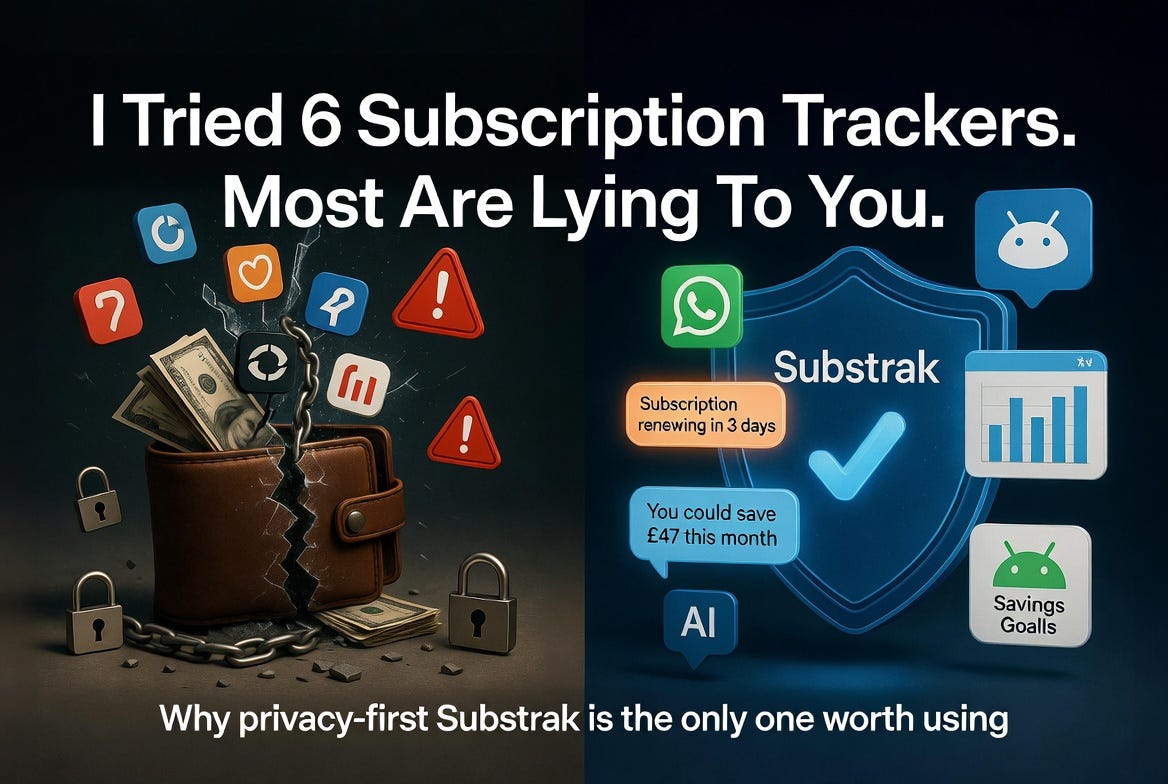
Not maliciously. But the gap between what they promise and what they deliver is wide enough to lose real money in.
Let me tell you exactly how I ended up testing six subscription management apps in the span of three months.
It started with a £12.99 charge on my bank statement I couldn’t place. Turned out it was a language learning app I’d downloaded the previous January, used for about eleven days, and completely forgotten about. Twelve pounds a month. For nearly a year.
That’s £143. Gone.
I’m not unusual. Studies consistently show people underestimate their subscription count by nearly half — and that’s before you factor in the annual plans that only show up once, the family plan someone else manages, the free trials you never actually cancelled.
So I went looking for a proper solution. Here’s what I found.
The bank sync trap
The dominant model in subscription tracking right now is: connect your bank, let us scan your transactions, we’ll find everything.
It works. Rocket Money, PocketGuard, Copilot Money — they’re genuinely good at finding subscriptions you forgot. The detection accuracy is real.
But there’s a cost most people don’t think about until after they’ve signed up.
When you connect your bank via Plaid or a similar aggregator, you’re not just giving the app read access to your transactions. You’re inserting a third party into your financial data chain. That aggregator has its own privacy policy. Its own data sharing agreements. Its own breach surface.
For users in the UK or Europe, where expectations around financial data are shaped by years of GDPR enforcement, this is not a theoretical concern. It’s a reason a lot of people bounce off these apps within the first week — they get to the “connect your bank” screen and close the app.
The apps that require bank sync don’t talk about this much. Because their entire product depends on you saying yes.
What I actually wanted
I didn’t need an app to detect my subscriptions. I know what I’m subscribed to — I just needed help organising them, getting reminded before renewals, and understanding where my money was actually going across the month.
I wanted intelligence, not surveillance.
That’s a harder product to build. Most apps don’t bother because bank sync is the path of least resistance — it makes onboarding feel magical and forgives a lot of user laziness.
Substrak is one of the few apps that took the harder path.
What Substrak does differently
It’s a privacy-first money manager. No bank sync required — you build your financial picture manually or let the AI extract subscriptions from documents and receipts. Your data stays on your device.
That sounds like a limitation until you realise most people’s frustration with finance apps isn’t detection — it’s the ongoing experience. The daily usefulness. The moments where an app either earns its place in your routine or doesn’t.
Three things made Substrak earn it for me.
The WhatsApp reminders. I know this sounds minor. It isn’t. Push notifications get dismissed. WhatsApp messages get read. Getting a renewal reminder through the app I check without thinking is a fundamentally different experience from a notification I swipe away at 7am. Substrak is the only tracker I’ve seen that delivers reminders this way — and it’s an obvious idea that somehow nobody else implemented.
The AI Copilot. Not just subscription detection — a conversational budget layer that surfaces insight on demand. Ask it where your money went last month. Ask it what you could cut. It doesn’t present you with a dashboard and expect you to interpret it; it interprets it for you. This is the feature that separates a tracker from a financial companion.
The scope. Substrak handles subscriptions, daily expenses, income, and savings goals. That’s a complete financial picture, not a single-use utility. Apps that do one thing narrowly get uninstalled. Apps that fit into your actual financial life get used.
The honest comparison
Here’s what the market actually looks like right now:
Rocket Money is powerful but takes a cut of negotiated savings and requires bank access. It’s also US-focused — if you’re not on American banking infrastructure, you’ll feel the friction immediately.
YNAB is a methodology, not just an app. If you’re willing to commit to zero-based budgeting and pay $14.99/month for the privilege, it’s excellent. Most people aren’t and don’t.
Copilot Money is genuinely beautiful and AI-smart — but it’s iOS and Mac only. Android users, which represent the majority of the global smartphone market, don’t exist in Copilot’s world.
Bobby and Tilla are honest manual trackers. No intelligence, no insight, no AI layer. Fine if you want a list. Not fine if you want your finances to actually improve.
ReSubs is the closest comparison to Substrak — privacy-first, no bank sync, solid feature set. But it doesn’t have an AI Copilot, doesn’t have WhatsApp reminders, and positions itself primarily as a subscription tracker rather than a full budgeting tool.
Substrak is the only option in this market that combines genuine AI intelligence, privacy-first architecture, WhatsApp-native reminders, full budgeting scope, Android support, and a free tier.
That’s not a small gap. That’s a different product category.
Who this is actually for
I’ll be direct about where Substrak fits.
If you want automatic detection and don’t mind bank sync — Rocket Money or Copilot Money will do that better. Automation has real value if you genuinely don’t know what you’re subscribed to.
But if you’re someone who values knowing where your financial data goes, who’s tired of being an iOS-only second-class citizen in the finance app market, who wants budget insight without a complete methodology overhaul, or who’s outside the US and exhausted by apps that treat international users as afterthoughts — Substrak is a direct answer to all of that.
It’s free to download on Android. Setup is fast. The AI Copilot starts being useful within the first session.
Sometimes the most useful thing isn’t the most automatic thing. It’s the thing that actually fits the life you have.
Content strategy and SEO by EEATEngine — automated content marketing for businesses that take organic seriously.
메타데이터
- post_id
- d72beeaefe96
- slug
- ive-tried-six-subscription-trackers-most-of-them-are-lying-to-you-d72beeaefe96
- url
- https://medium.com/@eeatengine/ive-tried-six-subscription-trackers-most-of-them-are-lying-to-you-d72beeaefe96
- canonical_url
- https://medium.com/@eeatengine/ive-tried-six-subscription-trackers-most-of-them-are-lying-to-you-d72beeaefe96
- author_url
- https://medium.com/@eeatengine
- status
- ok
- fetched_at
- 2026-07-09 06:11:55