Optimizing Speech Pipelines Using Voice Activity Detection
Introduction
Optimizing Speech Pipelines Using Voice Activity Detection
Introduction
While building a speech-to-speech pipeline, I needed a way to make the system behave more intelligently during real-time audio processing.
The requirement was simple:
- Continuously listen to incoming audio
- Detect when the user is speaking
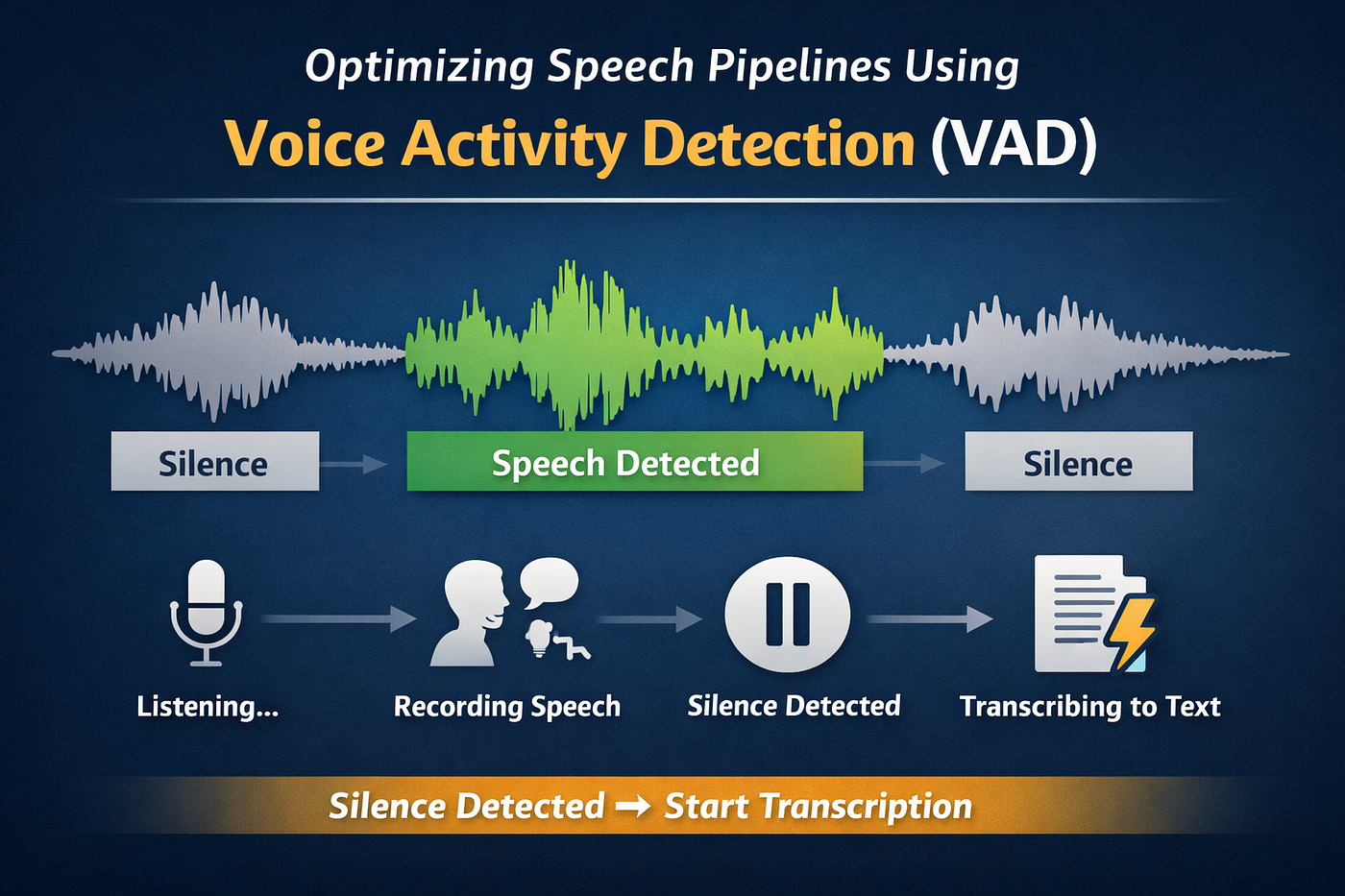
- And as soon as silence is detected, stop listening and start transcribing the captured speech
However, handling this logic wasn’t straightforward. Audio streams naturally contain pauses, and without a proper mechanism, the system either kept listening for too long or triggered transcription at the wrong time.
To solve this, I explored Voice Activity Detection (VAD).
VAD allowed me to precisely detect speech boundaries — when speech starts and when it ends. This made it possible to:
- Listen only during active speech
- Automatically stop when silence occurs
- Trigger transcription at the right moment
This small addition significantly improved the responsiveness and efficiency of my pipeline.
In this blog, I’ll walk through how I implemented this using:
- WebRTC VAD
- Silero VAD
- Pyannote Audio
with simple Python examples.
What is Voice Activity Detection (VAD)?
Voice Activity Detection (VAD) is a technique used to identify whether an audio signal contains human speech or silence. Instead of processing the entire audio continuously, VAD helps segment it into meaningful parts — detecting when speech starts and when it ends. This makes it easier to focus only on the relevant portions of audio where actual communication happens.
In a real-time pipeline like mine, VAD plays a key role as a trigger mechanism. The system continuously listens while speech is detected, and as soon as silence occurs, it stops recording and immediately starts transcribing the captured speech. This ensures efficient processing, reduces unnecessary computation, and improves the overall responsiveness of the system.
As part of my research, I identified three effective tools for implementing Voice Activity Detection: Silero VAD, WebRTC VAD, and Pyannote Audio. Each tool brings its own strengths, from lightweight real-time processing to advanced deep learning capabilities. In this blog, I’ll explore these approaches and demonstrate how they can be applied in real-world speech pipelines.
WebRTC VAD (Fast & Lightweight)
WebRTC VAD is a widely used voice activity detection tool known for its speed and efficiency. It is designed to process audio in small frames and classify each frame as either speech or silence.
Because of its lightweight nature and low latency, it is well-suited for applications that require real-time audio processing.
How It Works
WebRTC VAD splits audio into short frames (typically 10–30 ms) and applies signal processing techniques to determine whether each frame contains speech. Based on this, it continuously labels segments as speech or silence.
Python Example
import webrtcvad
import wave

vad = webrtcvad.Vad(2)  # Aggressiveness: 0 (low) to 3 (high)

def read_wave(path):
    with wave.open(path, 'rb') as wf:
        return wf.readframes(wf.getnframes()), wf.getframerate()

audio, sample_rate = read_wave("audio.wav")

frame_duration = 30  # ms
frame_size = int(sample_rate * frame_duration / 1000) * 2

for i in range(0, len(audio), frame_size):
    frame = audio[i:i+frame_size]
    if len(frame) < frame_size:
        break

    is_speech = vad.is_speech(frame, sample_rate)
    print("Speech" if is_speech else "Silence")
Key Points
- ⚡ Very fast and low latency
- 🪶 Lightweight and CPU-efficient
- 🎯 Works well for basic speech/silence detection
- ⚠️ Performance may drop in noisy environments
Silero VAD (Deep Learning-Based & Accurate)
Silero VAD is a deep learning-based voice activity detection model that provides higher accuracy compared to traditional approaches like WebRTC VAD.
It uses a trained neural network to analyze audio patterns, making it more robust in handling background noise, variations in speech, and real-world audio conditions.
How It Works
Instead of relying only on signal processing, Silero VAD uses a pre-trained neural network model to detect speech. It processes the audio and returns timestamps indicating where speech is present.
This makes it more reliable for detecting speech boundaries, especially in complex audio environments.
Python Example
import torch
torchaudio = __import__("torchaudio")

model, utils = torch.hub.load(
    repo_or_dir='snakers4/silero-vad',
    model='silero_vad',
    force_reload=False
)

(get_speech_timestamps, _, read_audio, _, _) = utils

wav = read_audio('audio.wav', sampling_rate=16000)

speech_timestamps = get_speech_timestamps(wav, model)

print(speech_timestamps)
Key Points
- 🎯 High accuracy compared to traditional VAD
- 🤖 Deep learning-based approach
- 🔊 Performs well in noisy environments
- ⚖️ Slightly heavier than WebRTC VAD
Pyannote Audio
Pyannote Audio is a powerful deep learning toolkit designed for advanced audio processing tasks such as voice activity detection, speaker diarization, and speech segmentation.
Unlike simpler VAD tools, Pyannote provides highly accurate results and is often used in production-grade systems where understanding speech structure is important.
How It Works
Pyannote uses pre-trained deep learning models to analyze audio and generate a timeline of speech segments. It can not only detect speech but also structure it in a way that can be extended to identify who is speaking and when.
This makes it especially useful for complex audio pipelines.
Python Example
from pyannote.audio import Pipeline

pipeline = Pipeline.from_pretrained(
    "pyannote/voice-activity-detection",
    use_auth_token="YOUR_HF_TOKEN"
)

vad = pipeline("audio.wav")

for speech in vad.get_timeline().support():
    print(speech.start, speech.end)
Key Points
- 🧠 Very high accuracy
- 🧩 Supports advanced tasks like speaker diarization
- 🏭 Suitable for production-level systems
- ⚖️ Heavier and more complex to set up

Conclusion
Voice Activity Detection plays a crucial role in building efficient speech processing systems, especially when you want to intelligently trigger actions based on silence or speech.
In this blog, we explored three different approaches:
- WebRTC VAD — lightweight, fast, and ideal for real-time applications
- Silero VAD — deep learning-based, offering better accuracy and noise handling
- Pyannote Audio — advanced and highly accurate, suitable for complex and production-level pipelines
Each tool comes with its own trade-offs in terms of speed, accuracy, and complexity. The right choice ultimately depends on your specific requirements — whether you prioritize real-time performance, robustness in noisy environments, or advanced speech analysis capabilities.
Understanding these tools gives you the flexibility to design more efficient and responsive audio pipelines, especially in applications like transcription, voice assistants, and streaming systems.
메타데이터
- post_id
- d7323e53178e
- slug
- optimizing-speech-pipelines-using-voice-activity-detection-d7323e53178e
- url
- https://medium.com/@dhanam2k03/optimizing-speech-pipelines-using-voice-activity-detection-d7323e53178e
- canonical_url
- https://medium.com/@dhanam2k03/optimizing-speech-pipelines-using-voice-activity-detection-d7323e53178e
- author_url
- https://medium.com/@dhanam2k03
- status
- ok
- fetched_at
- 2026-06-14 11:28:49




