Research Reciprocity: Amplifying Black Teachers as Scholars AND Practitioners
Ed.D. Programs as platform to amplify Teachers in education research
Research Reciprocity: Amplifying Black Teachers as Scholars AND Practitioners
Ed.D. Programs as platform to amplify Teachers in education research
Centering the voices of our classroom teachers has become even more crucial for educational researchers as they look to capture, analyze and reimagine new ways of supporting students in the classroom by amplifying the experience of their teachers. One unique space where this can happen in a variety of ways is through education doctoral programs (Ed.D). While there are many successful Doctor of Philosophy (Ph.D.) programs that engage in educational research, those pursuing an Ed.D. look to use existing knowledge to solve problems while leveraging as well as operationalizing theoretical frameworks and concepts in pragmatic ways. While the majority of those who choose to pursue educational doctorates are not classroom teachers, those that are, are given an opportunity to make direct impacts to their space as “scholarly practitioners”. This unique context of being both a researcher and teacher allows them to utilize their work setting as a laboratory of practice (Perry, 2012). As scholarly practitioners, their approach is that learning and practice occur at the same time, with ongoing interchange between intentional reflection, risk-taking, and new meaning making.
Reciprocity in “Scholarly Practitioner” Teacher Research AND Faculty Research
These teachers who have chosen to immerse themselves as well as their work environment, into a research context, can benefit from strategic collaboration with their program’s faculty as a way to amplify the work of the classroom teacher but also center faculty research around the authentic experience of teaching in a variety of school settings. As a faculty member and director of an educational doctorate program, I have had the honor of working firsthand with teachers entering this new identity as a scholarly practitioner and benefited in my own research by immersing myself in their experience as a teacher.
Program faculty in doctoral programs play a crucial role in guiding scholarly practitioners through the research process, and one of the most impactful ways they can support their students is by visiting their work environment as a potential site for the teacher’s research as well as the faculty researcher. This creates a reciprocal opportunity for faculty to gain real-time knowledge on the challenges and successes of classroom teachers that faculty can apply to support the doctoral student and to contextualize their own educational research. My current research looks at ways to center the indigenous knowledge from West African Adinkra symbols as educational epistemology to integrate motivation theory in teacher instructional practices. Self-Determination Theory (Ryan & Dec, 2018) and frameworks related to culturally responsive teaching and the brain (Hammond, 2014) anchor the research in developing ways teachers can intentionally reflect on their motivation as well as their students’ motivation when planning and implementing culturally relevant learning experiences. While I have had experience teaching in K-12 classrooms, my current six-year distance from the day to day grind of lesson plans, parent teacher conferences and professional learning communities has caused a level of humility as an educational researcher looking to develop useful practices for classroom teachers.
Faculty Immersion experience with a Special Education Teacher in a DC Public School
One doctoral student, who was also a Special Education teacher in a D.C. Public school, allowed me to shadow her for a day and gain valuable insight on her school’s culture and how receptive the school would be to antiracist interventions related to social and emotional learning. In addition, I was even introduced to a student that I would later informally mentor while he matriculated through middle school.
My presence alone supported the amplification of the teacher’s research and showed the community of support the teacher had in bringing her research into reality. The important bond and trust that was developed created an environment where the teacher was willing and genuinely interested in participating in my research centered around culturally responsive lesson planning and agreed to co-write an article to help communicate her authentic experience as a teacher with lesson preparation and implementation. In describing her experience with the lesson planning prototype, she explained that “the utilization of the Lesson Internalization tool in the collaborative planning of a lesson with both a first year general educator proved to be valuable in various ways. Initially, it facilitated a clear understanding of the general educator’s objectives for the lesson, encompassing both the teacher and students’ goals, along with the sequential order of activities to achieve those objectives. This understanding not only enabled me to grasp the overall lesson structure but also offered insights into how I could provide effective support for students with disabilities. I was able to proactively prepare necessary aids before the lesson, such as reviewing vocabulary, crafting sentence starters, and previewing the text.” In addition, we also were able to present her experience with the lesson planning tool at a literacy conference at the University of Pennsylvania, further amplifying this DC public school teacher’s voice in research.
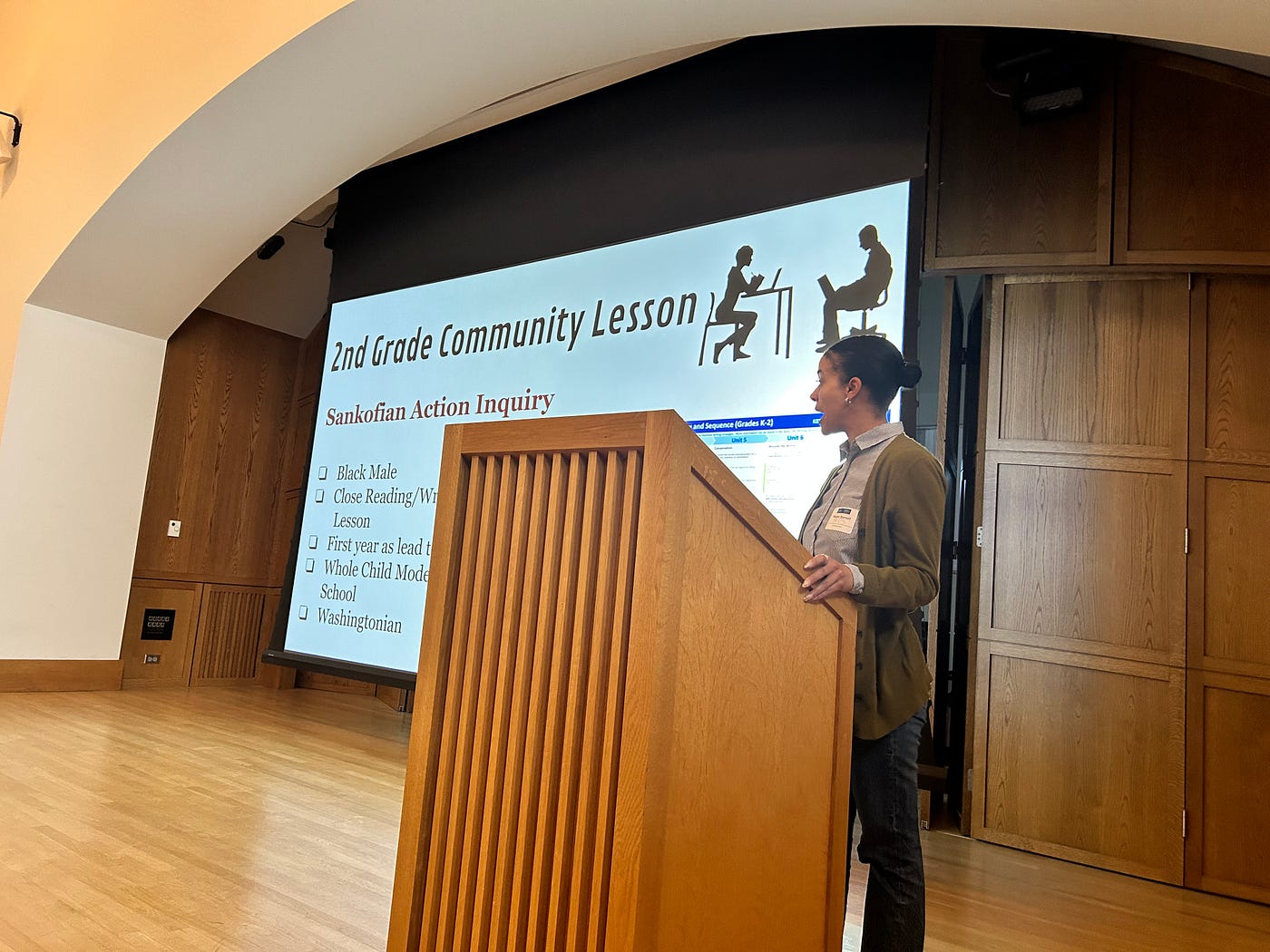
Dr. Magen Barnett, DCPS Special Education Teacher co-presenting at the University of Pennsylvania while a doctoral student while attending American University in 2023.
While this choice may expose faculty who are educational researchers, to vulnerabilities, such as confronting their own biases and assumptions or navigating unfamiliar environments, it also presents an invaluable opportunity to gain firsthand insight into the nuanced aspects of the teacher’s work experience. By witnessing the challenges and dynamics of the potential research site, faculty can provide more tailored and empathetic guidance, ultimately enhancing the quality and relevance of the dissertation research experience. This hands-on involvement demonstrates a deep commitment to the work of teachers and reinforces the importance of context in producing meaningful data for faculty who are educational researchers.
Faculty Immersion experience with a Fourth Grade Teacher in a Maryland Private School
Another doctoral student, who taught fourth grade at a private school in Potomac, Maryland, allowed me to observe her school which led to me being invited to present my research to her colleagues at a staff meeting. Not only was I able to help affirm her new identity as a scholarly practitioner to her school community but also was able to gather firsthand experience of an entire elementary school staff applying a portion of the lesson plan prototype from my research. After the professional learning experience, one teacher emailed me, expressing appreciation for “the way you explained semiotics and Sankofian Memory Paths was fascinating — it really opened my eyes to a whole new way of thinking about how we connect with and preserve our cultural stories.” In addition, the elementary school principal also described the impact it had on her and how she plans on supporting teachers in her leadership practices saying, “my sincere gratitude for your enlightening presentation on the Sankofian Approach and its application to reflective practice. The framework you shared has already begun to transform how I think about professional reflection. I was particularly moved by the conversations that emerged among our teachers as they engaged with your instructional delivery reflection tool. Their discussions demonstrated the immediate impact and practical value of your framework. The four-lens approach you presented — adjust, amplify, adopt, and abandon — offers a clear and comprehensive structure for meaningful reflection that I hadn’t considered before. While I’ve always been an advocate for reflective practice, your tool provides a fresh perspective that will undoubtedly enhance my own professional development. The systematic nature of the framework, combined with its flexibility, makes it both practical and powerful.”

Dr. Thomas visiting a fourth grade class at the Bullis School in Potomac, Maryland.
Overall benefits to Immersive experiences with Teachers for Ed.D. program faculty researching education
This active engagement approach mirrors the practice of teachers performing home visits to better understand the context in which their students live and learn. Just as home visits can reveal critical information about a student’s background, challenges, and support systems, faculty visiting teacher classrooms can uncover unique perspectives that are not always apparent through data and written reports. Such visits allow faculty who are educational researchers to observe the interactions, environments, and cultural contexts that influence teachers, leading to more informed and contextually grounded advice for the budding researcher and reflections for the faculty’s own research. This deeper understanding can help identify potential barriers and opportunities that may otherwise be overlooked, enabling the scholarly practitioner to refine their methodology and approach in ways that are more aligned with the realities of their teaching ecosystem.
Adopting this approach centers Black Teachers’ voices as counternarratives to the many assumptions educational researchers can have when gathering legitimate qualitative data in school settings. It also emphasizes and models for the scholarly practitioner teachers transparency, authenticity, and strategic support in the research process. By engaging directly with the teacher’s work space, faculty model a commitment to understanding and addressing the systemic inequities that may impact the research subjects and settings. This proactive stance encourages doctoral students to be more critical and reflective in their work, fostering research by Black Teachers and about Black Teachers that is not only academically rigorous but also socially just.
References
Hammond, Z. (2014). Culturally responsive teaching and the brain: Promoting Authentic Engagement and Rigor Among Culturally and Linguistically Diverse Students. Corwin Press.
Perry, J. A. (2012). To Ed.D or not to Ed.D? Phi Delta Kappan. 94(1), 41–44.
Ryan, R., & Deci, E. L. (2018). Self-Determination Theory: Basic Psychological Needs in Motivation, Development, and Wellness. Guilford Publications.
메타데이터
- post_id
- d732eb502edc
- slug
- research-reciprocity-amplifying-black-teachers-as-scholars-and-practitioners-d732eb502edc
- url
- https://medium.com/@glyphgraf/research-reciprocity-amplifying-black-teachers-as-scholars-and-practitioners-d732eb502edc
- canonical_url
- https://medium.com/@glyphgraf/research-reciprocity-amplifying-black-teachers-as-scholars-and-practitioners-d732eb502edc
- author_url
- https://medium.com/@glyphgraf
- status
- ok
- fetched_at
- 2026-08-08 07:09:42





