11,000 Secret Words Leaked. Open Source Was Winning. They Attacked Brutally.
The leaked memo had been printed for the third-ranking executive in the building, behind Gates and Ballmer. Every prediction in it came…
11,000 Secret Words Leaked. Open Source Was Winning. They Attacked Brutally.
The leaked memo had been printed for the third-ranking executive in the building, behind Gates and Ballmer. Every prediction in it came true.

Left to Right: Bill Gates and Linus Torvalds. The first time they met in 2025. Image credit: Mark Russinovich on LinkedIn
In public, a shrug. In private, an alarm.
For years, the company told reporters the same thing. Linux was a hobby project. Free software was something students played with on weekends.
Real businesses ran real software, and real software came with a license and a phone number.
That was the public position.
Behind those same walls, one of the analysts who briefed the company’s most senior executives was typing the opposite. The hobby project was not a hobby, and it was not losing. On servers, Linux was beating the company’s products on merit, built by thousands of volunteers improving the same code for free, faster than any payroll could ever match.
The memo slipped out of the building near the end of October 1998. It was headed straight for the one person outside the company who could turn it into a weapon.
The company did not yet know the memo had leaked. Its lawyers were standing in a federal courtroom in Washington, fighting the Department of Justice for the firm’s survival, their whole attention fixed on the different threat.
Outside the courthouse, Washington was dry and mild, one of the driest late Octobers the city had on record.
But the storm was coming… A memo, already loose, about to make the week much worse.
11,000 Words, Two Readers
The memo was written in fine weather. Nearly three months before the memo broke, Redmond was deep in the dry summer the Pacific Northwest waits all year for. On August 11, 1998, a Microsoft technical assistant named Vinod Valloppillil completed an internal assessment of the threat posed by Linux and the broader open-source and free-software movement.
Valloppillil had spent two years as a lead program manager, running a thirty-person team, before moving in March 1998 onto the executive staff of the Personal and Business Systems Group. He was one of four people picked for that fast track. The work fed strategic and technical analysis to the most senior people in the building, including Bill Gates, Steve Ballmer, and Jim Allchin.
This report was not his idea. By one account, senior vice president Jim Allchin had asked for it. What the document itself records is where it went: the final revision note reads “printed copies for PaulMa review,” meaning Paul Maritz, group vice president of platforms and applications and the third-ranking executive in the company, behind Gates and Ballmer.
It ran to roughly 11,000 words of internal strategy, written for leadership. In public, the company called Linux a harmless hobby. In this memo, the same company called it a serious threat that was already winning.
The memo may have been meant for Bill Gates himself. Whether he actually read it is not clear, and nothing on record confirms it.
It stated plainly that open source software, with Linux at the forefront, was technically competitive with Microsoft’s own products, especially on servers. It said this was true now, not a risk for some later year.
The assessment also described how the open source process could attract large numbers of volunteer programmers and move them quickly around a shared codebase. It admitted that Microsoft’s own developer evangelism scaled far more slowly.
Microsoft could hire the best programmers in the world and still be outnumbered by volunteers who worked for free.
This was a confidential internal document, meant for a few executives. By the end of October, the open source world had the full memo and was reading every page.
De-commoditize the Protocols
The memo laid out a plan for open standards. Adopt the open protocol everyone already uses. Extend it with your own additions. Over time, the pure open version falls behind, because the features people want only work if everyone runs your extended version.
It played out exactly this way inside mixed Windows and Linux networks through the years that followed.
A company runs Windows desktops and a Linux file server, and for years they all speak the same open protocol without trouble. A Windows update arrives that speaks the same protocol but adds new fields only Microsoft software understands. Single sign-on and richer permissions start working between Windows machines and stop working with the Linux server. The admin files a ticket, gets told the Linux box is unsupported, and puts a Windows license in next year’s budget. The open standard was never voted out. It fell behind because the features people wanted moved to the Microsoft version.
The memo had a name for this move. It called for Microsoft to “De-commoditize protocols & applications,” turning shared, interchangeable standards into something only Microsoft’s version did well. By extending the protocols everyone shared and inventing new ones, the memo said, Microsoft could “deny OSS projects entry into the market,” using its own shorthand for open source software. The goal was to shut the door before the open projects could reach the market at all, so there was no need to outbuild or outsell them.
Deny them entry into the market…
Microsoft was on trial for exactly this behavior that same October in a federal courtroom, with the Department of Justice reading everything it could get its hands on.
The Person Who Hit Publish
The leakers have never been named. The memo reached Eric S. Raymond by email in late October 1998, and he has said only that it came from three different sources he would not identify.
Raymond had co-founded the Open Source Initiative that February, the group set up to make open source safe for corporate buyers. His 1997 essay “The Cathedral and the Bazaar” explained the volunteer model to the world and helped push Netscape to open its browser.
He ran his own website, with an audience of exactly the people the memo was written to defeat.
He annotated the whole thing line by line and published it within days, over the Halloween weekend, close enough to the date that he named the whole affair the Halloween Documents. A second memo followed. Later ones did too.
Raymond called the theory that Microsoft leaked it on purpose “quite unlikely.” The document was “too damning,” he wrote, with portions that “could be considered evidence of anti-competitive practices for the DOJ lawsuit.” (DOJ: Department of Justice) And Valloppillil refused to confirm or deny when first contacted about the memo. Raymond took that silence to mean Microsoft had not yet worked out what to say in public. Someone inside had propped a door open and let the memo walk out.
The trial had opened on October 19, with the government playing Bill Gates’s videotaped deposition to the court and Microsoft’s lawyers insisting the company competed like everyone else.
Within two weeks of that, Microsoft’s own plan to shut competitors out of the market was on the public Internet, the whole memo, with Raymond’s rebuttal running down the margins.
The storm broke over the Halloween weekend, under a nearly cloudless sky. Rain reached the city on November 3, and on November 4 the San Francisco web magazine Salon published “Microsoft’s Halloween scare,” a full account of the leaked memo.
By then, Microsoft had already conceded the memo was real, but they still had something more to say.
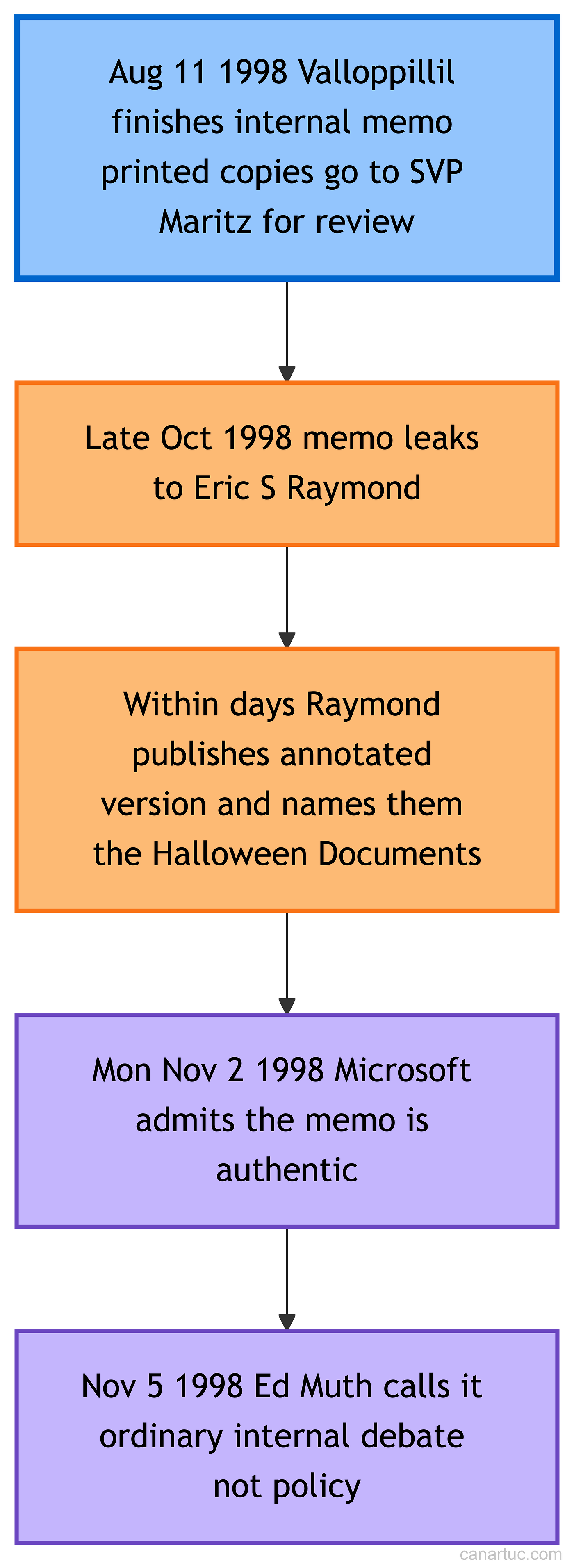
Credit: Author, Timeline of the 1998 Halloween memo leak from writing to Microsoft response
Microsoft now had to explain its own internal strategy, in public, in the middle of a federal antitrust trial. Clap and share this if you want more stories dug out of primary sources, and tell me in the comments what you would have done with that memo. What the company actually said comes next.
One Employee’s Opinion
Microsoft’s answer arrived in two parts.
First, Microsoft confirmed the document was real, on the Monday after it went public. They had to. Denying a memo that thousands of people were already reading in annotated form would have been suicide in the middle of an antitrust trial.
Then came the spin. The memo was just one employee’s views, Microsoft said, and did not represent company policy.
Ed Muth, a Microsoft enterprise marketing group manager, made that case formally on November 5, 1998, in a question-and-answer session the company posted on its own website, with the antitrust trial already under way in Washington. One of the questions on that page asked who Vinod Valloppillil was and what his role at Microsoft was. The published answer: “Vinod is a staff engineer.” The memos, the same page said, were “technical analyses written by a staff engineer that represent the thoughts of one individual at one point in time.” Muth framed the whole thing as ordinary internal debate about competitive threats, including Linux’s growing use in lower-end servers and at Internet service providers. Vigorous internal argument, he suggested, was a sign of a healthy company, not a smoking gun.
I was a teenager at that time, and I thought that Ed Muth was lying by looking us in the eyes, and I still do believe so.
Start with the role description that Microsoft chose: A staff engineer. It is a job title picked to make a reader picture a coder in a cubicle, writing up a private hunch on a slow afternoon. That is not who wrote it. Valloppillil was on the executive staff, one of four people on a program designed to move analysts into the orbit of the company’s top executives. Feeding analysis to the most senior people in the company, Gates and Ballmer and Allchin among them, is the job description of Vinod Valloppillil as of today in Microsoft-owned LinkedIn. Microsoft did not describe him that way in public, and the reason is obvious enough.
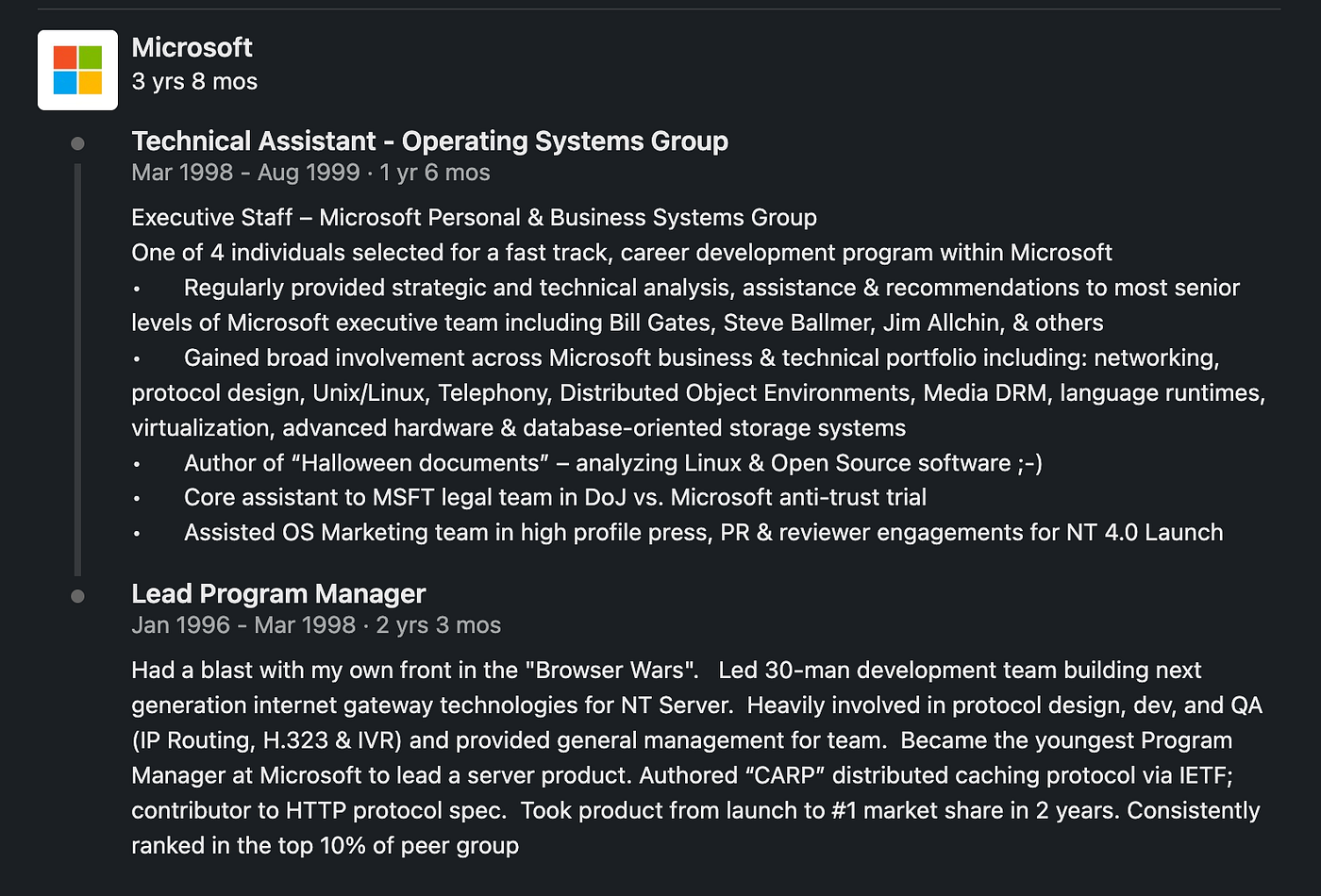
Credit: Author, taken from Vinod Valloppillil’s LinkedIn Profile
Then look at where the memo went. Paul Maritz, the company’s third-ranking executive, got printed copies for review. Jim Allchin, another senior vice president, is thanked in it by name. It ran to some 11,000 words of competitive strategy. Companies do not circulate threat assessments that size at that level and then call them one employee’s personal notes.
The memo then ruled out the tactic Microsoft reached for most. “OSS is long-term credible,” it warned, and “FUD tactics can not be used to combat it.” FUD stands for fear, uncertainty, and doubt: talking a rival’s product down instead of beating it in the market. Microsoft’s own analyst had examined the company’s standard play and told two senior vice presidents it would fail against Linux.
But they still followed their method anyway. Microsoft spent the next 9 years aiming that fear at the corporate buyers choosing between Windows and Linux, right through to the Get the Facts campaign that ran until 2007.
Every retelling of this story ends with a different three words, but Valloppillil never wrote them… It came from Intel.
Maritz Led That Meeting Too
Ask most engineers what the Halloween Documents said, and many answer with three words: embrace, extend, extinguish.
That wording traces to a different Microsoft fight. Steven McGeady, an Intel vice president, took the witness stand on November 9, 1998, days after the memo went public. He read from his own notes of a 1995 meeting with Microsoft: the plan was to kill HTML by extending it. He attributed that line to a Microsoft participant, without naming one.
McGeady told the court the strategy was “embrace, extend, and extinguish” and placed it at a meeting led by Paul Maritz. Microsoft’s lawyers pressed him on cross-examination, since the word extinguish appears nowhere in his notes. He accepted their narrower phrasing, “Mr. Maritz, or someone from Microsoft,” and stood by the memory.
Maritz was the same executive who got the printed copies of the Halloween memo for review.
People began quoting McGeady’s three words as if Valloppillil had written them, and the mix-up stuck.
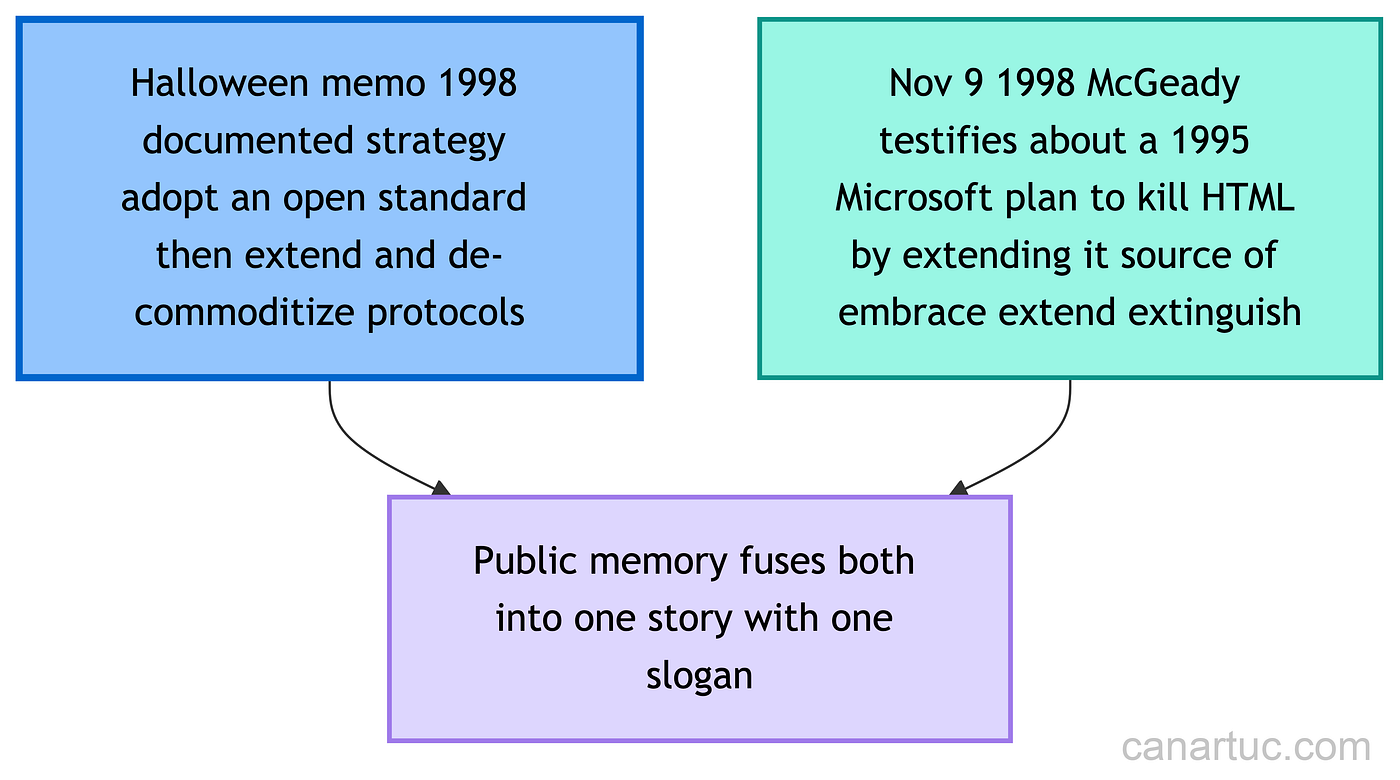
Credit: Author, Two separate 1998 sources fusing into one remembered slogan
By November 1998, Raymond had the memo, the annotations, and an audience. What he did not have yet was the rest of the file. 9 more documents were still coming, and the 10th one described $86 million moving from Microsoft toward the company that would attack Linux in court.
The Leak Had Ten Sequels
The Halloween series ran for nearly six more years, and Raymond published every installment.
The Halloween Documents go from I to XI. The first two were the leaked Microsoft memos: Valloppillil’s open source study, and a follow-up on Linux he co-wrote with a colleague named Josh Cohen. The other nine are a mixed file rather than a run of leaks: two more internal Microsoft memos that got out, Microsoft’s own public answer, a leaked email from inside SCO, and five rounds of Raymond’s own analysis, all numbered and annotated as the fight moved into the open.
Microsoft never accepted its own analyst’s verdict on fear tactics.
The Alexis de Tocqueville Institution, a Washington policy group that published studies to move lawmakers and reporters, began attacking open source in June 2002. Microsoft had been one of its backers for years, a fact Microsoft confirmed, though it said it had not funded any particular study. The campaign was the exact tactic the 1998 memo had ruled out, running at a distance, with someone else’s name on the letterhead.
Then the money showed up in writing.
Follow the Money
In June 2001, Microsoft CEO Steve Ballmer told the Chicago Sun-Times that “Linux is not in the public domain. Linux is a cancer that attaches itself in an intellectual property sense to everything it touches.”
At that time, we all thought that this was a CEO’s shout because Linux had begun beating Microsoft, specifically in the server world, night and day. In such a case, the hatred can be understandable, but then we saw that it is not actually only hatred but part of a play.
In March 2004, Raymond published Halloween X. He called it Follow the Money.
It was a leaked internal email from a consultant working for The SCO Group. SCO was then suing IBM and threatening the whole Linux world over Unix code it claimed had been stolen, a fight that would swell into a $5 billion demand. In the email, the consultant boasted to an SCO executive that Microsoft had steered roughly $86 million toward SCO through various channels, much of it via a single large investment, and stood ready to line up more.
SCO confirmed the email was genuine. It rejected Raymond’s reading of it, arguing the consultant had misunderstood the arrangements and that Microsoft was not secretly funding the lawsuit.
Intellectual property was exactly the ground SCO chose to fight on, as Steve Ballmer mentioned in 2001.
Microsoft’s own analyst had ruled out attacking open source head-on in 1998. The 2004 attack arrived in a courtroom instead, with another company’s name on the complaint and Microsoft’s money somewhere in the picture.
Two months after Raymond published that email, the same Washington institute went public with a claim that Linus Torvalds had not really written Linux.
The Professor
SCO’s lawsuit was about Unix. The company sued IBM in March 2003, claiming IBM had broken its Unix license by moving code from its own Unix systems into Linux. Torvalds was not a defendant. Years later, a jury found that SCO did not even own the Unix copyrights it had been waving around.
A book called Samizdat made a different accusation. The Alexis de Tocqueville Institution pre-released it in May 2004 and never formally published it. It was written by Kenneth Brown, the institute’s own president. The book’s argument was that Torvalds could not have written Linux on his own and had lifted much of it from MINIX, the small teaching operating system used in universities. The author of MINIX was Andrew Tanenbaum.
Different code, different accuser, same charge: Linux was stolen property.
Professor Andrew S. Tanenbaum taught operating systems at Vrije Universiteit Amsterdam and wrote MINIX so his students could read a complete Unix-like system end to end. 12 years before Samizdat, he had opened a public argument with Torvalds under the heading “LINUX is obsolete,” and told him that such a design would not earn him a high grade.
A Washington group that counted Microsoft among its funders was now trying to tell the world that Torvalds had built Linux out of MINIX code.
Prof. Tanenbaum defended Torvalds. He published a detailed rebuttal, went through the accusation point by point, and pointed out the evidence the book had omitted. Kenneth Brown, the institute’s own president, had paid a programmer to compare Linux and MINIX. That programmer, Alexey Toptygin, found no copied code, and the comparison never appeared in the book. Computing trade publications and Linux news sites took Samizdat apart within weeks, and Microsoft publicly distanced itself from the book.
The MINIX accusation was dead within a month, while SCO’s Unix case ground on for years, and the protocol plan in the memo was about to cost Microsoft far more in a Brussels courtroom.
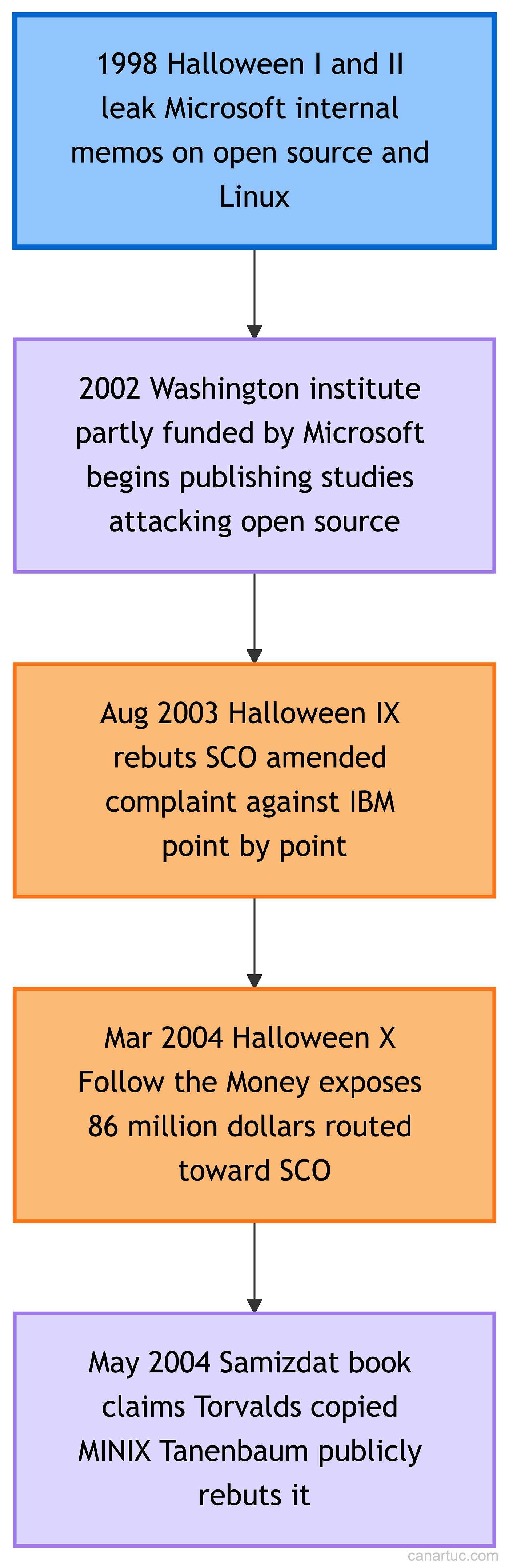
Credit: Author, Timeline of the Halloween saga from the 1998 leak to the 2004 SCO and Samizdat campaigns
The Strategy Went on Trial
Of everything in the memo, the protocol plan is the part Microsoft actually put into practice.
Extend the shared protocols, the memo had said, invent new ones, and deny open source projects entry into the market. Microsoft did that with the protocols that let Windows machines communicate with each other and with servers across a corporate network. Competitors who wanted their software to interoperate needed the specifications. Microsoft would not release them.
That refusal ended up in front of a court, this time in Europe.
Brussels was cold and overcast on March 24, 2004, two degrees above freezing at dawn, the air close to saturation, with nothing falling until a brief shower late in the afternoon. That was the day the European Commission ruled that Microsoft had abused its dominant position by withholding exactly that interoperability information from competitors, in the same month Raymond published Follow the Money. It fined Microsoft €497,196,304 for that abuse and one other, the bundling of Windows Media Player, and ordered it to hand the specifications for its workgroup server protocols to any competitor that wanted them, on reasonable and non-discriminatory terms, so rivals could build software that spoke the same language. Microsoft fought the ruling for 3 years.
The Court of First Instance in Luxembourg rejected almost all of that appeal on Monday, September 17, 2007, another dry morning, 13 degrees at sunrise, cloud but no rain. The outcome was as dry as the morning: The fine stood, and so did the order to hand over the protocol specifications. The court struck down only the provision appointing an independent monitoring trustee at Microsoft’s expense.
Microsoft had been watching Linux for years without writing any of this down. What finally poked the company into it started in a small office in Mountain View, six months before Valloppillil typed a word.
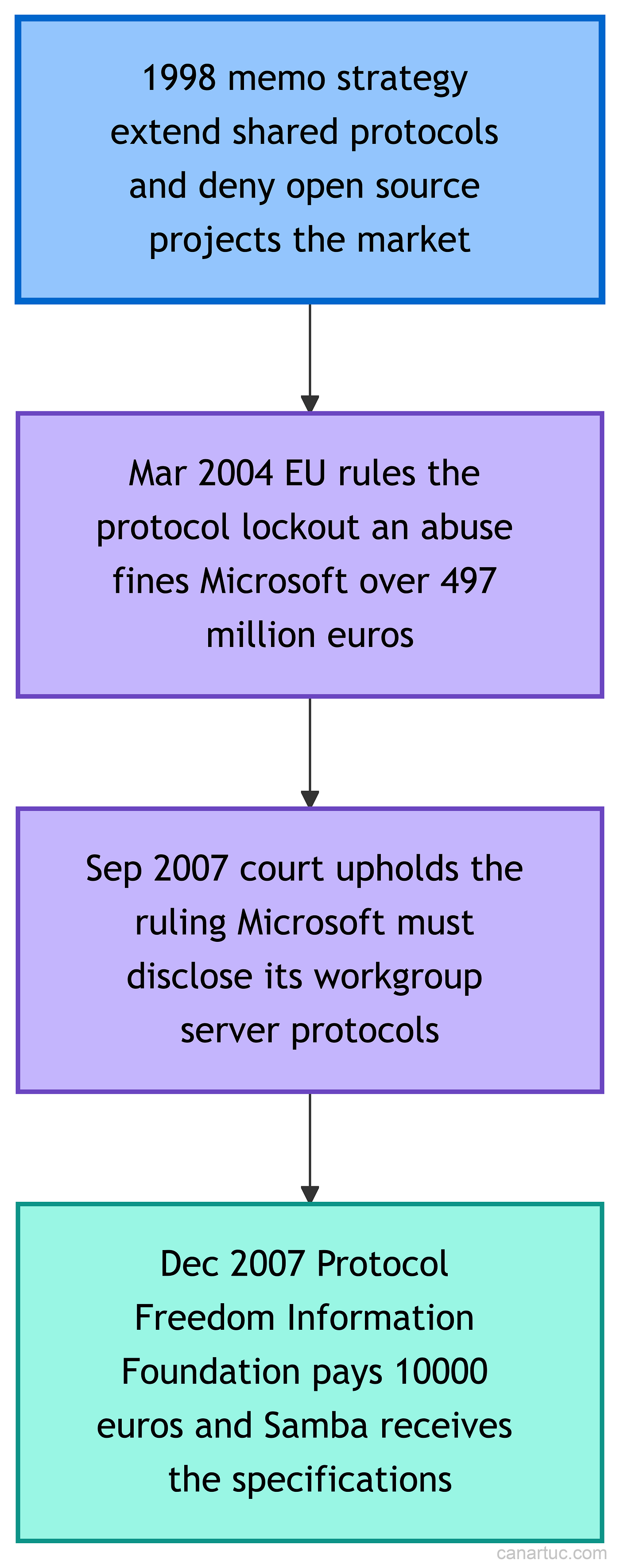
Credit: Author, How the 1998 protocol strategy became an EU antitrust ruling Microsoft was forced to reverse
The Room Where the Word Was Born
If you follow the memo back far enough, you reach a room. A small company in Mountain View called VA Research. Larry Augustin had started it while he was a graduate student at Stanford. He could not afford a Sun workstation, so he assembled a 66MHz 486 running Linux for about $2,000 and watched it run his own code up to twice as fast as the $7,000 Sun machines. He started the company out of his apartment in November 1993.
On February 5, 1998, months before Valloppillil typed his first line, a handful of people gathered at VA’s offices to work out how to sell free software to companies. Netscape had just promised to release its browser source code, and the movement needed a label that would not scare corporate buyers. “Free software” scared them. Christine Peterson coined the term open source, and Todd Anderson put it to that room. Five people were there: Eric Raymond, Todd Anderson, Christine Peterson, Larry Augustin, and Sam Ockman. Jon “maddog” Hall was on the phone.
So the thing Microsoft spent 11,000 words fearing had been given its name 6 months earlier, in the offices of VA Research, the company about to become Microsoft’s Wall Street nightmare.
And Raymond did not just publish the memo but sat on VA’s board, too. When VA Linux Systems went public on December 9, 1999, the stock closed its first day up 698 percent, the largest first-day gain in the history of American public offerings at the time, a record that stood for 25 years. Raymond’s 150,000 share options were worth about $36 million by the closing bell.
What frightened Microsoft was cheap commodity hardware running a free operating system, undercutting the expensive proprietary machines the industry was built to sell. That was Augustin’s company in one sentence: an Intel box running Linux, doing the same work 1.5 to 2 times faster than the Sun machine he had measured it against, at a third of the cost. Microsoft wrote the threat down in August 1998. VA had been shipping it since 1993.
The memo had called open source “long-term credible.” 13 months later, the stock market agreed, and the people behind VA Linux, Augustin and Raymond among them, were rich on paper by the closing bell.
So we can say that Vinod Valloppillil was a good analyst, as whatever he wrote became reality, even though Microsoft announced it was just one person’s opinion…
Monopolist, But Never Broken Up
The case that opened on October 19, 1998, took 3 more years to finish. Judge Thomas Penfield Jackson found on November 5, 1999, that Microsoft held monopoly power, ruled on April 3, 2000, that the company had broken the Sherman Act, and on June 7, 2000, ordered it split into two firms: one for Windows, one for everything else.
Microsoft appealed and won that round. The Court of Appeals in Washington threw out the breakup on June 28, 2001, partly because Jackson had been discussing the case with reporters while it was still running. The court left his findings of fact intact, while reversing part of his legal conclusions. Microsoft was still an adjudicated monopolist, just not one that would be broken up.
The Department of Justice announced on September 6, 2001, that it would no longer seek a breakup and would instead press for smaller penalties. Microsoft settled on November 2, 2001, agreeing to share its programming interfaces with other companies and to accept a panel of 3 inspectors with access to its systems, records, and source code for 5 years.
Washington stayed dry through the trial and dry on the day the memo went public. Brussels was cold and grey when the Commission ruled, with barely enough rain to wet the pavement. Luxembourg’s morning was dry when the appeal died, and the rain held off until evening. Every turning point in this story landed on a still morning.
So there was never a storm over any of it. Who knows, maybe the unknown wind got into a room of Microsoft HQ in Redmond one August afternoon and carried the memo out of the building on its own.
Who knows…
Writer’s note:
I wrote this last week: “One piece of this puzzle is still missing. There are more Linux stories than I could ever tell, but in this particular thread, one big piece is still out there, waiting. I already know which one it is. You do not, yet. Or you know, and it sits in the dark part of your memory to be pulled out…”
This story is that piece. The thread is complete.
You already knew these names. You had read most of these scenes in my stories. What every one of those articles held back was how they connect, and this is where you get it.
I did not extend the earlier articles whenever the Halloween Documents came up in them. When I return to a story I have already written, I bring new detail with me, so reading me twice is never reading the same thing twice. That was never about holding anything back. It was story mechanics, and I knew from the start that every truth would land when the thread closed.
Work like this takes dedication. I plan every paragraph like a detective and fit it into the map of the whole thread.
If you like my stories, Medium already gives you everything you need to say so: Clap, comment, share.
My stories go viral. The reactions to them run at roughly one-tenth of the reads. Claps, comments, and shares are the only connection between you and me. Maybe we can find a chance to meet face-to-face in the future, but now, this is all we have.
I used the same approach George Lucas used in Star Wars in this thread; of course, I am not that skillful either. The series jumps back and forth. Now that the full thread is done, I can give you the exact reading order, and it does not match the publication dates.
Linux was never a north star or an ambitious project. It did not even carry the name Linux at the beginning. It started as a hobby, and it started with a rejection from one of the authorities in the field:
We name Linus Torvalds as the person who started Linux; that’s true. But more people turned it into a commercially viable product, at a time when companies were afraid of the words “free software”. This is the story of those people:
After that much attention, the big players could not stop themselves from punishing the success and trying to block it. The story you just read sits in that window.
We all thought the fight was over. It had restarted behind a different mask, called SCO this time, with the same backers who had already been fined more than once:
Linux came through accusations, takedowns, and a lot of hatred. What kept it alive was the opposite force. Every attempt to bury Linux pulled brilliant minds from around the world together to push it forward, and that is the mentality Vinod Valloppillil described in his report.
The Linux community has never been easy to be part of. Bright minds lose their clarity when they lose control. This is the story of how modern Linux file systems were born and how its starter ended, unexpectedly:
I publish fresh articles every Tuesday and Thursday, and a piece of history every Saturday. Follow me and switch on email delivery so the next one lands in your inbox instead of getting lost in the feed.
And thank you for all of it, the kind feedback and the hard feedback both. Keep it coming, up my email or down in the comments. It is the reason I have the power to keep writing good stories in an AI-slop world!
The memo and the leak
- Eric S. Raymond, annotated Halloween Document I. The memo itself, including the August 11, 1998 byline and the revision note recording printed copies for Maritz: http://www.catb.org/~esr/halloween/halloween1.html (catb.org was unreachable at the time of writing; archived copy: https://web.archive.org/web/2023/http://www.catb.org/~esr/halloween/halloween1.html)
- Eric S. Raymond, Halloween Documents FAQ, on how the memos reached him and the November 1, 1998 release date: https://web.archive.org/web/19991013130749/http://opensource.org:80/halloween/halloween-FAQ.html
- Vinod Valloppillil’s own professional record of the role he held when he wrote the memo: Technical Assistant, Operating Systems Group, on the executive staff of Microsoft’s Personal and Business Systems Group, March 1998 to August 1999, following two years as a lead program manager. Self-reported (LinkedIn), and his own account rather than a Microsoft document.
Microsoft’s response
- Eric S. Raymond, annotated Halloween Document III, “Microsoft’s Reaction to the Halloween Memorandum,” on Microsoft admitting authenticity on Monday, November 2, 1998: https://web.archive.org/web/2023/http://www.catb.org/~esr/halloween/halloween3.html
- Microsoft, “Microsoft Responds to the Open Source Memo Regarding the Open Source Model and Linux,” a question-and-answer session with Ed Muth, Enterprise Marketing Group Manager, posted November 5, 1998: https://web.archive.org/web/1999/http://www.microsoft.com/NTServer/nts/news/mwarv/linuxresp.asp
- Salon, “Let’s Get This Straight: Microsoft’s Halloween scare” (November 4, 1998): https://www.salon.com/1998/11/04/straight_39/
The phrase everyone remembers
- US v. Microsoft trial transcripts, Steven McGeady testimony (November 9 and 12, 1998), Harvard Openlaw archive. The source for the wording and attribution of “embrace, extend, extinguish” and “kill HTML by extending it”: https://cyber.harvard.edu/msdoj/transcripts/1109b.doc and https://cyber.harvard.edu/msdoj/transcripts/1112a.doc
- Wikipedia, “Embrace, extend, and extinguish,” used only as a lead to that testimony: https://en.wikipedia.org/wiki/Embrace,_extend,_and_extinguish
The rest of the series, and SCO
- Wikipedia, “Halloween documents,” for the full list of documents I through XI: https://en.wikipedia.org/wiki/Halloween_documents
- Eric S. Raymond, annotated Halloween Document X, “Follow The Money”: http://www.catb.org/~esr/halloween/halloween10.html (archived copy: https://web.archive.org/web/2023/http://www.catb.org/~esr/halloween/halloween10.html)
- The Register, “SCO confirms MS ‘smoking gun’ memo is genuine” (March 5, 2004): https://www.theregister.com/2004/03/05/sco_confirms_ms_smoking_gun/
Samizdat and the MINIX accusation
- Wikipedia, “Samizdat: And Other Issues Regarding the ‘Source’ of Open Source Code”: https://en.wikipedia.org/wiki/Samizdat:_And_Other_Issues_Regardingthe%27Source%27_of_Open_Source_Code
- Andrew S. Tanenbaum, rebuttal to Kenneth Brown’s Samizdat: https://www.cs.vu.nl/~ast/brown/rebuttal/
- Alexey Toptygin’s Linux and MINIX code comparison, commissioned by Kenneth Brown and left out of the book: https://www.cs.vu.nl/~ast/brown/codecomparison/
The European case
- Court of First Instance judgment, Microsoft v Commission (September 17, 2007), on the fine and the workgroup server protocol remedy: https://eur-lex.europa.eu/legal-content/EN/TXT/?uri=celex%3A62004TJ0201
The American case
- Judge Jackson’s Findings of Fact (November 5, 1999) and Conclusions of Law (April 3, 2000): https://cyber.harvard.edu/msdoj/findings.html and https://cyber.harvard.edu/msdoj/conclusions-l.html
- Department of Justice press release announcing the settlement (November 2, 2001): https://www.justice.gov/archive/atr/public/press_releases/2001/9463.htm
메타데이터
- post_id
- d732ec4558be
- slug
- 11-000-secret-words-leaked-open-source-was-winning-they-attacked-brutally-d732ec4558be
- url
- https://medium.com/@canartuc/11-000-secret-words-leaked-open-source-was-winning-they-attacked-brutally-d732ec4558be
- canonical_url
- https://medium.com/@canartuc/11-000-secret-words-leaked-open-source-was-winning-they-attacked-brutally-d732ec4558be
- author_url
- https://medium.com/@canartuc
- status
- ok
- fetched_at
- 2026-07-31 06:51:58