GDPR and PIPEDA Compared: A Complete Guide to Data Privacy Compliance
Organizations that collect personal information across borders often encounter two major privacy frameworks: the European Union’s GDPR and…
GDPR and PIPEDA Compared: A Complete Guide to Data Privacy Compliance
GDPR and PIPEDA Compared: A Complete Guide to Data Privacy Compliance : NetSet Software
Organizations that collect personal information across borders often encounter two major privacy frameworks: the European Union’s GDPR and Canada’s PIPEDA. They share a common goal of protecting individuals’ personal information, but they differ in scope, legal basis, enforcement, and operational requirements. Understanding those differences is essential for building a practical, defensible compliance program.
What Is GDPR?
GDPR (General Data Protection Regulation) is the primary data protection law governing the processing of personal data in the European Union and European Economic Area. It applies not only to organizations established in the EU, but also to organizations outside the EU that offer goods or services to EU residents or monitor their behavior.
GDPR is often considered one of the world’s strictest privacy regimes because it establishes detailed obligations around lawful processing, transparency, security, accountability, and individual rights.
Core GDPR principles
- Lawfulness, fairness, and transparency.
- Purpose limitation.
- Data minimization.
- Accuracy.
- Storage limitation.
- Integrity and confidentiality (security).
- Accountability.
What Is PIPEDA?
PIPEDA (Personal Information Protection and Electronic Documents Act) is Canada’s federal private-sector privacy law. It applies to personal information collected, used, or disclosed in the course of commercial activities, except where substantially similar provincial legislation applies.
**PIPEDA** is built around fair information principles and emphasizes consent, appropriate purposes, openness, safeguards, and individual access rights. Compared with GDPR, it is generally more principles-based and less prescriptive in some operational areas.
The 10 fair information principles under PIPEDA
- Accountability.
- Identifying purposes.
- Consent.
- Limiting collection.
- Limiting use, disclosure, and retention.
- Accuracy.
- Safeguards.
- Openness.
- Individual access.
- Challenging compliance.
GDPR vs. PIPEDA: The Most Important Differences
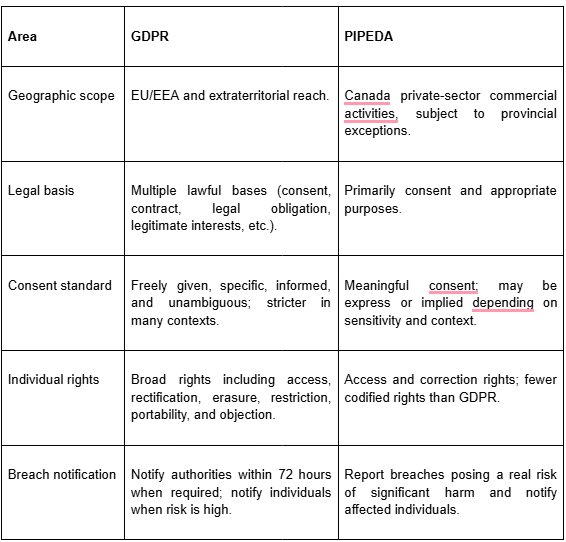
When Consent Is Not Enough
A common misconception is that GDPR is simply a consent law. In reality, consent is only one lawful basis among several. Many B2B processing activities rely on contract performance or legitimate interests rather than consent. Under PIPEDA, organizations often focus heavily on obtaining meaningful consent and ensuring that collection and use align with reasonable, appropriate purposes.
This distinction matters operationally. A company may need a GDPR lawful-basis analysis even when it already has a PIPEDA-style consent flow.
Data Subject Rights: Where GDPR Goes Further
Both laws allow individuals to access and correct personal information. GDPR goes further by codifying additional rights such as data portability and, in certain circumstances, erasure (“right to be forgotten”).
For organizations, that means GDPR programs usually require:
- Identity verification workflows.
- Request intake and tracking systems.
- Data discovery across multiple systems.
- Documented decision-making for exemptions and refusals.
Cross-Border Data Transfers
PIPEDA does not prohibit transfers outside Canada, but organizations remain accountable for the information and must use contractual and security measures to provide comparable protection.
GDPR imposes additional transfer restrictions. Personal data leaving the EEA generally requires an approved transfer mechanism unless an adequacy decision applies. Organizations frequently rely on standard contractual clauses and supplementary safeguards.
Practical implication
If a Canadian company processes EU resident data using U.S.-based cloud services, GDPR transfer analysis may be required even though PIPEDA alone would not impose the same transfer framework.
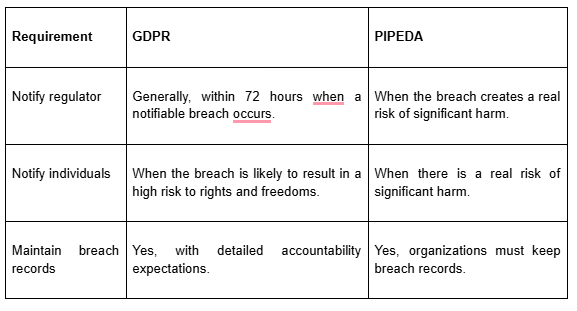
Breach Notification Requirements
Both frameworks require breach response capabilities, but the triggers differ.
How to Build a Compliance Program That Works for Both
- Map your data flows. Identify what personal information you collect, why, where it is stored, who receives it, and whether it crosses borders.
- Define lawful processing purposes. For GDPR, document the lawful basis for each processing activity. For PIPEDA, ensure purposes are appropriate and clearly communicated.
- Strengthen transparency notices. Privacy notices should explain categories of data, purposes, retention, rights, contact information, and international transfers where relevant.
- Implement consent governance. Use clear language, avoid bundled consent where inappropriate, and maintain evidence of consent decisions.
- Establish rights-request procedures. Create a repeatable workflow with verification, deadlines, exemptions review, and response templates.
- Review vendor contracts. Ensure processors and service providers commit to confidentiality, security, incident reporting, and appropriate cross-border safeguards.
- Test your breach response plan. Conduct tabletop exercises that include notification decision trees for both GDPR and PIPEDA scenarios.
- Assign accountability. Designate responsible personnel, maintain policies, train staff, and document key privacy decisions.
Which Law Applies to Your Organization?
Many organizations mistakenly assume they only need one framework. In practice:
- A Canadian business serving EU customers may be subject to both GDPR and PIPEDA.
- An EU company with Canadian commercial activities may need to consider both regimes.
- A domestic Canadian company operating solely within a province that has substantially similar legislation may have a different primary compliance path than a company operating nationally.
The safest approach
Perform a jurisdiction-by-jurisdiction applicability assessment rather than assuming a single law governs all operations.
Final Thoughts
GDPR and PIPEDA are not competing versions of the same law. GDPR is a comprehensive, highly structured privacy regime with broad extraterritorial reach and extensive individual rights. PIPEDA is a Canadian principles-based framework centered on accountability, meaningful consent, and appropriate handling of personal information.
For organizations operating internationally, the goal should not be to choose one framework over the other. Instead, build a unified privacy program that satisfies the stricter operational requirements where they apply, while preserving the flexibility needed to meet Canadian expectations around meaningful consent and accountability. That approach reduces compliance fragmentation, improves customer trust, and creates a stronger foundation for future privacy-law changes.
FAQ
1. What is the main difference between GDPR and PIPEDA?
The primary difference is that GDPR is the European Union’s comprehensive data protection regulation, while PIPEDA is Canada’s federal privacy law for private-sector organizations engaged in commercial activities. GDPR provides multiple lawful bases for processing personal data, whereas PIPEDA places a strong emphasis on meaningful consent.
2. Does GDPR apply to businesses outside the European Union?
Yes. GDPR can apply to organizations located outside the EU if they offer goods or services to individuals in the EU or monitor their behavior online. This extraterritorial reach makes GDPR relevant for many global businesses.
3. Is consent required under both GDPR and PIPEDA?
Both laws recognize the importance of consent, but they handle it differently. Under GDPR, consent is one of several lawful bases for processing personal data. Under PIPEDA, meaningful consent is generally the foundation for collecting, using, and disclosing personal information.
4. Which law has stricter penalties for non-compliance?
GDPR is known for its significant enforcement powers and substantial financial penalties for violations. PIPEDA also includes compliance obligations and enforcement mechanisms, but GDPR generally carries higher regulatory risks and larger potential fines.
5. How can businesses comply with both GDPR and PIPEDA?
Organizations can align with both frameworks by maintaining a clear data inventory, obtaining appropriate consent, publishing transparent privacy notices, implementing strong security measures, managing third-party vendors carefully, and establishing procedures for handling user data requests and breach notifications.
6. What types of personal information are protected under GDPR and PIPEDA?
Both laws protect information that can identify an individual, including names, email addresses, phone numbers, account details, IP addresses, and other online identifiers. Sensitive data, such as health information, often requires additional safeguards.
7. Do GDPR and PIPEDA require breach notifications?
Yes. Both regulations require organizations to notify relevant authorities and affected individuals when certain breach thresholds are met. Businesses should maintain a documented incident response plan to meet these obligations efficiently.
메타데이터
- post_id
- d73fec1bfb1f
- slug
- gdpr-and-pipeda-compared-a-complete-guide-to-data-privacy-compliance-d73fec1bfb1f
- url
- https://medium.com/@netsetsoftware1/gdpr-and-pipeda-compared-a-complete-guide-to-data-privacy-compliance-d73fec1bfb1f
- canonical_url
- https://medium.com/@netsetsoftware1/gdpr-and-pipeda-compared-a-complete-guide-to-data-privacy-compliance-d73fec1bfb1f
- author_url
- https://medium.com/@netsetsoftware1
- status
- ok
- fetched_at
- 2026-07-13 06:23:13