Seeing Eileen Gu speak made me realise I grew up between cultures, not inside one.
When identity doesn’t match where you’re “from”… maybe I’m a third culture kid?
Seeing Eileen Gu speak made me realise I grew up between cultures, not inside one.
When identity doesn’t match where you’re “from”… maybe I’m a third culture kid?
I was scrolling on Instagram when a short interview clip came up and caught my attention.
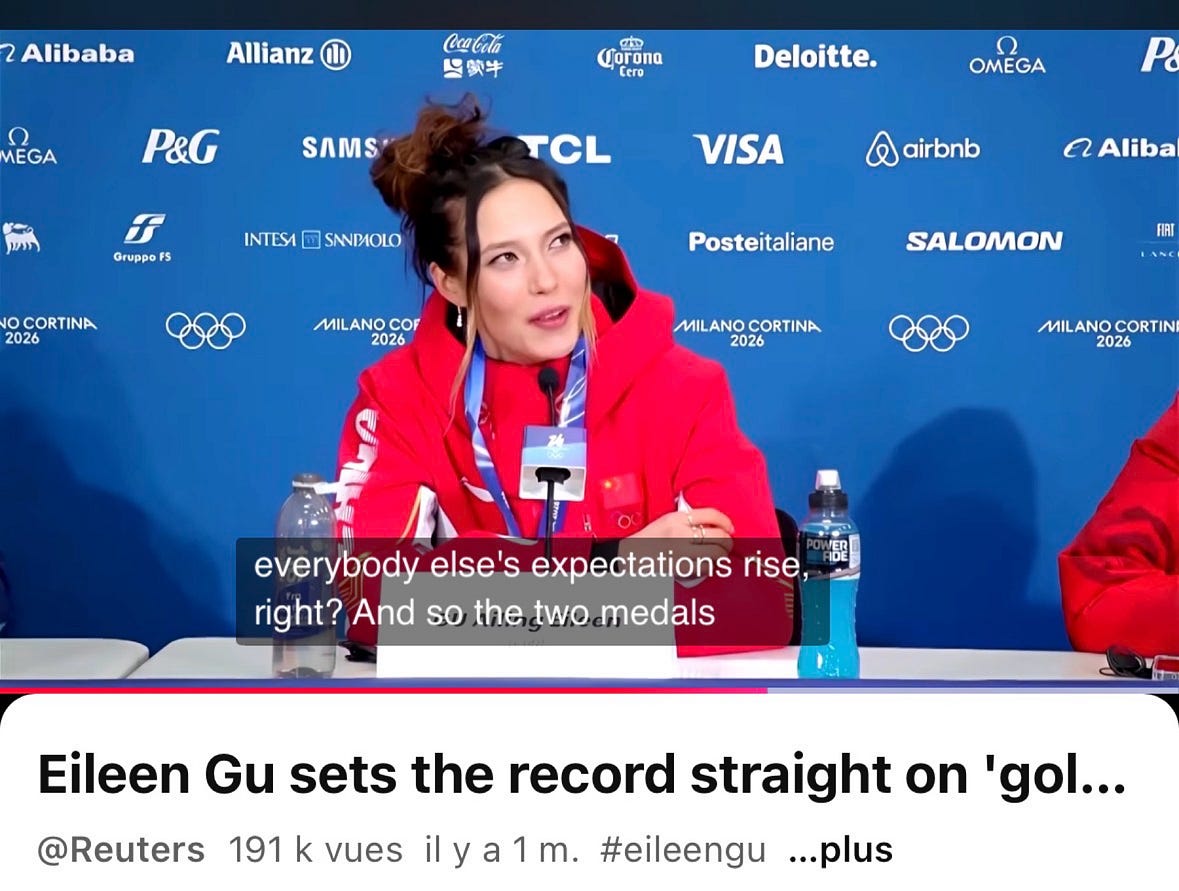
The interview of Eileen Gu on youtube — Reuters
It was Eileen Gu, the Olympic skier. At that point I did not know much about her. I saw her name, I saw her face, and I saw the way she answered in an interview during this year’s Winter Olympic Games.
She looked Asian.
The journalist asked a question, and she responded very directly. She did not soften her words or try to make the answer more agreeable. She stayed clear, assertive and she did not adjust her position.
That is what made me stop.
I thought, wow. I wish I could respond like this in daily life. And also, I realized I had expected something else.
What caught me off guard
I am half Chinese, so that reaction did not come from nowhere. It comes from something I have also been shaped by, even if I do not always think about it consciously.
There is a certain way of behaving in public that I associate with that part of my background. You stay polite, you avoid being too confrontational, and you keep things smooth.
Seeing someone who looked Asian and spoke like that did not match that internal cultural reference I had inherited.
That is what made me curious enough to look further.
Realising it was not just about her
When I read more about her, I realized she grew up in the United States and represents China. She moves between both cultures without trying to simplify it into one version of herself.
That is also when I came across the term “third culture kid” (TCK) in one of her interviews.
I had heard it before but somehow never linked it to my own identity.
The fact that she was half Asian, half American, which means also half “Western”, undeniably put a mirror in front of me and I had to acknowledge it. I always felt I was different, but I also always tried to adapt culturally. The downside is that you suppress a part of yourself, and with it, a part of your authenticity. She did the opposit.
Growing up across places
I have a German and Chinese background, and I was born in Germany, but I did not grow up there in a way that people usually assume.
I spent my early years in the UK, and then moved to France when I was eight. Most of my school years and habits were shaped there. German came later in my teens, when I decided at 15 that I wanted to learn it properly. My parents were still living in France while I was building my life in Germany.
At some point I became fluent in German, but I could not share the childhood references. No TV shows, no songs, no movies. I had French references instead, like “Club Dorothée,” that would resonate with kids who grew up in France in the 90s. Or when an old French Céline Dion song plays and everyone sings along.
From there, I lived many years close to the border between France and Germany, crossing it for school and later for work. I always enjoyed that border feeling. Being German and French felt somehow normalized there because of the history of the regions Saarland, Lorraine, Baden-Württemberg, and Alsace.
Later I spent several years in Switzerland, also in a bilingual environment, and now I live in Amsterdam. It is a multicultural melting pot that I enjoy a lot from an international perspective.
That is also where I noticed again that when people ask where I am from, there is no simple answer that reflects that path.
The gap between label and experience
In Switzerland, I often avoided saying that I was German. Because I spoke fluent French, people assumed I was Swiss French. But when I spoke with Swiss French people, they knew I was not from there. I spoke French like someone from France, not like someone from Switzerland.
At the same time, when I spoke German, you could hear something different. It was not fully standard either. As my father would say, I “sing” when I speak German.
If I say Germany, it is technically correct, but it does not describe what actually shaped me. In the south of Germany, my “singing” German is accepted. In the north, it stands out more.
Most of my memories are tied to France. The way people speak, the way conversations are talked, the way you position yourself in a group, all of that comes from there.
So when someone tries to connect with me through Germany, like Frankfurt, I often cannot follow. At the same time, I could speak at length about France or Switzerland.
But what do I say?
If I say Bern, people think I am Swiss. If I say Strasbourg, people think I am French. Even French people get confused. When I say I am German, they tell me I speak very good French, and then I have to explain everything.
There is always a gap between the label and the experience.
Are you confused too?
Naming it
The term “third culture kid” explains that more accurately.
It is not about nationality alone. It is about growing up across countries rather than within one. Your identity is shaped by different environments that do not fully overlap.
The “third culture” is not a place you can point to. It is something that forms in between those places. Think about the word “hybrid”.
What I learnt from it
Over time, you learn to adjust without thinking about it. You notice how tone, communication, and expectations change depending on where you are, and you adapt.
What is considered normal is not fixed, and you move with that without needing to name it. It sounds like a strength, but you still often need to justify who you are.
There are moments where this becomes visible in small ways.
Someone asks why you did not become French, as if identity followed a clear path. Someone assumes you know a place because it is written in your background.
You answer, you move on, but the gap remains and wonder if that was the correct response.
Watching her made me realize that what stayed with me was not only what she said, but the fact that she did not adjust herself in that moment.
She did not try to fit into an expectation. She spoke from where she stands, without explaining it.
After becoming a mother
After giving birth, identity and culture became a bigger topic for me.
People sometimes think I need to fix something, like identity is a problem to solve. I do not feel that I am missing parts. I tried to take the best from all the different worlds I grew up in.
This is also the legacy I want to pass on to my daughter.
I believe these are the skills that will matter in the future, in a world that is becoming more complex when it comes to identity and cultural understanding.
She is already exposed to four different European languages in her daily life. She will likely be more anchored in one place, but still shaped by multiple cultural references.
I do not think identity needs to be simplified into one answer.
Some lives are built across places, and they remain shaped by all of them at once.
I am curious what that looks like for others who grew up between cultures? Happy to hear about your experience!
메타데이터
- post_id
- d74738533170
- slug
- seeing-eileen-gu-speak-made-me-realise-i-grew-up-between-cultures-not-inside-one-d74738533170
- url
- https://medium.com/@iam.karola/seeing-eileen-gu-speak-made-me-realise-i-grew-up-between-cultures-not-inside-one-d74738533170
- canonical_url
- https://medium.com/@iam.karola/seeing-eileen-gu-speak-made-me-realise-i-grew-up-between-cultures-not-inside-one-d74738533170
- author_url
- https://medium.com/@iam.karola
- status
- ok
- fetched_at
- 2026-08-16 16:52:00




