Ripples in Time (25–30/82)
XXV Paris, The Office of Monsieur Marbleaux, 20 August 1793, 11:45 a.m.
Ripples in Time (25–30/82)
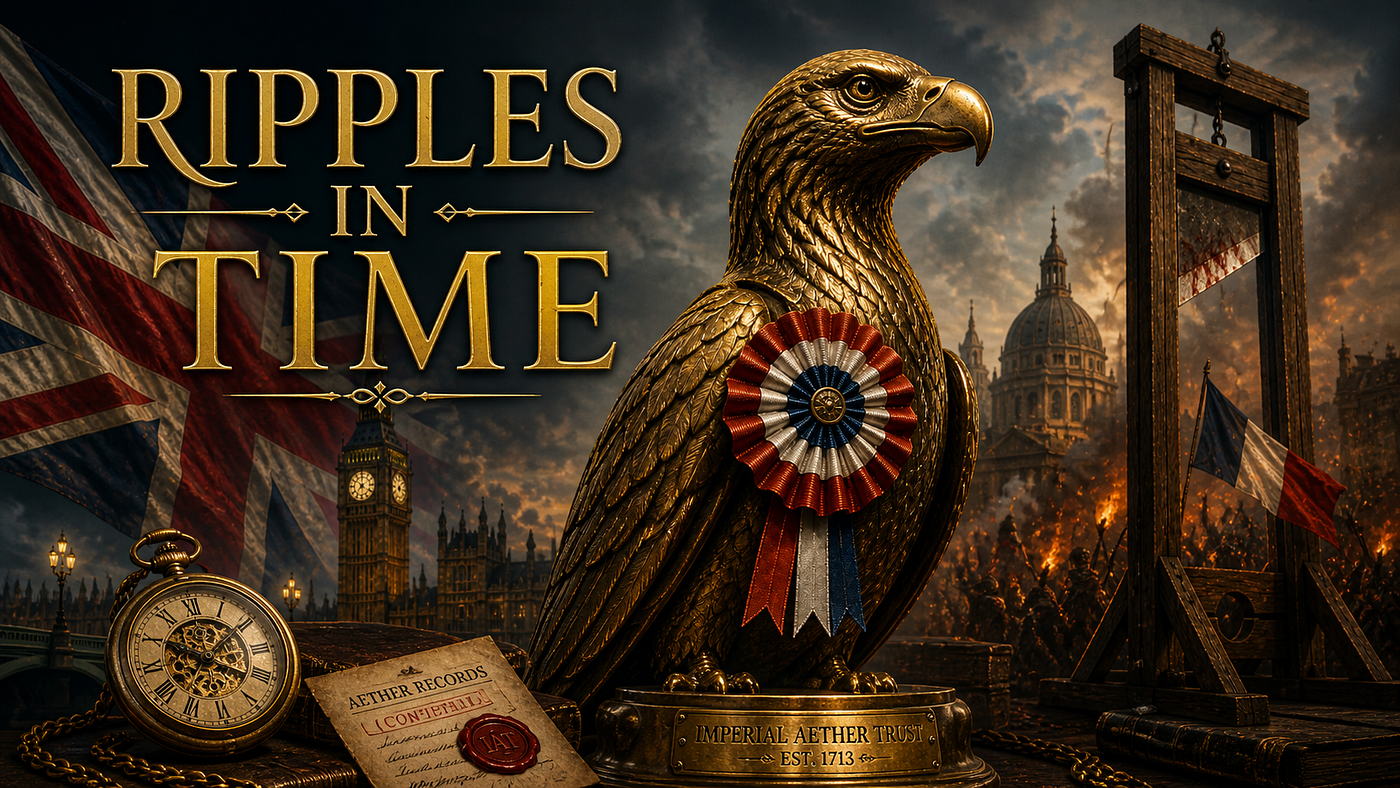
XXV Paris, The Office of Monsieur Marbleaux, 20 August 1793, 11:45 a.m.
To Emma, the return to Constance’s house on Rue Saint-Jacques felt like a defeat. A dead-end she was unable to back out of, battered as she was from travel sickness, the mounting heat, and the emotional strain of the morning’s encounters.
And yet, despite all the temporal entanglements that followed in the wake of meeting Constance, Emma couldn’t help but enjoy the young woman’s company. Within hours, their acquaintance had taken on a level of familiarity that was unmistakable evidence of their familial relationship. Although there were several times when Constance seemed poised to say something, only to bite her tongue, making Emma wonder what the future Founder would have liked to observe or ask.
William’s presence dampened their conversation, even when he had been riding on the back of the cab, shouting out greetings and revolutionary demands — the most chilling of them all calling for enemies of France to be hanged from the nearest lamppost. Listening to him, Emma was mortified. The William she had known and admired would never have done anything like this!
Is this subterfuge or calculation? Opportunism or the honest wish to keep Constance safe after she decided to take the wrong fork in the road?
They left the cab some hundred yards past Constance’s house and made their way through a couple of narrow alleys to a door in an impressively high garden wall. Five minutes later, Emma was resting on a rather comfortable sofa, wishing fervently that Constance would stop fussing and William would just go away.
Clearly, there’s a point to be made in favour of not fraternising with people from a different time frame. The only thing they do is get in the way and prolong a time agent’s mission. And what’s worse, William knows this!
In an effort to keep her temper in check while she waited for the right moment to leave the house, Emma fixed her gaze on the ceiling of the room Constance had allocated to her. The frescoes were still fresh, depicting charming scenes of cherubs chasing each other across a heavenly landscape. But there were cobwebs in the corners, and when her eyes dropped to the tester of the lovely four-poster bed, it became clear that its curtains were in dire need of a good shake, to say the least. The chores that came with a home like this were piling up, and there were far too many for one person.
No wonder she looks so wan. Emma sipped the tea William had insisted on making her. Unless, of course, there’s another reason… The handsome Monsieur Marbleaux and Constance seem to be on more intimate terms than would have been acceptable in any other era, she thought with a touch of disapproval, unwilling to even think what sort of trouble she feared the young woman might be in.
The realisation that for her it was much easier to be philosophical about the shortcomings of younger generations than to accept the missteps of older ones made her chuckle.
Still, the young man seemed too conscientious to have taken advantage of Constance. He wasn’t the type, although… Well, at any rate, the fallout would be unimaginable.
Absentmindedly, Emma fidgeted with the ChronoDial in her pocket. The thing was exuding a slight upward pull towards the third floor. It was there that Constance had her workshop, to which she had retired as soon as she had felt that Emma had settled in, and where she was now performing her experiments with William’s help.
XXVI Paris, The Coligny Town House, 20 August 1793, 11:55 a.m.
Not for the first time, Emma wished she had paid more attention while reading Maisie’s book. However, she was reasonably certain that it had been after Constance had left for Edinburgh that she had laid the foundation for her extraordinary discoveries in the realm of aether utilisation.
So why is the ChronoDial suddenly reacting to being here, when just a few hours earlier it didn’t? Could it be that the first breakthrough in aether technology is imminent?
Hoping that she might be allowed to witness one of the most momentous events in history, Emma decided to investigate. Maybe there was nothing to prevent Constance from inventing the aether condenser at this point in time because the thought of it had been conceived much earlier.
Not that this would keep Emma’s own timeline alive. The more Constance got entangled in her new future, the less likely it was that she would meet Hamish Whirlum when she needed to.
Now, however, Emma would go witness her grandmother become the founder of aether technology. Instead of sneaking upstairs and eavesdropping on Constance and William’s conversation, she chose to maintain an air of casualness and slipped on her shoes before leaving her room. Her steps were measured, her breath steady, and her errand — if William should be lurking about in the shadows and challenge her — was to reassure Constance that she was feeling much better and wanted to see a milliner to exchange her wig for a mobcap. An excuse that had the benefit of being true, if not comprehensive.
She had almost reached the third floor when she heard voices coming from the direction her ChronoDial was indicating she should head in. The conversation was growing more distinct with each step she took. Not surprisingly, the voices belonged to Constance and William — she sounded upset, irritated rather than sad, while William’s tone remained measured and detached, as though he were trying to persuade her of something inevitable.
“Maybe I should have listened to Étienne in January, when he said that I should leave with Mary,” Constance said. “Now the glassmaker in the Faubourg St. Michel has disappeared too. And he had promised so faithfully that the lenses would be ready today. Tell me, Guillaume, how can I do my work if there are no precise instruments to be had?”
So, there had been talk about her leaving with her housekeeper, Emma thought. Which means that the timeline was intact until January.
Seven months later, this was little comfort.
“There are those who make their instruments themselves,” William pointed out. “Letting strangers in on the secrets of one’s craft before the result is satisfactory…” He let his words hang in the air for a moment before continuing. “And Mademoiselle cannot be sure that Madame is no spy. I ask Mademoiselle, would a respectable woman be in the streets early in the morning all by herself? These are tough times, Mademoiselle, with rivals everywhere. Everything Mademoiselle has achieved here may very well be for naught if Mademoiselle is too trusting.”
That insinuating bastard! Emma thought, incensed.
What additional stake did he have in Constance’s work, apart from the obvious, of course, that without the discoveries and inventions that were imminent, the future would unfold in an even more unpredictable way that was already the case? Was he trying to mitigate the jeopardy the young woman’s infatuation had put them in? Or did he seriously see Emma as the antagonist here? Without so much as asking if that was true?
Grimly, she decided to pass the latter off as speculation, chiding herself for having grown too suspicious with age. All he most likely wanted to do was guide this new timeline back to its origins with as few deviations as possible.
But then why had he accused her of being untrustworthy? It smarted and had been uncalled for, but was probably worth remembering in her dealings with the man, whose inner workings seemed to bear only a faint resemblance to those of the William who had guided her through the first years of her career as a time agent. This version of him felt distant, almost alien. It would be prudent to approach him with caution, and to tread lightly on the shifting ground of their precarious relationship.
With yet another deep breath, she knocked on the door. The contact of her knuckles on the wood gave a clear, strangely well-defined sound in the palpably charged atmosphere, bringing the man’s torrent of words to an abrupt end.
“Come in!” called Constance, her voice frail, as if the delicate threads of her resolve were threatening to snap.
Emma entered, trying her best to look apologetic rather than curious as she stepped into what could most accurately be described as a tinkerer’s workshop in the making. The space was pleasantly cluttered without looking chaotic, filled with half-finished contraptions, tools scattered across the workbench, and sketches pinned haphazardly to the walls, each one a testament to Constance’s brilliant mind. One of them — depicting her groundbreaking aether burner — Emma had seen more often than she cared to remember, hanging in a gilded frame behind the desk in Alvar’s office.
The air was thick with the scent of oil and metal. Emma felt a flicker of familiarity amidst the chaos, a reminder of the countless hours she herself had spent in a similar sanctuary, inventing, creating, and refining the machines and mechanisms she and Bertie had shared a lifetime working on in an effort to make life less burdensome.
Constance stood behind the workbench, like a sentinel protecting the perimeter of her realm. Her arms were crossed tightly over her chest, her face pale, eyes turned to Emma carrying the remnants of the challenge that had probably been meant for William. In front of her sat the innermost part of a rather primitive aether condenser.
The first of its kind, Emma thought in awe.
It was a remarkable contraption, simple in its genius: two rings, one neatly nestled within the other, rotating speedily around a lens that needed to be cut just so. Its task was to gather light and send it through a myriad of tiny crystals embedded on the inner surface of the smaller ring, each facet sparkling with the promise of untold possibilities.
This is the starting point of everything that matters, Emma thought, mesmerised by the intricate dance of light and machinery before her.
How she would have loved to take a closer look at this device, to talk to Constance about her invention and the thoughts that had given rise to its development. But unfortunately, this was not what she had come for. Any revelation that she, too, was interested in this kind of work could easily be misconstrued and weaponised.
Better not give William any more grist to his mill.
“I am recovered now,” she said with a confident smile, ignoring William, who was hovering in the periphery of Emma’s vision like an unwelcome ghost, as best she could. “And there are some errands that cannot wait.”
The young woman nodded. “When will you be back?” she asked brightly.
“I don’t know,” Emma replied truthfully, since she had never been shopping in revolutionary Paris before. “In a couple of hours, perhaps? Do you happen to know a good milliner nearby?”
She cast a quick glance at William, hoping her expression would convey that this was not a subject to be expanded upon with a manservant in attendance.
“There’s Madame Marais,” Constance said, frowning, as if milliners belonged to an unknown and enigmatic species of creature. “Her shop isn’t far. Turn towards Notre Dame when you leave the house and look for a sign sporting some unique headgear. You can’t miss it.”
Emma nodded, said her farewells, and left the workshop, glad that neither Constance nor William had offered to accompany her. Because when all was said and done, her main mission was still to retrieve the Buzzard and hand it over to Alvar in her own time frame.
XXVII Paris, Rue Saint-Jacques, 20 August 1793, 12:10 p.m.
As Emma stepped into the street, the stifling air took her breath away. The house had been cool compared to outside, and she had not yet had time to acclimatise herself to the spasms of late summer in Paris, which was trying to overwhelm her with its unpleasant, sickly-sweet stench of waste and decay.
Travelling to a warmer season had always been difficult for her. Returning to the cold and damp of the British capital could be miserable too, but was easier mitigated with a shawl or a coat. Although this time it would be of no consequence, because on her return she and Bertie would depart immediately for the South of France, which Emma was beginning to really look forward to.
“Courage!” she mumbled under her breath as she went in search of the milliner Constance had mentioned.
First the cap, then the bird, then Mathilda, if possible — and then home!
William, she would gladly leave to her cousin.
In the afternoon heat, the street lay half-empty, a rare respite from the usual bustle. Those who could afford to do so had left the city to seek refuge from the sweltering weather in the countryside, while everybody else tried to rest until the sun was considerably lower in the sky.
A couple of stray dogs were sniffing a rubbish heap without any sign of enthusiasm, closely watched by what was so aptly called a conspiracy of ravens perched above them on a windowsill.
Isn’t it too early for ravens to leave the countryside?
Emma knew very little about these birds apart from them being carrion eaters. The thought made her shudder and nearly miss the hat shop and its eye-catching sign, which depicted a lavishly decorated cocked hat and was swinging gently in the warm breeze.
The window display was sober in acknowledgment of the times, showcasing mainly mobcaps of assorted designs. They were just what Emma had hoped for: white and, as far as she could tell by sight, made from soft cotton. Full of purpose, she entered the shop with its heavily scented air for a quick purchase, so she could concentrate on her main task.
As it turned out, Clothilde Marais, the owner of Madame Marais’ Hat Emporium, had entirely different expectations from their interaction, Emma being her only customer.
Even the most unassuming of the milliner’s caps came with an array of options, particularly concerning the delicate lace that secured the fabric in place. Not surprisingly, each of them was at least available in blue, white, and red, either individually, in colourful patterns, or with the coloured strands entwined.
“However,” said Madame Marais, who was a wiry woman in her forties, sharp-eyed and quick-witted, her hair hidden under a discreetly elegant snowy-white cap. “If Madame would like something more discreet…”
With these words, she opened a drawer to show Emma a collection of caps made of silk, notable because of the quality of their colours and the fine stitching.
Rushing the woman along, Emma decided, might raise suspicion, just like paying without any attempt to haggle.
“Silk seems a bit too warm given the heat,” she told the milliner with an admiring look at the wares spread out in front of her. “I promise you I will come back for one of these beauties when the temperatures are less challenging.” Then she selected a ribbon made from lace that felt robust enough to withstand the tugging and pulling that would inevitably follow as she learned how to properly put on her new head covering.
She had just settled her bill at thirty percent below the asking price when her ChronoDial twitched excitedly, announcing, it seemed, an important aether-based event.
The door swung open to admit a woman in her early forties. With a mane of red hair, piercing blue eyes, and a vivacity like the cool breeze everybody longed for on this hot afternoon, this younger version of Mathilda LaCroix was very much like Emma remembered her cousin to have been.
It was truly remarkable how little she had changed over the years. In that respect, life had been kind to her. Yet, here was a vitality that made her seem infinitely more alive and present than the Mathilda Emma had left behind in London — an embodiment of adventure and wit she was more than just a little relieved to be reunited with.
The newcomer scrutinised Emma, her gaze keen and appraising. Then Mathilda’s pupils widened slightly, a glimmer of recognition flickering in her eyes.
With a barely perceptible raise of an eyebrow, Emma affirmed their unspoken connection. Now it was Mathilda’s turn to either acknowledge their relationship on the spot or catch up with her outside at the third bakery to the left of the shop. Emma only hoped that Mathilda remembered this, as well as her work name. Their future depended on it.
Madame Marais had just handed Emma a little box containing her new cap, and she was about to leave the shop when Mathilda placed one gloved hand on her arm, the other holding a very pretty bonnet made from revolutionary blue silk.
“Madame Virlain, isn’t it?” she cried, sketching a curtsy. “I thought I recognised you! It has been far too long since I saw you last. What do you think?”
She put on the headdress, turning here and there in front of the shop’s large Venetian mirror, scrutinising every inch of her appearance, from the elegant cut of her blue coat to the white and red stripes of her skirt and generous snowy-white ruffle of her blouse. “Isn’t this wonderful?” she asked happily, the inspection over.
“Indeed, it is,” Emma replied with an indulgent smile, “but if you choose it, you may want to do something about your hair.” She motioned towards her own forehead, indicating her curls, where her cousin at present had none.
Mathilda nodded thoughtfully. “I’ll speak to my maid about that,” she said with a speculative look in the mirror, as if she was trying to imagine how that kind of hairdo would affect her features. “It’ll be something to do when I’m bored.”
She handed the bonnet to Madame Marais and gestured towards a similar creation in soft pink. “I’ll take them both — and if you ask the right price, I might even come back on Tuesday for a green one.”
This was a carrot Madame Marais couldn’t possibly let pass her by, prompting her to hasten the transaction, her movements quickening as she excitedly escorted her customers towards the door, expressing her hope to see them again soon.
Outside, Mathilda took Emma’s arm, her grip light yet determined as she steered her older cousin into one of the quieter side streets, away from prying eyes and chance encounters. The muffled sounds of the city faded rapidly and were soon replaced by the rhythmic echo of their footsteps on the cobblestones.
The ChronoDial stopped twitching, which Emma took as a good sign.
“All right,” Mathilda said, pausing after a couple more steps to ensure they were out of earshot. The frown between her brows revealed a mixture of curiosity and annoyance. “My mission has looked like a failure for some time now, but since when does the Trust send older agents to babysit on a timeline that isn’t theirs?”
Emma felt a flicker of sympathy for her cousin, sensing the underlying frustration in her tone. It was a sentiment that resonated all too well — many of the constraints imposed by the Trust seemed to be nothing but the whims of the management. Among active agents, this was a subject always worth pursuing, as it served to reaffirm their shared concern about their colleagues at the head office in Battersea: What did they truly know?
“They haven’t,” Emma replied under her breath. “But there’s trouble brewing. Do you know a place where we can speak freely?”
XXVIII Battersea, Clock Tower, 5 April 1892, 11:14 a.m.
At the Trust, Bertie reappeared in the opening of the clock tower’s trapdoor, carrying a basket with tea, crockery, and biscuits, his gaze flitting from Alvar to Mathilda and back again.
“Still nothing?” he demanded as he climbed up the last of the rungs of the ladder. “It’s been fifteen minutes…”
Mathilda closed her eyes, not only to avoid looking at his uncomprehending face, but also to brace herself against an unexpected onslaught of thoughts and memories that until this very moment hadn’t belonged to her. Nobody had prepared her for this deluge of images, smells, and feelings that suddenly flooded her being and in the blink of an eye left her a slightly different person.
“We’ve met,” she gasped and pinched the bridge of her nose in order to regain a sense of self.
Both men moved towards her.
“Who?” asked Alvar.
“Emma and me, of course!”
Why can’t that man pay attention?
“But you weren’t supposed to!” objected Alvar. “I told Emma explicitly that she had to stay away from you!”
Bertie harrumphed dismissively.
“Where are they?” Alvar added sternly.
“At a milliner’s shop on the Rue Saint-Jacques,” Mathilda replied. “Madame Marais’ place. I had cultivated her as a possible helper but never mind that now. And it was a chance meeting. Such things happen.”
She lowered her lenses back onto her nose and checked the tangle of timelines again. “There’s another loose end that has disappeared.” She sighed and stretched her hand out, signalling to her companions to supply her with tea. “Maybe we’re lucky, and things will sort themselves out, albeit in a slightly unorthodox way.” She turned towards Bertie and lifted her goggles. “Emma is fine,” she said pointedly. “Alive and resourceful as ever.”
“Yes, yes!” Alvar interrupted her impatiently. “But what about the Buzzard?”
Mathilda closed her eyes, sorting through the wealth of news she was being confronted with. “Nothing so far,” she said finally and took a sip of tea. “But we should be able to learn more very soon.”
XXIX Paris, Rue des Boucheries, 20 August 1793, 1:15 p.m.
Mathilda the Younger, as Emma had decided to call the Parisian version of her cousin, had secured lodgings on Rue des Boucheries — a charming suite of rooms on the second floor of a handsome apartment building adorned with intricate wrought-iron balconies and flowering window boxes. The accommodation came complete with the services of a cook and a maid, as well as the shared assistance of a young man who served as some sort of factotum, scuttling about with an air of diligent efficiency.
In the elegantly appointed salon, over a glass of Sauternes that glittered like liquid gold in the afternoon sun and a plate of delicate macarons arranged artfully on a dish of the finest china, Emma shared what she could with her cousin: how the Founder had escaped her confinement, how she herself had been tasked with the urgent retrieval of the elusive Buzzard, and how, in the most bewildering twist of fate, she had made the acquaintance of their grandmother-to-be.
“But isn’t she supposed to be in Scotland?” Mathilda demanded, her brow furrowing in disbelief as she reached for her glass. “She left before the King had his head chopped off, if memory serves.”
“My thoughts exactly,” Emma replied, a wave of relief washing over her as her cousin’s reaction echoed her own concerns. “But it gets even worse.”
Mathilda’s eyes widened, her glass suspended in mid-air as she stared at Emma, a mixture of curiosity and trepidation etched on her features. “Yes?” she prompted, her voice barely above a whisper, as if fearing the answer.
With a gentle touch, Emma took the beautifully cut crystal goblet from her cousin’s hand and placed it with care on the small table before them to signal the gravity of the situation they faced.
“Oh,” Mathilda mouthed, her expression shifting to one of profound concern. “That bad?”
“I’m afraid so,” Emma replied. She kept her voice steady despite the turmoil brewing within her. “She’s engaged to be married.”
Mathilda snorted, then rolled her eyes as she reached for her glass once more to take a sip of sweet wine. “Just what we need!” she said dryly. “At least she isn’t pregnant.”
Emma took the glass from her cousin’s hand and put it back on the table. “I’d leave that alone for now,” she advised firmly.
“Why?” Mathilda demanded. “Is she pregnant?”
“I hope not,” Emma said. She decided to stop beating about the bush. “I met her fiancé this morning, and his servant. Do I own a pocket watch in your time frame?”
Mathilda nodded. “Grandmama’s, yes. Why?”
“It belonged to her young man.”
“You can’t be serious!”
Emma sent the younger version of her cousin a scathing look.
“Apologies — of course you can. But that sounds troublingly like fate. We can’t have that!”
“I agree. As it is, we can only hope that the fiancé is nothing but an unwelcome obstacle for us. There’s more though.”
Mathilda leaned toward Emma. “I am all ears.”
“Her fiancé’s servant… Mathilda, his servant is William Periwinkle.”
The younger woman’s head tilted slightly back, her features softened, and then she nodded.
“You knew!” said Emma accusingly.
“No, I didn’t!” protested her cousin. “But someone has been selling miracle ointments to the nobility for decades. They’re more efficient than you can believe, knocking years off faces! And someone has pilfered all the money from our caches — but you know that already, don’t you?”
Emma nodded. “Though not the part about the ointments,” she said thoughtfully. “How is it that you know?”
XXX Paris, Rue des Boucheries, 20 August 1793, 1:50 p.m.
Mathilda pursed her lips. “After I got here and found that all the money was gone from our letterboxes, I took what aether was left and began mixing it into ordinary creams and whatnot. Even now, there’s a demand for beauty products of a more potent variety, if you know where to advertise. One of my clients told me that her supplier had disappeared five years ago, and going by her radiant complexion, I was sure that she had been treated with aether.” She took a sip of the Sauternes and stayed silent for a while.
“That was, when I first suspected that there was someone from the Trust using what wasn’t theirs,” she said quietly, as if talking mainly to herself. “But I would never have thought it was William. How did he not die in that aether storm? Or is it a younger version of him? I mean, this point in time seems to be so contaminated that anything is possible.”
Emma watched her cousin feverishly trying to make sense of everything she had heard so far. “He’s definitely not a younger version of himself,” she answered categorically. “He’s aged. But less than he would have done if he hadn’t disappeared.” Giving her next words some thought, she continued, “He looks a bit as though he’s been pickled in aether, if that makes sense to you.”
“Pickled in aether?” Mathilda chuckled. “My word! Did he recognise you? Did he say anything?” She leaned forward, all eyes and ears, as though willing Emma’s answer to materialise in the air between them.
“I’m afraid so,” she nodded. “And just before I left for the milliner, I overheard him trying to convince Constance not to trust me.”
Mathilda gave her an arched look.
“So we cannot count on him for help,” Emma summed up her story and bit into a bergamot-flavoured chocolate macaron, which came as close to a taste of heaven as she had ever sampled.
“And what now?” Mathilda wanted to know.
Emma shrugged. “Now we go and find the Buzzard.” When she noticed her cousin’s doubtful look, she added, “I know how to locate it. It can’t escape me the way it has escaped you.”
Mathilda snorted, the failure of her own mission still raw. “May I ask which year you came from?”
Emma pondered her question for a while. “1892,” she replied eventually, unable to find a rational reason for refusing to answer.
Mathilda gave a lopsided smile. “That’s a long time until the Trust finally thinks this matter should be solved,” she remarked with satisfaction.
“You’re absolutely right,” Emma agreed. “And we have modern technology. Shall we go?”
“In a moment,” replied Mathilda. “Do you have a proper plan? Or do we make things up as we go?”
Emma sighed, staring into thin air. “We’ll go and get the bird first,” she decided eventually. “The instrument I’ve brought will help us with that, so it shouldn’t take long. Then we take care of Constance.”
Mathilda leaned back in her chair and looked pensively at Emma. “How do you propose we do that?” she mused. “We’re entering the bloody part of the Reign of Terror in a couple of weeks, and only God knows how the timeline is going to react to her being in the wrong place at such a pivotal time. Anything we do may exacerbate the situation.”
Emma pursed her lips. “I’ll introduce you to her,” she said slowly. “You could cushion her against William’s influence. She seems lonely, if you ask me. That makes her easy prey. But most of all, she feels like a relative, and I think she shares this experience. Between the two of us, we can help her come to her senses, then act when the opportunity presents itself.”
Mathilda looked doubtful.
“It’s the best I can think of!” Emma cried, exasperation washing over her like a tidal wave. “Before I left, Bertie warned me that this is a difficult point in time, but who could foresee these kinds of entanglements?”
Mathilda exhaled with an exaggerated sigh. “I don’t know what to tell you,” she said as she rang for her maid to clear the coffee table and bring her hat. “Other than it’s good to know that he’ll still be around in 1892 too. — Are you supposed to extract the bird immediately and return later, or will you keep it with you while we’re nudging Constance to do the right thing?”
“I’d rather stay and get the whole mess sorted out in one fell swoop,” replied Emma, hoping to avoid further travel sickness and any talk about aether openings. The invention of ChronoDials with their homing beacons had made obsolete the kind of careful planning that considered the weak points in the aether channels, where it was possible to enter and leave different time frames. This, however, was a piece of knowledge which needed to be kept from Mathilda the Younger, who would have to wait another ten years to benefit fully from this kind of inventions.
On their way out, they heard the sound of breaking glass from the salon.
The wine glass, Emma assumed. It was doomed all along. There are some fates that just cannot be put off.
메타데이터
- post_id
- d74da885d06c
- slug
- ripples-in-time-25-30-82-d74da885d06c
- url
- https://medium.com/@deixis.danmark/ripples-in-time-25-30-82-d74da885d06c
- canonical_url
- https://medium.com/@deixis.danmark/ripples-in-time-25-30-82-d74da885d06c
- author_url
- https://medium.com/@deixis.danmark
- status
- ok
- fetched_at
- 2026-07-16 11:52:33