A Brief History of the First Computers
There is some debate as to which was the first computer. However, there can be little doubt that the first electronic ones date back to the…
A Brief History of the First Computers
There is some debate as to which was the first computer. However, there can be little doubt that the first electronic ones date back to the 1940s. These early models were of some design variation.
The Z3 is one of the earliest of the period, so some consider it the first computer. It was a German model used for war. The Z3 was a binary-based system designed by Zuse in the early ’40s. It was partly mechanical and electronic. However, the Z3 was short-lived and was destroyed in 1943 by aircraft bombing.

A diagram of the Z3
Others of note are the Mark 1 and Mark 2 computer systems. These were fully electronic, binary-based systems with patch cables and switches. They were also UK systems, so they are perhaps often overlooked as the first for their non-American origins, like the Z3.
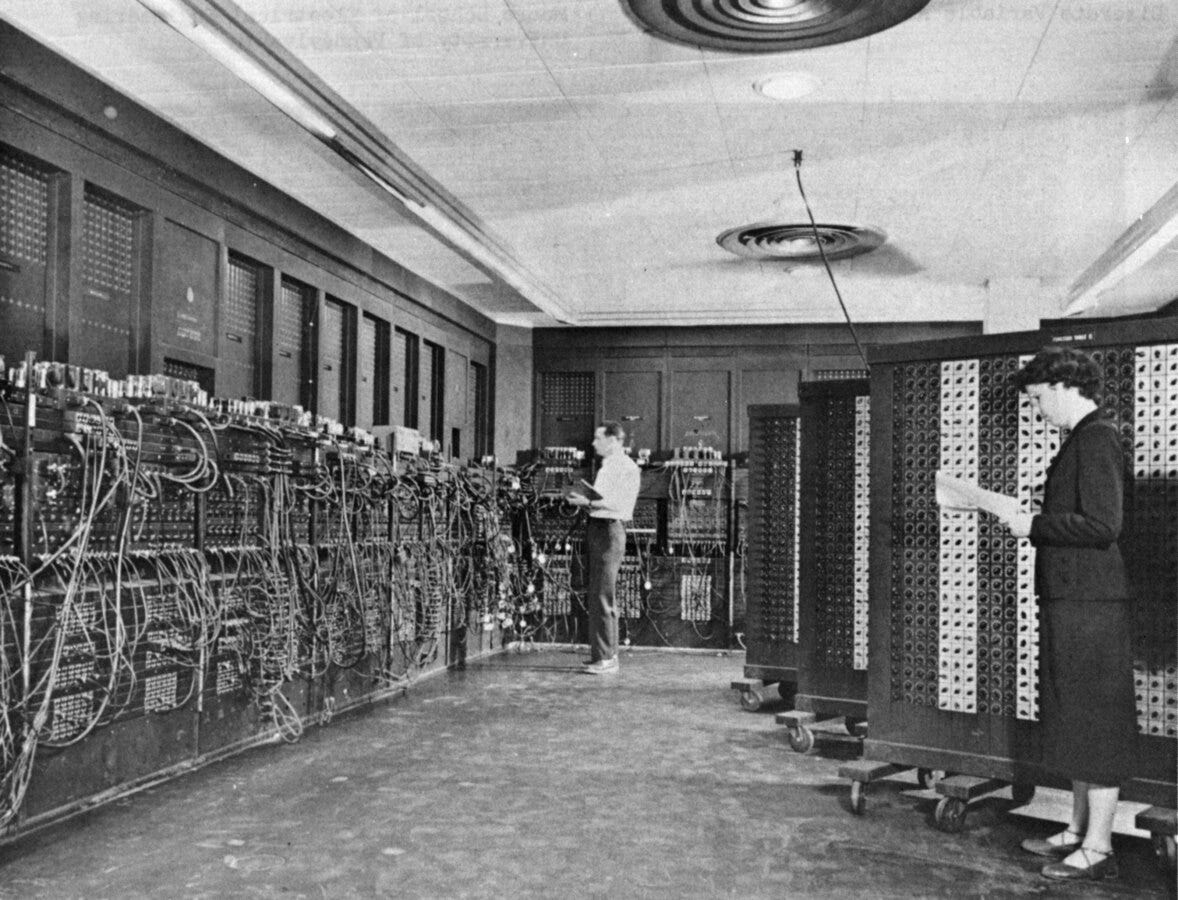
As such, the ENIAC, or Electronic Numerical Integrator and Computer of 1946, was the first general electronic computer system based on decimal and packet switches. John Mauchly and Presper Eckert designed ENIAC with the support of design engineers at Pennsylvania University.
ENIAC was largely a military system. It was funded by the US military and primarily designed for artillery firing tables and other calculations.

In 1946, the ENIAC system was also temporarily shut down. This was for a refurbishment, and then it was moved to Maryland. ENIAC was restarted at Aberdeen Proving Ground in 1947.
However, the ENIAC system had its limitations. As such, Eckert and Mauchly began designing a modified system. Most notably, ENIAC also had the attention of the prominent mathematician Von Neumann.

Von Neumann
The modified ENIAC later emerged in 1948. Most notably, this system included ROM-based storage, as suggested by Von Neumann.
At any rate, Von Neumann also had a hand in the design of the new system of EDVAC. This system would have stored programs and was also binary-based. EDVAC would not be complete until the late 1940s, so it is not considered the first computer. Overall, it was a progression from the first more limited ENIAC of 1946.

So, the first general electronic computer was ENIAC in 1946. This was in addition to the more modified ENIAC of 1948 and then EDVAC, which was released shortly after ENIAC. These systems were upgraded and ran up until 1961 when EDVAC was replaced.
메타데이터
- post_id
- d756e51cbb6f
- slug
- a-brief-history-of-the-first-computers-d756e51cbb6f
- url
- https://medium.com/@mav44233/a-brief-history-of-the-first-computers-d756e51cbb6f
- canonical_url
- https://medium.com/@mav44233/a-brief-history-of-the-first-computers-d756e51cbb6f
- author_url
- https://medium.com/@mav44233
- status
- ok
- fetched_at
- 2026-06-27 10:07:59