The Dark Reality of Modi’s India: A Youth Crisis
Didn’t Fail the Youth. Trapped Them in Exams So They Don’t Ask for Jobs.
Politics| Education
The Dark Reality of Modi’s India: A Youth Crisis
Didn’t Fail the Youth. Trapped Them in Exams So They Don’t Ask for Jobs.
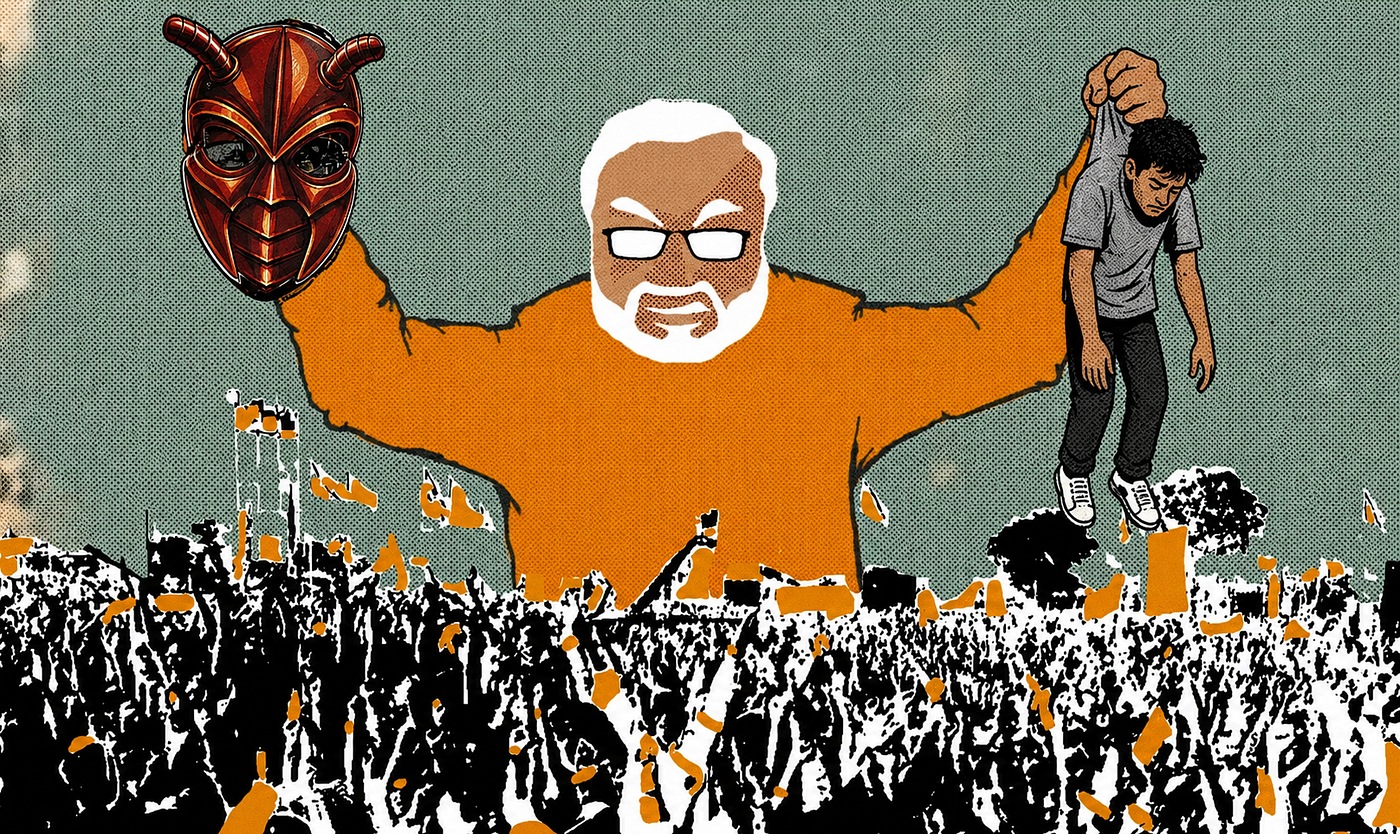
Image Edited By Author from AI, Originally graphic by Soham Sen, theprint
India often projects itself as a rising power, the world’s fastest-growing major economy, the most populous country, a leading voice of the Global South, and an aspiring superpower.
On the other side, the Western media pretends India is a country with immense poverty, corruption, overcrowded cities, and endless chaos. And a country which is still a so-called third-world country.
But certainly the reality lies somewhere in the grey zone.
India has certainly achieved remarkable economic and technological progress, but it is also struggling with deep structural problems which millions of people are facing every day.
One of the biggest is an education system that increasingly appears to be failing the very people it is supposed to reward.
Repeated paper leaks, unfair recruitment processes, poor exam administration, and a lack of accountability have eroded public trust for more than a decade.
But rather than handling this issue, the system seems intent on putting a blindfold over the eyes of ordinary Indians on the issue.
Resulted,
Across India, students are protesting after a series of major examination paper leaks that have shattered the hopes of millions of young people competing for government jobs and university admissions.
At the centre of this movement is “**Sonam Wangchuk”**, the educationist and climate activist.
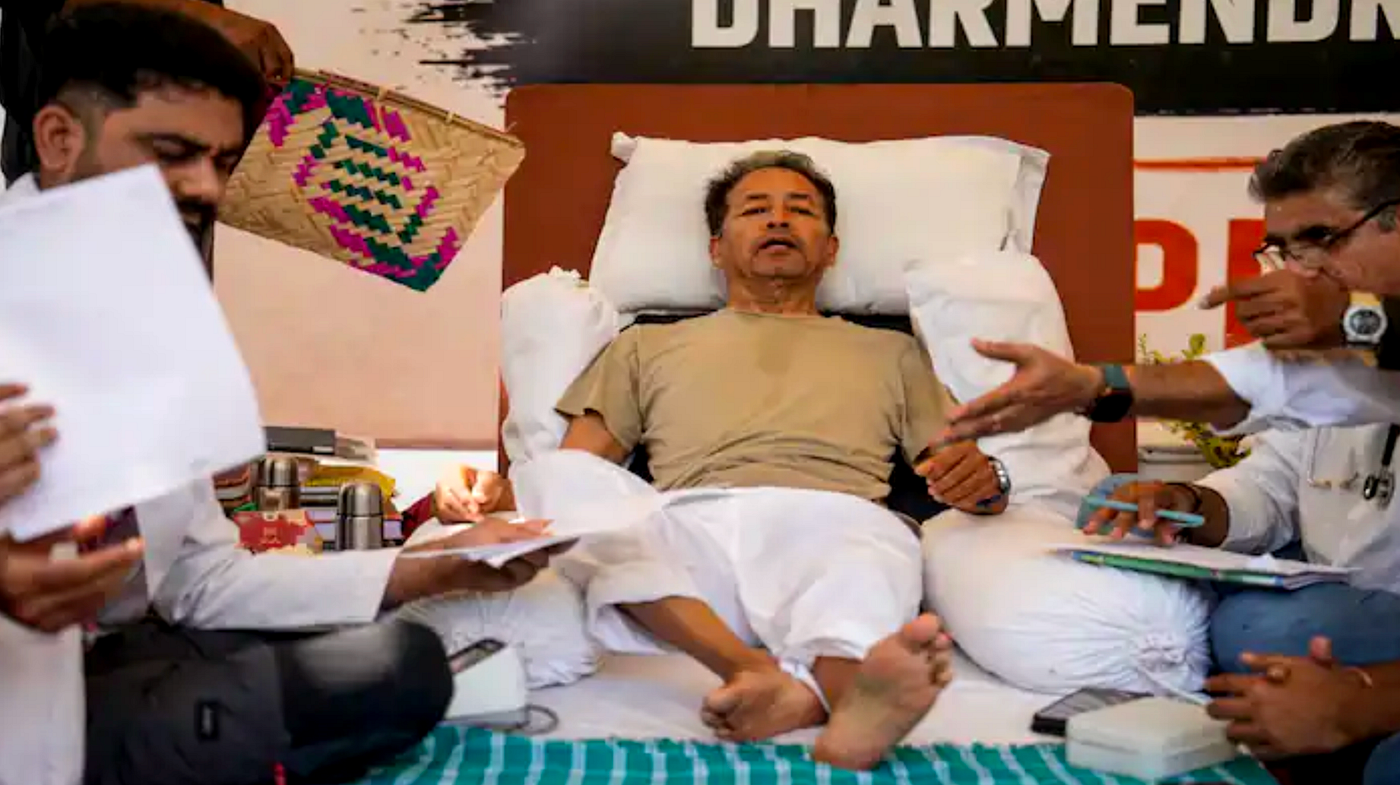
Sonam Wangchuk’s hunger strike enters day 18, appeals to end agitation grow, petition filed in HC (PTI)
Ironically, the person who inspired a movie, 3 Idiots, which itself is the most famous movie ever made about India’s broken education system.
Right now he is sitting on the huger strike, and it’s been 18 days so far in the scorching July heat of New Delhi.
Until now, he has lost 8.5 kilograms. His blood pressure has dropped to 109/70. The Delhi High Court is now hearing a petition asking whether he should be force-fed to prevent his death.
His demand is simple: the Education Minister should resign. Because the government has been leaking its own exams, destroying the futures of millions of students, and nobody has been held accountable.
But the indian govenemt, which pretend it’self a superpower on the world stage, is not ready to take accountability
You certainly need to understand the context behind the whole story
On May 15, 2026, India’s Chief Justice Surya Kant called unemployed youth and activists “cockroaches” and “parasites of society.”
Literally, the CJI (Head of the judges of the Supreme Court of India) of a country is calling unemployed people as insect.
He was referring to young people protesting exam fraud, people who had spent years of their lives preparing for government exams that turned out to be rigged.
Image by Mahendra Kohle AAP
The next day, a 30-year-old named Abhijeet Dipke did something no one expected.
He founded the Cockroach Janta Party, a satirical play on the ruling BJP’s full name (Bharatiya Janata Party). It started as a meme page. A joke. Within days, the CJP’s Instagram had 22 million followers. More than India’s main opposition party. More than most political parties on the planet.
What began as parody exploded into a channel for anger over exams, jobs, and a fraying sense of economic promise.
Since June, Dipke has been camped at Jantar Mantar — the historic protest ground near India’s parliament — refusing to leave until the Education Minister resigns.
The CJP is demanding sweeping exam reforms, accountability for paper leaks, and financial compensation for the families of students who died by suicide because of testing irregularities.
As certain news outlate called it as “a rare show of defiance against Prime Minister Narendra Modi’s 12-year rule.”
And the reality is that it’s not just about a few leaked exam papers. This is about the most sophisticated system of youth control ever constructed by a democracy.
The Numbers That Should Terrify You
Everyone focuses on one number: 937,000 people applied for India’s UPSC Civil Services exam in 2025. Only 958 were selected. A success rate of 0.1%.
But that 937,000 figure is a lie by omission. It only counts one year’s applicants. The real number, the number of people trapped inside the UPSC ecosystem at any given moment, is vastly larger.
The government allows up to 6 attempts for general-category candidates and up to 9 for certain reserved categories.
Each attempt cycle takes a full year of preparation. That means the 937,000 who applied this year include first-timers, second-timers, third-timers, and people on their sixth and final attempt. But it doesn’t count the hundreds of thousands who are taking a gap year between attempts, working dead-end jobs to fund the next try, or who dropped out of the cycle after three failed attempts and are now deciding whether to re-enter.
At any given moment, the actual number of Indians whose lives revolve around UPSC preparation isn’t 937,000. It’s conservatively 3 to 4 million.
Entire neighbourhoods in Delhi, Mukherjee Nagar, Old Rajinder Nagar, are cities within a city, populated entirely by UPSC aspirants living in tiny rented rooms, eating cheap meals, watching coaching videos, and waiting for an exam that will reject 99.9% of them.
And UPSC is just one exam.
NEET — the medical entrance exam — had 2.27 million students registered in 2026 for roughly 90,000 seats. The JEE engineering exam draws 1.47 million applicants for 60,000 seats. In 2018, Indian Railways received 19 million applications for 63,000 Group D posts, such as track maintenance and cleaning, that require only a 10th-grade certificate. Nineteen million people.
For cleaning jobs. The entire population of Romania applied for fewer positions than exist in a mid-size corporation.
India’s coaching industry services 75 to 100 million students competing for 1.2 million seats across all professional courses combined. At any given time, when you add the multi-year aspirants, the gap-year students, the part-time workers studying on the side, and the people preparing for state-level exams, such as SSC, banking, police, and teaching eligibility, the total number of Indians whose primary identity is “exam aspirant” is somewhere between 20 and 30 million people.
That’s the population of Australia. Sitting in rooms.
Studying. Waiting. Not working. Not protesting. Just preparing for an exam, most of them will never pass.
[embed]
The Leak Factory
Here’s the cruelty. These exams that tens of millions sacrifice their youth for? They can’t even be conducted honestly.
According to The Wire’s investigation, there have been 148 documented cases of exam fraud between 2015 and 2026, averaging 12 per year. Before 2015, paper leaks made up about 32% of fraud cases. After 2015, that number shot to 70%. Nearly 89 papers have been leaked in the last decade, leading to 48 re-examinations, affecting an estimated 100 million students.
Of those 148 fraud cases? One conviction. One. In eleven years.
The most recent disaster: NEET 2026. The medical entrance exam was held on May 3rd for 2.27 million students. Nine days later, the entire exam was cancelled after CBI investigators found that a pre-circulated “guess paper” from coaching centres in Rajasthan matched the actual questions. The same racket, investigators discovered, had also compromised NEET 2025. Two years in a row. The same gang. The same printing press.
Before that, the UGC-NET — the exam that qualifies you to become a university professor — was cancelled in June 2024 after cybercrime units found the paper online before the test was even over. And even the 2026 exam seems to be leaked for the same subject just after the Neet- UG leak. In Uttar Pradesh, the police constable recruitment exam was scrapped after affecting nearly 4.8 million applicants. The SSC exam was compromised in 2018. State teacher eligibility tests. Railway recruitment exams. The list never ends.
A country that sends rockets to the Moon and builds nuclear submarines cannot conduct a paper-based exam without someone photographing the question paper in a printing press bathroom.
148 cases. One conviction. A hundred million students cheated. And the Chief Justice calls them cockroaches.
Ironically, an examination paper is only called a “paper leak” once it is exposed. The cases that make headlines are simply the ones that are discovered.
There may have been hundreds of other exams where question papers were compromised but never detected. Without evidence, they are never officially recorded as leaks — even if the integrity of the examination was quietly undermined.
There is a number that the Indian media reports with the detachment of a weather forecast
93 suicides linked to NEET alone since 2021. Four in 2021. Nine in 2022. Fourteen in 2023. Nineteen in 2024. Thirty-two in 2025.
And 14 already in 2026 — five of them after the cancellation of the leaked exam was announced on May 12th.
After the NEET 2026 cancellation, 13 suicides were reported directly linked to the paper leak scandal. Ahead of the re-exam scheduled for June 21, 12 more students killed themselves in just 37 days.
Research published in the National Institutes of Health shows that 65% of students preparing for competitive exams experience high stress, with 42% exhibiting clinical depression symptoms.
And then there’s Kota, Rajasthan — India’s “coaching capital.” A small desert city where over 200,000 teenagers from across the country used to arrive every year to prepare for NEET and JEE in factory-style coaching centres. Many are 15, 16, 17 years old, sent by parents who have mortgaged their homes to pay for coaching fees.
Twenty-six students died by suicide there in 2023. The number dropped to 17 in 2024 — not because the system got kinder, but because enrollment collapsed from 250,000 to roughly 85,000. Fewer students, fewer deaths. The math is that simple and that grotesque.
The $6 Billion Machine That Feeds on Failure
Who benefits from keeping tens of millions of young Indians trapped in an endless cycle of exam preparation?
Follow the money. India’s coaching industry is valued at over $6 billion and projected to hit $18 billion by 2030.
This is not an education sector. This is a failure-monetisation machine. Because the coaching industry doesn’t make money from the 0.1% who clear exams. It makes money from the 99.9% who don’t — and come back next year.
Think about the incentive structure. If UPSC selects 958 people out of 937,000 applicants, that’s roughly 936,000 potential repeat customers. Each pays thousands of dollars in coaching fees. Each buys another year of test series, mock exams, and “guaranteed selection” courses. Multiply that across NEET, JEE, SSC, banking exams, state services, and the coaching industry has an annual customer base of millions of people who have already failed once and will pay anything to avoid failing again.
And the government helps this machine run. How? By expanding the number of attempts. UPSC allows up to 6 attempts for general-category candidates. Some state exams have no attempt limit at all.
On the surface, this looks compassionate — give young people more chances. In reality, it’s the perfect trap. Every additional attempt is another year a young person spends outside the job market, outside the workforce, outside political engagement. They’re not unemployed — they’re “aspirants.” They’re not demanding jobs — they’re “preparing.” The language itself hides the crisis.
And then there’s the glorification. Every year, newspapers run front-page profiles of the UPSC topper. Television channels broadcast their faces for days. Coaching centres plaster their photos on billboards across the country.
The story is always the same: the auto-rickshaw driver’s daughter who became an IAS officer. The son of a vegetable seller who cracked the exam on his fifth attempt. The message to the other 936,000 is: look how glorious this is. This could be you. Keep trying. Keep paying. Keep waiting.
The Trap: Why This Is Not a Bug — It’s a Feature
India has 1.4 billion people. It adds roughly 12 million young people to the job market every year. Youth unemployment rose to 15.2% by March 2026 and keeps climbing.
For young women, it’s 17.7%. Applications per open role on LinkedIn have more than doubled since 2022. Only 2–3% of job applications lead to an interview.
Now imagine if those 20 to 30 million “aspirants” weren’t sitting in coaching centres and tiny rented rooms with their heads buried in textbooks. Imagine if they were on the streets instead.
Demanding jobs. Demanding an industrial policy that actually creates employment. Demanding accountability for an economy that produces tech billionaires but not livelihoods for the majority.
The exam system prevents that. It is, whether by design or by decades of convenient neglect, the most effective crowd-control mechanism ever invented by a democracy. It works like this:
Step one: create a handful of prestigious government positions, IAS, IPS, IFS, and glorify them until they become the only definition of success for hundreds of millions of families.
Step two: allow millions to apply, but select fewer than a thousand.
Step three: expand the number of attempts so the rejected don’t give up — they try again, spending another year out of the job market.
Step four: build a $6 billion coaching ecosystem that monetises the gap between hope and reality.
Step five: When exams are leaked, and the whole system is exposed as fraudulent, call the protesters cockroaches.
The result? Tens of millions of India’s most educated, most ambitious, most politically dangerous young people spend the prime years of their lives locked in individual competition rather than collective action. They don’t march on parliament. They don’t demand structural economic reform. They don’t organise unions or political movements. They go back to their rooms and start preparing for the next attempt.
The exam system turns a structural failure of the economy, not enough jobs, into a personal failure of the individual — you didn’t study hard enough.
It tells 20 million young people: the problem isn’t the system. The problem is you.
And for the first time, the warehouse is on fire.
The Cockroach Janta Party has 22 million followers. Sonam Wangchuk is starving at Jantar Mantar and Bloomberg is covering his deteriorating health. CNN is calling it a viral youth movement.
The CJP protest has entered its 26th day, and the government has maintained total silence.
what India’s exam system really is, stripped of all pretence. It is a country of 1.4 billion people that produces 75 million students every year, feeds them into a $6 billion coaching industry, makes them compete for 1.2 million seats across all professional courses, leaks their papers 148 times in 11 years with exactly one conviction, watches 93 of them die in five years from NEET pressure alone, and when they finally protest, the Chief Justice of the country calls them cockroaches and the Education Minister refuses to even acknowledge the hunger strike outside his office.
For decades, this system worked perfectly. Millions of young Indians poured their energy, their parents’ savings, and the best years of their lives into a machine that was designed to reject them — and then convinced them the rejection was their own fault. Not the economy’s failure. Not the government’s failure. Yours. Study harder. Try again. Six attempts allowed.
For the first time in modern Indian history, they’re studying the system itself. And what they’re finding is that the examination system was never designed to select the best.
It was designed to keep the rest quiet.
You can call them cockroaches. You can call them parasites. You can let a 68-year-old man starve for 18 days while the government pretends nothing is happening. But the thing about cockroaches is — you can’t kill them all. And 22 million of them just woke up.
IndiaNEETUPSCYouth ProtestEducationCockroach Janta PartyUnemploymentSonam Wangchuk
메타데이터
- post_id
- d758e95c8dd3
- slug
- the-dark-reality-of-indias-exam-system-d758e95c8dd3
- url
- https://medium.com/the-geopolitical-economist/the-dark-reality-of-indias-exam-system-d758e95c8dd3
- canonical_url
- https://medium.com/the-geopolitical-economist/the-dark-reality-of-indias-exam-system-d758e95c8dd3
- author_url
- https://medium.com/@vikas162202
- status
- ok
- fetched_at
- 2026-07-17 06:05:59