The Navy Spent 4 Weeks Trying to Sink Its Own Carrier
April 19th, 2005. Hundreds of miles off the Virginia coast.
The Navy Spent 4 Weeks Trying to Sink Its Own Carrier
[embed]
April 19th, 2005. Hundreds of miles off the Virginia coast.
A retired American supercarrier, the USS America, sits motionless in the deep Atlantic. No crew aboard. No aircraft on her deck. She has been towed here for a single purpose. To die.
The U.S. Navy wants to know, with hard data, exactly how difficult it is to kill one of its own carriers. So for the next four weeks, they will try.
Bombs fall from the air. Missiles strike from the surface. Torpedoes drive in beneath the waterline. The explosions hammer the ship day after day, above, below, inside. And day after day, the America stays afloat.
After nearly a month of escalating violence, the Navy gives up trying to sink her from a distance. The only way to put their own carrier on the seabed is to board her and place demolition charges by hand. On May 14th, the bow finally tips beneath the waves. She comes to rest upright and largely intact, nearly three miles down.
That was a carrier launched in the 1960s. And it took the most powerful navy on Earth four weeks to put her under.
Today’s carriers are built tougher.
So how, exactly, do you sink a ship designed to refuse?
To understand why a carrier resists destruction, you first have to understand what one actually is.
A Nimitz-class supercarrier, the workhorse of the current American fleet, displaces more than one hundred thousand tons of water. She measures over a thousand feet from bow to stern, and from keel to mast top, she stands twenty-five decks high. Larger than any battleship ever launched. Larger than the great ocean liners.
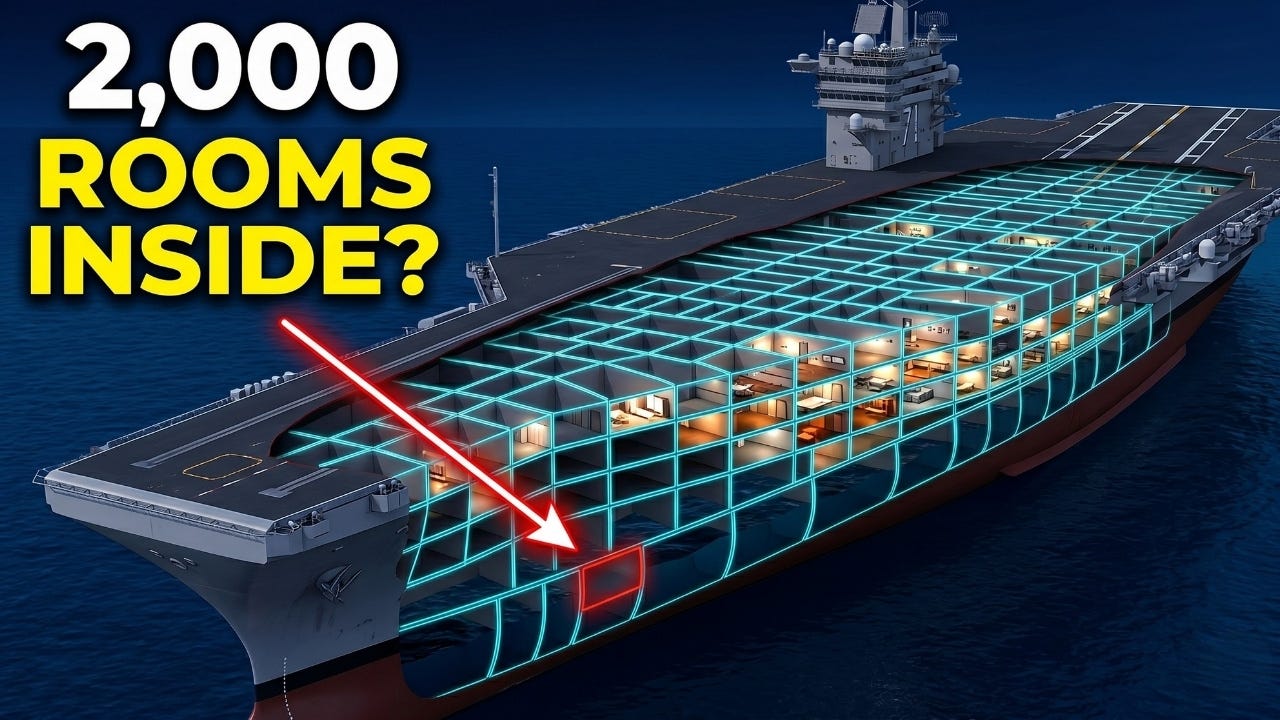
Inside her hull are more than two thousand separate compartments, sealed off from one another by hundreds of watertight bulkheads. Aboard live five thousand sailors. Above her flight deck sit some seventy combat aircraft. And beneath her decks burn nuclear reactors capable of running the ship for more than twenty years without refueling.
A carrier is not, in any meaningful sense, a ship. It is a sovereign military base, the size of a small town, that happens to move at thirty knots across open ocean.
But sheer size is only half of why these vessels are so hard to kill.
The other half is that a carrier never, ever, fights alone.
To reach her, an incoming weapon has to cross three layered rings of defense before it can even touch the hull.
The outermost ring begins two hundred miles away.
The first thing standing between an enemy weapon and an American aircraft carrier is not a wall, a missile, or a hull.
It is an airplane.
Long before any threat reaches the strike group, fighters from the carrier’s own air wing are already in the sky. F/A-18 Super Hornets and F-35C Lightning IIs fly what’s called Combat Air Patrol, known throughout the fleet simply as CAP, orbiting in pre-assigned arcs hundreds of miles from the ship. Their job is uncomplicated. Nothing reaches the carrier. Nothing comes close enough to try.
Above them, even higher and farther out, flies the aircraft that makes the entire defensive picture possible: the E-2D Hawkeye. A propeller-driven plane with a massive rotating radar dome bolted to its back, the Hawkeye can see over the curvature of the Earth itself. It tracks hundreds of contacts at once: aircraft, missiles, surface vessels. And it pipes that information to every fighter, every destroyer, every screen in the strike group.
Nothing flies toward an American carrier in secret. The horizon, as far as the strike group is concerned, has been pushed back two hundred miles.
By the time a hostile aircraft or cruise missile has been spotted, fighters are already being vectored to intercept. The shot is taken long before the threat gets within sight of the carrier’s mast.
But fighters can be evaded. Missiles can come in low, fast, and from multiple directions at once.
When that happens, the second ring takes over.
A carrier never sails alone. She moves at the center of a formation called a Carrier Strike Group, typically built around two or three Aegis-equipped destroyers of the Arleigh Burke class, a Ticonderoga-class cruiser, at least one nuclear-powered attack submarine prowling somewhere beneath the surface, and a supply ship keeping the entire formation fed and fueled.
And even all of this might not be enough. Because we haven’t talked yet about what happens when a weapon actually hits the hull.
The destroyers and cruisers are the hard core of the defensive screen. Each one carries the Aegis Combat System: a network of phased-array radars, fire-control computers, and vertical launch cells, all wired into a single integrated picture of the battlespace. The radars don’t rotate. They sweep the sky in milliseconds with electronic beams.
When a target appears, the destroyer can fire SM-6 interceptors. Long-range missiles capable of killing high-altitude aircraft, sea-skimming cruise missiles, and even ballistic warheads in the upper atmosphere.
This is not theoretical. In the Red Sea in 2024, American destroyers used these exact systems to shoot down ballistic missiles and drones fired by Houthi forces. It was the first time in history that a U.S. warship intercepted a ballistic missile in combat. The technology works. And it scales: a single Aegis ship can track and engage dozens of incoming threats simultaneously.
Below the waves, the strike group’s submarine listens. Anything trying to approach from the deep is hunted long before it reaches firing range.
But missiles are fast. Some will get through.
And when one slips past the Aegis ring, only seconds remain.
By the time a missile penetrates the Aegis screen, it is already within twenty miles of the carrier and closing at speeds approaching one mile every two seconds. The defense now compresses into a frantic, last-ditch envelope measured not in distance, but in heartbeats.
The carrier itself answers in layers. Mounted on her flight deck and superstructure are launchers for the Evolved Sea Sparrow Missile, or ESSM, a medium-range interceptor that can pull twisting maneuvers no aircraft could survive, hunting cruise missiles that skim just feet above the water. Backing it up is the Rolling Airframe Missile, RAM, firing from a twenty-one-round launcher and locking onto the heat or radar signature of whatever the ESSM missed.
And if even those fail, the carrier has one final hard-kill defender. It looks almost cartoonish: a squat white dome topped with a six-barreled Gatling cannon, nicknamed throughout the Navy R-two D-two. It is the Phalanx Close-In Weapon System. When a threat closes inside a few hundred yards, the Phalanx spins up and throws thousands of rounds of tungsten through the air every minute.
By this point, the carrier has been defended in depth across hundreds of miles, by aircraft, destroyers, submarines, missiles, and finally by its own guns.
But suppose, somehow, against every single layer, a weapon still strikes the hull.
That is where the ship itself takes over.
A modern American carrier is not really one ship. It is more than two thousand ships, stacked into one.
Her hull is divided into over two thousand watertight compartments, sealed off from one another by hundreds of transverse and longitudinal bulkheads. Steel walls running both lengthwise and crosswise through the vessel. If a torpedo or missile breaches the outer skin, only the compartments directly affected take on water. The rest of the ship remains dry, sealed, and operational. Damage control teams, drilled relentlessly for exactly this moment, close hatches, shore up bulkheads, and isolate the flooding within minutes.
The hull along the waterline is itself a layered structure. High-strength alloy steel backed by a torpedo protection system designed to absorb massive underwater detonations without rupturing the inner hull. Above the waterline, critical spaces are armored with Kevlar spall liners several inches thick, intended to stop the storm of fragments that would otherwise scythe through compartments after a hit.
And everything aboard is redundant. Power can be rerouted. Propulsion has backups. Steering, command, communications. All built in duplicate or triplicate. A carrier is engineered around a single principle: no single hit, and no five hits, should ever be enough.
Which brings us back to the USS America.
That carrier, struck repeatedly by missiles, bombs, and torpedoes over four full weeks in the open Atlantic, refused to sink because she was built exactly this way.
And she was a ship built over forty years earlier.
The Nimitz and Ford-class carriers in service today are tougher still.
The last American aircraft carrier sunk by enemy action was the USS Bismarck Sea, struck by two kamikaze aircraft off Iwo Jima on February 21st, 1945.
More than eighty years have passed.
In that time, the world has seen jet aviation, supersonic missiles, nuclear submarines, satellite targeting, and now hypersonic weapons designed specifically to defeat carrier defenses. Nations like China have built entire military doctrines around the idea of anti-access and area-denial, aimed at threatening the American carrier from a thousand miles offshore.
The threat is real. Modern weapons may yet damage a carrier. They may kill some of her crew. They may degrade her mission, force her home for repairs, and shake the assumptions on which decades of naval planning have rested.
But sinking one, putting one hundred thousand tons of steel, redundancy, armor, and resolve onto the seafloor, is something else entirely.
The USS America took four weeks of deliberate, escalating violence to put under. And even then, her own Navy had to board her with demolition charges by hand.
And right now, in shipyards in Virginia, the next generation of American carriers is already taking shape. Bigger reactors. Smarter defenses. Hulls designed against weapons that did not even exist when the America first slid down the slipway.
The question is no longer whether a carrier can be sunk.
The question is whether anyone, anywhere, will ever manage it again.
메타데이터
- post_id
- d7641ef42ecb
- slug
- the-navy-spent-4-weeks-trying-to-sink-its-own-carrier-d7641ef42ecb
- url
- https://medium.com/@officialengineeredexplained/the-navy-spent-4-weeks-trying-to-sink-its-own-carrier-d7641ef42ecb
- canonical_url
- https://medium.com/@officialengineeredexplained/the-navy-spent-4-weeks-trying-to-sink-its-own-carrier-d7641ef42ecb
- author_url
- https://medium.com/@officialengineeredexplained
- status
- ok
- fetched_at
- 2026-07-17 16:16:29