JJ Gibson — almost as if he designed his theories while hanging from a cliff face!
James J. Gibson reshaped how we think about perception by shifting the lens from internal processing to the meaningful, action-oriented…
JJ Gibson — almost as if he designed his theories while hanging from a cliff face!
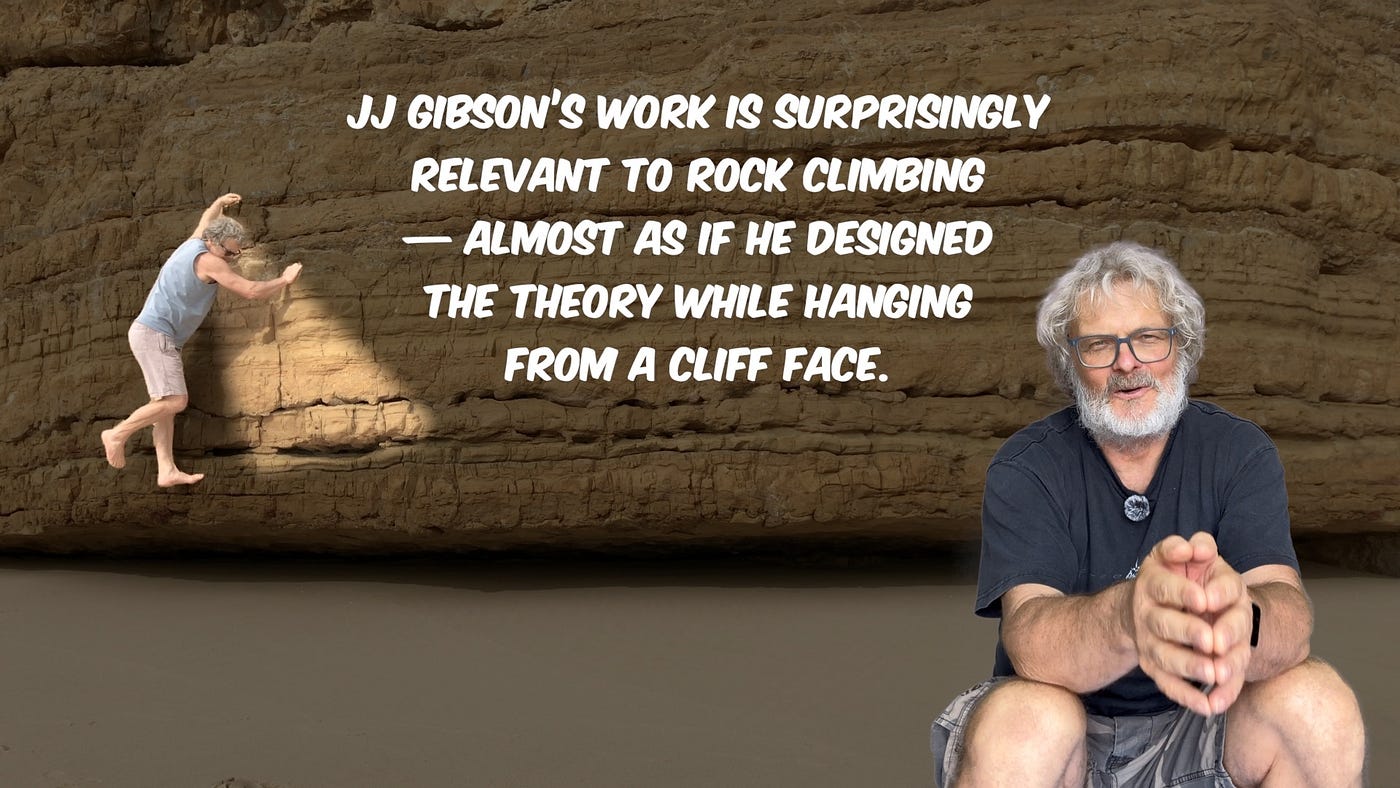
Gibson’s work is surprisingly relevant to rock climbing — almost as if he designed the theory while hanging from a cliff face!
James J. Gibson reshaped how we think about perception by shifting the lens from internal processing to the meaningful, action-oriented information available directly in our environment. His theories continue to inform diverse domains where understanding how people interact with their surroundings is essential — from aviation safety and technology to design and even… Climbing!

My coaching and my new book https://udini.com/produkt/climbing-performance-coaching/ is greatly inspired by JJ Gibson’s work.
Gibson’s work is surprisingly relevant to rock climbing — almost as if he designed the theory while hanging from a cliff face. Gibson is the pioneering psychologist behind ecological theories of perception. He transformed our understanding of perception by showing that it’s less about internal inference and more about an organism directly engaging with the world. He for instance termed the opportunities of an environment Affordances. And these affordances constitute what our environment means to us. When we look around we are constantly surrounded by affordances and thus: meaning.
[embed]
Gibson’s Landmark Publications are:
- The Perception of the Visual World (1950): Detailed mechanisms like texture and motion gradients that support depth perception .
- The Senses Considered as Perceptual Systems (1966): Broadened his theory to incorporate all sensory modalities .
- *The Ecological Approach to Visual Perception* (1979): Culminated his lifelong theoretical development, framing perception in ecological terms and introducing affordances fully.

Ecological Psychology???
Many people and even psychology students are irritated by the term “Ecological Psychology”, so let me tell you what it means and why I think it is worth considering for climbing coaches. Lets look for example observe how differently Perception is looked at in the different psychology schools. In Cognitive psychology Perception is indirect. Sensory input is often incomplete or ambiguous, so the brain must “construct” reality using internal representations, memory, and inference.
In Ecological psychology on the other hand Perception is direct. The environment contains rich, structured information that organisms can detect without reconstructing it internally. Therefore environment is inseparable from perception and action. Organisms pick up affordances — opportunities for action — directly from their surroundings.
Ecological psychology is a branch of psychology that studies perception, action, and cognition in relation to an organism’s environment. It emphasizes that behavior cannot be fully understood by looking only at what happens inside the brain; instead, it must be understood in terms of the continuous interaction between organisms and their surroundings.
The field was founded largely by James J. Gibson in the mid-20th century. His key ideas include:
• Direct perception: Organisms can pick up information directly from the environment without needing to construct complex internal representations.
• Affordances: The environment offers possibilities for action (e.g., a chair affords sitting, a handle affords pulling), which are perceived in relation to an organism’s abilities.
• Information in the environment: The structure of light, sound, and other energy patterns contains usable information that guides action.
In short, ecological psychology views perception and action as deeply intertwined with the environment, focusing on how organisms actively explore and engage with their world.

The Visual Cliff Experiment (Eleanor Gibson & Richard Walk) demonstrated that crawling infant’s perception becomes attuned to the affordance of danger.
The contrast between ecological psychology and mainstream cognitive psychology
The contrast between ecological psychology and mainstream cognitive psychology is one of the core debates in psychology. Here’s a breakdown:
View of Perception
- Cognitive psychology: Perception is indirect. Sensory input is often incomplete or ambiguous, so the brain must “construct” reality using internal representations, memory, and inference.
- Ecological psychology: Perception is direct. The environment contains rich, structured information that organisms can detect without reconstructing it internally.
Role of the Environment
- Cognitive psychology: The environment is mainly a source of raw data (stimuli) that the brain interprets.
- Ecological psychology: The environment is inseparable from perception and action. Organisms pick up affordances — opportunities for action — directly from their surroundings.
Representations
- Cognitive psychology: Mental representations are central; cognition involves processing symbols or images in the mind.
- Ecological psychology: Mental representations are unnecessary or downplayed; behavior can be explained by the real-time coupling of perception and action.
Action and Cognition
- Cognitive psychology: Perception and action are often studied separately; the mind “processes” information and then tells the body how to act.
- Ecological psychology: Perception and action are inseparable — organisms perceive in order to act, and act in order to perceive.
Methods
- Cognitive psychology: Often lab-based, focusing on controlled tasks and measuring mental processes (e.g., reaction times, memory recall).
- Ecological psychology: Emphasizes studying behavior in naturalistic settings, where perception–action cycles unfold in real environments.
In summary:
- Cognitive psychology = mind as an information processor, working with representations.
- Ecological psychology = mind as part of a dynamic organism–environment system, with direct access to meaningful information.

Climbing Performance Coaching, p.406
Rock climbing highlights the difference between ecological and cognitive psychology
Cognitive Psychology Perspective
- Perception: Climbers see holds as visual input, which must be interpreted and represented mentally. They may construct a “mental map” of possible moves.
- Action planning: Before moving, climbers mentally simulate sequences (e.g., “left hand to that crimp, right foot to that ledge”), relying on memory, problem-solving, and internal representations.
- Skill emphasis: Training focuses on improving internal processes like route visualization, working memory, and strategic planning.
Example: A climber studies a route from the ground, memorizes hold sequences, and mentally rehearses the climb before starting.
Ecological Psychology Perspective
- Perception: Climbers directly perceive affordances — possibilities for action in relation to their body (e.g., “that hold is reachable with my left arm,” “that ledge affords stable footing if I shift weight”).
- Action planning: Movement unfolds through continuous perception–action coupling, not detailed pre-planning. Climbers adjust in real time as they explore holds.
- Skill emphasis: Training develops attunement — the ability to detect relevant environmental information — and effectivities (the climber’s physical abilities) that shape which affordances are usable.
Example: A climber dynamically tests grips and shifts body position while climbing, relying less on a pre-mapped plan and more on real-time interaction with the rock.
Active Touch
Gibson’s “active touch” is very relevant to climbing — in fact, climbers use it almost constantly, even if they don’t realize it.
What “Active Touch” Means
Gibson distinguished between passive touch (just feeling something pressed against your skin) and active touch (moving your body or fingers to explore and gather information). In active touch, movement is part of perception — you’re not just receiving sensation, you’re probing the world for affordances.

Olympian Lucia Dörfel using Active Touch to exploit the affordances of a hand hold
What “Active Touch” Means
Gibson distinguished between passive touch (just feeling something pressed against your skin) and active touch (moving your body or fingers to explore and gather information). • In active touch, movement is part of perception — you’re not just receiving sensation, you’re probing the world for affordances.

From my new book Climbing Performance Coaching, p.426
Affordances
Affordances are opportunities for action that are both athlete and frame-dependent. The Greek philosopher Heraclitus stated,
“No man ever steps in the same river twice, for it’s not the same river and he’s not the same man.”
This notion implies that no two experiences are the same, which means the perception of affordances is highly context-dependent and influenced by the interacting constraints on behavior.
The verb to afford is found in the dictionary, but the noun affordance is not. James J. Gibson made it up to refer to both the environment and the animal in a way that no existing term does. It implies the complementarity of the us and the environment. Climbing walls are climb-on-able when the holds and volumes are grasp-able and reachable (not too far apart). These relationships are scanned by the competitors first. Different layouts afford different behaviors for different climbers, and different mechanical encounters.
Moreover, whether the climber chooses to act on an affordance is highly individualized. Affordance perception can be influenced by many factors, including but not limited to height, age, experience, intentions, and previous injury history. These individual factors tend to be more obvious and more understood. But other factors such as situation, tactics, position, conditions, and intentions can differ from moment to moment and also play an important role in affordance perception.
The ability to detect individual affordances lies at the heart of climbing.

Boulder problems require solutions that work. What “works” in each case and what leads to success, depends entirely on the individual climber and an individual’s unique movement requirements. The requirements and options of a boulder problem are its Affordances. Affordances are possibilities for motor action. Actions are possible only when there is a fit between your physical capabilities and the behaviorally relevant features of your environment.

The ability to detect individual affordances lies at the heart of climbing
To be pinch-able, a hold must have opposite surfaces separated by a distance less than the span of the hand. So, what is graspable for a climber with big hands might be not for a climbers with small hands. Affordances don’t cause movement behaviors; they only channel or constrain them. Additionally, the perception of affordances depends on the skill level of the performer, where their action capabilities open up the possibilities.

Affordances in Climbing
- In climbing, affordances are the possibilities for action the rock offers — a crack that affords jamming, a ledge that affords standing, a hold that affords crimping.
- Importantly, these affordances depend on your body and skill: a tiny edge might afford standing for an experienced climber with strong footwork, but not for a beginner.
- This matches Gibson’s idea that affordances are relative to the perceiver.
Direct Perception & Environment Interaction
- Climbers don’t calculate every move using abstract mental geometry; they see a hold and know instantly how they might use it.
- Gibson’s direct perception theory says the environment provides sufficient information — you perceive climbable features directly without reconstructing the scene in your head.
Invariants & Optical Flow
- As you move up a wall, certain visual patterns remain stable (e.g., the shape of a jug, the width of a crack) — these are invariants that help you judge reachability and stability.
- Changes in the visual scene while moving (the “optical flow”) help you gauge distance, body position, and balance.
Skill Learning & Perceptual Tuning
- Over time, climbers learn to detect subtler affordances: small thumb catches, friction changes, or balance points that a novice wouldn’t notice.
- This is perceptual attunement — Gibson’s idea that practice tunes your senses to pick up the most useful environmental information for your activity.
Ecological Approach to Risk & Decision-Making
- Choosing a route or committing to a move is about perceiving not just what the rock “is” but what it allows you to do safely given your physical state, fatigue, and available protection.
- This fits the ecological perspective: perception is always embedded in an action context.

Climbers should learn adaptability and perceptual attunement, not just rote memorization of moves.
Why It Matters in Practice
Route setting: A cognitive approach might design routes that test memory of sequences, while an ecological approach would design routes that emphasize balance, body positioning, and exploration.
Training and Practice:
- Cognitive: visualization exercises, practicing mental rehearsal.
- Ecological: varied practice in natural rock environments, learning to perceive new affordances (e.g., how a tiny edge can support weight when body position changes). Ecological psychology suggests climbers should learn adaptability and perceptual attunement (responding to unexpected slips for instance), not just rote memorization of moves.
So, in short:
- Cognitive psychology treats climbing as solving a problem in your head, then executing.
- Ecological psychology treats climbing as exploring and responding to the environment in real time.
The ecological approach to coaching highlights the close link between athletes and their environment. It believes that perception is direct and that athletes can learn effectively through well-structured practice environments that provide clear information. By focussing on system shaping and encouraging exploration and movement, coaches help athletes develop skills and improve performance.
Ecological psychology emphasises the role of intention in shaping perception and action, challenging the traditional view of the brain as a storage device. Instead of drills that create representations, coaches should design tasks with meaningful goals that allow athletes to adapt and evolve their perceptual-action systems. This approach, based on the idea that experience alters how an organism acts and perceives, encourages athletes to discover effective patterns through exploration and interaction with the environment.
Ecological psychology emphasises the inseparable link between perception and action, suggesting that athletes should engage in drills that encourage exploration and movement to sharpen their perception-action loop. It rejects pre-programmed explanations and focuses on designing situations where coordinated patterns emerge naturally. By aligning practice environments with ecological psychology, athletes can evolve their perceptual-action systems and become more adaptable and skilled.

Janja Garnbret detecting individual affordances
J. J. Gibson’s research arc
Here’s a crisp tour of J. J. Gibson’s research arc — what he worked on, when, and why it mattered.
Early career (late 1920s–1930s): from Gestalt to perception problems
Gibson trained at Princeton (B.S. 1925, M.A. 1926, Ph.D. 1928), then joined Smith College, interacting with Gestalt psychologist Kurt Koffka. This set the stage for Gibson’s lifelong focus on lawful structure in stimulation rather than inner “constructions.”
WWII (1942–46): aviation and the birth of optic flow
Leading a U.S. Army Air Forces research group, Gibson studied pilots’ space perception for flight and landing, training methods, and visual guidance. From these very applied problems emerged the idea that global patterns of visual motion specify self-motion and layout — what he later called “optic flow.” He also emphasized surface layout and texture gradients as information for slant and distance.
1950 — The Perception of the Visual World: ecological optics begins
In this book Gibson argued that perception picks up information already present in the ambient optic array, introducing optic flow and texture gradients as invariants specifying the environment. It was a break from cue/constructivist views and a bridge from aviation work to a general theory.
1960s — Direct perception & “perceptual systems”
At Cornell, Gibson reframed the senses as active “perceptual systems” that explore the world to detect invariants, not passive channels delivering sensations. The 1966 book The Senses Considered as Perceptual Systems consolidated this stance and expanded ecological optics into a general psychology of perception.
Late 1970s — Affordances and the full ecological approach
Gibson introduced the construct of affordances — action possibilities offered by the environment to an animal — arguing they are specified in ambient information and perceived directly. The mature synthesis appears in The Ecological Approach to Visual Perception (1979), which binds perception to action (locomotion, manipulation), information pickup to invariants over time, and behavior to the environment’s affordances.

Core concepts he developed and refined
- Optic flow: global motion pattern specifying self-motion and layout (e.g., expansion during approach).
- Texture gradients & surface layout: lawful changes in texture density specify surface slant and distance.
- Direct perception / information in the array: invariants in stimulation specify the world, reducing the need for internal reconstruction.
- Affordances: opportunities for action defined in organism–environment relations, perceived without inference.
Influence and legacy
Gibson’s ecological program reshaped vision science, ecological psychology, and applied areas from aviation to human–computer interaction and robotics (via affordances). It remains an active research tradition, frequently revisited in historical and theoretical summaries.

Thanks for reading, as you can tell — my coaching and my new book are greatly inspired by JJ Gibson. I barely scratched the surface of his work, here you can find much deeper insight:
[embed]
[embed]
[embed]
And finally, here is some great historic footage:
[embed]
[embed]
메타데이터
- post_id
- d76e471cdda1
- slug
- jj-gibson-almost-as-if-he-designed-his-theories-while-hanging-from-a-cliff-face-d76e471cdda1
- url
- https://medium.com/klettertraining-in-english/jj-gibson-almost-as-if-he-designed-his-theories-while-hanging-from-a-cliff-face-d76e471cdda1
- canonical_url
- https://medium.com/klettertraining-in-english/jj-gibson-almost-as-if-he-designed-his-theories-while-hanging-from-a-cliff-face-d76e471cdda1
- author_url
- https://medium.com/@udini
- status
- ok
- fetched_at
- 2026-06-10 08:17:25