Cramps Are Never Just Cramps
Perimenopause cramps are often more than physical discomfort. A reflective exploration of pain, hormones, stress, and the body’s changing…
Cramps Are Never Just Cramps
Perimenopause cramps are often more than physical discomfort. A reflective exploration of pain, hormones, stress, and the body’s changing language.
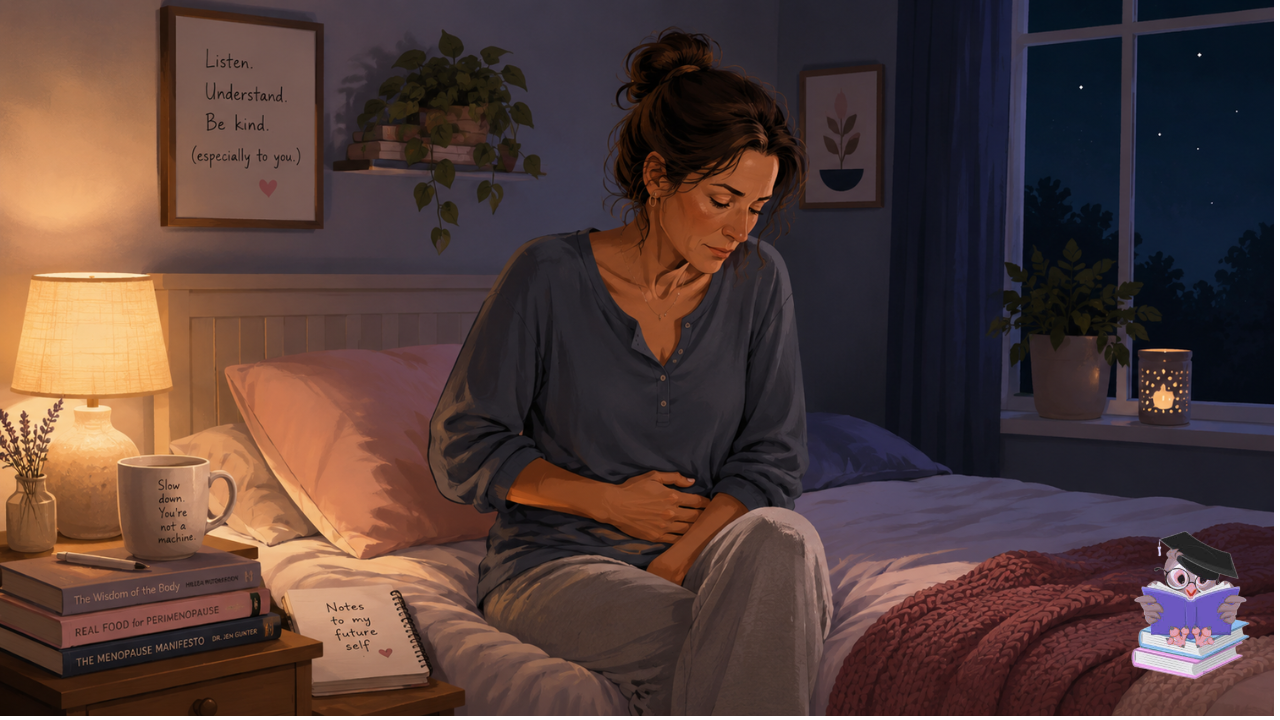
There are pains that arrive dramatically, loud enough to interrupt your life. And then there are pains that slip in quietly, sit beside you uninvited, and refuse to leave.
Cramps belong to the second category.
They don’t scream, they don’t collapse you onto the floor, they don’t necessarily stop the day from moving forward.
But they linger.
And perhaps that’s precisely the problem.
Many of us grew up believing that “real pain” was only the kind that justified complete surrender. The kind that confined you to bed, cancelled plans, demanded sympathy.
Only that kind of pain deserved to be taken seriously.
Everything else? Annoyances. Hormones. “Women’s stuff.” Normal.
Perimenopause is often the moment when the body quietly renegotiates the meaning of the word normal, without asking for permission first.
And the cramps? They become part of that negotiation.
The Body as a Place We Live In (But Rarely Listen To)
There was a time when cramps belonged to a very clear map in our minds.
Period arrives → cramps arrive. Period ends → cramps disappear.
Simple. Predictable. Almost comforting in its own inconvenient way.
Then, one day, the cycle starts behaving like a confused ex-partner.
- It disappears.
- It comes back.
- It pretends to leave forever and then reappears three weeks later as if nothing happened.
And the cramps?
They stay, or return, or appear at completely random moments, disconnected from any visible logic. That’s usually when the first silent question emerges:
What exactly is happening to me?
And no, it’s rarely just a medical question. Because when the body changes language, identity changes with it.
Nobody Really Explained This Part
One of the things that shocked me most when I started working professionally in perimenopause care was how much information women only discover after colliding with the experience themselves.
Before that, the cultural narrative is strangely vague.
- Hot flushes.
- Mood swings.
- Periods stop.
That’s the simplified version we inherit.
Nobody really mentions the strange unpredictability of the body; the feeling of no longer recognising your own internal signals. The exhausting suspicion that maybe you’re overreacting and cramps are a perfect example of this ambiguity.
They’re not dramatic enough to immediately alarm you, but they’re not mild enough to ignore completely either. And ambiguity is exhausting.
Particularly for women who have spent decades trying to be efficient, reliable, composed, functional.
When Pain Stops Asking Permission
There’s a line by Susan Sontag that returns to me often when I think about illness and the body:
“Illness is the night-side of life.”
Perimenopause can sometimes feel exactly like that: a strange double citizenship. During the day, you continue functioning: you work, organise, care for others, answer emails, make dinner.
And then, in quieter moments, the body presents its invoice.
Cramps do not politely ask: “Is this a good time?”, “Are you emotionally available for this?”, “Would you like to discuss your pelvic floor now?”
They simply arrive. Usually while you are already carrying too much.
Women are extraordinarily skilled at enduring discomfort. Almost professionally so. We learn early that the body can be deprioritised. That pain can be normalised. That there is always something more urgent.
But perimenopause often disrupts that strategy. Not because the body is “breaking,” but because it stops collaborating in the same silent way it once did, and cramps become an oddly persistent message:
You cannot continue pretending not to hear me.
It’s Never Only Physical
Here is the delicate part.
Pelvic pain and uterine cramps are never purely mechanical experiences. Not because “it’s all in your head” — a phrase that deserves permanent exile, but because the body is never just tissue.
The pelvis carries memory. Identity. Time.
The uterus is not merely an organ we use reproductively and then emotionally archive away.
It remains living muscle. Responsive tissue. A structure influenced by hormones, the nervous system, inflammation, tension, stress.
And when these systems begin changing during perimenopause, the signals themselves change too.
Oestrogen, after all, is not simply a “fertility hormone.” It also modulates inflammation, muscle response, nervous system sensitivity, and even pain perception. As levels fluctuate and eventually decline, the body often becomes less tolerant of imbalance.
Things previously unnoticed become suddenly perceptible.
- Small contractions become sensations.
- Mild tension becomes heaviness.
- Background discomfort becomes impossible to ignore.
Not because you are weaker.
But because the buffering system has changed.
The Cognitive Exhaustion Nobody Talks About
As a pharmacist, I sometimes find that understanding physiology doesn’t necessarily make the experience emotionally easier.
If anything, it occasionally complicates it.
Knowledge creates awareness, but awareness can also create hypervigilance.
I often find myself oscillating between two extremes:
“It’s probably normal.” …and… “What if I’m overlooking something important?”
And honestly? Many women I speak with seem exhausted not only by the symptoms themselves, but by the endless interpretation process surrounding them.
- Is it hormonal?
- Stress?
- The cycle returning?
- HRT?
- Ageing?
- Something serious?
At a certain point, the dream is no longer “understanding everything.”
It becomes: Can I simply exist inside my body without constantly interrogating it?
The Body Sends Push Notifications at 3am
Here’s the uncomfortable truth: At least initially, the goal is not always making the cramps disappear immediately.
Sometimes the first step is understanding the role they are playing.
Perimenopausal bodies are not elegant communicators. They do not send calm, well-structured emails.
They send chaotic push notifications in the middle of the night.
But underneath the noise, the message is often surprisingly simple:
The old rhythm is no longer sustainable.
We live in a culture that celebrates resilience but rarely teaches regulation.
Performance over presence. Endurance over recovery.
Yet perimenopause often asks for something radically different:
A new form of bodily literacy.
Not obsession. Not fear. Just attention.
Cramps, in many ways, behave like a yellow traffic light.
Not an emergency stop. But certainly a request to slow down and notice something.
When Hormones Stop Cushioning Everything
For years, many of us unknowingly lived with an extraordinary internal buffering system.
Oestrogen softened things.
It regulated. Stabilised. Smoothed edges we never even realised existed.
As hormonal patterns shift, the nervous system becomes more reactive. Muscles become more sensitive to tension. Chronic stress becomes harder to compensate for.
And this matters because there is an elephant quietly sitting in the room whenever we discuss pelvic pain:
→ Chronic stress. Not dramatic stress. Not visible crisis.
But the low-grade, daily, normalised tension of modern life.
Holding everything together, never fully resting, remaining permanently alert.
The pelvic floor is often where that stress quietly accumulates.
And when hormonal resilience changes, accumulated tension finally becomes audible.
Not as punishment but as consequence.
The Frustrating Absence of Clear Answers
I understand the frustration many women feel when there is no neat explanation.
No single diagnosis. No immediate solution. No satisfying certainty.
For women used to solving problems efficiently, uncertainty itself can feel more distressing than the pain.
But perhaps cramps are not always asking to be “fixed” immediately. Sometimes they are asking to be translated, and maybe the deeper work of this phase of life is not becoming stronger, but becoming more fluent in the body’s new dialect.
Because the body rarely betrays us when it changes; it betrays us when we stop listening entirely.
And perhaps perimenopause is not asking us to become tougher women. Perhaps it is simply asking us to become gentler ones. Especially on the days when the pain is small, persistent, and difficult to explain.
Thank you for reading! 🍫🌻💜
메타데이터
- post_id
- d76ec7625ea5
- slug
- cramps-are-never-just-cramps-d76ec7625ea5
- url
- https://medium.com/@The_Curious_Pharmacist/cramps-are-never-just-cramps-d76ec7625ea5
- canonical_url
- https://medium.com/@The_Curious_Pharmacist/cramps-are-never-just-cramps-d76ec7625ea5
- author_url
- https://medium.com/@The_Curious_Pharmacist
- status
- ok
- fetched_at
- 2026-07-10 11:40:45