Why Back-Office Process Automation Is Becoming a Strategic Priority for Modern Enterprises
In boardrooms across industries, a quiet but powerful shift is taking place. Leaders are no longer asking whether automation is necessary —…
Why Back-Office Process Automation Is Becoming a Strategic Priority for Modern Enterprises
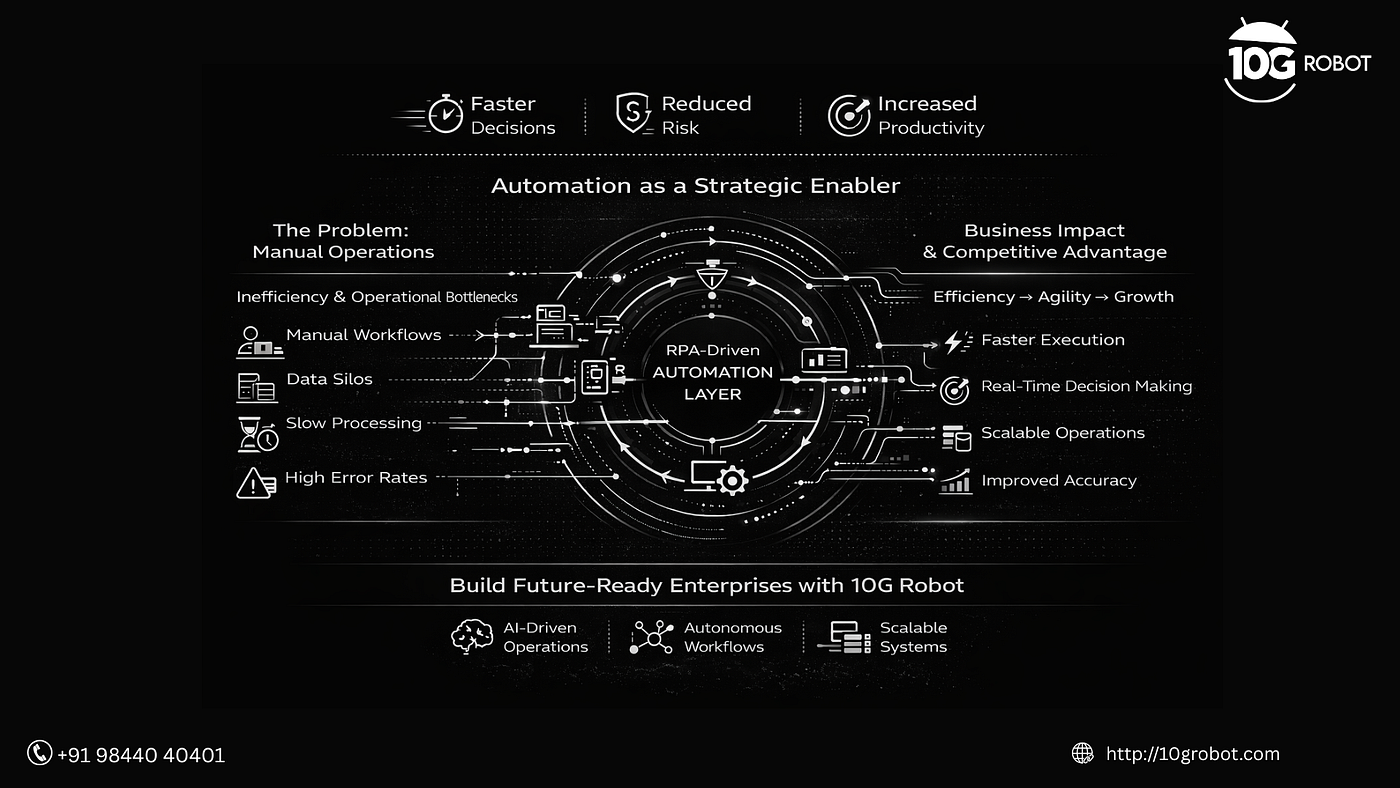
In boardrooms across industries, a quiet but powerful shift is taking place. Leaders are no longer asking whether automation is necessary — they are asking how quickly it can be implemented, scaled, and aligned with business outcomes.
At the center of this transformation is **back-office process automation**, a capability that is fundamentally redefining how modern enterprises operate. What was once considered a support function is now emerging as a strategic pillar for efficiency, agility, and long-term growth.
As organizations face increasing pressure to optimize costs, improve accuracy, and accelerate decision-making, automation is no longer a tactical initiative — it is a business imperative.
The Hidden Cost of Manual Operations
Back-office functions — finance, HR, procurement, compliance — are the backbone of any enterprise. Yet, they often remain invisible until inefficiencies begin to impact performance at scale.
Manual workflows, fragmented systems, and repetitive tasks create a chain reaction of operational challenges. Delays in processing, data inconsistencies, and increased error rates not only slow down execution but also affect strategic decision-making.
For decision-makers, this creates a significant challenge: how to improve efficiency, accuracy, and speed without disrupting existing systems or increasing operational complexity.
The cost of inaction is high. Manual operations lead to:
- Slower response times
- Higher operational expenses
- Increased compliance risks
- Limited scalability
In a data-driven economy, these limitations can directly impact competitiveness.
Automation as a Strategic Enabler
Automation is often viewed through the lens of cost reduction, but its true value lies in enabling smarter, more adaptive business operations.
By automating repetitive and rule-based tasks, enterprises can unlock several strategic advantages:
- Faster decision-making through real-time data processing
- Improved data accuracy, minimizing errors and rework
- Reduced operational risks through standardized workflows
- Enhanced productivity, allowing teams to focus on high-value tasks
More importantly, automation transforms the back office from a reactive function into a proactive, insight-driven engine that supports business growth.
This shift enables leadership teams to move from operational firefighting to strategic planning.
The Role of RPA in Enterprise Transformation
Robotic Process Automation (RPA) serves as the foundation of modern automation strategies. Unlike traditional automation systems that require extensive infrastructure changes, RPA integrates seamlessly with existing applications.
It mimics human actions — clicking, typing, extracting, and processing data — while operating with unmatched speed, consistency, and accuracy.
This makes RPA particularly effective for back-office environments where processes are repetitive, high-volume, and rule-based.
Platforms like 10G Robot enable organizations to deploy automation rapidly without disrupting ongoing operations. By working across legacy and modern systems, RPA allows enterprises to modernize workflows while preserving their existing technology investments.
From Efficiency to Competitive Advantage
Automation is no longer just an operational improvement — it is a competitive differentiator.
Organizations that adopt **back-office process automation** early are gaining a measurable advantage. They can execute processes faster, respond to market changes more effectively, and deliver better experiences across the value chain.
Key outcomes include:
- Faster execution of critical processes
- Improved customer and employee experience
- Greater scalability without increasing operational overhead
- Enhanced compliance and risk management
In contrast, organizations that continue to rely on manual processes face increasing inefficiencies and risk falling behind.
Automation is not just about doing things better — it is about staying relevant in an increasingly competitive landscape.
The Future of Enterprise Operations:
The evolution of automation is leading toward a future where enterprises operate with minimal manual intervention.
Back-office functions are becoming intelligent, interconnected systems capable of processing data, making decisions, and executing tasks autonomously. This transformation is being driven by the convergence of RPA, artificial intelligence, and advanced analytics.
In this new model, organizations are building self-optimizing operations that continuously improve performance over time.
Enterprises that embrace this shift will be better positioned to:
- Adapt to changing market conditions
- Innovate faster
- Scale efficiently
- Maintain long-term competitive advantage
Why Strategic Adoption Matters Now
Timing is critical. The longer organizations delay automation, the wider the gap becomes between them and their more agile competitors.
Strategic adoption of back-office process automation enables businesses to:
- Build operational resilience
- Improve cost efficiency
- Enhance decision-making capabilities
- Scale operations without complexity
For decision-makers, this is not just a technology investment — it is a transformation initiative that directly impacts growth and profitability.
FAQs
1. Why is back-office automation important? It improves operational efficiency, reduces costs, and enhances accuracy across critical business functions.
2. How does automation impact decision-making? Automation enables real-time data processing, allowing leaders to make faster and more informed decisions.
3. Can automation integrate with existing systems? Yes, RPA tools are designed to work seamlessly with current applications without requiring major changes.
4. Is automation scalable? Absolutely. Automation can be expanded across departments and processes as business needs evolve.
5. What is the ROI of automation? Most organizations begin to see measurable ROI within months through cost savings, efficiency gains, and improved accuracy.
CTA
If your organization is ready to move beyond manual processes, now is the time to take a strategic approach.
Explore how 10G Robot can help you build a future-ready enterprise with scalable, intelligent back-office automation.
메타데이터
- post_id
- d784bc732ad3
- slug
- why-back-office-process-automation-is-becoming-a-strategic-priority-for-modern-enterprises-d784bc732ad3
- url
- https://medium.com/@grobot799/why-back-office-process-automation-is-becoming-a-strategic-priority-for-modern-enterprises-d784bc732ad3
- canonical_url
- https://medium.com/@grobot799/why-back-office-process-automation-is-becoming-a-strategic-priority-for-modern-enterprises-d784bc732ad3
- author_url
- https://medium.com/@grobot799
- status
- ok
- fetched_at
- 2026-07-07 14:10:04




