Indoor Party Games That Don’t Require Screens
Screens are everywhere. At work, in the car, on the couch, at the dinner table. So when it comes time to host a party or gather friends and…
Indoor Party Games That Don’t Require Screens
Screens are everywhere. At work, in the car, on the couch, at the dinner table. So when it comes time to host a party or gather friends and family at home, handing everyone another device to stare at feels like a missed opportunity.
The good news is that some of the most genuinely enjoyable, laugh-out-loud, memorable party experiences have nothing to do with technology. Screen-free indoor party games bring people into the same physical and social space, create shared moments that no app can replicate, and remind everyone in the room why gathering in person is worth the effort.
This guide covers the best indoor party games that work without a screen in sight, organized by activity type and group size, with practical tips for making each one land.
Why Screen-Free Party Games Create Better Social Experiences
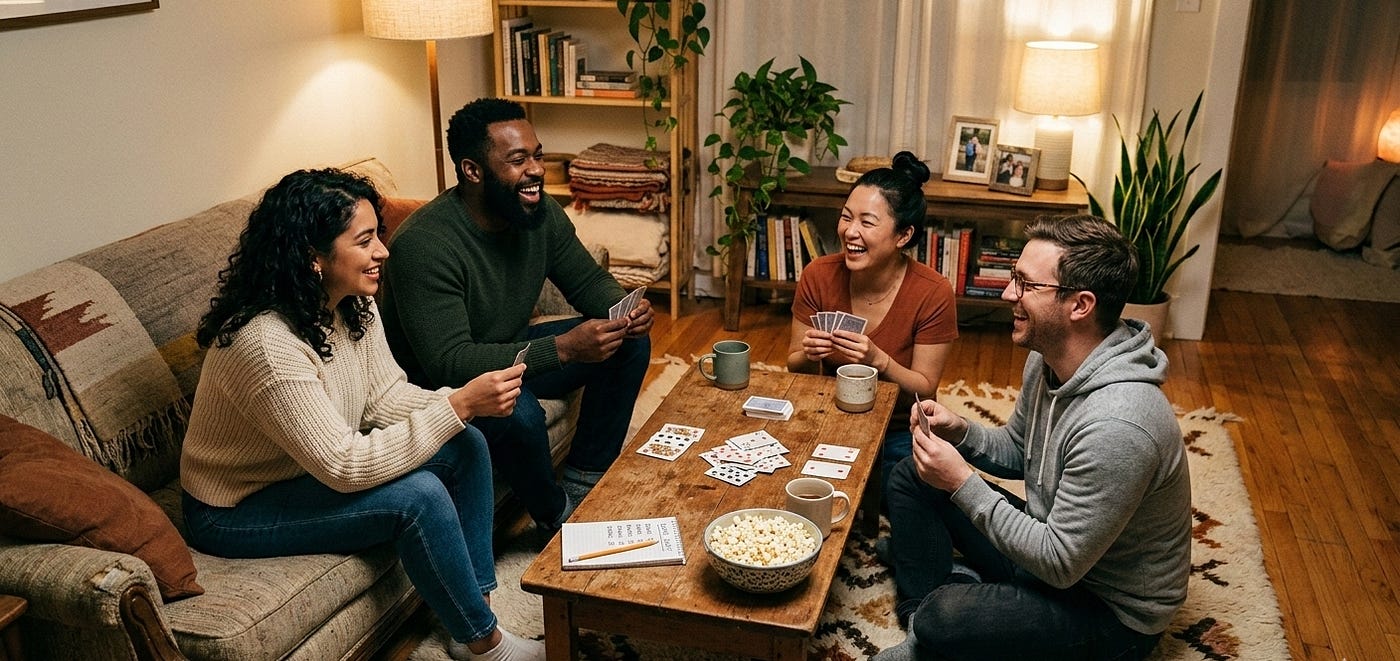
Before jumping into the games themselves, it is worth understanding why unplugged entertainment tends to create stronger social bonds than digital alternatives.
The Value of Face-to-Face Interaction During Group Play
When people play together without screens mediating the experience, they make direct eye contact, read each other’s body language, react to facial expressions, and share physical space in a way that digital games simply cannot replicate. These non-verbal communication cues are a fundamental part of how humans build trust, develop rapport, and feel genuinely connected to the people around them.
Psychologists who study social bonding consistently note that shared physical experiences, especially ones that involve laughter, mild competition, and collaborative problem solving, are among the most effective drivers of group cohesion and interpersonal closeness.
Why Unplugged Games Reduce Social Anxiety at Gatherings
Screen-free games also tend to reduce the social awkwardness that can settle over a party when nobody quite knows how to start a conversation. A well-chosen game gives everyone a shared focus, a reason to interact, and a social structure that removes the pressure of making conversation from scratch. Even naturally reserved guests tend to open up once a game is underway and the atmosphere becomes playful.
Best Screen-Free Trivia and Quiz Games for Indoor Parties
Trivia and quiz formats are among the most versatile screen-free party game options available. They scale easily from two players to twenty, work across age groups, and can be themed to suit virtually any gathering.
How to Run a Homemade Trivia Night Without Any Technology
Running your own trivia night at home requires nothing more than a set of questions, answer sheets, and a host willing to read aloud. Divide guests into teams of three to five, run five or six rounds of eight to ten questions each, and keep a running score on a whiteboard or piece of paper.
The key to a successful homemade quiz night is question variety. Mix easy warmup questions with genuinely challenging ones, and rotate through different subject categories including general knowledge, history, science, pop culture, food and drink, and geography to keep every player engaged regardless of their areas of expertise.
Using Themed Trivia to Match the Mood of Your Party
Themed trivia rounds work especially well for specific occasions. A holiday party benefits from seasonal trivia. A birthday gathering can feature rounds built around the guest of honor’s favorite topics. A reunion of old friends is the perfect setting for nostalgia trivia centered on shared memories, music from their youth, or events from a particular decade.
If you want a ready-made collection of questions that works for mixed groups and varied skill levels, browsing through a good set of Funny Trivia Questions is a great starting point. Lighthearted questions that get people laughing are particularly effective early in a trivia night when the group is still warming up.
Pub Quiz Style Formats That Work at Home
The pub quiz format translates naturally to a home setting. Printed answer sheets, a clear scoring system, a designated host who reads questions and keeps time, and a small prize for the winning team are all you need. Adding a picture round, a music identification round using hummed or clapped rhythms rather than a device, or a lightning round at the end keeps the format fresh and prevents the pacing from flatlining.
Classic Word and Language Games That Never Get Old
Word-based games require no equipment beyond imagination and sometimes a pen and paper. They are endlessly adaptable, work with any group size, and tend to generate some of the most genuine laughter of any party activity.
Charades and Its Many Variations for Different Age Groups
Charades is one of the oldest and most reliable party games in existence for good reason. Its origins trace back to 18th century France, and it has remained a fixture of social gatherings across cultures ever since. You can read more about its history on the Charades Wikipedia page. It requires no materials, scales from two to twenty players, works across generations, and creates shared moments of comedic effort that guests talk about long after the party ends.
The basic format involves one player acting out a word or phrase without speaking while teammates attempt to guess it within a time limit. Variations include reverse charades where the whole team acts and one person guesses, one-word charades for younger children, and category-specific rounds focused on films, books, famous people, or places.
The One Word Game for Breaking Ice at Parties
The one word game is simple and surprisingly revealing. Go around the room and ask each person to describe a shared experience, the party host, or a given topic using only a single word. Hearing how different people interpret the same prompt generates natural conversation, laughter, and occasional debate that can carry an entire party forward.
Story Spine for Creative Groups Who Enjoy Collaborative Storytelling
Story spine is a collaborative storytelling game where each player adds one sentence to an ongoing narrative, beginning their contribution with a set phrase such as “once upon a time,” “every day,” “until one day,” “because of that,” and eventually “until finally.” The constraint forces creative thinking and the results are almost always absurd, funny, and completely unpredictable.
It works especially well with groups of creative adults or older teenagers who enjoy wordplay, improvisation, and comedic storytelling.
Active Indoor Party Games That Get People Moving
Not every party game needs to involve sitting around a table. Active screen-free games bring energy into a room and work particularly well when the crowd includes children, physically engaged adults, or anyone whose attention tends to wander during seated activities.
Minute-to-Win-It Challenges Using Household Items
Minute-to-win-it challenges use simple household objects and short physical tasks to create fast, hilarious competitive rounds. Players attempt challenges like moving cotton balls across a table using only a spoon, stacking dice using a popsicle stick held in the mouth, or keeping a balloon in the air for sixty seconds using only breath.
Set up a tournament bracket, rotate players through each challenge station, and keep a running leaderboard. These challenges require no preparation beyond gathering items already found in most homes, and they generate a level of enthusiastic chaos that more sedate games rarely match.
Indoor Scavenger Hunts for Groups of All Ages
A well-designed indoor scavenger hunt works for parties with children, adults, or mixed age groups. Write clues in advance that lead players from one location in the home to the next, with each clue pointing toward the hiding place of the next one.
For adult groups, increase the difficulty with cryptic clues, riddles, or clues written in a foreign language. For younger children, use picture-based clues or simple rhymes. Team formats work best at larger gatherings where individual hunts would become logistically unwieldy.
Freeze Dance and Statue Games for Parties With Children
For parties that include younger children, freeze dance is a perennial favorite that requires nothing beyond music played from a single device, if that is the only screen use you allow. When the music stops, every player must freeze in place and hold their position. Anyone who moves is out. The last player frozen wins the round.
The statue game is a related alternative that does not require any music at all. One player turns their back while the others move, and must freeze the moment the designated watcher turns around. Anyone caught moving is out. It is simple, physical, and endlessly entertaining for children between the ages of four and twelve.
Strategy and Thinking Games That Challenge the Mind
Not every group wants high-energy physical activity. For gatherings that lean toward intellectual engagement, strategy and thinking games provide the same social electricity through mental challenge rather than physical effort.
Codenames as a Team Deduction Game for Adults
Codenames is a word-based team deduction game in which a designated spymaster gives one-word clues to help teammates identify their target words on a grid while avoiding the other team’s words and a single instant-loss card. It requires careful thinking, lateral association, and clear communication within teams.
The game plays best with six to ten people divided into two competing teams and typically runs for twenty to thirty minutes per round, making it ideal for parties where guests arrive and depart at different times.
The Resistance and Social Deduction Games for Larger Groups
Social deduction games like The Resistance place players in roles of either loyal team members or secret traitors, with the loyal players attempting to identify and vote out the traitors before they can sabotage the group’s missions. These games are deeply engaging for groups of six to ten players and tend to generate intense discussion, suspicious glances, and dramatic accusations that keep the energy in a room extremely high.
They work best with groups who enjoy psychological play, strategic thinking, and the kind of competitive social dynamics that make parties genuinely memorable.
20 Questions and Its Adaptations for Mixed Groups
Twenty questions is one of the most portable and equipment-free games available. One player thinks of a person, place, or object and the remaining players take turns asking yes-or-no questions, limited to twenty in total, to identify what the player is thinking of. The player who guesses correctly takes the next turn.
Adaptations include celebrity 20 questions, where all answers must be famous people, and category-specific versions where all answers must fall within an agreed topic such as animals, foods, or historical events. It requires no setup, no materials, and works with groups as small as two or as large as the room allows.
Card and Board Games Worth Having at Every Party
A small collection of well-chosen card and board games covers almost every party scenario you are likely to encounter. The best ones are quick to learn, hard to put down, and work for players with no prior experience.
Cooperative Board Games That Bring Teams Together
Cooperative board games, where all players work together against the game itself rather than against each other, tend to work well at parties because they eliminate the social friction that competitive outcomes can sometimes create. Games like Pandemic, Forbidden Island, and Hanabi require genuine collaboration, clear communication, and shared strategic thinking to win.
The cooperative format also means that experienced players can guide newer ones without the experience feeling one-sided or frustrating for either party.
Card Games That Require Nothing Beyond a Standard Deck
A standard 52-card deck supports dozens of excellent party games requiring no additional purchase. Spades, Hearts, Rummy, and Crazy Eights are classics that most adult guests will already know. For larger groups, Kemps and Spit are fast-paced, loudly entertaining options that work well in social settings.
For groups that want something new, the game Golf, where players attempt to assemble the lowest-value hand across multiple rounds by drawing and swapping cards, is easy to teach and genuinely strategic once players understand the card values.
Storytelling Card Games for Creative Adult Gatherings
Storytelling card games like Dixit use illustrated cards to prompt abstract narrative creation, with players scoring points by describing a card in a way that only some of their opponents can identify it. The game rewards lateral thinking, creative language, and the ability to read what other players are likely to interpret from a visual prompt.
It plays best with four to six players and typically runs for forty-five to sixty minutes, making it a strong centerpiece game for smaller, more intimate gatherings.
How to Choose the Right Game for Your Specific Party
Having a strong collection of screen-free party game options is only useful if you can match the right game to the right group and occasion. A few key factors determine which choice will work best.
Matching Game Complexity to Your Guest List
Guest familiarity with game-playing should guide your choice of complexity. A group of regular board game enthusiasts will enjoy the strategic depth of social deduction games and complex cooperative challenges. A mixed group of occasional players and non-gamers needs something with rules that can be explained in under two minutes.
When in doubt, start simpler than you think you need to. A game that everyone understands and enjoys beats a sophisticated option that half the room finds confusing.
Considering Energy Levels and Party Timing
The timing within a party matters as much as the group composition. Early in a gathering, when guests are still arriving and conversations are just forming, quick icebreaker games and casual word games work better than complex strategy games that require full attention. Later in the evening, once the group is warmed up and energy is high, more involved games that require sustained engagement tend to land better.
Planning for Different Group Sizes Throughout the Evening
Guest numbers at home parties often fluctuate as people arrive and leave at different times. Having a range of games suited to different group sizes means you are never caught without an option that fits the current headcount. Games that accommodate two to twenty players, like trivia and charades, are particularly valuable in this context because they remain playable regardless of how many people are present at any given moment.
Common Mistakes to Avoid When Hosting Screen-Free Game Nights
Even well-intentioned game nights can fall short when a few avoidable mistakes get in the way.
Choosing Games That Only Suit Part of the Group
A game that works brilliantly for half your guests but alienates the other half is a net negative for the evening. Always consider the full range of ages, personalities, and comfort levels in the room before settling on your game lineup for the night.
Spending Too Long Explaining Rules Before Playing
Long rules explanations before a game begins are one of the fastest ways to kill momentum at a party. Where possible, learn the rules yourself in advance and teach them through a short demonstration round rather than a lecture. Players learn faster by doing than by listening to instructions.
Ignoring the Energy in the Room
The best game night hosts stay attentive to how the group is feeling throughout the evening and adjust accordingly. If energy is dropping, switch to something more physical. If competitive tension is getting too intense, move to a cooperative or collaborative format. Reading the room and pivoting when needed is one of the most important hosting skills there is.
Frequently Asked Questions
What are the best indoor party games for a mixed group of adults and children?
Trivia with tiered difficulty levels, charades, minute-to-win-it challenges, and scavenger hunts all work reliably across age groups. The key is choosing formats where younger and older players can contribute meaningfully without the game feeling too easy for adults or too hard for children.
How many games should I prepare for a three-hour party?
Prepare three to four options and expect to play two or three of them. Having backup choices ensures you can adapt to how the evening develops without the group running out of things to do.
Can screen-free party games work for large groups of twenty or more people?
Yes, with the right format choices. Team trivia, large-scale charades, scavenger hunts, and minute-to-win-it tournament formats all accommodate large groups well. Avoid games with player limits of six to eight in these settings unless you plan to run multiple simultaneous games.
What is the easiest screen-free party game to set up last minute?
Twenty questions, the one word game, story spine, and any variation of charades require zero preparation and no materials. All four can be started within minutes of the idea being suggested and work with any group size.
The Case for Putting Screens Away at Your Next Gathering
Screen-free party games are not a nostalgic throwback to simpler times. They are a deliberate and genuinely effective choice for creating the kind of shared, present, and memorable social experiences that bring people closer together.
The conversations that start during a well-run trivia round, the laughter generated by a charades performance gone hilariously wrong, the collective tension of a social deduction game in its final moments: these are the experiences guests remember and talk about afterward. No streaming service, social media feed, or gaming app competes with the energy of a room full of engaged, laughing, genuinely connected people.
Put the screens away. The party is better without them.
메타데이터
- post_id
- d78bca2678be
- slug
- indoor-party-games-that-dont-require-screens-d78bca2678be
- url
- https://medium.com/@hello.funnytriviaquestions/indoor-party-games-that-dont-require-screens-d78bca2678be
- canonical_url
- https://medium.com/@hello.funnytriviaquestions/indoor-party-games-that-dont-require-screens-d78bca2678be
- author_url
- https://medium.com/@hello.funnytriviaquestions
- status
- ok
- fetched_at
- 2026-07-18 07:15:57