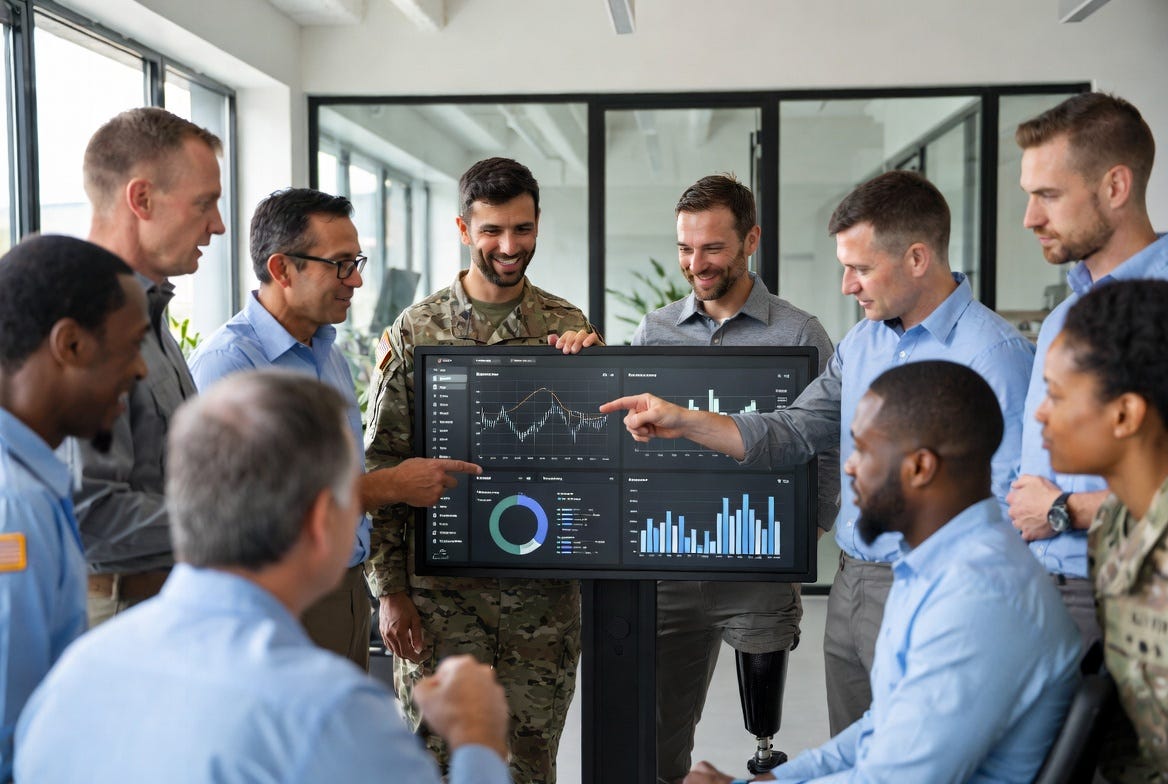
The $200B Supply Chain Nightmare: A Veteran’s Wake-Up Call for Small Businesses
Why Ignoring Disruptions Could Kill Your Company—and How to Build Unbreakable Resilience
The $200B Supply Chain Nightmare: A Veteran’s Wake-Up Call for Small Businesses
Why Ignoring Disruptions Could Kill Your Company—and How to Build Unbreakable Resilience

A Navy Maintenance Officer’s Realization About the Gap Nobody’s Talking About
I remember the precise click of a parts container locking into place — right on schedule, every single time. In Oak Harbor Naval Base, I supervised aircraft maintenance for five years. Disruption wasn’t an option. Lives depended on it. Every procedure documented. Every failure anticipated. Every contingency planned.
Then I left the Navy and started looking at small business supply chains.
What I discovered shocked me: The same military discipline that kept aircraft flying doesn’t automatically translate to business resilience. I watched veteran entrepreneurs struggle with supplier concentration, demand swings, and cyber vulnerabilities — problems they’d never face in uniform because the military had already solved them.
Here’s the gap: Military operational continuity is built into the system. Business continuity has to be intentionally designed, documented, and defended.
According to Gartner’s 2025 SCM Survey, small businesses now lose $200B+ annually to supply chain disruptions — up 37% from 2023. But here’s what excites me: Federal buyers are now explicitly demanding resilience documentation in procurement. For veteran-owned businesses, this represents a structural competitive advantage — if you can formalize what the military taught you.
I started researching this question: Why do military-trained leaders struggle to translate operational discipline into formal business resilience frameworks — and how can they systematize that translation?
What I found by talking to veteran business owners and researching federal contracting trends could change how you think about your supply chain.
The Hidden Opportunity: Why Giants Survive, Small Businesses Crumble
Here’s what shocked me in my research: it’s not bad luck. It’s structural.

Source: Gartner 2025 SCM Survey; NIH 2024 Supply Chain Resilience Study
The data patterns are clear. When supply chain disruption hits, two-thirds of SMEs see significantly disrupted operations, compared to only 40% of larger firms. Why?

It’s not bad strategy. It’s structural inequality.
Large corporations have:
- Redundant suppliers across geographies
- Buffer inventory funded by capital reserves
- Risk management teams (often 5–10 people)
- Insurance and contractual protections negotiated from positions of strength
Small businesses have:
- Single or dual-source suppliers (62% rely on 1–2 suppliers)
- Just-in-time inventory (no cash for buffers)
- The owner wearing 5 hats, none of which is “risk manager”
- Unequal contract terms that shift all risk downstream
A manufacturing firm I researched sourced 87% of critical components from one supplier. When shipping delays hit, they lost $340K — 16% of annual profit, evaporated. Their large competitor faced the same delay. They activated a backup supplier and lost 2 weeks of efficiency. 3% impact instead of 16%.
The gap isn’t smart strategy. It’s documented resilience.
What I Learned From Researching Veteran Business Owners (And What It Means For You)
Through conversations with veteran entrepreneurs and federal contracting research, three critical blind spots emerged.

Blind Spot #1: Supplier Concentration (Affects 62% of SMEs)
The Reality: Military veterans understand single points of failure. You’ve trained to eliminate them. Yet many veteran business owners operate with one or two critical suppliers, fully aware it’s risky but unable to see the alternative.
Why? “It’s the path of least resistance,” one veteran-owned distributor told me. “One vendor relationship is easier to manage than five. You think you’re saving money.”
But the math is brutal:
- If your primary supplier controls 70%+ of critical inputs
- And they face disruption (weather, cyber, financial crisis)
- You have 7–14 days of inventory, then you stop
- Recovery timeline: 4–6 weeks minimum
- Cost: 30–50% revenue loss in that period
The Fix (Actionable):
- Map your critical dependencies (30 minutes today)
- Identify suppliers representing >50% of any category (this is your danger zone)
- Engage backup suppliers immediately — even at 15–20% cost premium
- Test them quarterly with small orders (proof they can deliver)
- Cost-benefit: 3–5% overhead cost vs. 300% recovery cost when the primary fails
Question for you: How many suppliers do you have for your most critical input? If the answer is “one” or “two,” you’re not alone — but you’re exposed.
Blind Spot #2: Demand Swings You Can’t Forecast (42% Cite As #1 Challenge)
The Data Point: Gartner’s 2025 survey shows demand volatility as the top supply chain risk — ahead of geopolitics, ahead of cyber. Why? Post-pandemic, consumer behavior is unpredictable. Retailers order 10% less. Distributors order 30% less. Manufacturers cancel expansion plans.
For small businesses, this is lethal. You can’t absorb demand swings. You can’t negotiate favorable contracts based on volume guarantees. You absorb all the volatility yourself.
The Bullwhip Effect in Action: A retail chain reduces orders by 10%. The distributor, seeing declining demand, reduces their supplier order by 30%. The manufacturer, now uncertain, cancels a planned expansion. The equipment supplier lays off workers.
Small businesses caught in the middle get crushed. Excess inventory they can’t move. Liquidation at cost. Margins evaporated.
Here’s How to Build Resilience:
- Invest in basic supply chain software ($3–5K annually; tools like Shopify Supply Chain, SAP Insights exist for small budgets)
- Real-time demand tracking reduces bullwhip effect by 40–50%
- Build contracts that allow flexibility (order minimums that scale with demand, not fixed)
- Maintain 30-day buffer inventory for high-risk items (it costs 3–5% more annually, but saves everything in a crisis)
The military taught you contingency planning. Apply that principle to demand: Plan for the 30% drop, not the average scenario.
Blind Spot #3: Cyber Risk You Don’t See Coming (52% of Companies Underprepared)
The 2025 Reality: APQC’s analysis shows: ransomware attacks on supply chain partners are up 52% year-over-year.
A major port experienced a ransomware attack in 2025 that locked customs data for a week. Shipping records encrypted. 50+ logistics providers couldn’t access information. Shipments sat. Customers saw delays.
Competitors with backup systems? Unaffected.
For small businesses, one cyber attack on your supplier can halt your entire operation. You probably don’t have cyber insurance. You definitely don’t have backup systems.
Here’s What Changes The Game:
- Ask your suppliers about cyber insurance (non-negotiable in 2025)
- Use encrypted communication channels for critical orders
- Maintain manual backup procedures (yes, pen and paper, for critical suppliers)
- Test your recovery plan quarterly (war game it with your team)
The Research Insight: Military Discipline Meets Business Advantage
Here’s what I’m studying more deeply:
The Core Question: “Why do military-trained leaders excel at operational continuity in uniform, but struggle to systematize that discipline into formal business resilience frameworks that federal buyers reward?”
What Federal Buyers Now Require:
- SDVOSB certification unlocks 5% of all federal contracts (set-asides)
- Federal buyers increasingly mandate documented continuity planning as procurement criteria
- Veterans have inherent credibility in discipline, but lack formalized frameworks to demonstrate it
The Insight I’m Exploring: Veteran-led firms with documented resilience frameworks appear to win federal contracts at higher rates — not because they’re veterans, but because federal buyers can see systematic discipline. It’s translatable. It’s measurable. It’s defensible.
The gap between military excellence and business resilience isn’t your capability. It’s documentation.
The Four-Step Resilience Framework: From Risk to Advantage
If you’re a small business owner or veteran entrepreneur, here’s what actually changes the game:

Step 1: Conduct a Real Risk Assessment (Not Checkbox Compliance)
- Identify your top 5 suppliers by risk (if one goes down, you stop)
- Quantify exposure: If X fails, how many days until cash crisis?
- Map every single point of failure (one person? One facility? One certification?)
Cost: 4 hours of your time Benefit: You’ll find 2–3 catastrophic risks you didn’t know existed
Step 2: Design for Redundancy
- Dual-source minimum for anything critical
- Geographic diversification (don’t cluster all suppliers in one region — 2024 climate disruptions hit Asia 3x worse than North America)
- Maintain 30-day buffer inventory for high-risk items
Cost: 3–5% overhead annually Benefit: When supply disruption hits, you survive it instead of closing
Step 3: Formalize & Document Your Plan
This is where veterans have an advantage. You already understand documentation discipline.
- Write it down: Your recovery procedures, response timelines, responsibility assignments
- Test it: Run quarterly war games with your team
- Update it: Every six months (supply chains change fast)
Cost: 8 hours documentation + 4 hours testing per quarter Benefit: Federal buyers explicitly reward this in procurement scoring
Step 4: Build Visibility into Your Supply Chain
- Implement supply chain software (Shopify, Looker, even a well-built Excel dashboard)
- Real-time demand tracking (reduces volatility shock by 40–50%)
- Supplier communication loops (catch problems before they cascade)
Cost: $3–5K annually for entry-level tools Benefit: You see disruptions 2–3 weeks earlier, giving you time to respond
The $250B Opportunity (Not Crisis)
Yes, small businesses globally lost $250B+ to supply chain disruptions in 2024 (Interos updated figures, 2025). That’s the cost of resilience blindness.
But here’s the flip side: Federal agencies are now using resilience documentation as a contractor scorecard.
If you’re a veteran-owned business with:
- ✓ Documented supply chain risk assessment
- ✓ Formal continuity plan
- ✓ Quarterly testing/updates
- ✓ Cyber insurance verification from suppliers
You automatically score above 70% of your competition, even if their prices are lower.
That’s not luck. That’s structure. And it’s a structural advantage that veterans are uniquely positioned to build.
A Question For You
If you’re building a veteran-owned business or running a small company right now:
What’s your biggest supply chain vulnerability? Is it supplier concentration? Demand swings? Cyber risk? Or something else entirely?
The fact that you’re reading this means you’re already thinking about resilience. Most small business owners aren’t. That’s your competitive advantage — awareness is the first step.
Drop your biggest concern in the comments. I’m actively researching these real problems and would love to hear what’s keeping you up at night.
What’s Next
I’m exploring this question more deeply: How can military operational discipline systematically translate into business advantage in federal contracting?
If you’re interested in this topic — whether you’re a veteran entrepreneur, small business leader, or just curious about how military principles apply in business — follow for more.
메타데이터
- post_id
- d79a2d899b32
- slug
- the-200b-supply-chain-nightmare-a-veterans-wake-up-call-for-small-businesses-d79a2d899b32
- url
- https://medium.com/@sdvosb-consultant/the-200b-supply-chain-nightmare-a-veterans-wake-up-call-for-small-businesses-d79a2d899b32
- canonical_url
- https://medium.com/@sdvosb-consultant/the-200b-supply-chain-nightmare-a-veterans-wake-up-call-for-small-businesses-d79a2d899b32
- author_url
- https://medium.com/@sdvosb-consultant
- status
- ok
- fetched_at
- 2026-06-09 14:34:10