Vessels and Distribution: Why Empty Strings Are A Rational Play in 2026
Designing the next wave of TLDs. You cannot schedule exogenous luck.
Vessels and Distribution: Why Empty Strings Are A Rational Play in 2026
Designing the next wave of TLDs. You cannot schedule exogenous luck.
Every website address ends in something like .com, .org, or .uk, and that final piece is called a top-level domain, or TLD. There are two types of top-level domains: generic ones (gTLDs) like .com, .org, and .shop, which aren’t tied to any country, and country-code ones (ccTLDs) like .uk, .de, and .ai, each assigned to a specific country or territory. The organization called ICANN governs which of these are allowed to exist, and roughly once a decade, it opens a window where companies can apply to create and run an entirely new gTLD, paying a substantial fee for the privilege of becoming its “registry,” the wholesaler that then sells individual names underneath it. The last time this happened was in 2012, when extensions like .shop, .app, and .xyz were introduced, and the next window is now open in 2026.
In 2025 the global domain industry generated an estimated $10 billion in total economic activity across registry fees, registrar margins, and the premium/secondary market, with gTLDs, dominated by .com, accounting for the large majority, as the recurring registration-and-renewal core sat closer to $3.5 billion. Owning a TLD can be lucrative because you collect a recurring annual fee on every domain registered under your extension, but most of the ones created in 2012 never made money. The interesting strategic question is which kinds of new extensions are actually worth pursuing.

Göran Marby in 2014 at the ICANN Congress, (I’m seated to his right).

Pre-reads on the way to Helsinki: “Another Milestone Towards the IANA Stewardship Transition.”
The instinct when entering the domain space is to chase a string that already means something, to buy or fight for a word the market, or culture, has already loaded with value. In the 2026 round, that instinct is more expensive than it has ever been. Unresolved contention now culminates in an ICANN auction, since private settlements and private auctions between applicants are prohibited. Any obviously valuable generic will therefore go to open bidding against registries with deeper capital, established distribution, and portfolios to defend. You pay a premium for the “meaning” which someone else’s market already built, then pay again to win it. However…
The rational alternative inverts the logic: acquire a cheap, empty string, and manufacture the meaning around it.
That argument rests on linguistics. Charles Hockett, the linguist and anthropologist, identified arbitrariness as a defining feature of all human language. Words, in English and most languages, do not look or sound like what they mean. Even in symbol-driven writing systems like Chinese, where characters evolved from pictures, the form has abstracted so far from the object that the resemblance is mostly gone. The bond between a form and its meaning is settled by convention alone. There is no natural law binding a “string” to a concept. That bond is socially installed and maintained; arbitrariness relies on conventionality to create and sustain the connection between linguistic signs and their meanings. The strategic consequence is that emptiness is an asset, because words can be freely created and assigned new meanings without being constrained by natural connections, and a blank string has more room to absorb the value you install precisely because nothing competes with it.
But linguistics only establishes that new meaning is possible, not that a TLD will succeed. The key link in the TLD business model is distribution. A coined string earns nothing until someone places it in front of buyers at scale, and meaning, once manufactured, must be actively sustained or it fades. This is why the insight into arbitrariness is not, by itself, a business. We can think of it in this order: meaning is arbitrary, so it can be manufactured; manufacturing requires installation; installation is distribution; distribution is controlled by capitalized registries. The conclusion is not “a clever name wins.” The conslusion is that an operator who controls distribution may be able to convert a cheap string into a valuable category. Distribution, more than naming, is the hero… with a caveat which I will bring up later in this essay.
The market data confirms where the real scarcity lies. New gTLDs were the fastest-growing TLD segment in 2025, expanding nearly 30% to 47.8 million registrations, and the category is highly concentrated, with the top ten extensions holding roughly 89% of all gTLD names and .xyz alone reaching 8.1 million, enough to rank among the five largest gTLDs overall. Yet the most recent renewal estimate for new gTLDs sits around 31%, against roughly 70% or higher for legacy extensions. First registrations are cheap and abundant; durable demand is the scarce resource. The prize is not volume but renewal, and renewal is what a manufactured, well-distributed meaning can produce and a promotional spike does not.
The TLD .xyz is both a proof and a cautionary tale. A string chosen because it meant nothing, the last in the alphabet, became one of the largest gTLDs on earth through a deliberate “next generation” narrative and aggressive distribution. It did not succeed because it was empty; emptiness was the opening, while registrar promotions, low prices, major distribution deals, and high-visibility adoption did the actual installing. The tell is in the renewals: .xyz’s quarterly renewal rate runs near 22%, among the lowest of any major TLD, evidence that registration volume and installed meaning are not the same thing. “Engineered meaning” should mean engineering for renewal, not for the launch-week number.

Session at the 2014 ICANN Congress
For example, .ai is the same lesson taken to its purest form, with intent removed entirely. It is the country-code domain for Anguilla, a small Caribbean territory, assigned in the 1990s on the standard ISO basis with no thought of artificial intelligence whatsoever. For decades, it was a sleepy ccTLD; then the cultural meaning of those two letters shifted underneath it, and the extension was suddenly sitting atop the most valuable concept in tech, earning Anguilla tens of millions a year on a string nobody engineered for the purpose. Because the bond between string and meaning was arbitrary enough to the general world population, this showed that value can be poured into a form entirely from the outside, by the culture rather than the operator. But it also marks the limit of the strategy. You cannot schedule exogenous luck. A windfall like .ai is real, unrepeatable, and uncontrollable, which is precisely why a rational response is not to wait for one but to engineer vessels that distribution can fill efficiently, treating any cultural tailwind as upside you never paid for rather than the plan itself. Notably, .ai’s demand comes from genuine end-user desire to live at that address, which produces far healthier renewals than a promotional spike, a reminder that durable meaning, however it arrives, is the thing that renews.

AFRALO / AfriCANN Joint Meeting
Two design constraints seem to apply. First, meaning follows power: any signifier might do for any signified, and social power expressed as convention acts to sustain the link within a community, which is precisely why this belongs with a distribution-capable operator rather than a lone speculator. Second, the form is not neutral. Sound symbolism is measurable: the sounds of brand names influence consumer perceptions, with front vowels associated with lightness and smallness and back vowels with heaviness and largeness. These effects vary by language, so a string must be engineered for both its intended meaning and its target market. The string is a vessel, and the distribution strategy fills it.
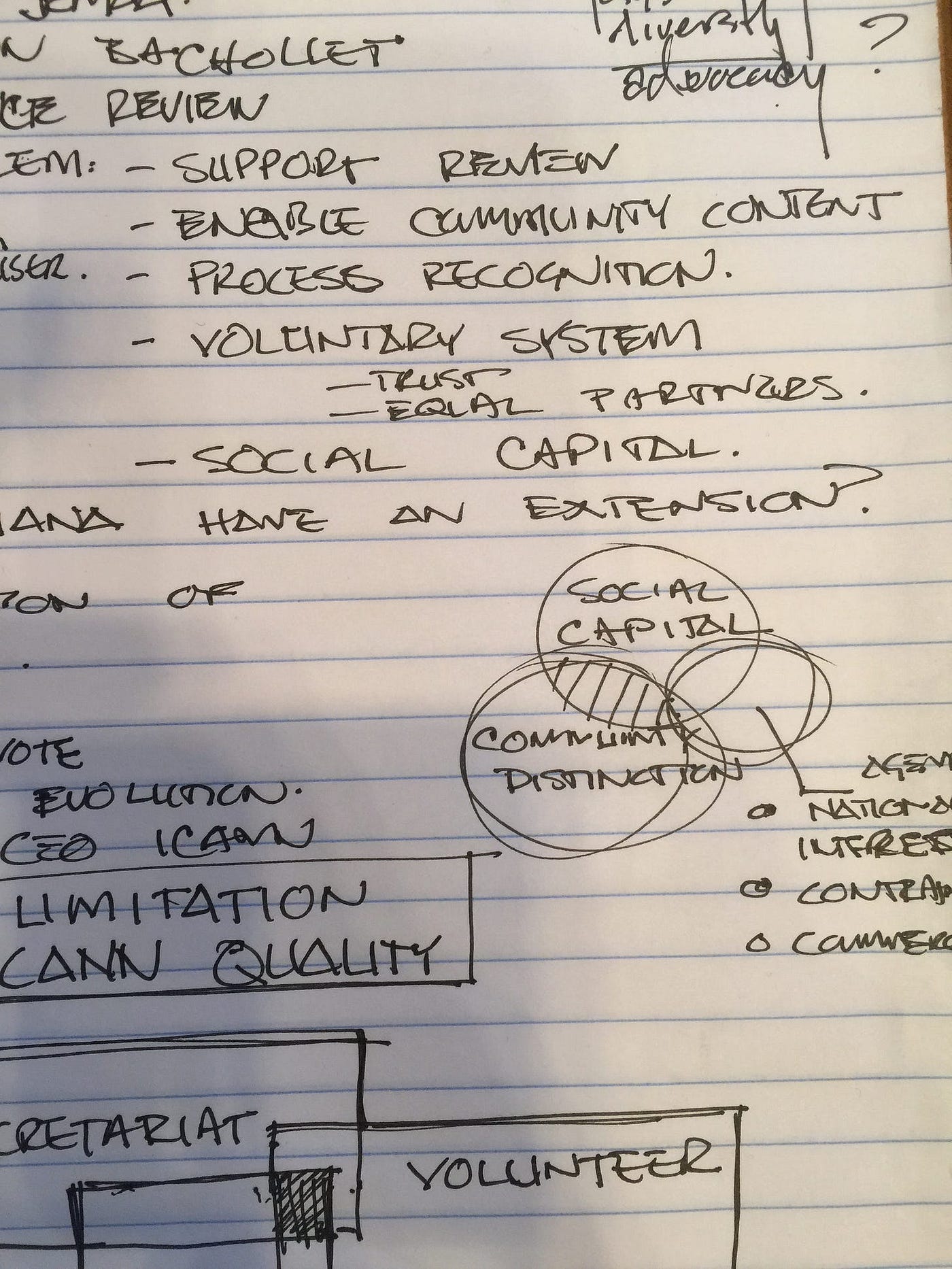
My note-taking and musings from the 2014 ICANN Congress. Social Capital, Community Distinction, and Agency form the nexus of digital leverage, in other words: people pay to belong, belonging is defined by distinction, and value goes to whoever can shape that distinction.
Designing the vessel well means reading where consumer sensibility is heading, not where it has been. Naming conventions move in cycles that track broader cultural mood: the bare, lowercase, vowel-dropped style of the last tech decade (Flickr, Tumblr, Grindr) signaled informality and speed, while the current drift toward soft, open, vowel-rich names (Aura, Oura, Lumi, Cala) tracks a wider appetite for calm, wellness, and approachability. A string carries an era’s fingerprint, whether or not you intend it to, so the choice is either to ride the prevailing current or to deliberately cut against it for contrast. The same instincts that brands use to telegraph “premium” through clipped hard consonants, or “friendly” through round repeated syllables, apply to an extension, with the added weight that a TLD must stay legible across a decade of shifting taste rather than a single product cycle. The discipline, then, is not just to pick a string that sounds right today, but to anticipate the social and aesthetic direction it will live inside, and to build in enough neutrality that a single trend’s passing does not date it. Convention is not a fixed target; it is a moving consensus, and the designer’s real task is to position the vessel slightly ahead of where that consensus is going.
It is worth dispelling one intuition that runs counter to this strategy: the assumption that a pre-loaded string like .design or .photography needs less marketing than an empty one and therefore offers a shortcut. That may have been true early in the stages of internet TLD expansion; however, in modern practice, the promotional burden of market education can be surprisingly similar. The mechanisms for communication are the same. The integrated strategy is different. A descriptive extension tells people what it is, but not why they should choose it over .com, and converting a category that already exists in the buyer’s mind into actual registrations and renewals still demands the full apparatus of registrar deals, pricing strategy, channel placement, and sustained narrative. The semantic head start may be largely cosmetic, because the hard, expensive work, getting the extension in front of buyers at scale and persuading them to stay, is identical whether the string arrives with meaning or without. The empty string may require a similar promotional effort but often starts at a lower price, carries no constraining literal meaning, and lets you install a category you own outright rather than one you have to share.
The caveat I promised earlier is this: distribution is the hero, but it is not a magician. It can install meaning into a well-formed vessel far more cheaply than into a poorly chosen one, which is why string design, though the cheaper link, can potentially set the ceiling on what distribution can affordably achieve. A poorly chosen string does not make installation impossible, only expensive, since every awkward sound, every misread connotation, every mismatch with the target market’s ear adds friction that distribution must spend against. A well-designed vessel lowers that cost at every turn, so the same marketing budget reaches further and the resulting meaning sits more naturally and renews more reliably. This is the sense in which origination and distribution are not rivals but multipliers: the string sets the efficiency of the spend, and distribution converts that efficiency into a category. The cheapest link in the chain quietly governs the economics of the most expensive one.
Revenue like that only exists on the far side of a serious investment, so it is worth asking what would need to be funded first, if anything. A TLD is capital-intensive for years before it is a revenue stream. The application fee runs into the low hundreds of thousands, and it is the smallest line item; behind it sit registry backend contracts, legal and compliance work, ICANN’s recurring fees, and an open-ended, front-loaded promotional budget. A serious entry should assume well over a million dollars committed across the first several years, most of it spent before the renewals that justify it arrive. That risk falls almost entirely on whoever supplies the capital and runs the distribution, which is the fact that any reasonable arrangement has to begin from.
It is also why the originator should not assume a royalty is the right instrument. A royalty loads the most risk onto the creative: it defers all compensation, makes it contingent on someone else’s execution, and depends on finding an operator willing to sign such a contract at all, no small thing when that operator carries the capital and may prefer to owe nothing downstream. The alternatives trade risk for reward differently. A flat fee pays now and cleanly, surrendering upside for certainty. A retainer compensates for ongoing involvement, rather than a transactional, one-time arrangement, keeping the originator where the real creative happens. An equity stake ties them to the whole venture rather than a single string, sharing both the risk and the larger reward. A hybrid, a modest fee plus a smaller royalty or equity slice, banks some certainty while keeping a claim on the upside. Which is rational depends on the originator’s appetite for risk, need for near-term cash, and conviction in the operator’s ability to execute: a royalty rewards high conviction and patience, while a fee, retainer, or equity may serve better when those are absent.
Take the royalty, the option that most needs scrutiny. The economics should track the contribution. Using an illustrative revenue estimate of roughly $200K to $3M per year per TLD, a 2% royalty runs about $4K to $60K per year early on: modest if a TLD wins, no drag if it fails, since it is a share of gross rather than a fixed cost. The chain has distinct links: ideation, capital, distribution, and auction backing, each carrying different value and different risk. Origination shapes everything downstream, but is the least leverageable link on its own, earning nothing until distribution carries it to market, which suggests origination and operation are different contributions that need not be rewarded on the same basis.
So perhaps the future business mission model in this space might sound something like this: We will acquire cheap, empty strings designed and engineered as deliberate “vessels,” phonetically shaped to carry an intended meaning, rather than buying or auction-fighting for words the market has already valued. We pair that string design with the distribution and capital required to install the meaning durably, optimizing for renewal rather than launch-week volume. We then capture the full value of a category we created and sustained, instead of paying a premium to enter one we didn’t.
Have fun, create value.
Charles Austen Angell is the founder EPRIA.ai — smart government solutions, and of the design and innovation firm Modern Edge, which has worked with companies within the domain-name industry, including Porkbun LLC and Donuts Inc. (now Identity Digital, Inc.).
메타데이터
- post_id
- d7a8af2bdabb
- slug
- vessels-and-distribution-why-empty-strings-are-a-rational-play-in-2026-d7a8af2bdabb
- url
- https://medium.com/@austenangell.design/vessels-and-distribution-why-empty-strings-are-a-rational-play-in-2026-d7a8af2bdabb
- canonical_url
- https://medium.com/@austenangell.design/vessels-and-distribution-why-empty-strings-are-a-rational-play-in-2026-d7a8af2bdabb
- author_url
- https://medium.com/@austenangell.design
- status
- ok
- fetched_at
- 2026-07-30 23:55:51