The Robotaxi Split Nobody’s Talking About
Waymo is building the UPS of urban mobility. Uber is making sure every robotaxi follows. The question is, who gets stuck being the Post…
The Robotaxi Split Nobody’s Talking About
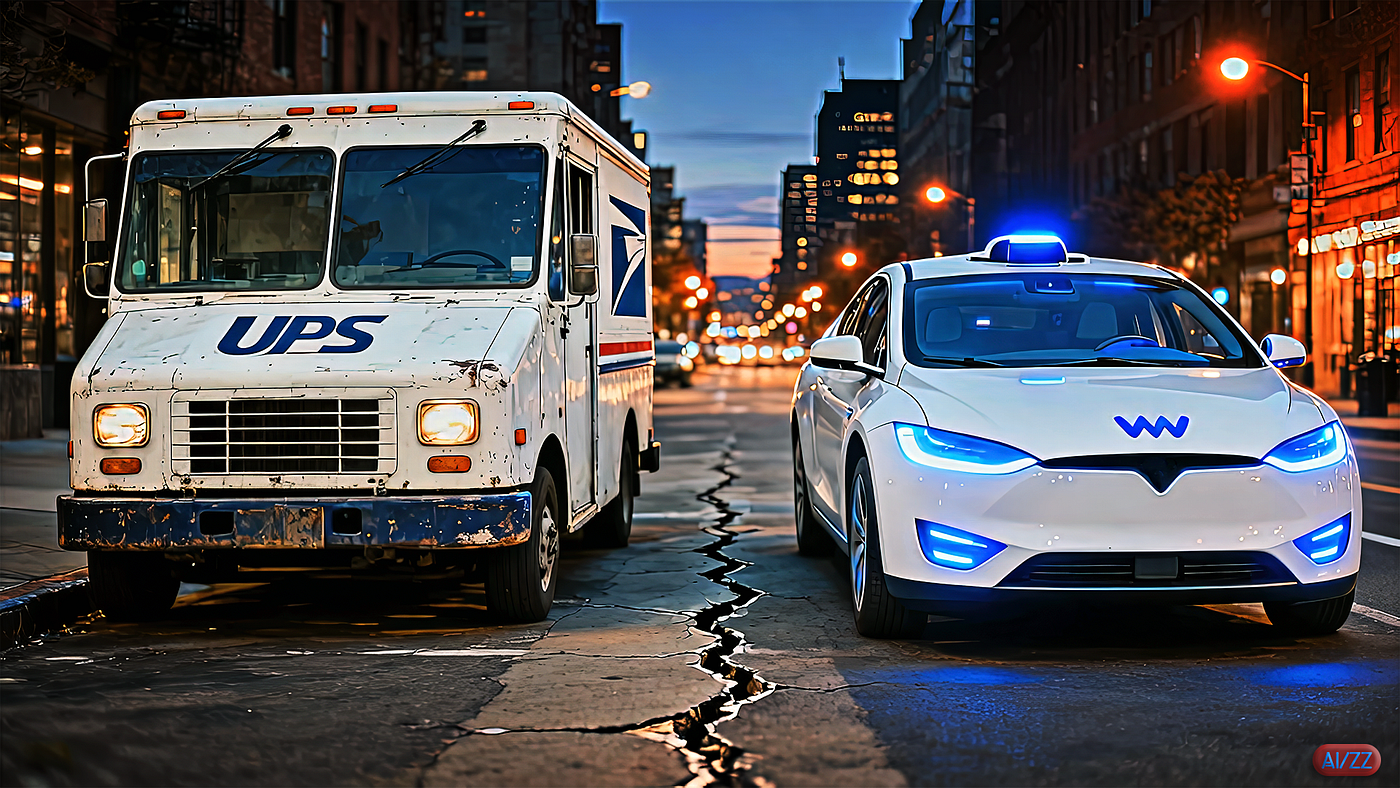
Waymo is building the UPS of urban mobility. Uber is making sure every robotaxi follows. The question is, who gets stuck being the Post Office?
The Truck That Always Comes
Picture a postal truck winding its way through rural West Virginia, burning money with every mile. The route stretches on, houses scattered across the hills, package volume barely a trickle, and fuel costs that would make a city dispatcher wince. No private delivery company touches this run. The Postal Service does it anyway, six days a week, because two and a half centuries ago, someone decided that every address in America gets mail — profitable or not.
That choice has a name: the universal service obligation. It’s why a letter from Manhattan finds its way to a cabin in Appalachia for the same price as a note sent across town. UPS and FedEx skip the money-losing routes. The Postal Service covers them all, with the profitable runs propping up the rest. This cross-subsidy is the backbone of American mail delivery. It’s not pretty, and it’s not efficient, but it works — because the high-volume routes pay the bills, and no private carrier can undercut the Postal Service where it counts.
Public transit runs on the same logic. The packed buses downtown at rush hour pay for the late-night runs to the suburbs. The paratransit van crawls along, picking up a single passenger an hour. The rural shuttle averages less than two riders per trip. These routes exist because someone said they should, and they survive only because the busy lines keep them afloat.
That system is starting to come apart — not because anyone chose to end it, but because nobody stepped in to keep it together.
The Routes That Don’t Pay
The numbers behind money-losing transit routes are worse than most people realize. That’s because most riders only see the lines that turn a profit.
Look at the best data on demand-responsive transit — the on-demand shuttles meant to reach the places regular buses skip. Across 142 services in 22 countries, the average is just over two passengers per vehicle per hour. More than half do worse. Some barely move anyone at all, carrying one person an hour or less. These are publicly funded taxis, bleeding money with every trip.
Take Sprinti, Germany’s biggest on-demand transit service. It operates one of the largest fleets in Europe and still loses about 20 million euros a year. Each passenger costs between fifteen and twenty euros to move. It fields one of Europe’s biggest fleets and still loses about twenty million euros a year. Each passenger costs fifteen to twenty euros to move — enough to make even the operator question the wisdom of more subsidies. Sprinti isn’t an exception. This is what success looks like on the losing side: getting squeezed, and anything that can’t show decent numbers is on the chopping block. The routes that lose money are already feeling the squeeze, and that’s before the real competition even shows up.

The Private Carrier
Waymo isn’t picking cities out of a hat. If you look at the thirty-two places where Waymo is either up and running or getting ready — ten active, twenty-two in the pipeline, covering twenty-nine of the fifty biggest metros — the pattern isn’t about spreading out. Waymo isn’t rolling dice when it picks cities. Out of thirty-two locations — ten active, twenty-two in the pipeline, covering most of the country’s biggest metros — the pattern is clear. Waymo goes where the riders are. Dense, high-traffic corridors. The routes that make money. When Waymo’s cars hit the streets, they’re not exploring — they’re just double-checking that the curb is where the satellite said it would be, the intersections match the model, and the traffic flows as predicted. The city is mapped before the first car rolls out. What looks like a launch is really just an audit.
And those audits keep getting faster. Phoenix took years to get comfortable. Miami was up in months. Austin was quicker still. Dallas, which came online in early 2026, is pushing the timeline even further. Every new city benefits from everything Waymo’s fleet has already learned — 170 million driverless miles, collecting edge-case data at a pace no smaller operation can match. A bigger fleet doesn’t just see more rare events; it sees them in combinations that smaller fleets might never encounter. The advantage accrues to the same routes that bring in the most money and the most valuable data. Waymo’s Dallas operation covers downtown, Highland Park, and the logistics corridor — over 30 miles — and is served by a driverless fleet that runs from two purpose-built depots at opposite ends of the area to maximize vehicle use. These aren’t the cheapest locations. They’re the ones where the geometry is right for the highest returns. The depot layout matches those in Miami and Santa Monica. The infrastructure is standardized. The corridor is chosen. The data keeps flowing.
This is the UPS playbook, rewritten for city streets. UPS doesn’t deliver everywhere. It goes where the money is, squeezing every drop of efficiency from those routes. Waymo does the same, using two decades of Alphabet’s data to pick the corridors worth serving before a single car rolls out. Both companies know how to pick their spots. Neither is required to serve everyone.
The Marketplace
If Waymo is building its own version of UPS — one private carrier picking its routes — Uber is doing something bigger. Uber is building a marketplace that guarantees every robotaxi company ends up fighting for the same profitable corridors, all at once. In early 2026, Uber’s leadership was asked if the company was becoming the Marriott of autonomous vehicles. The answer was yes. Uber acts as mission control for autonomous fleets, handling charging, repositioning, insurance, financing, and maintenance. The vehicles are owned by institutional investors in big cities and by smaller entrepreneurs running twenty-car fleets in the suburbs. Uber doesn’t need to build the autonomy tech, own the vehicles, or take on the regulatory risk. It just routes the demand.
Uber’s platform now counts twenty-five autonomous vehicle partners — Waymo, AV Ride, May Mobility, Motional, Zoox, WeRide, Pony.ai, and more. Each company picks its own spots, but they all make the same choice: go where the riders and the money are. Uber doesn’t have to nudge them. The incentives do the work. The platform sends riders to whatever autonomous car is available, and those cars cluster on the profitable corridors, because that’s where every smart operator sets up shop.
So what happens? Twenty-five companies, each picking their own routes, end up with the same result as if there were just one: the profitable corridors get snapped up, again and again, by different operators, all funneled through a single platform that takes a cut from each. Nobody is building a marketplace for the routes that lose money — there’s no profit in it. The platform accelerates the very problem the universal service model was meant to avoid. In Dallas, for example, Waymo runs driverless in the high-value downtown corridor. AV Ride, a Nebius subsidiary, operates with safety drivers near Southern Methodist University. May Mobility runs supervised vehicles in suburban Arlington. Three companies, three non-overlapping service areas, three different levels of tech maturity — all deployed according to the corridor hierarchy set by economics. The proven driverless system takes the premium corridor. The supervised pilots get the fragments. The suburban route goes to the operator, still chasing commercial viability.
At the W Hotel in Dallas, a woman steps out with her family and finds a car waiting — no driver in sight. She didn’t ask for an autonomous vehicle. She just wanted a regular Uber. The platform assigned her an AV Ride car, without warning or notice in the app. She got in, and the ride likely went smoothly. But the real story is that the platform made the corridor decision for her, routing her into a driverless car she never chose, on a route now claimed by a technology she didn’t even know existed. She never saw it happen.


The Cross-Subsidy Collapse
The mechanism isn’t complicated. It just gets overlooked, because the people who understand transit economics aren’t the ones covering autonomous vehicles, and the AV reporters aren’t thinking about the bus route in the neighborhood where nobody’s calling a robotaxi. Transit systems fund their unprofitable routes with revenue from the profitable ones. When a commercial autonomous fleet grabs a big share of peak-hour riders on the high-density corridors — the ones that generate the cross-subsidy — the transit agency doesn’t just lose a slice of its budget. It loses the part that was carrying everything else. If a transit system loses twenty percent of its peak-hour riders to robotaxis, it hasn’t lost twenty percent of its funding base. It’s lost the 20% that paid for the paratransit van, the late-night route, and the demand-responsive shuttle that carries 2.19 passengers per hour in a county where the next closest option is a 40-minute drive to the grocery store.
The remaining routes become more expensive to run. The remaining routes become more expensive to run. Service gets cut. Fewer people ride, revenue drops, and the cycle repeats. It’s a downward spiral, and it lands hardest on the routes serving people with nowhere else to go. In 2025, trips per hour on ride-hailing platforms dropped about 5.3 percent in markets with active autonomous vehicles, compared to a 2.6 percent drop nationwide. In Los Angeles, it was almost ten percent year over year. These might sound like small numbers, but they’re hitting exactly where the cross-subsidy comes from — because that’s where the AVs are. The erosion isn’t spread out. It’s targeted.
And the gap keeps widening. On the profitable corridors, Waymo collects valuable data from every mile — behavioral details about how the city actually moves, at a level nobody else can match. Uber gets value from every ride it routes. The transit agency, left with the unprofitable routes, gets none of that. With every mile, private carriers and the marketplace build an intelligence advantage that tightens their hold on profitable routes. At the same time, the transit agency is left defending a cross-subsidy model with nothing left to stand on.
Nobody here is acting in bad faith. Waymo goes where the numbers and safety record add up. Uber sends riders where the autonomous cars are. Transit agencies are just trying to keep the lights on with shrinking budgets. Everyone is acting rationally, following their own incentives. The result isn’t a grand design. It’s what happens when nobody decides who serves the routes that don’t pay, after the profitable ones are gone.
The Decision Nobody Made
Two hundred and fifty years ago, someone looked at the economics of mail delivery and saw the same split that is arriving now on the roads. Some routes would pay for themselves. Most would not. The question was not whether private carriers would eventually serve the profitable ones — of course they would. The question was whether the country would make a political decision in advance that the unprofitable routes would also be served.
They made that decision. They called it the universal service obligation, and it has survived every technological disruption since — the railroad, the automobile, the airplane, the internet. Private carriers arrived. They took the profitable routes, as everyone knew they would. The Postal Service kept the rest, because someone had decided it should.
The autonomous vehicle transition is the first time in two centuries that an equivalent disruption is arriving on transportation infrastructure without an equivalent decision having been made. Waymo is selecting the corridors that generate returns. Uber is building a marketplace that makes that selection systemic. Public transit agencies are watching their cross-subsidy base erode. And nobody — not Congress, not the Federal Transit Administration, not the state legislatures, not the city councils — has asked the question that the founders of the postal system asked before the first private carrier arrived: when the profitable routes are enclosed, who has the obligation to serve the rest?
The answer to that question is a political decision, not a technological one. Waymo cannot make it. Uber cannot make it. The market will not make it because the market’s answer to an unprofitable route is not to run it. The decision has to be made by the same kind of institution that made it for the mail — a government that understands the question well enough to act before the economics forecloses the answer.
The window to make that decision won’t stay open forever. In San Francisco, where AVs have been around the longest, the city’s chance to manage the transition on its own terms is basically gone. The tech is set. The corridors are claimed. The data infrastructure is already in place. Dallas still has a shot — people are still surprised when they see a car with no driver. That sense of unfamiliarity is a window, and it’s closing fast.
Somewhere in America, a bus route loses money every day. It hauls a handful of people to a grocery store, a clinic, or a job that starts before sunrise. It exists because someone once decided it mattered. But nobody is asking what happens to that route when the corridors that pay for it belong to someone else. Nobody is asking who picks up the slack.
The real question isn’t whether robotaxis will change American cities — they already are. The question is whether anyone will make the kind of decision the postal system made 250 years ago, before all that’s left are the routes nobody wants.
Part of an ongoing series on autonomous vehicles and surveillance capitalism.
Related: Waymo vs. Uber: The Platform Trap · The Third Religion · Toyota Isn’t Hedging

This publication is reader-funded — no ads, no sponsors, no brand deals. Medium’s algorithm pays roughly 25¢ per article and actively buries long-form in favor of clickbait. If you want more writing like this, buy me a coffee. It funds the next one directly.
메타데이터
- post_id
- d7ae3b4b7cf2
- slug
- the-robotaxi-split-nobodys-talking-about-d7ae3b4b7cf2
- url
- https://medium.com/truthseeker-journey-to-wisdom/the-robotaxi-split-nobodys-talking-about-d7ae3b4b7cf2
- canonical_url
- https://medium.com/truthseeker-journey-to-wisdom/the-robotaxi-split-nobodys-talking-about-d7ae3b4b7cf2
- author_url
- https://medium.com/@zygmundzee
- status
- ok
- fetched_at
- 2026-08-20 15:07:23