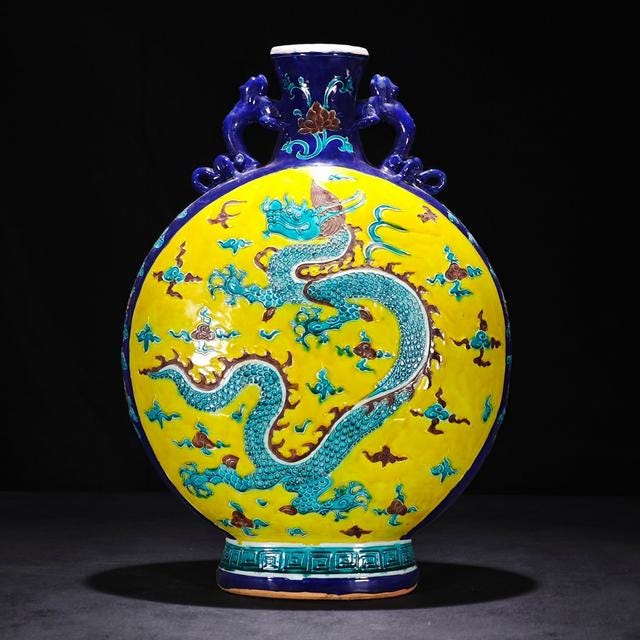
Canton Enamel Porcelain: The Golden Tapestry of Global Trade
Amidst the celebrated traditions of Chinese porcelain, one genre stands out for its explicit purpose as a **global commodity** and its…
Canton Enamel Porcelain: The Golden Tapestry of Global Trade

Amidst the celebrated traditions of Chinese porcelain, one genre stands out for its explicit purpose as a global commodity and its flamboyant, cross-cultural aesthetic: Canton Enamel Porcelain (广彩, Guǎngcǎi, literally “Canton Colors”). Known in the West as ”Rose Medallion,” “Rose Canton,” or simply ”Famille Rose”, this is not the product of a mountain kiln, but of the bustling port workshops of Guangzhou (Canton). It represents the vibrant, sometimes lavish, artistic dialogue between China and the West during the 18th and 19th centuries.
Historical Context: The Port of a Thousand Orders
Era: Emerged and peaked during the Qing Dynasty, particularly the Yongzheng (1723–35) and Qianlong (1736–95) reigns. Location: Guangzhou (Canton), Guangdong Province. It was the sole port (via the “Canton System”) open to Western trade for much of this period. Nature: A decorative finishing industry, not a production kiln. White porcelain “blanks” were shipped from the interior kilns of Jingdezhen to Guangzhou, where specialized workshops overpainted them with enamels and gilt to fulfill specific foreign orders.
The birth of Guangcai was driven purely by export demand. European traders (from the British, Dutch, French, and Swedish East India Companies) and later American merchants brought designs, samples, and even their own artists to guide production.

The Technical Process: Precision and Opulence
Guangcai is defined by its overglaze enamel decoration. The process was meticulous:
- The Blank: A fine, white, glazed porcelain body from Jingdezhen arrived in Guangzhou.
- The Palette: Artisans used a distinctive opaque enamel palette, pioneered in the early 18th century. Its key feature was a pinkish-red derived from colloidal gold (hence “Famille Rose” or “Rose Medallion”), which allowed for softer shading and a wider, more pastel-like range of colors than earlier Chinese palettes.
- Gilding: Extensive use of liquid gold (chinoiserie) was a hallmark. Borders, details, and entire background panels were lavishly gilded, creating an immediate impression of luxury.
- Multiple Firings: Each color, and the gilt, required a separate low-temperature firing (around 800°C) to fuse it to the glaze, making production complex and costly.

The Artistic Grammar: A Hybrid Visual Language
Guangcai designers brilliantly synthesized Chinese motifs with Western compositional tastes to create a new, hybrid style.
1. The “Rose Medallion” Pattern: The most famous schema. It typically features:
- A central medallion with flowers (peonies, roses) or a symbolic motif.
- Surrounding paneled reserves alternating between scenes of Chinese figures (in gardens, pavilions) and colorful birds, butterflies, or insects.
- An intensely decorated border of geometric or floral patterns.

2. “Rose Canton” & Other Patterns: ”Rose Canton”: Similar to Rose Medallion, but without the human figures, focusing solely on birds, flowers, and insects. ”Famille Verte”: An earlier style using a dominant green and iron-red palette, also produced in Guangzhou for export. Armorial & Commissioned Wares: Direct copies of European coats of arms, mythological scenes, portraits, or specific topographical views, made to exact customer specifications.
3. The “Fencai” (粉彩) or “Powdered Color” Technique: This was the technical foundation. Opaque white enamel was used as a base or mixer, softening colors and allowing for subtle gradations, much like European oil painting. This was a key advancement over the harder lines of earlier Wucai.

A Two-Way Street: Influence and Imitation
The cultural exchange was mutual:
- To the West: Guangcai porcelain flooded European and American markets, defining the Western image of “Chinese export art” and influencing Rococo design with its asymmetry and naturalistic motifs. It was imitated by European soft-paste porcelain factories like Meissen and Chelsea.
- To China: The demand for perspective, shading, and foreign subject matter influenced Chinese painting and decorative arts. The technical skill of Guangzhou’s enamellers was later applied to domestic-market wares.
Legacy & Distinction
Guangzhou Enamel Porcelain is distinct from other “great kilns”:
- It is mercantile art, shaped by global market forces.
- It is a fusion style, the first truly global decorative schema.
- It represents a technological peak in overglaze enamel painting and gilding on porcelain.
While sometimes considered by purists as less “authentically Chinese” than imperial wares, its historical significance is immense. It is a direct, glittering record of the China Trade, embodying the fascination, misunderstanding, and creative synthesis that occurred when East and West met across the tea and porcelain tables.
Conclusion
Guangcai is more than just porcelain; it is a document of globalization. Each vibrant plate or gilded vase tells a story of long sea voyages, cultural curiosity, and commercial acumen. It captures a moment when Chinese artisans, with peerless skill, held the brush for the world’s imagination, creating a brilliant, golden tapestry that still enchants collectors today as a symbol of a connected, opulent age.
메타데이터
- post_id
- d7badfae72f2
- slug
- canton-enamel-porcelain-the-golden-tapestry-of-global-trade-d7badfae72f2
- url
- https://medium.com/@owlchenweiliang219/canton-enamel-porcelain-the-golden-tapestry-of-global-trade-d7badfae72f2
- canonical_url
- https://medium.com/@owlchenweiliang219/canton-enamel-porcelain-the-golden-tapestry-of-global-trade-d7badfae72f2
- author_url
- https://medium.com/@owlchenweiliang219
- status
- ok
- fetched_at
- 2026-06-24 13:29:15