A Beacon Made of Gutters and 0.25 Watts
— An SSTV signal I “fished up” on KiwiSDR carried the scent of ingenuity
A Beacon Made of Gutters and 0.25 Watts
— An SSTV signal I “fished up” on KiwiSDR carried the scent of ingenuity
A few days ago, I was “fishing” the 20-meter band on an Irish KiwiSDR receiver. I didn’t have a specific goal. When you slowly sweep across a band, you sometimes catch something that’s far more interesting than what you were looking for in the first place. I keep scanning because I want to run into that kind of accident.
That day, an image suddenly rose out of the noise. SSTV. Horizontal streaks cut across the frame, the sync was slightly off, and the text was blurred. But it wasn’t “just noise.” There was intention behind it.
The decoded picture showed a callsign and the suffix “/QRPP.” QRPP points toward the ultra-low-power end of QRP — milliwatts, not watts. It’s not a game you win merely by turning the power down. It’s the smell of an experimenter: What can I still do under harsh limits of power and antennas?

The SSTV image I decoded — callsign and “/QRPP” visible through the artifacts.
I couldn’t let it go, so I sent an email. I wrote that I had received his beacon via an Irish KiwiSDR and managed to decode the image. I also told him I enjoy practical low-power experiments myself. And at the end I added: if he had a website, blog, or social media where he documented his projects, I’d love to see it.
His reply came quickly — and the very first line hit hard:
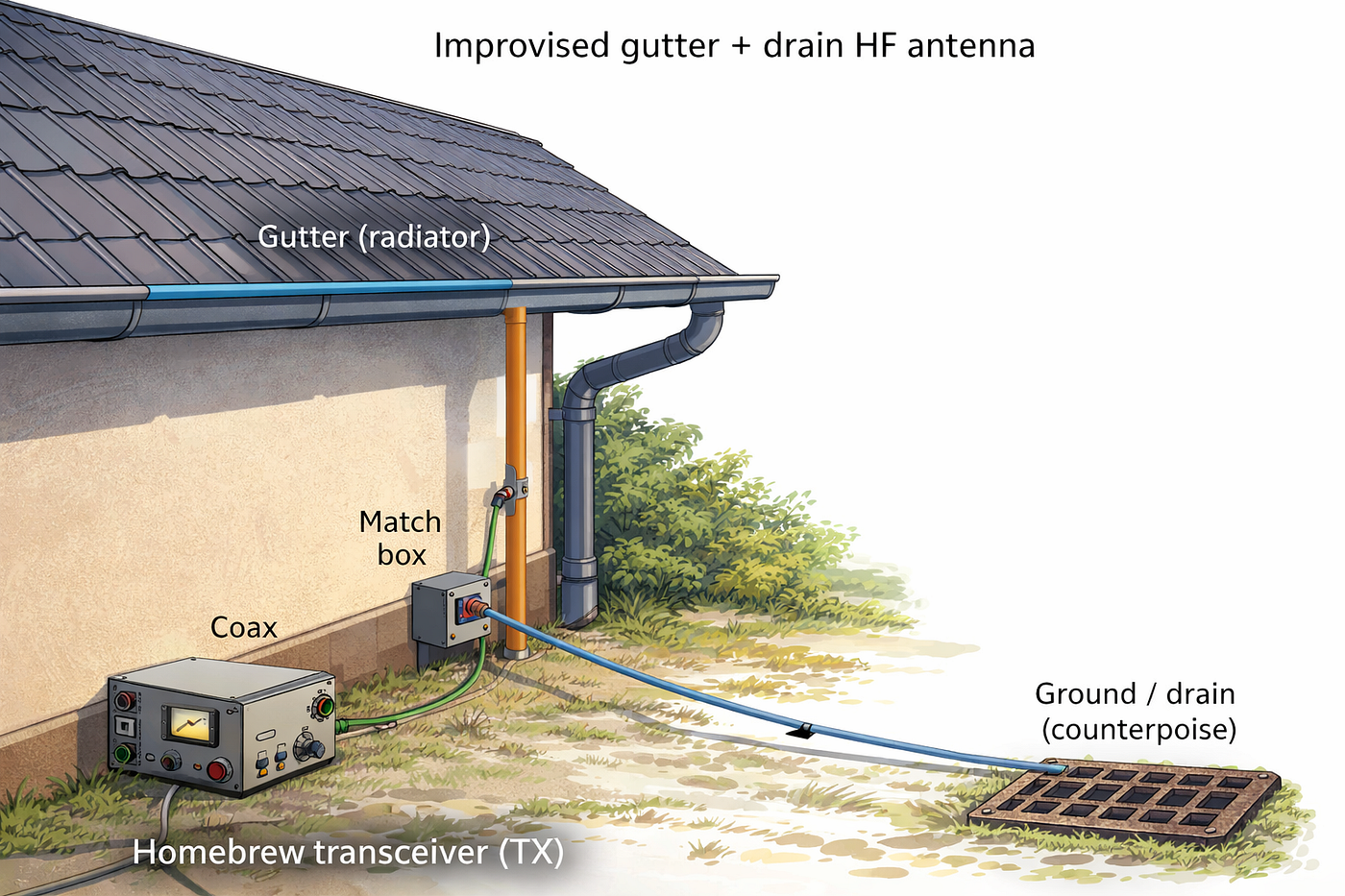
Output is 250 mW. The antenna was “gutter and drain.”
I laughed out loud. Not in mockery — more like the reflex you have when you catch the scent of a clever hack. A gutter and a drain. It’s the opposite of “building a proper antenna.” But that’s often where QRPP becomes truly fun: before you polish the conditions, you break them. Use the metal you already have. Get it on the air first. That lightness is where ingenuity starts.
The mental picture that formed immediately: an improvised “gutter + drain” HF antenna.
Not “audio SSTV into SSB” — but drawing SSTV directly at RF
What fascinated me even more was how the beacon itself was built. He described a small SSTV beacon made with a microcontroller and an Si5351 — and, crucially, he was generating SSTV directly at RF. Not creating an audio signal and feeding it into an SSB transmitter, but updating the RF frequency continuously to “draw” the picture. The update interval was roughly every 0.5 ms.
Once numbers like that appear, the story stops being about operating and becomes a story about building.

An Si5351 clock/signal generator module (illustrative).
And then came the detail that completely sealed it: his “camera.”
Instead of a conventional camera, he used a chip called PAA3905 to capture his garden — at a resolution of 35×35 pixels.
That sounds absurdly small. But if you’re going to put an image onto HF, small is not a compromise — it’s design. Here, the “camera’s” job is not to create a sharp image, but to reshape the world into something that can be transmitted. Deliberately throwing away resolution for a purpose. I love that kind of clean, unapologetic tradeoff.

PAA3905 — used here as the “image source.”

A garden in 35×35 pixels — small enough to ride on HF.
At that moment I realized what I actually want others to understand. Not the headline result — how many milliwatts over how many kilometers — but the ingenuity before the result. What constraints existed, how they were dodged, and where the builder chose to compromise. The texture of a design, the habits of a maker: that’s the interesting part. That’s also the part I want understood.
“I don’t blog” doesn’t mean “I don’t want to be understood”
He explained that the SSTV beacon grew out of discussions with Kazu/AG6NS. AG6NS had been experimenting with pico balloons and an SSTV transmitter (text only) at around 10 mW on 20 meters. Because line-of-sight reception (under ~100 km) wasn’t possible, they discussed how much power would actually be needed for real skywave propagation. His estimate was that ~100 mW might be enough.
So he designed a small PA that could produce roughly 140 mW from a 3.3 V supply. He first used a DDS approach, then moved to the Si5351 once he could handle the timing needed for direct-RF SSTV. The outcome matched his intuition: even with a makeshift antenna, around 100 mW-class power was sufficient.
In the same email thread, he responded to my question about whether he had a blog or social media:
He didn’t. He wrote something along the lines of: If you’ve seen my QRZ page, you’ll notice I’m better at building things than promoting them :-)
That line made everything click. He isn’t the type who packages his work outwardly. His energy goes into the bench — trial and error, modifications, the next test.
But “not publishing” is not the same as “not wanting to be understood.” His emails were full of clear numbers, parts, and units: 0.25 W, 0.5 ms, 35×35, gutter and drain. Those details aren’t for applause. They’re there to transmit the logic of the hack. If a few people understand, that’s enough. It’s a restrained, very pure kind of sharing.
A thin line that turns ingenuity into fact
He also attached a screenshot showing reception on an EA8 path — over 3000 km. He noted that his own signal — 0.5 mW / vertical — appeared at the very bottom. There was no “sound” there, only a thin line etched into a waterfall display.
How much ingenuity is stacked up behind a single line? And when that line is observed far away, the ingenuity becomes fact, not just personal satisfaction.

That’s why reception reports matter. They’re not merely politeness. They’re not just “amazing!” They’re feedback that says: Your ingenuity was observable on my end too. Ingenuity completes itself only when it’s observed.
The next time I “fish” the 20-meter band, I might run into that beacon again. A tiny image rising from the noise feels like a signal in itself: somewhere, someone is still building. Somewhere on a bench, gutters and drains are carrying RF. Just knowing that makes my own bench feel a little brighter.


Related articles

https://medium.com/@LowPowerRadioLab/the-future-of-bcl-swl-a7fab8a5c133
I have other articles as well. If you’d like, please also visit: http://www.lowpowerradiolab.org/
메타데이터
- post_id
- d7cd0ff8b535
- slug
- a-beacon-made-of-gutters-and-0-25-watts-d7cd0ff8b535
- url
- https://medium.com/@LowPowerRadioLab/a-beacon-made-of-gutters-and-0-25-watts-d7cd0ff8b535
- canonical_url
- https://medium.com/@LowPowerRadioLab/a-beacon-made-of-gutters-and-0-25-watts-d7cd0ff8b535
- author_url
- https://medium.com/@LowPowerRadioLab
- status
- ok
- fetched_at
- 2026-07-13 06:23:13