Zero-Day Threats: The Invisible Battle Before the Patch Exists
In cybersecurity, some of the most dangerous attacks happen before the world even realizes a vulnerability exists. These are called…
Zero-Day Threats: The Invisible Battle Before the Patch Exists
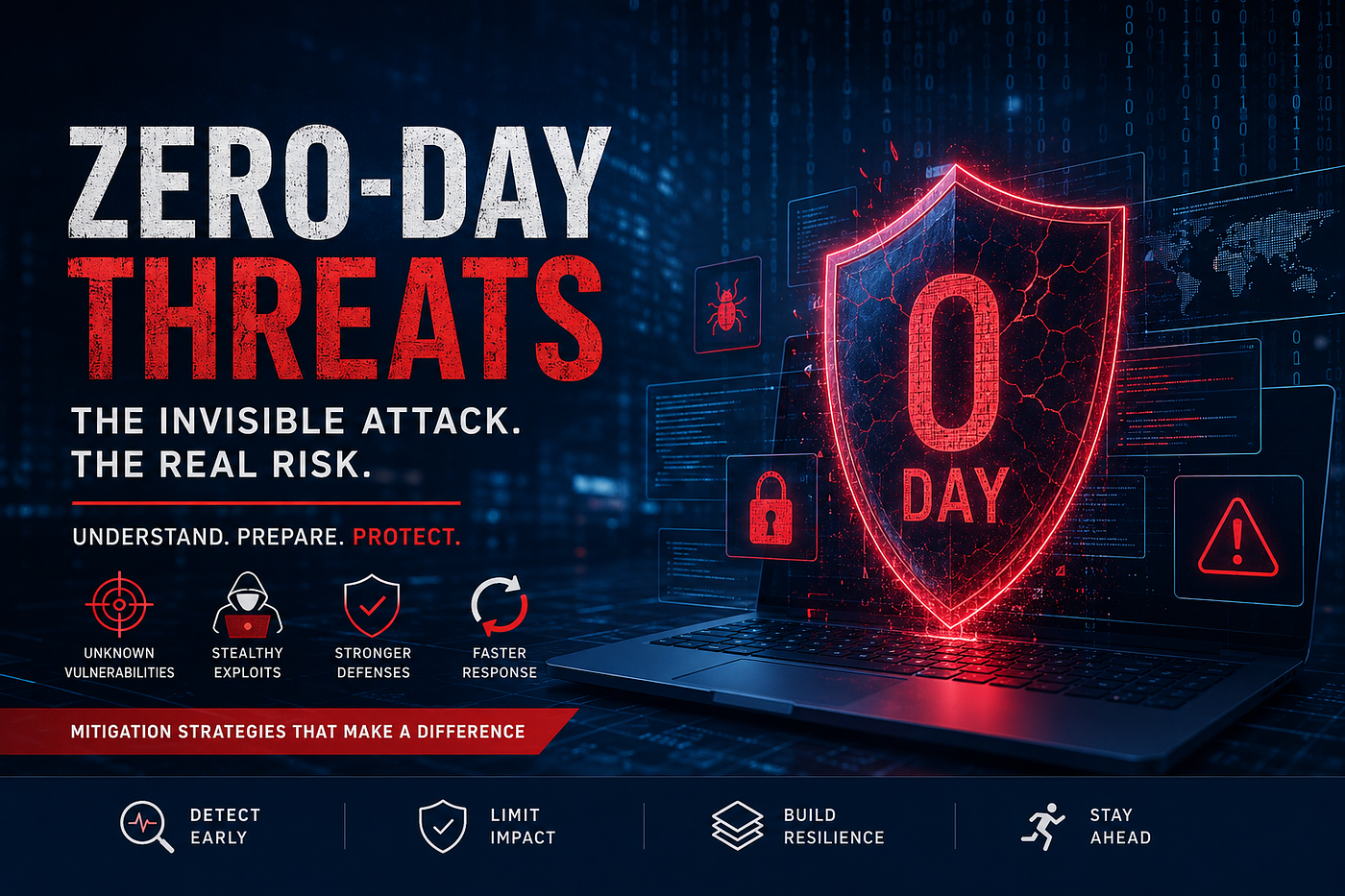
In cybersecurity, some of the most dangerous attacks happen before the world even realizes a vulnerability exists. These are called Zero-Day Threats — attacks that exploit software vulnerabilities before vendors release a fix or patch.
For organizations building digital products, cloud platforms, IoT ecosystems, mobile apps, or enterprise infrastructure, zero-day threats are no longer rare events. They are part of modern cyber warfare.
From governments and enterprises to startups and SaaS platforms, everyone is a potential target.
What is a Zero-Day Vulnerability?
A zero-day vulnerability is a software flaw unknown to the software vendor or security community.
A zero-day attack occurs when attackers exploit that flaw before a patch becomes available.
The term “zero-day” means defenders have had zero days to prepare.
Common targets include:
- Operating systems
- Browsers
- Mobile apps
- Cloud platforms
- IoT devices
- APIs
- Enterprise software
- Firmware and embedded systems
Why Zero-Day Threats Are Dangerous
Traditional cybersecurity relies heavily on known signatures, patch updates, and predefined attack patterns.
Zero-day attacks bypass these defenses because:
- No signature exists yet
- Antivirus engines may not detect them
- IDS/IPS systems may miss them
- Patches are unavailable
- Exploits evolve rapidly
This creates a dangerous window where attackers can operate silently.
Real-World Impact
Zero-day attacks have been used for:
- Ransomware deployment
- Data theft
- Espionage
- Supply-chain attacks
- Infrastructure sabotage
- Credential harvesting
- Remote code execution
Major technology companies, governments, and critical infrastructure providers have all experienced zero-day incidents.
In many cases, organizations discover the compromise weeks or months later.
Common Entry Points
Attackers often use zero-day exploits through:
Web Browsers
Malicious websites exploiting browser rendering engines.
Email Attachments
Documents or PDFs containing exploit payloads.
Unpatched Servers
Internet-facing APIs and services.
Third-Party Libraries
Open-source dependencies with hidden vulnerabilities.
Mobile Applications
Weak runtime protections or insecure SDK integrations.
IoT & Embedded Devices
Firmware vulnerabilities with limited update mechanisms.
The Zero-Day Attack Lifecycle
A typical zero-day attack follows several stages:
- Vulnerability discovery
- Exploit development
- Initial compromise
- Privilege escalation
- Persistence establishment
- Data exfiltration or disruption
- Covering tracks
Advanced attackers often chain multiple vulnerabilities together.
Mitigation Strategies for Zero-Day Threats
No organization can guarantee complete immunity, but strong architecture and operational discipline can significantly reduce risk.
1. Adopt a Zero Trust Security Model
Never assume trust based on network location.
Key principles:
- Verify every request
- Enforce least privilege
- Segment networks
- Continuously validate identities
- Limit lateral movement
If one system gets compromised, containment becomes easier.
2. Defense in Depth
Relying on a single security layer is dangerous.
Use multiple layers:
- WAFs
- Endpoint Detection & Response (EDR)
- IDS/IPS
- Runtime monitoring
- API gateways
- Network segmentation
- Sandboxing
Even if one layer fails, others can slow or block attackers.
3. Aggressive Patch Management
While zero-day vulnerabilities are initially unpatched, many attacks continue long after fixes become available because organizations delay updates.
Best practices:
- Maintain asset inventory
- Prioritize internet-facing systems
- Automate patch deployment
- Test updates rapidly
- Monitor vendor advisories continuously
Patch latency is one of the biggest security risks.
4. Behavioral Detection Over Signature Detection
Modern security tools should detect anomalies, not just known malware signatures.
Focus on:
- Abnormal process execution
- Unusual outbound traffic
- Suspicious privilege escalation
- Unexpected API behavior
- Memory injection patterns
AI-assisted behavioral analytics are becoming critical in modern SOC operations.
5. Secure Software Development Lifecycle (SSDLC)
Security must begin during development.
Key practices:
- Secure code reviews
- Static Application Security Testing (SAST)
- Dynamic testing (DAST)
- Dependency scanning
- Threat modeling
- Secure API design
- Secrets management
Building security early reduces attack surfaces later.
6. Application Sandboxing & Isolation
Sandboxing limits the damage caused by successful exploitation.
Examples:
- Container isolation
- Browser sandboxing
- Mobile app sandboxing
- Virtualized execution environments
Compromised processes should never gain unrestricted system access.
7. Principle of Least Privilege
Applications, users, and services should only have the minimum permissions required.
This limits:
- Privilege escalation
- Lateral movement
- Data exposure
- Infrastructure compromise
Overprivileged systems are extremely dangerous during zero-day incidents.
8. Continuous Monitoring & Threat Hunting
Zero-day attacks often remain hidden.
Organizations need:
- Centralized logging
- SIEM platforms
- Real-time alerting
- Threat intelligence feeds
- Security audits
- Proactive threat hunting
Detection speed determines damage severity.
9. Backup & Recovery Strategy
Some zero-day attacks eventually deploy ransomware.
Critical practices:
- Offline backups
- Immutable backups
- Recovery drills
- Multi-region redundancy
- Backup encryption validation
Recovery readiness matters as much as prevention.
10. Supply Chain Security
Third-party software can become the weakest link.
Mitigation steps:
- Audit dependencies
- Use trusted repositories
- Verify software signatures
- Monitor CVEs
- Maintain Software Bill of Materials (SBOM)
Supply-chain attacks are increasingly sophisticated.
Cloud & IoT Considerations
For cloud-native and IoT ecosystems, additional precautions are essential.
Cloud Security
- Restrict public exposure
- Use IAM properly
- Enable runtime monitoring
- Rotate secrets frequently
- Harden APIs
IoT & Embedded Systems
- Signed firmware updates
- Secure boot
- OTA update mechanisms
- Hardware-backed security
- Device authentication
IoT environments are especially vulnerable because many devices remain unpatched for years.
Human Awareness Still Matters
Technology alone cannot stop every attack.
Employees should understand:
- Phishing risks
- Suspicious attachments
- Social engineering
- Credential hygiene
- MFA importance
Human error still remains one of the largest attack vectors.
Final Thoughts
Zero-day threats represent one of the harsh realities of modern cybersecurity:
Sometimes attackers know about a vulnerability before defenders do.
Organizations cannot rely solely on reactive security anymore.
The focus must shift toward:
- Resilient architectures
- Continuous monitoring
- Fast response capabilities
- Layered security
- Secure development practices
- Operational preparedness
Cybersecurity is no longer just about preventing attacks.
It is about minimizing blast radius, detecting intrusions quickly, and recovering efficiently when prevention fails.
In today’s connected world, resilience is the real competitive advantage.
CyberSecurity #ZeroDay #CyberThreats #InformationSecurity #CloudSecurity #IoTSecurity #DataProtection #SoftwareSecurity #Ransomware #SystemsIndia
메타데이터
- post_id
- d7cde1de4e31
- slug
- zero-day-threats-the-invisible-battle-before-the-patch-exists-d7cde1de4e31
- url
- https://medium.com/%E0%A4%9C%E0%A5%8D%E0%A4%9E%E0%A4%BE%E0%A4%A8%E0%A4%B8%E0%A5%8D%E0%A4%B0%E0%A5%8B%E0%A4%A4%E0%A4%B8%E0%A5%8D/zero-day-threats-the-invisible-battle-before-the-patch-exists-d7cde1de4e31
- canonical_url
- https://medium.com/%E0%A4%9C%E0%A5%8D%E0%A4%9E%E0%A4%BE%E0%A4%A8%E0%A4%B8%E0%A5%8D%E0%A4%B0%E0%A5%8B%E0%A4%A4%E0%A4%B8%E0%A5%8D/zero-day-threats-the-invisible-battle-before-the-patch-exists-d7cde1de4e31
- author_url
- https://medium.com/@geeky.vartika
- status
- ok
- fetched_at
- 2026-06-15 22:55:51