Unexpected Costs of Fragmented AI Governance
As part of my ongoing “FinOps for Production AI” series, I’ve been writing about the costs of AI systems that never show up in the compute…
Unexpected Costs of Fragmented AI Governance
As part of my ongoing “FinOps for Production AI” series, I’ve been writing about the costs of AI systems that never show up in the compute forecast. This one starts somewhere unexpected: a policy tracker.
made in canva
I recently read a great write-up by Hayley May, “I Built an AI Policy Tracker So You Don’t Have to Read Legal Jargon” — a free, automated site that monitors AI legislation across the UK, US, and EU and translates it into plain English. Buried in her technical section is an observation that anyone who has run cloud infrastructure at scale will recognize immediately:
She needed three completely different scrapers for three jurisdictions. GOV.UK has a clean, documented REST API — structured JSON, no authentication, an actual OpenAPI spec. Congress.gov has an API, but it’s organized around bill numbers and endpoints rather than free-text search, so she pulls 2,500 bills and filters them locally. And EUR-Lex, home of the EU AI Act? No simple REST API at all — machine access means a SPARQL endpoint most developers have never touched, so in practice she parses raw HTML that breaks whenever the page redesigns.
Hayley solved this as an information problem, and did it elegantly. But if you build AI products commercially, the same fragmentation shows up somewhere far less visible: your budget. I’ve spent years doing cost attribution for large cloud fleets, most recently on FinOps for production AI workloads, and here’s the pattern I keep seeing — regulatory fragmentation compounds infrastructure cost, and almost nobody counts it.
Every jurisdiction adds a scraper. Then a compliance layer. Then a separate cost center that gets absorbed into “infrastructure” and disappears from view. If you’re building AI products globally, your real cost driver often isn’t compute. It’s legal and operational overhead wearing a compute costume.
This isn’t just my experience talking. The study behind the EU AI Act’s own impact assessment (Renda et al., CEPS) priced compliance at roughly €29,000 per AI system per year — and every line of that estimate is labor: human oversight, documentation, transparency work, data governance. Not one euro of it is compute. Ponemon’s compliance benchmark found the same shape years earlier: about 60% of compliance cost is administrative and indirect overhead. The expensive part of compliance has always been lawyers, engineers, and reviewers — not servers.
Let’s make that concrete, with code.
Cost #1: The integration tax
Hayley’s three-scraper problem generalizes. Every jurisdiction sits on a tier of machine-readable infrastructure quality, and that tier drives your build cost, your maintenance burn, and your breakage risk. You can model this in about fifty lines:
class InfraTier(Enum):
    CLEAN_API = "clean_api"      # documented REST API, structured JSON
    PARTIAL_API = "partial_api"  # API exists, missing basics (search, filters)
    HTML_SCRAPE = "html_scrape"  # no API; breaks on redesign
TIER_COSTS = {
InfraTier.CLEAN_API: {"build_hrs": 8, "maint_hrs_per_month": 0.5, "break_prob_per_year": 0.05},
InfraTier.PARTIAL_API: {"build_hrs": 24, "maint_hrs_per_month": 2.0, "break_prob_per_year": 0.20},
InfraTier.HTML_SCRAPE: {"build_hrs": 40, "maint_hrs_per_month": 6.0, "break_prob_per_year": 0.60},
}But the monitoring pipeline is the cheap part. The expensive part is what each regulatory change triggers downstream: legal review, engineering assessment, possibly re-architecture. Add a per-change review cost, and the model starts telling the truth:
compliance_review = (changes_per_year * len(regimes)
                     * review_hrs_per_change * blended_rate)
Running this with conservative assumptions — the EU AI Act’s phased (and recently re-phased) implementation, the steady drip of US state AI laws, UK guidance updates — a three-jurisdiction footprint lands around $118K/year in engineering and review time, and roughly 75% of it is compliance review, not scraper maintenance. The pipes are cheap. The people reacting to what flows through them are not.
Jurisdiction       Build     Maint  Breakage      Review       Total
UK                 1,200       900       120      14,400      16,620
US                 3,600     3,600       480      43,200      50,880
EU                 6,000    10,800     1,440      32,400      50,640
                                                  ANNUAL     118,140
Calibrate the coefficients to your own team’s velocity — the exact numbers matter less than the shape, and the shape matches the published research: the CEPS study’s per-system breakdown allocates the largest chunks to human oversight (~€7,800/year) and robustness/documentation work, and its single biggest line item — a Quality Management System at €193K–€330K to stand up — is pure people-and-process. If your compliance budget is mostly a tooling budget, you’re measuring the wrong thing. (Full runnable example: https://github.com/timurista/governance-cost-models-examples))
Cost #2: Fragmentation compounds — faster than linearly
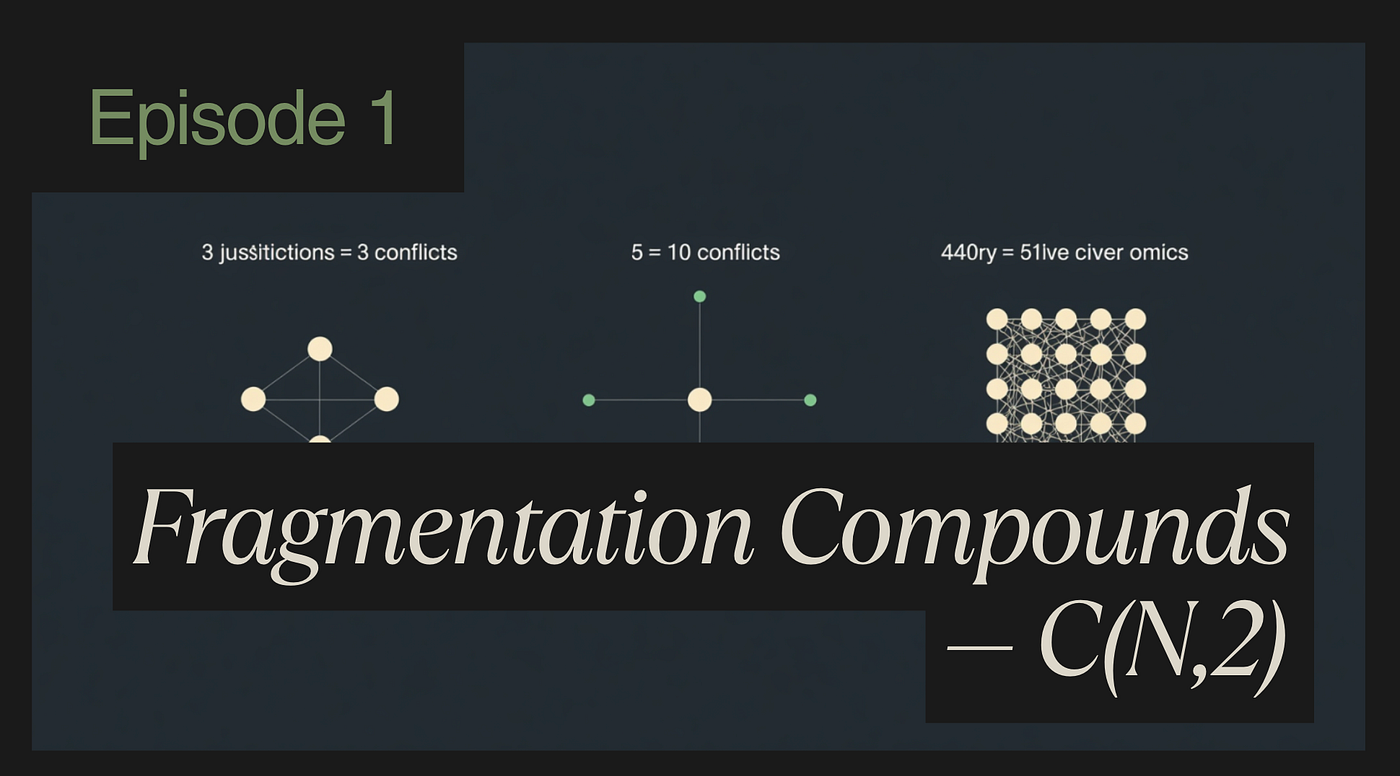
compunding image
Here’s the part that surprises finance teams. Adding jurisdiction number four doesn’t cost you one jurisdiction’s worth of overhead. It costs that plus a conflict-resolution tax with every regime you already support. And these conflicts aren’t hypothetical. The cleanest example: GDPR Article 48 prohibits handing EU personal data to non-EU authorities without an international agreement, while the US CLOUD Act compels US-headquartered companies to produce data on demand no matter where it’s stored. Schrems II confirmed the collision. There is no single architecture that satisfies both — you reconcile, you separate stacks, or you accept the risk. Add divergent definitions of “high-risk AI” and transparency requirements that contradict each other in the details, and every new regime multiplies the reconciliation work.
That’s pairwise growth — C(N, 2):
def fragmentation_cost(jurisdiction_costs, conflict_hrs_per_pair=20.0, blended_rate=150.0):
    base = sum(jurisdiction_costs.values())
    pairs = list(combinations(jurisdiction_costs.keys(), 2))
    conflict = len(pairs) * conflict_hrs_per_pair * blended_rate
    return {"total": base + conflict, "overhead_pct": 100 * conflict / base}
Watch what happens as you expand coverage:
N=1  base=$ 16,000  pairs= 0  conflict=$      0   (+0% overhead)
N=3  base=$116,000  pairs= 3  conflict=$ 9,000   (+8% overhead)
N=5  base=$171,000  pairs=10  conflict=$30,000   (+18% overhead)
Three jurisdictions feels manageable. Five is where the pairwise term stops being noise. Ten — which is where a genuinely global AI product is headed as more countries legislate — gives you 45 regime-pairs to reconcile. (Full example: https://github.com/timurista/governance-cost-models-examples))
The financial sector, which has lived with this dynamic longest, has put a price on it: an IFAC/OECD survey of 250+ compliance leaders found regulatory divergence costs financial institutions 5–10% of annual revenue — over $780 billion a year globally — and smaller institutions were twice as likely as large ones to report significant costs, because the burden is heavily fixed. That’s the compounding signal: the tax doesn’t scale down with your size, and it doesn’t scale linearly with your footprint. This is why “we’ll just expand to that market later” is a cost decision, not only a go-to-market one.
Cost #3: The invisible cost center
Both models above estimate people costs. But fragmentation also lives in your cloud bill, and this is the FinOps move that pays for itself fastest: tag every resource with the compliance regime it exists to satisfy.
That EU-region inference cluster you run purely for data residency? It’s not a rounding error. Forced localization raises data-hosting costs by 30–60% (Leviathan Security), because it defeats the economies of scale that make centralized cloud cheap. Sovereign-cloud variants from the hyperscalers typically carry a 10–30% premium — AWS’s European Sovereign Cloud, GA in Germany since January 2026, runs roughly 17% above the standard Frankfurt region and launched without GPU instances at all. That audit-log store the AI Act’s record-keeping rules require, the duplicated eval pipeline for a state-level impact assessment — untagged, they all melt into “infrastructure.” Tagged, they become a line item finance can see:
def attribute_compliance_cost(billing_rows):
    by_regime = defaultdict(float)
    for row in billing_rows:
        regime = row.get("tags", {}).get("compliance_regime", "untagged")
        by_regime[regime] += row["cost"]
    total = sum(by_regime.values())
    return {"by_regime": by_regime,
            "untagged_pct": 100 * by_regime["untagged"] / total}
Run against a (representative, simplified) billing export:
By compliance regime:
  EU AI Act - data residency        $42,000
  SOC 2                             $38,000
  UK GDPR                           $21,000
  untagged                          $15,000
  CO ADMT - transparency            $ 9,000
  EU AI Act - record keeping        $ 6,500
Untagged spend: 11.4% - your first cleanup target.(Full example: https://github.com/timurista/governance-cost-models-examples))
In every real environment I’ve seen, that untagged bucket starts much bigger than 11% — and the industry data agrees: as environments grow, tagging coverage that used to be “good enough” routinely leaves 20–30% of spend unallocated, and only about 44% of organizations have implemented chargeback or showback at all. Shrinking that bucket is your first project, because you cannot manage — or negotiate, or deprecate — a cost you cannot attribute. Once regimes show up as line items, useful conversations become possible: “EU data residency costs us $500K/year — is that market’s revenue covering it?” That question is unanswerable today at most companies, not because the answer is hard, but because nobody instrumented for it.
This is about to matter more, not less. The FinOps Foundation’s State of FinOps 2026–1,192 practitioners representing $83B+ in cloud spend — found 98% of teams now manage AI spend, up from 31% two years ago, and named visibility into AI costs as the #1 challenge. The margin pressure is already visible: average AI product gross margins sit around 52% (ICONIQ, 2026) versus 70–90% for traditional SaaS, and the published post-mortems blame inference costs. I’d argue compliance is the next hidden line item — invisible today for exactly the same reason inference was invisible in 2023: it’s absorbed into “infrastructure.”
Start counting it now
Hayley’s tracker exists because governments fragment their information infrastructure and someone had to absorb the translation cost — she automated it for free, for the public. Companies don’t get that option. They absorb the same fragmentation into engineering time, legal review, and duplicated infrastructure, and then wonder why AI margins look worse than the compute forecast promised.
Three things you can do this quarter. Model your integration tax — even rough coefficients per jurisdiction will show you where the review burden concentrates. Price expansion honestly — run the pairwise-conflict model before committing to a new market, and make the C(N,2) term part of the business case. And tag by regime — add a compliance_regime tag to your tagging standard today; it costs nothing and turns an invisible cost center into a managed one.
AI governance fragmentation isn’t going away — if anything, it’s accelerating. US states introduced over 1,200 AI bills in 2025 alone, with 40-plus states enacting at least one measure; South Korea’s AI Basic Act took effect in January 2026; China keeps layering binding rules; Brazil’s bill is moving through its Chamber of Deputies. Even the “simplifications” fragment: the EU’s Digital Omnibus just pushed high-risk obligations to December 2027 — which means another round of legal review, timeline replanning, and roadmap churn for everyone who’d built to the old dates. The compliance cost is real either way. The only choice you have is whether it shows up in your dashboards or in your margins.
FAQ
What is the EU AI Act, and when does it actually take effect? The EU AI Act is the world’s first comprehensive, risk-based law for AI. It entered into force in August 2024 and applies to any company whose AI system affects people in the EU, regardless of where the company is based. It arrives in phases: bans on certain practices began February 2025, general-purpose AI model rules in August 2025, and transparency rules (like labeling AI-generated content) in August 2026. The heaviest obligations — for “high-risk” systems like hiring or credit-scoring tools — were recently delayed by the EU’s Digital Omnibus agreement to December 2027 (August 2028 for AI embedded in regulated products).
What does “regulatory fragmentation” mean? There’s no single global AI rulebook — dozens of jurisdictions are writing their own laws that disagree on definitions, scope, and even whether AI needs a dedicated law at all. The EU has one comprehensive Act; the US has dozens of state laws and no federal statute; the UK relies on existing regulators and principles; South Korea and China have their own binding regimes. A company operating in several markets has to comply with all of these overlapping, sometimes conflicting, regimes at once.
What is FinOps? FinOps (“cloud financial operations”) is the practice of managing cloud and technology spend with the same rigor as any major investment — making engineering, finance, and product teams jointly accountable for what technology costs and what value it delivers. It has expanded well beyond cloud bills: in the FinOps Foundation’s 2026 survey, 98% of teams now manage AI spending, and “AI cost management” is the field’s most in-demand skill.
What is data residency, and why does it require duplicate infrastructure? Data residency (or localization) is a legal requirement that certain data be stored — and sometimes processed — within a specific country or region. Cloud economics depend on centralizing workloads at scale, so forcing data to stay in one region breaks that efficiency: research puts the hosting-cost penalty at 30–60%. In practice, companies stand up separate regional stacks — for example, EU-based inference servers that exist purely so European data never leaves the EU — often on “sovereign cloud” offerings that carry a 10–30% price premium.
Why can’t companies just comply once and be done? Because requirements can directly contradict each other. The clearest example: GDPR prohibits handing EU personal data to non-EU authorities, while the US CLOUD Act compels US-headquartered companies to produce data on demand wherever it’s stored. There’s no single configuration that satisfies both. On top of that, the rules keep changing — over 1,200 AI bills were introduced in US states in 2025 alone — so compliance is a continuous process, not a one-time project.
Do small companies need to worry about this? Yes, and disproportionately. Compliance has a large fixed, people-heavy component that big firms spread across more revenue; in the financial sector, smaller institutions were twice as likely as large ones to report significant costs from regulatory divergence. The EU AI Act offers SMEs some relief (lighter documentation, capped fines, free regulatory sandboxes), but the core work — inventorying your AI systems, classifying risk, documenting decisions — still has to be done.
Is compliance cost mostly a technology expense? No — it’s mostly a people cost. The study behind the EU AI Act’s own impact assessment modeled per-system compliance cost entirely as staff time: oversight, documentation, transparency, data governance. No compute line item. Ponemon’s benchmark similarly found about 60% of compliance cost is administrative overhead. The expensive part is lawyers, engineers, and reviewers — which is exactly why it hides so easily inside an “infrastructure” budget.
What is a “compliance regime tag”? In cloud cost management, a tag is a label attached to a resource so its cost can be attributed to a team, product, or purpose. A compliance regime tag records why a resource exists — e.g., marking an EU inference cluster as “runs solely for EU data residency.” Without it, the cost of complying with a specific law melts invisibly into a generic “infrastructure” line — which is how 20–30% of cloud spend in growing environments ends up unallocated.
Full working code for all three models: https://github.com/timurista/governance-cost-models-examples — runnable with plain Python 3, no dependencies. Inspired by Hayley May’s article “I Built an AI Policy Tracker So You Don’t Have to Read Legal Jargon” (live site · code).
Sources: Renda et al. (CEPS/ICF/Wavestone), Study to Support an Impact Assessment of Regulatory Requirements for AI in Europe (2021); Ponemon Institute, The True Cost of Compliance; IFAC / Business at OECD, Regulatory Divergence: Costs, Risks, Impacts (2018); Leviathan Security Group, Quantifying the Cost of Forced Localization; FinOps Foundation, State of FinOps 2026; ICONIQ Capital, State of AI Snapshot (Jan 2026); MultiState / NCSL state AI legislation trackers; European Commission, Digital Omnibus on AI (2026).
메타데이터
- post_id
- d7ce2a5a5834
- slug
- unexpected-costs-of-fragmented-ai-governance-d7ce2a5a5834
- url
- https://medium.com/devsecops-ai/unexpected-costs-of-fragmented-ai-governance-d7ce2a5a5834
- canonical_url
- https://medium.com/devsecops-ai/unexpected-costs-of-fragmented-ai-governance-d7ce2a5a5834
- author_url
- https://medium.com/@timothy-urista
- status
- ok
- fetched_at
- 2026-07-13 10:43:04