Frieren Waited 1,000 Years to Cry at a Funeral — and the Tears Weren't Grief
The Japanese title literally means “Frieren of the Funeral Send-Off,” a double meaning the English title can’t carry. It points at the…
Frieren Waited 1,000 Years to Cry at a Funeral — and the Tears Weren't Grief
The Japanese title literally means “Frieren of the Funeral Send-Off,” a double meaning the English title can’t carry. It points at the series’ real subject: knowing someone and mourning them are the same skill.
⚠️ Spoiler warning: This piece covers the opening episodes of Season 1 (the premise of the whole series) and nothing beyond. If you’ve seen the first two episodes — or read the first two chapters — you’re safe.
The most famous scene in Frieren: Beyond Journey’s End happens ten minutes into the first episode, and the series never stops orbiting it.
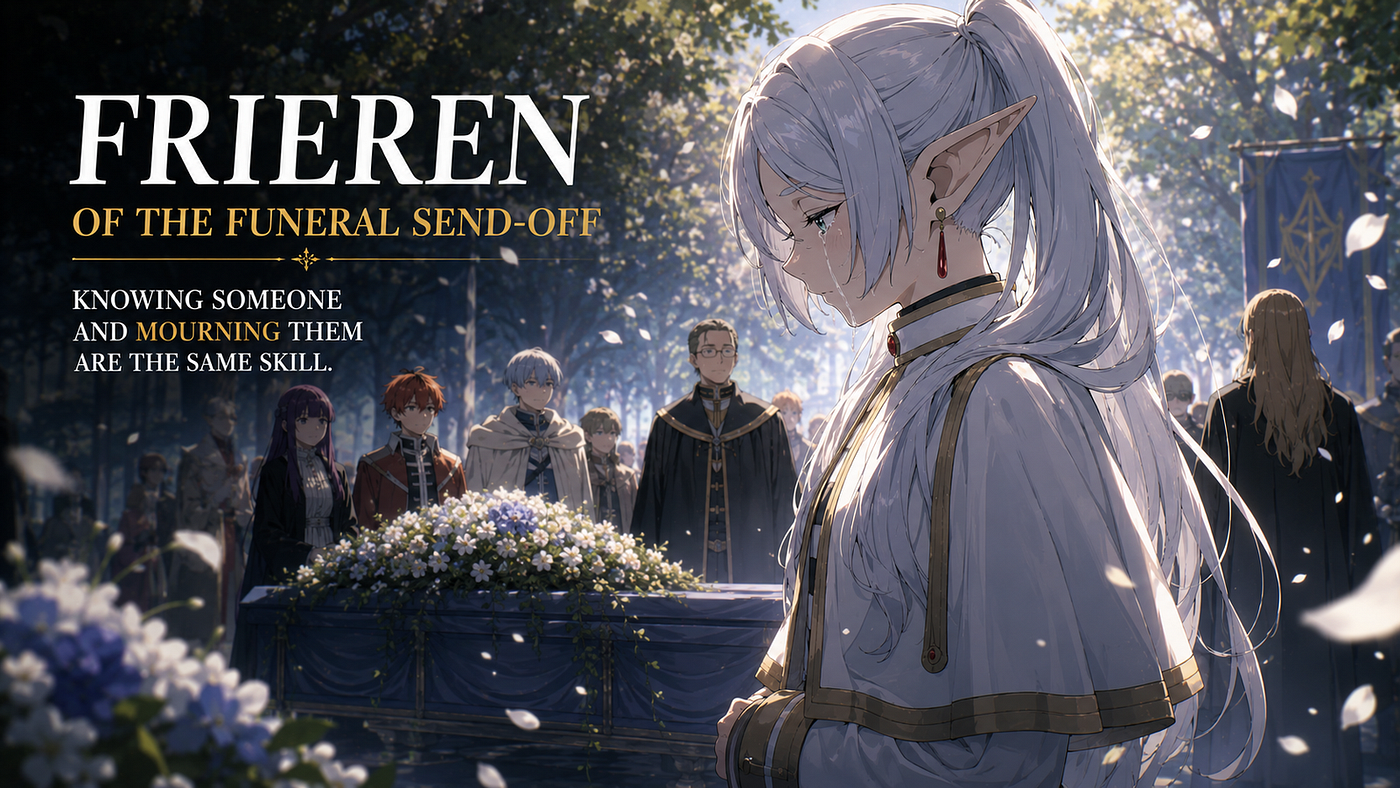
Himmel the Hero is dead. Old age, a full life, a state funeral. His former party gathers: the priest, the warrior, and Frieren — the elf mage who fought beside him for ten years and then, being an elf, simply went on living. She stands at the grave looking mildly inconvenienced, and says something so cold the mourners around her flinch: she barely knew the man. They only traveled together for ten years.
And then, mid-sentence, she starts crying — and can’t explain why.
Here’s our read on why that scene broke so many viewers, in Japan and everywhere else: the tears aren’t grief. Not exactly. What Frieren says through them — roughly, “I knew human lives were short. Why didn’t I try to know him?” — isn’t “I’m sad he died.” It’s “I ran out of time to know him, and I didn’t even notice the clock.” Most stories about loss stop at someone precious died and it hurts. Frieren starts one level deeper: someone was precious, and I only found out when the chance to know him expired. Death isn’t the wound. The unasked questions are.
A death every season
To see why it took her a thousand years to get there, you have to take the elf timescale seriously — and the series absolutely does.
For a being who has lived over a millennium, a human death isn’t a tragedy; it’s weather. Seasons turn. Spring comes, summer goes, winter arrives, and it will all happen again next year. People are born, get old, and die, and Frieren has watched that cycle repeat for ten centuries. Nothing about it is wrong, or cruel, or even notable. You don’t mourn October.
That’s not coldness as a character flaw — it’s the honest math of her lifespan. Ten years is to Frieren roughly what a season is to us. Would you expect to be transformed by an acquaintance you saw for one summer?
Which is exactly what makes the funeral scene land. The math said this death was weather. The tears said otherwise. Something had happened inside those ten “negligible” years that her thousand-year arithmetic couldn’t account for — and the whole series is her going back to find out what.
The title you’re not reading
Before going further, we want to hand overseas fans the thing that doesn’t survive translation, because in this case it’s the whole thesis.
The English title, Beyond Journey’s End, is lovely and evasive. The Japanese title is neither: Sōsō no Frieren (葬送のフリーレン) — literally “Frieren of the Sōsō,” where sōsō means a funeral send-off: the act of accompanying the dead on their way.
The series wrings a double meaning out of it. In-story, it’s the name demons gave her — rendered in the official English release as “Frieren the Slayer” — the mage who has sent so many demons to their graves. That’s the surface reading, the battle-title. But sit with the Japanese for a second and the quieter reading opens up: Frieren is the one who sees everyone off. She outlives every human she will ever love. Her existence, stretched over centuries, is one long funeral procession — she walks each companion to the edge of their life, and then keeps walking alone. The demons meant it as a threat. The author means it as her job description.
There’s a second gift buried in the names, this time from German. Nearly every name in the series is a German word: Frieren means “to freeze.” Heiter, the drunk priest, means “cheerful” — or a clear sky. Eisen the warrior is “iron”; Stark, his apprentice, is “strong”; Fern means “far away.” And Himmel — the hero whose death starts the story, the man Frieren is desperate to speak with one more time — Himmel means heaven.
Hold that thought. It’s about to matter.
Memory here doesn’t fade — it compounds
What Frieren actually does after the funeral is deceptively simple: she re-walks the old route. Same roads, same towns, same inns the hero’s party passed through fifty-odd years ago, now with two kids — Fern and Stark — in tow.
On paper it’s a nostalgia tour. In practice it’s an excavation. Every place holds a memory of Himmel, and every time she revisits one, the memory means more than it did when she made it. A spot where Himmel once stopped to admire something, and young-Frieren shrugged; standing there now, she can finally see what he was actually doing — that half the time, the point was never the scenery. The point was looking at it together. The data was all recorded a thousand percent accurately. She’s just reading it properly for the first time.
This inverts the way our stories usually treat memory and the dead. For humans, memory is the thing that decays — the voice you slowly forget, the photo that replaces the face. Grief has a half-life because we do. But Frieren will live a thousand more years, and so, therefore, will her memory of Himmel. He got eighty years of life; he gets a millennium of being remembered, in perfect elf-grade fidelity, by someone who is still learning things about him. His memory isn’t eroding with time. It’s appreciating.
In this series, the dead don’t fade from memory. They grow — because the one remembering finally learned how to look.
That, we’d argue, is the emotional engine that makes Frieren feel unlike any other fantasy about loss: it’s not a story about holding on to the dead. It’s a story about getting to know them afterward.
The death where she proves she learned
If Himmel’s funeral is the wound, Heiter’s death — one episode later — is the first stitch, and it’s constructed with surgical care.
Frieren visits the old priest decades later and finds him ancient, frail, and raising an orphaned girl, Fern. He asks Frieren to take Fern on as an apprentice, then plays out his final act with the same tidy consideration Himmel would have used: when his time gets close, he urges Frieren and Fern to leave on a journey — so the girl won’t have to watch him die, so the loss will happen offscreen. A quiet exit. A kindness, by his lights.
And Frieren refuses. The elf who once treated death as weather looks at the dying man and tells him no — give the child a real farewell, make as many memories with her as you can. Because Frieren now knows exactly what it costs to be left holding a mostly blank notebook with someone’s name on it. She won’t let Fern inherit her regret. Heiter — who, it turns out, had orchestrated the entire apprenticeship as a way of buying time for Fern’s future, knowing full well the “immortality grimoire” he’d asked Frieren to decipher was a dud — spends his last days making memories with his daughter in everything but name, and dies known.
Watch what death does structurally in these opening chapters, because it’s the series’ whole architecture in miniature: Himmel’s death launches Frieren’s journey. Heiter’s death gives her Fern. Eisen — still alive, but old enough to feel the door closing — declines the road, points her toward her destination, and entrusts her with his own apprentice, Stark. Every ending hands something forward. Death here is never a wall; it’s a relay handoff. Master to student, journey to journey, regret to resolve.
An atheist elf walks toward heaven
So where is she actually going? The far north — to Ende, the end of the world — seeking a place called Aureole, “the land where souls rest.” The place humans call heaven. Because if it’s real, she can talk to Himmel again.
Stop and appreciate how strange that is for this character. Frieren is a creature of pure accumulated rationality — a magic user with a thousand years of empirical evidence about how the world works, from a species that never needed religion’s consolations. Elves don’t build churches. And yet here she is, staking decades of travel on a human folk belief, on the word maybe.
It’s the same move as a scientist deciding, late in life, to take a miracle seriously — not because the evidence improved, but because wanting something badly enough changes what you’re willing to bet on. Humans have always built their heavens out of exactly this feeling: I want to see them again. It might be the most human impulse there is. And now a thousand-year-old elf has caught it, the way you catch a language by living somewhere long enough.
That’s why the German pun lands like it does. Her destination is heaven, and heaven’s name — Himmel — is the man she’s walking toward. The journey and the person are the same word. Whether Aureole is real, whether the series ever grants her that conversation — it almost doesn’t matter (and we won’t say a word about where later arcs take it). The story’s point is already made the moment she starts walking: she found something worth believing irrationally in. Ten years with humans did to her what a thousand years alone never could.
Knowing someone is how you earn the right to mourn them
Strip the series down and one equation is left, and it’s the one Frieren is still learning: to know someone and to be able to grieve them are the same capacity. You can’t cry over a stranger. The tears only come for the person you actually saw. Which means Frieren’s thousand tearless years weren’t strength, and weren’t elf biology — they were a thousand years of not looking. The funeral didn’t reveal that she’d finally lost someone. It revealed that, for the first time, she’d had someone — and had barely opened the gift.
And the quiet proof of her growth isn’t in any battle. It’s in how she watches her new companions: cataloguing the specific flavors of Fern’s sulking, clocking Stark’s nervous tics. Small acts of knowing, banked daily, against farewells she is fully aware are coming — because they always come, on her timescale, and this time she intends to be ready. Not ready to avoid the pain. Ready to have earned it.
That’s the promise coiled inside that first funeral, and the thing this series offers its readers as gently as any story ever has: the people you love are knowable now. The tears, whenever they come, will be a receipt — proof of exactly how well you looked while looking was still possible. A ten-year season and an irreplaceable decade contain the same number of days. The difference is only in how much attention you paid.
This is what we love digging into at Manga Deep Dive — the layer of a series (starting with its own title) that doesn’t quite survive the trip out of Japanese. Follow along, and tell us in the responses: which farewell in this series got you — and did you see it coming?
A note on sourcing: The following are canon or public record — Frieren: Beyond Journey’s End (Sōsō no Frieren) by Kanehito Yamada and Tsukasa Abe has run in Shogakukan’s Weekly Shōnen Sunday since April 2020 (15 volumes as of December 2025); the funeral scene, Frieren’s regret, and her tears are chapter 1 / episode 1; Heiter’s death, the grimoire ruse, and Frieren’s refusal of his “leave before I die” request are chapter 2 / episode 2; Aureole, “the land where souls rest,” lies in Ende in the far north, and Frieren’s stated goal is to speak with Himmel again; demons’ name for her is rendered “Frieren the Slayer” in the official English release; the German meanings of the names (Himmel = heaven, Heiter = cheerful/clear sky, Eisen = iron, Stark = strong, Fern = distant, frieren = to freeze) are dictionary fact; the Madhouse anime aired Season 1 in 2023–24 and Season 2 in January–March 2026. Quoted lines are paraphrased from memory of the official English release, not verbatim. The readings offered here — the tears as regret rather than grief, memory that compounds instead of fading, death as relay handoff, and belief in heaven as Frieren’s “most human” acquisition — are our interpretation, supported by the text but not stated by it.
메타데이터
- post_id
- d7dce634e94a
- slug
- frieren-waited-1-000-years-to-cry-at-a-funeral-and-the-tears-werent-grief-d7dce634e94a
- url
- https://medium.com/@mangadeepdivejp/frieren-waited-1-000-years-to-cry-at-a-funeral-and-the-tears-werent-grief-d7dce634e94a
- canonical_url
- https://medium.com/@mangadeepdivejp/frieren-waited-1-000-years-to-cry-at-a-funeral-and-the-tears-werent-grief-d7dce634e94a
- author_url
- https://medium.com/@mangadeepdivejp
- status
- ok
- fetched_at
- 2026-08-12 23:53:48