Why Push Notifications Are the Most Important Feature in a Mobile Softphone
Push notifications are what let a mobile softphone ring when the app is backgrounded or the phone is locked. Without proper push (APNs on…
Why Push Notifications Are the Most Important Feature in a Mobile Softphone
Push notifications are what let a mobile softphone ring when the app is backgrounded or the phone is locked. Without proper push (APNs on iOS, FCM on Android), the OS suspends the app and calls never come through. It’s the one feature that decides whether a mobile softphone is actually usable, ahead of call quality, features, or how nice the app looks.
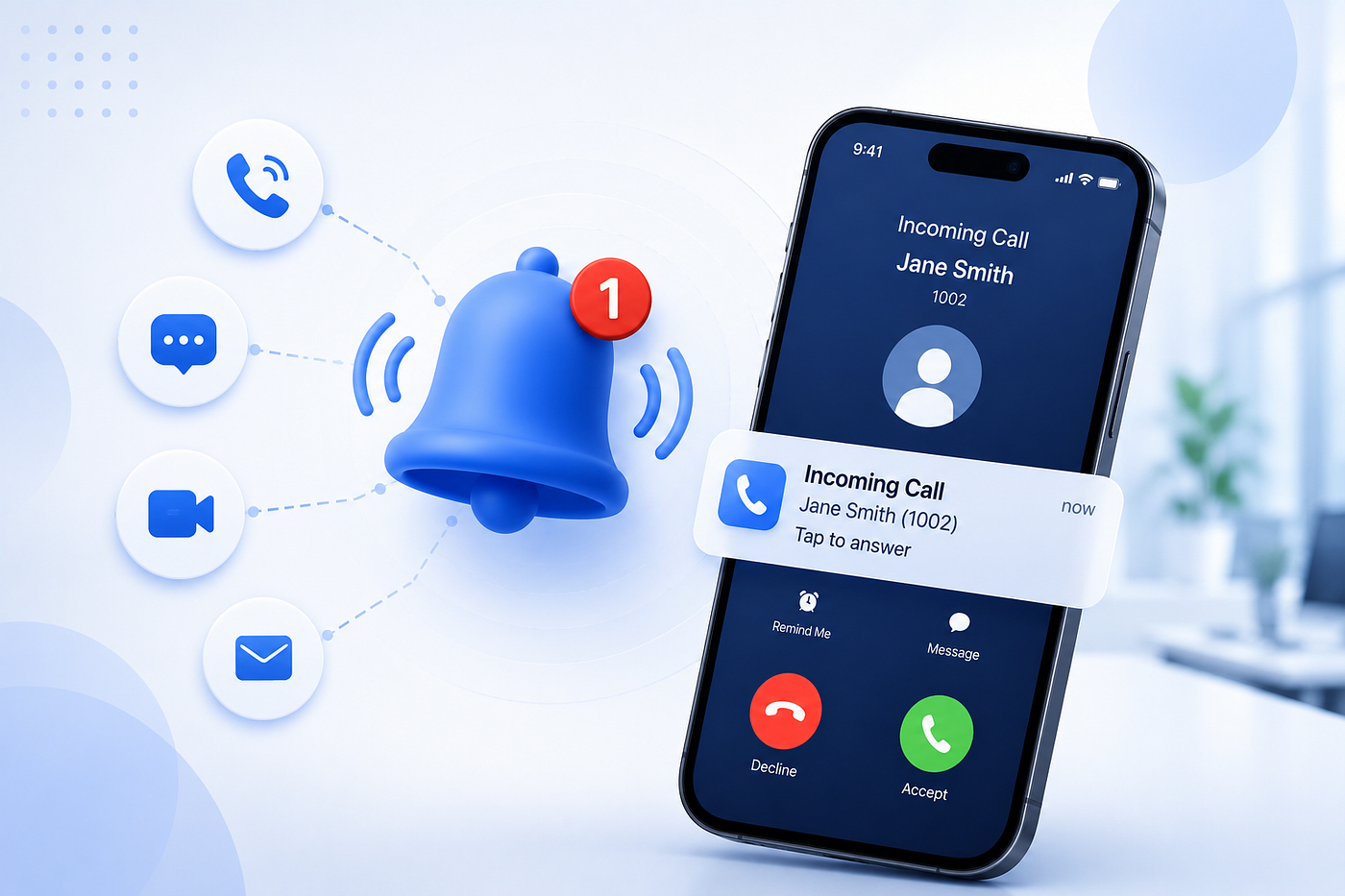
Ask someone what matters in a mobile softphone and you’ll hear about call quality, or features, or the interface. All fair. But there’s one thing sitting underneath all of it, and when it doesn’t work, none of the rest matters at all. Push notifications.
I know, Not exactly the feature anyone gets excited about. It never leads a comparison chart and no salesperson opens with it. But I’ve watched more mobile deployments fall apart over push notifications than over everything else combined, so I’ve come around to thinking it’s the single most important thing in the whole app.
Here’s why.
What push notifications actually do here
Quick definition first, because the term gets used loosely. In a mobile softphone, push notifications are the mechanism that wakes the app when a call comes in. On iOS that’s APNs (Apple Push Notification service), on Android it’s FCM (Firebase Cloud Messaging). Someone calls, the server fires off a push to the device, the OS wakes the app, and the phone rings like a normal call.
Take that away and a backgrounded app has no dependable way to know a call is even happening.
Why it beats every other feature
The whole thing comes down to how phones manage background apps.
iOS and Android both shut down background apps pretty ruthlessly to protect battery. Great for your battery, terrible for anything that needs to stay reachable. So a softphone that tries to hold a SIP registration open in the background is basically picking a fight with the operating system, and it’s a fight it loses every time. App gets frozen. Registration expires. Call comes in, gets routed to a phone that just sits there silent.
Push flips the model. The app doesn’t try to stay awake. The server sends a push the instant a call arrives, and the OS wakes the app right then, for exactly as long as it’s needed. Which happens to be precisely the thing mobile operating systems are built to allow.
That’s the reason push matters more than audio quality or a slick UI. Think about it. A softphone with gorgeous audio and a beautiful design that drops incoming calls is worthless. An average-sounding one that rings every single time is a real phone. Reliability wins, and push is what reliability is made of on mobile.
The one test that tells you the truth
Here’s what’s annoying about push. “Supports push notifications” on a spec sheet tells you basically nothing. Loads of softphones claim it and still drop calls in the real world. You have to test it yourself.
The test couldn’t be simpler. Lock the phone. Leave it an hour, long enough for the OS to fully put the app to sleep. Then call it.
Rings like a normal call? Push is done properly. Doesn’t ring, or rings a minute late, or shows up as some sad delayed notification? Then the app’s leaning on background registration the OS already killed. I cannot tell you how many otherwise-impressive softphones fail this exact test.
If you’re a business evaluating a mobile softphone, run this before you look at anything else. Not after the feature comparison. Before. Because if the app can’t pass it, the feature comparison is irrelevant.
Where push tends to go wrong
It helps to know the usual failure points, because they tell you what to look for.
Most often it’s the persistent-registration thing I mentioned, the app trying to stay alive in the background instead of using push. That’s the classic one.
Sometimes it’s half-finished platform work. iOS push done right needs PushKit and VoIP push wired into CallKit so the call shows up as a proper call. Android needs FCM tied into ConnectionService. Do those halfway and you get a softphone that works on Tuesday and fails on Wednesday for no obvious reason.
And people forget push isn’t only a client-side thing. The server, or whatever SBC sits in front of it, has to actually send the push when a call lands. Miss that and even a beautifully built client stays silent. Android throws in one more wrinkle too: aggressive battery savers can strangle push delivery, and the good softphones plan around that while the lazy ones pretend it isn’t happening.
What good looks like
When push is built right, the sequence goes something like this. Call hits the platform. Server fires a VoIP push through APNs or FCM. The push wakes the app and hands it the call details. App reports the call to CallKit or ConnectionService, so it lands on the lock screen looking like any other call. User taps answer. Connected.
And the user has no clue any of that just happened. The phone rang. That’s the whole experience from their side. That invisibility is actually the mark of a good implementation, all the machinery vanishing so the thing just behaves like a phone.
For businesses and providers who need this working reliably across a lot of users, a mobile softphone with dedicated push notification handling takes care of the APNs and FCM side properly instead of leaving it to luck. Plenty of other options exist and they implement it to different depths, which loops right back to why that locked-phone test earns its place in every evaluation.
Bottom line
Push notifications are the least exciting and most important feature in a mobile softphone. They don’t demo well, they don’t win the spec-sheet battle, and they’re the thing that decides whether the app works as a phone at all.
Everything else, the audio, the features, the design, the integrations, only counts if the phone rings when someone calls. Push is what makes that happen on mobile. So start there. Lock a phone, wait an hour, make a call. Whatever passes is worth your time. The feature list can wait until the thing has proven it actually rings.
메타데이터
- post_id
- d7e2a91cb163
- slug
- why-push-notifications-are-the-most-important-feature-in-a-mobile-softphone-d7e2a91cb163
- url
- https://medium.com/@John-william09/why-push-notifications-are-the-most-important-feature-in-a-mobile-softphone-d7e2a91cb163
- canonical_url
- https://medium.com/@John-william09/why-push-notifications-are-the-most-important-feature-in-a-mobile-softphone-d7e2a91cb163
- author_url
- https://medium.com/@John-william09
- status
- ok
- fetched_at
- 2026-08-22 01:46:00