The Psychology of Why We Love Abandoned Places
Discover the reason some of us love abandoned places. Explore the dingy reality of urban decay, memory, and the human fascination with…
The Psychology of Why We Love Abandoned Places
Discover the reason some of us love abandoned places. Explore the dingy reality of urban decay, memory, and the human fascination with forgotten spaces.

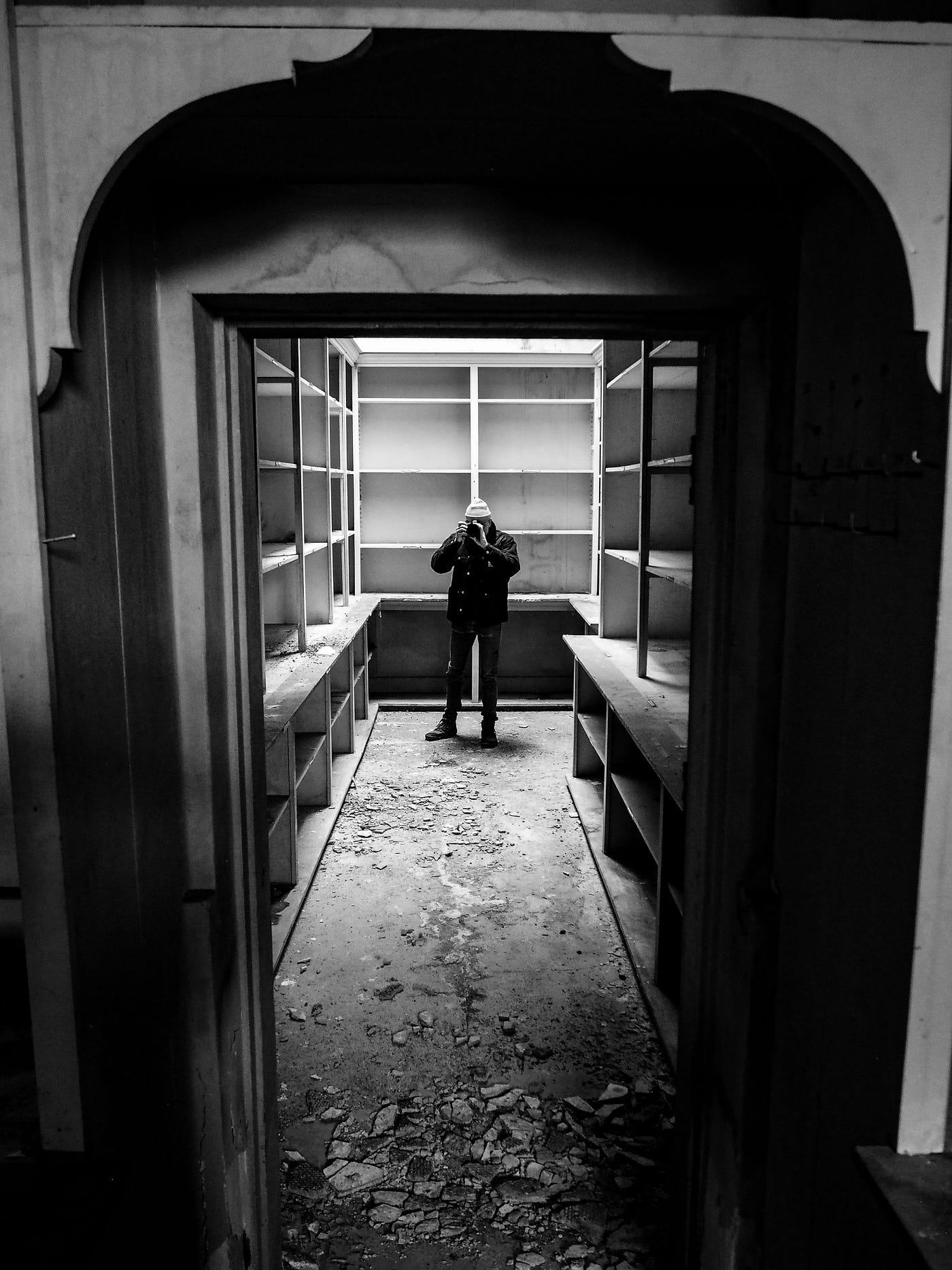
Image Taken by me, Nick Bagley
I have been chasing ghosts since I was a kid. The moment I got my first camera, I stopped caring about smiling portraits or pristine landscapes. I wanted the rot. I wanted the rust. I was instantly drawn to peeling paint, shattered glass, and the hollowed-out skeletons of forgotten buildings. Fast forward a few decades, and I now have four published books on abandoned exploration and photography.
People always ask me the same two questions. They look at my photos of collapsed asylum roofs or rusted-out factory floors and ask, “Why?” Why spend your time wading through asbestos and pigeon droppings? Why risk arrest just to stand in a dark, damp hallway that smells like wet earth and decay? Then of course, they ask, “Aren’t you afraid of running into ghosts?”
First off, no, I’m not afraid of running into ghosts. I’ve never met one yet. Second, our obsession with ruined, forgotten spaces is rooted deep in the wiring of the human brain. The intersection of photography, travel writing, and psychology reveals a dark, beautiful truth about who we are. We do not just look at abandoned places. We look at ourselves.
The Raw Appeal of Morbid Curiosity
Humans are morbid creatures. We crane our necks to look at car crashes. We consume true crime stories like comfort food. Psychologists call this morbid curiosity, and it is a survival mechanism. Our brains are hardwired to scan our environment for threats. By examining the aftermath of a disaster, whether it is a collapsed hospital or an abandoned steel mill, we are safely processing the concept of destruction.
When you step into a ruined building, you are looking at the corpse of a human endeavor. You see the guts of the architecture spilling out. The wires hang like severed veins. Your brain gets to experience the thrill of danger and the reality of death without actually being in harm’s way (although most would argue we are most definitely in harm's way, but we like it that way).
We love abandoned places because they allow us to flirt with the end of the world. It is a controlled dose of apocalypse. We get to stand in the ruins, take a deep breath, and walk away completely unscathed.
Terror Management Theory and the Rusting Reminders
Being the curious writer that I’ve become, I wanted to figure out why people like me are so attracted to these long-forgotten places. So, I did a deep dive into the reasons why.
There is a psychological concept known as Terror Management Theory. It suggests that a subconscious fear of our own mortality drives most human behavior. We build massive skyscrapers, create art, and write books to leave a legacy. We desperately want to believe that something of us will survive after we stop breathing.
Abandoned places are a brutal slap in the face to that illusion. They are massive, rotting monuments to human impermanence. When you stand in the grand lobby of a decaying theater, you realize that nothing lasts. The people who laid those bricks thought the building would stand forever. Now, weeds are growing through the floorboards, and rain is pouring through the ceiling.
This realization is strangely liberating. If nothing lasts, then the immense pressure of everyday life suddenly feels a lot lighter. The bills, the bad jobs, the broken relationships, they all seem incredibly small when you are staring down the barrel of a collapsed cathedral. It forces a brutal kind of mindfulness.
The Thrill of Psychological Reactance
Yes, I can’t lie, I love those signs. You know the ones I’m talking about. Heavy metal plates bolted to chain-link fences, screaming in bold red letters: NO TRESPASSING. KEEP OUT. VIOLATORS WILL BE PROSECUTED.
For a certain type of person, those signs do not act as a deterrent. They act as an invitation.
Psychology has a term for this as well: psychological reactance. When our freedom to do something is threatened or restricted, we experience a powerful urge to rebel. We want what we are told we cannot have. Abandoned exploration triggers this reactance perfectly. Society tells us that these places are off-limits, dangerous, and illegal to enter. So, naturally, we want to get in.
There is an intoxicating rush that comes with slipping through a hole in a fence or climbing through a broken rooftop window. You are stepping off the grid. You are entering a zone where the normal rules of society no longer apply. For a few hours, you are not a citizen paying taxes and following traffic laws. You are an explorer navigating a concrete jungle.
Anemoia and the Ghosts of Memory
Have you ever felt intensely nostalgic for a time you never actually lived through? There is a word for that: anemoia. It is the hollow, aching feeling you get when you look at an old black-and-white photograph of strangers.
When you do travel writing focused on abandoned places as I do, anemoia is your constant companion. You walk into a derelict 1950s diner or a rusted-out psychiatric ward, and the air is thick with the ghosts of memory. You can almost hear the clinking of coffee cups. You can almost smell the antiseptic and the stale cigarette smoke.
The human brain is a meaning-making machine. When we see a chair left entirely alone in the center of a decaying room, our minds immediately start spinning a narrative. Who sat there? Why did they leave in such a hurry? What were they thinking about when the door slammed shut for the last time? We project our own emotions, fears, and hopes onto the blank canvas of the ruin.
This reconstructive memory makes the experience deeply personal. The building is dead, but our minds bring it back to life. We weave ourselves into the history of the place, connecting our present to a past we never actually knew.
Order in the Insanity
Our current world is a messy, unpredictable place. It often feels entirely out of our control. But when you look through the viewfinder of a camera, you get to dictate the terms. You decide what stays in the frame and what gets cut out.
I use photography as a psychological coping mechanism. Imagine you are standing in a room full of chaos, shattered glass, collapsed beams, graffiti, and maybe a feral cat. But by adjusting your lens, finding the right angle, and waiting for that perfect beam of dusty light to cut through the darkness, you bring order to the destruction. You find the beauty in the breakdown.
This process is incredibly therapeutic. It teaches you how to look at broken things and see value. It trains your brain to find light in the darkest, grittiest corners of the world.
Keep Moving Forward
We are drawn to abandoned places because they hold up a cracked, dirty mirror to the human condition. They show us our fears, our mortality, and our deep need for connection. They remind us that the world is brutal but also beautiful.
You don’t have to write books or carry heavy camera gear to understand this. You need to be willing to look closer at the things most people ignore. The next time you pass a boarded-up house or a rusted factory, don’t just look away. Stop for a second. Think about the lives that moved through those doors. Acknowledge the decay, feel the weight of the history, and then do what humans have always done best.
Keep moving on. Let the ruins remind you that you are still here, still breathing, and still capable of finding beauty in the wreckage.
메타데이터
- post_id
- d7f0f5986b50
- slug
- the-psychology-of-why-we-love-abandoned-places-d7f0f5986b50
- url
- https://medium.com/activated-thinker/the-psychology-of-why-we-love-abandoned-places-d7f0f5986b50
- canonical_url
- https://medium.com/activated-thinker/the-psychology-of-why-we-love-abandoned-places-d7f0f5986b50
- author_url
- https://medium.com/@njb6665
- status
- ok
- fetched_at
- 2026-07-12 01:03:28