June 2026. Raw, a “graphix magazine”
1989, Penguin Books, 200 pages. Written in English, read in English.
June 2026. Raw, a “graphix magazine”
1989, Penguin Books, 200 pages. Written in English, read in English.
[For the purpose of this month’s reading, I’ve chosen the Vol. 2, №1 issue of the magazine]
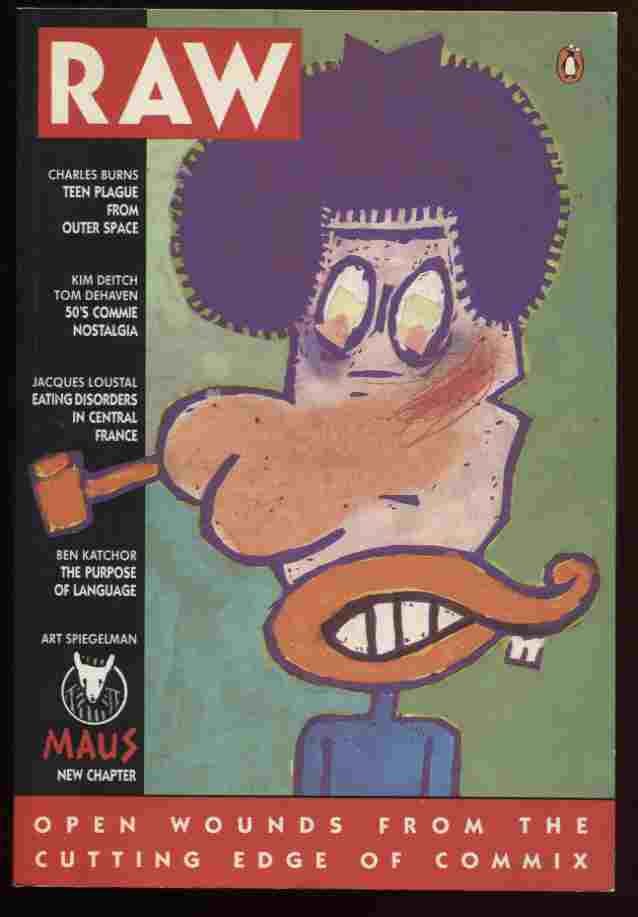
Cover of issue 1 of volume 2 of Raw, a Graphix Magazine
In the middle of the first issue of the second volume of Raw, self defined as a “graphix magazine”, there is a six page comic titled “Here”. It is a precursor to a full graphic novel written by Richard McGuire, which was recently also made into a movie by Robert Zemeckis. Both formats, the comic and the film, seem at the same time, to be and not to be the right formats to portray the idea that McGuire had — the narrative of one place, the location of a house, ranging from the time of the dinosaurs to our near future. But in spite of it, maybe because of it, that is one of the most beautiful pieces of graphic narrative art that I’ve ever seen — these six pages are worth the price of the magazine alone.
Surrounding it, are several different varieties of graphic narrative art, in various artistic styles and various levels of coherence — some of it, I suspect, is intended, and some maybe not. Apart from one piece that is designed as a traditional magazine article, all of the contributions to this issue are different formats of comics, with panel setup ranging from the traditional to a single, horizontal, panel per page. A detailed explanation about each of the contributing artists is provided as a version of a table of contents.
The magazine, Raw, was the creation of artists Francoise Moully and Art Spiegelman, at the beginning of the 1980s. Moully felt that with the disappearance of previous underground comics anthologies, one of which was the pioneering “Arcade”, co-edited by Spiegelman, there was no longer a place for graphic narrative artists to publish their work to a larger audience, and especially, there was no way for American fans to consume European underground comics. She set out first to convince Spiegelman to partner with her in editing the anthology, which on its face should not have been a difficult task — they have been living in the same house, as a married couple — and then to determine how it can be produced and distributed. Spiegelman had eventually relented, at the cusp of 1979 turning into 1980, and the couple started coordinating the creationg of the first issue.
There were two phases — two volumes — of the magazine. The first was more in a DIY vain, in which Moully and Spiegelman worked with friends, Spiegleman’s students, and other contributors, on an issue by issue workflow, often gathering the bulk of the contributions for the next issue during the launch party of a current issue. Over the course of the 1980s, they have published eight issues of the magazine.
The second volume, of which I read the first issue, was a more mainstream affair for various reasons — Spiegelman and Moully were both more established artists by that point, With Spiegleman’s Maus, that has been offered in instalments in previous issues of the magazine, already recognized as an instant classic, becoming the first graphic novel to every win a Pulitzer prize; graphic novels in general, and the establishment of comics as a form of art, rather than a vehicle for depicting the adventures of superheroes, were much more popular and acceptable by that time; and comic artists had many more outlets to publish and distribute their art. Therefore the second volume contained only three yearly issues, each formatted in a more accessible paperback form (contrasting with the issues of the first volume which were the size of a broadsheet) and distributed by the farther reaching Penguin Books. Therefore, after the third issue of the volume was published in 1991, the magazine ceased to exist.
This volume contains, in addition to Here that I’ve already mentioned, another instalment of Maus, the first chapter of what will eventually become Maus II; a story by Charles Burns that is set up to look like a horror comic book from the ‘50’s containing two layers of allegory — one applicable to the 1950s it is meant to resemble, and one to the late 1980s, in which it was written; a piece by Pascal Dourry which was prepared with wood cuttings, and of which each panel takes a full page (and with which the reader is instructed to flip the magazine on its side); a piece by Ben Katchor that contains a view of the growing multi ethnicity of New York in the 1980s (as well as any other decade); a spoof magazine piece from Kim Deitch, containing a first person testimonial from a ’50s housewife who is actually a Russian spy; and several more pieces — some longer, some only occupying one page; some more coherent than others; some spoofing other, better know, comic styles like that of the Beano; some so original in style that it is difficult to understand what I see in them.
Raw is a good introduction to underground comics, even from this temporal distance — containing a measured balance of art and narrative. Some of the comic creations it contains are good short stories in their own right, and some appear to be provided only for their artistic value, and should be considered pure works of art. The inclusion of a portion of a widely recognized graphic novel is helpful as an anchor and allows for more acceptance of other, more challenging pieces. From almost forty years later, it appears that the magazine has succeeded in doing what it set out to do — prove that comics do not belong solely to Marvel or DC superheroes, or to subversive underground artists; that they can be considered creations of art and of literature at the same time; and that there is a worldwide audience for graphic narrative art from anywhere in the world.
The July 2026 selection for the David Bowie Book Club will be Tadanori Yokoo by Tadanori Yokoo.
메타데이터
- post_id
- d7f4be6d239f
- slug
- june-2026-raw-a-graphix-magazine-d7f4be6d239f
- url
- https://medium.com/david-bowie-book-club/june-2026-raw-a-graphix-magazine-d7f4be6d239f
- canonical_url
- https://medium.com/david-bowie-book-club/june-2026-raw-a-graphix-magazine-d7f4be6d239f
- author_url
- https://medium.com/@apostleofsound
- status
- ok
- fetched_at
- 2026-06-09 15:37:30