Creativity AI #70: Midjourney V8.1
Plus editable text in Ideogram and why some workers would rather retire than learn AI
Creativity AI #70: Midjourney V8.1 next week, Niantic scans the world in 3D, and Anthropic’s AI finds decades-old bugs
Plus editable text in Ideogram and why some workers would rather retire than learn AI

Creativity AI is a free weekly publication that brings together interesting articles and recent developments in AI art and creativity.
You can also read this newsletter on the website.
News about AI art
Midjourney V8.1 is coming early next week
The latest office hours confirmed that V8.1 will drop early next week, delayed slightly because the HD model is still finishing training. And this isn’t a minor patch. Internally, the team prefers it over V8.0 at near 100% rates. Their own description: it feels like a much stronger V7, not V8.0.
That positioning matters. V8.0 launched with better raw capabilities but lost the default aesthetic. V8.1 brings that back. Better prompt understanding, better coherence, faster generation, higher resolution, and a clear aesthetic direction again. The team estimates it’s a net improvement across 95–99% of use cases.
There is one trade-off. Text rendering takes a slight step back compared to V8.0. The ongoing tension between aesthetics and text quality continues, and for now, aesthetics has won.
What’s supported at launch
Image prompts, style references (Sref), mood boards, remix, variations, blending, stylize, chaos, and weird are all fully supported. The — no and — tile parameters should land at launch or shortly after. Personalization works, but requires V7 personalization codes. Older personalization systems have been removed entirely.
No character reference (Oref/Cref) replacement yet. That’s planned for later.
HD mode gets a major rework
HD is still being finalized (a blurriness fix just went through training), but the changes are significant. Right now, HD costs roughly 4 times as much as standard generation. The target for V8.1 is 1.5 to 2.5 times instead. That’s a big drop. HD may also become the default mode, though they’re still debating the default resolution (native 2048 versus generating lower and upscaling). The “HD” name might change later, too.
The cost reduction depends on balancing GPU margins. They don’t want to run infrastructure too close to the edge, especially with new server clusters still coming online.
Expect some bumps over the next month or two
The team was upfront about the infrastructure instability. Server transitions and new clusters mean speed fluctuations and possible pricing adjustments over the next one to two months. If things get tight, they’ll degrade in order: relax mode goes first (slower or temporarily disabled), then basic plan speeds drop. But even degraded V8.1 should match V7 speeds at higher quality. That’s the baseline.
Rollout plan
Alpha drops early next week. Production follows within 1 to 2 weeks. It becomes the default model about two weeks after that. V8.0 sticks around temporarily for A/B comparisons and edge case feedback. They stressed that meaningful bug reports require 16–100+ example generations, not just single images.
What comes after V8.1
The roadmap is: V8.1, then a new upscaler targeting 4096px outputs, then editor improvements, then data updates (possibly V8.2 or V8.3 with new datasets), then V9. Video features come after V9. The V9 timeline is “next few months” but depends on new compute infrastructure.
There’s also a major website and mobile redesign in progress. The largest UI overhaul they’ve done. The focus is on clarity, consistency, and reducing the learning curve for new users. No radical new systems, just making everything easier to find and use.
I hope they get it right. V8.0 was a mixed bag for many users, and V8.1 feels like the course correction we’ve been waiting for. If it delivers on even half of what the office hours promised, Midjourney is back on track. The HD pricing alone could change how people use the tool daily. And frankly, getting that default aesthetic back is what most users care about. V7 had a look. V8.0 lost it. V8.1 should bring it home and enhance it.
Ideogram adds editable text layers
Ideogram is pushing hard to become the default AI tool for anything with text, and this update makes a strong case. You can now pick a design format (posters, logos, social posts) and get a layout tailored to that format. Hit “Layerize text” and every piece of copy becomes editable. Swap fonts, rewrite headlines, change the body copy. No regeneration needed.
Well, sort of. To use the text layer feature, you first need to regenerate the image so Ideogram can convert the existing text to an editable version. Then you edit freely. A bit tricky, yeah. But once you’re past that initial step, it’s genuinely useful. You can also drop in your own images and edit individual layers without touching a prompt.
For anyone doing social media graphics or poster designs with AI, this is worth trying. Text has always been a weak spot in Midjourney image generation (even in V8), and Ideogram keeps chipping away at it.
Ideogram Layerize UI

An example of Ideogram image before clicking the “Layerize text” (artistic font)
After “Layerize text”. The text becomes editable but loss its artistic flair.

Niantic sold Pokémon Go and is now scanning the entire world
The company that made Pokémon Go sold the game about a year ago and completely reinvented itself. They’re now called Niantic Spatial, and their mission is to build a centimeter-accurate, continuously updated 3D map of the real world.
Their main product is Scaniverse, which began as a consumer app for 3D-scanning hobbyists. It’s now a full enterprise platform. You can capture spaces with a phone, a 360-degree camera, or a drone, and then the cloud processing turns that footage into detailed 3D models using a technique called Gaussian splatting. Basically, it converts 2D video into millions of 3D blobs you can view from any angle.
The ambition is big. As robots and AI agents move from labs into the physical world (delivering packages, driving vehicles, running warehouses), they need detailed spatial understanding to function. Without accurate 3D maps, autonomous systems are stuck. And Niantic’s approach is clever: instead of sending expensive camera cars everywhere like Google did with Street View, they crowdsource scanning from millions of people with everyday devices. Anyone can rescan an area after it changes, keeping the map fresh.
They’ve already shown some impressive results. One person with a 360-degree camera scanned San Francisco’s Ferry Building plaza in minutes. T
[embed]
Why AI content creators should pay attention
This matters beyond robotics. Scanning a space with your phone and getting a photorealistic 3D model in minutes opens up creative possibilities that once required expensive equipment and advanced technical skills. The 3D maps Niantic is building are exactly the kind of spatial training data that next-generation AI models will need. If you’re building tools that understand or generate spatial content (AR filters, virtual worlds, anything for Apple Vision Pro), this data pipeline is relevant.
There’s also a bigger picture here. Think about world-building for writers or AI content creators. This technology could accelerate the creation of 3D immersive worlds where AI characters and objects react to you in real time. We’re not there yet, but the pieces are coming together faster than most people realize.
Anthropic launches Project Glasswing to hunt software vulnerabilities with AI
Anthropic announced Project Glasswing, a cybersecurity initiative that brings together AWS, Apple, Google, Microsoft, NVIDIA, CrowdStrike, and a bunch of other major players to find and fix software vulnerabilities before attackers get to them.
At the center of it is Claude Mythos Preview, an unreleased model that has already autonomously found thousands of zero-day vulnerabilities in every major operating system and web browser. Some of these bugs had survived decades of human review.
[embed]
Watching the announcement made me feel like we’re preparing for super-intelligent AI entering the real world. First, we rely on machines to patch the vulnerabilities we can’t see. Then we have to trust that they’re honest and diligent about it, at least until the next more advanced model comes along. And whoever creates an AI more intelligent than other AIs could exploit the system before anyone reacts. It’s exciting and unsettling at the same time. What if, instead of finding software bugs, AI is used to find your vulnerabilities, as a person?
My cat blinks and looks at me. As if he’s saying no need for AI, his cat scan already knows my soft spots.
Older workers are retiring rather than learning AI

Think your senior management is really keen to learn and use AI at work? Think again.
The share of Americans aged 55 and older in the workforce hit a record low of 37.2% in March 2026, according to the Bureau of Labor Statistics. A growing number of experienced workers are choosing early retirement rather than learning the AI tools their employers now require.
The reasons make sense when you hear them. Many of these workers have already spent entire careers adapting to desktop publishing, the internet, and smartphones. One 68-year-old content strategist put it simply: his “battery doesn’t hold a charge as long as it used to.” Another worker described spending 40 hours at their regular job plus 20 hours a week training on new AI tools before deciding to just leave. That’s a 60-hour week, and the math didn’t add up with retirement around the corner.
It’s not that they can’t learn. They’ve proven that multiple times over. The issue is motivation. When you weigh months of intense upskilling against a few remaining working years, the return on investment looks terrible. A Pew study found that only 18% of employed adults over 50 have used ChatGPT at work, compared to 38% of those aged 18 to 29. An AARP survey found that 68% of older adults worry that AI will reduce human interaction.
I see this first-hand in my day job. Some smart colleagues pretend to be interested in AI to portray an image of progressiveness. But I can see the pretense. And it’s not just seniors close to retirement. Some middle managers who are still years away from it do the same thing. They’re quick to point out AI’s shortcomings (hallucination, inaccuracy) and use those as reasons to dismiss the whole thing.
The article carries a message that companies often miss: mandating AI isn’t the same as enabling it. Pushing tools on people without adequate time and support just drives experienced workers out the door, and decades of institutional knowledge walk out with them. The learning burden is real, and it falls unevenly. Organizations that treat AI upskilling as something employees absorb on their own time are going to lose good people.
The world is changing fast. I wonder what comes next for the colleagues who simply choose to stop learning, without an alternative plan.
Inspiration
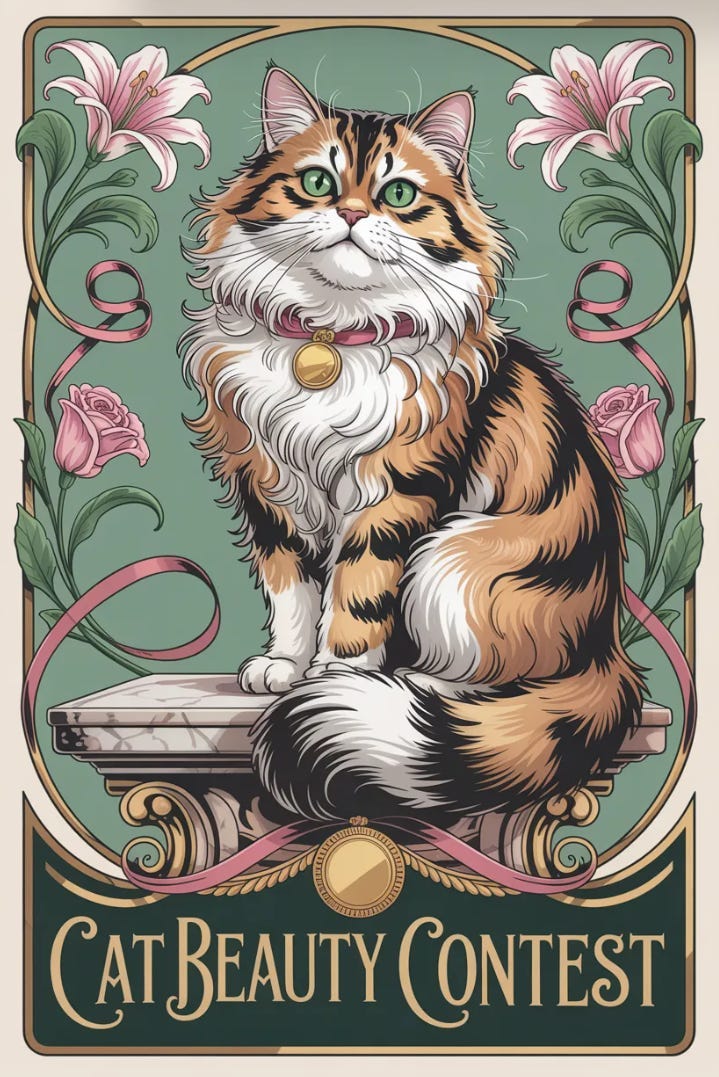
Jugendstil (pronounced “YOU-gihnd-steal”, meaning “Youth Style”) was Germany and Austria’s answer to Art Nouveau, emerging around 1895. Named after the Munich magazine Die Jugend, the movement rejected rigid academic art in favor of organic forms, flowing curves, and nature-inspired motifs.
What makes Jugendstil interesting for AI generation is its total design philosophy. Architecture, furniture, typography, illustration where everything is connected. That unity of vision across mediums gives you a rich visual language to pull from.
Moodboard code: — p j3t4kxa
(To use the code, add the — profile j3t4Kxa or — p j3t4Kxa to the end of your prompt)
Elegant woman pausing beside climbing roses, poised and luminous, flowing auburn hair and embroidered gown, Jugendstil poster illustration, stylized floral geometry, soft celadon and crimson accents, decorative fin de siècle elegance --ar 16:9 --profile j3t4kxa --v 7
Elegant woman among blooming roses, dreamy gaze, long flowing gown, Jugendstil poster illustration, curving stems and stylized petals surrounding her, luminous afternoon glow, romantic ornamental design, soft muted colors --ar 16:9 --profile ppjylid j3t4kxa
Elegant woman wandering through a rose garden at golden hour, silk dress trailing between blooming arches, dreamy Jugendstil illustration, graceful curves, delicate botanical motifs, warm rose and sage tones, romantic ornamental composition --ar 16:9 --profile j3t4kxa --v 7
Elegant woman laughing softly at a lively party, playful cat perched on her arm, swirling Jugendstil décor, gold and emerald palette, flowing ribbons, festive glamour, whimsical Art Nouveau illustration --ar 16:9 --profile j3t4kxa --v 7
Elegant woman seated in a grand party salon with her poised cat, stained glass, sinuous Jugendstil lines, floral wallpaper, champagne shimmer, aristocratic mood, richly detailed illustration with ornamental storytelling --ar 16:9 --profile j3t4kxa --v 7
Elegant woman among blooming roses, dreamy gaze, long flowing gown, Jugendstil poster illustration, curving stems and stylized petals surrounding her, luminous afternoon glow, romantic ornamental design, soft muted colors --ar 16:9 --profile ppjylid j3t4kxa --v 7
Elegant woman smiling with quiet delight at a festive party, a playful cat balanced lightly on her arm while ribbons, flowers, and sparkling glassware animate the room around her, the entire scene wrapped in swirling Jugendstil lines and organic ornament, gold and emerald hues deepening the celebratory mood, her dress adorned with iris and vine motifs that merge with the decorative interior, guests moving like a living pattern behind her, whimsical yet luxurious illustration, animated Art Nouveau grace, storybook glamour with polished detail --ar 16:9 --profile j3t4kxa --v 7
Recent articles
Free Geeky Animals’ Sref code: 2377438266
. --sref 2377438266 --profile pdrmrdy --sv 6 --v 7


SV7 on V8


Cover prompt: Elegant woman among blooming roses, dreamy gaze, long flowing gown, Jugendstil poster illustration, curving stems and stylized petals surrounding her, luminous afternoon glow, romantic ornamental design, soft muted colors — ar 16:9 — profile ppjylid j3t4kxa — v 7
I hope you like this article!
Thank you for reading and happy creating!
메타데이터
- post_id
- d7f93c69aeb0
- slug
- creativity-ai-70-midjourney-v8-1-d7f93c69aeb0
- url
- https://medium.com/creativity-ai/creativity-ai-70-midjourney-v8-1-d7f93c69aeb0
- canonical_url
- https://medium.com/creativity-ai/creativity-ai-70-midjourney-v8-1-d7f93c69aeb0
- author_url
- https://medium.com/@geekyanimals
- status
- ok
- fetched_at
- 2026-06-12 07:40:50






