ArtifactInterestMeter: The Seal Stone
Confabulations by M.A.Tucker, May 2026
ArtifactInterestMeter: The Seal Stone
Confabulations by M.A.Tucker, May 2026
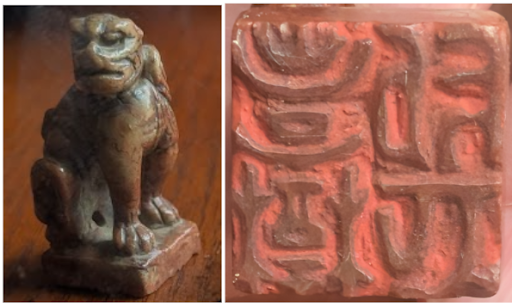
The Seal Stone creature on base with symbols (peaks) & red ink (valleys). Photo by M.A.Tucker
Artifacts can tell stories. Those that interleave art & symbols are especially intriguing.
The Story
o What is a seal stone?
o What is this creature?
o Chinese, Korean & Japanese Seal Scripts
o Which way is “up”?
o Mirror, Mirror
o How to read the symbols?
o Reading the Seal Script
o When, where & who
What is a seal stone?
A seal stone is an intricately carved mythical creature conveying some elemental force. This carving sits on a base & is designed to be grasped firmly. The flat base is pressed into a layer of red ink. The base contains symbols (peaks) that will be the form seen on the document or parchment & white space (valleys) framing those symbols. Seal stones were used extensively in ancient China, Korea & Japan for thousands of years. Very early in history, they became essential for government & trade. They might be a personal stone (early form of signature), administrative seals legitimizing the document or proclamation or perhaps “leisure” stones expressing sentimental themes.
What is this creature?

Gargoyle guarding a building, overlooking Paris, France. Photo of postcard by M.A.Tucker
At first glance, a gargoyle comes to mind. Gargoyles were evil demonic forces designed to drive away even more evil demonic forces. However, gargoyles are a European mythical creature. This creature is from a different tradition — a celestial Guardian Lion.

Guardian lions — neutral (stability), yin (male principle), yang (female principle) forms. Photos by M.A.Tucker
According to legend, a traveler gifted lions (which are not native to China) to an emperor of the Han Dynasty (~2,000 years ago) . Very few people actually saw these lions as only a few were blessed to walk with the emperor through his menagerie. There were also a few servants or caretakers who saw them. However, the lions inspired descriptions & fantastical stories like a viral meme.
These became “Guardian Lions”, a celestial mythical creature embodying strength, fierce protection & stability. A pair might guard the entrance to a temple. The Guardian Lions above guard the entrance to an excellent Chinese restaurant. They can take several forms: yin, yang, neutral. This seal stone being examined has a neutral form with both paws squarely on the ground signifying stability (left above). The male principle (Yin) form has a paw on a sphere (center above). The female principle (Yang) form is fiercely protecting a cub (right above). The smashed snout is the common form of classical guardian lions.
Chinese, Korean & Japanese Seal Scripts
A quick scan of Chinese, Korean & Japanese seal scripts reveals a wealth of images, associated descriptions & many artistic or language related nuances. With a European bias, you might think there would be a limited number of symbols (20–30 letters) so an eyeball scan might result in a “hit” or match. You would be wrong.
The classical seal stone script (originated ~2,000 years ago), has ~1,200 symbols. Since you don’t know the orientation of the symbols (which way is “up”?), you’d want to scan all four possible orientations. Then there are the variations that result from allowed artistic license, introducing even more symbols to scan. This extends to thousands of images to scan, correlate & ideally, drag along descriptions of the meanings. No joy.
You’ll need an ensemble of models to extract symbol images from the sources, compare to the symbols on the seal stone, rate which ones are the closest fit & associate descriptions with those images. Ideally, the confabulations of these models would closely match human findings from scholarly or artistic sources (which themselves may be inaccurate confabulations). But first, it would simplify the search to determine…
Which way is “up”?

Seal stone being gripped to determine orientation of the symbols & the resulting orientation (mirrored). Photos by M.A.Tucker
“Up” will be determined by how the seal stone is held. In this case, the forked tail forms a nice landing pad for the thumb. The middle finger fits nicely on the front legs while the index finger can be applied to the top to press the stone into the ink tray. The symbols closest to the viewer are top left & top right. Those further away from the viewer are bottom left, bottom right. The Guardian Lion’s fierce visage will be staring out.
Mirror, Mirror

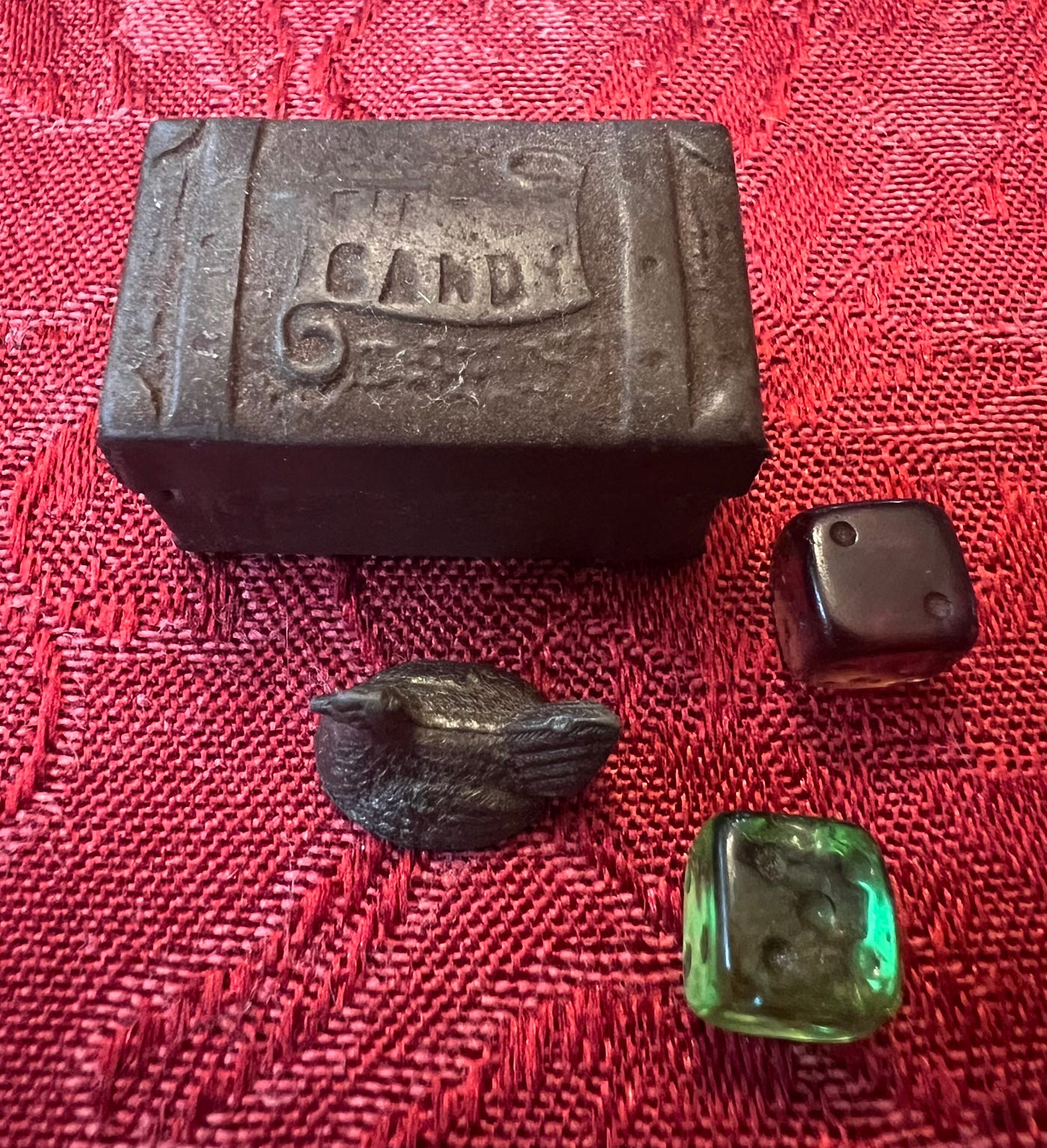
Seal stone posing with mid-twentieth century signature stamp amidst various artifacts. Photos by M.A.Tucker
The seal stone was found in a small collection of objects that included a mid-twentieth century signature stamp (upper left in left image above) used for administrative purposes. When directly viewing the stamp, it appears to be gibberish (right image above).

Mirror image showing the signature “Ray E. Tucker”. Photo by M.A.Tucker
You’ve probably already intuited that when you apply the stamp, the mirror image appears on the paper. A mirror shows “Ray E. Tucker” which is the signature of an American somewhere in the world years ago.
Ah, you might say, so that’s why the eyeball scan came up empty-handed. However, this highlights the complexity of the interpretation task. Seal Script can be rotated horizontally around the vertical axis so the mirror image has the same meaning. However, the order of the symbols would be changed, possibly altering the overall meaning significantly.
The artist was given great latitude to select the orientation & layout of the symbol elements to create a visually stunning & compelling script. There are “visual anchors” that must be present in the proper orientation & relation to other elements. The artist’s skill & the value of the stone would be judged based on the ultimate shape & form of the stamp on the paper.
How to read it?
The symbols embody concepts that when combined with other symbols may emphasize certain aspects of the concept. Chinese calligraphy is not read like European languages (left to right, top to bottom). Calligraphy is a “columnar” language. The seal stone is read from the right-top to the right-bottom (the right column) & then proceeds from the left-top to the left-bottom (left column). Ever wonder why you start with the last page of a Manga Japanese comic book or graphics novel? Manga honors this tradition.
Reading the Seal Script

Red ink shows as the seal would look on a piece of paper. Blue ink are some observations. Doodle by M.A.Tucker
The red (above) shows how the seal would look (enlarged). Smaller actual size is shown below the seal imprint. It is read top-right, bottom-right, top-left, bottom-left. The symbols have visual elements that capture the concept of the symbol. Together, they form a “sentence”.
This is a Blessing Stone which says: “Peace, Joy, Long Life”.
Imagine, if you will, writing a poem to a distant friend (calligraphy, of course). You might use this blessing stone to sign the poem with these kind wishes.
When, where & who?
The form is Small Seal Script (~2,200 years ago) which was introduced by the Qin Dynasty to standardize writing in China. The style is from the Han Dynasty (~1,800 years ago). However, it is unlikely the seal stone is 2,000 years old. Around 100–150 years ago, there was a “rival” or “renaissance” among the literati of Han Seal Script during the Qing Dynasty (1644–1912). Artists created many “leisure” stones to express a sentiment or wishes. They were also used as talismans to protect or ward off evil.
Artists & the literati in China, Korea & Japan all embraced the ancient Han Seal Script. Therefore, where it was made & who made it is problematical. The Japanese in this period imported collectives of Korean artists to create “leisure” stones. So it could have been made in Japan by a Korean artist for Japanese patrons using the Chinese Han Seal Script.

Peace, Joy, Long Life
A Blessing Stone it may be, Dear Reader, created long ago by an artist far across the sea.

Blessing Stone posing in front of the Seven Lucky Gods of Japanese lore. Photo by M.A.Tucker
메타데이터
- post_id
- d7f9f6a8ccfc
- slug
- artifactinterestmeter-the-seal-stone-d7f9f6a8ccfc
- url
- https://medium.com/@matucker/artifactinterestmeter-the-seal-stone-d7f9f6a8ccfc
- canonical_url
- https://medium.com/@matucker/artifactinterestmeter-the-seal-stone-d7f9f6a8ccfc
- author_url
- https://medium.com/@matucker
- status
- ok
- fetched_at
- 2026-06-09 15:37:30