A Walk Through The Web of Modularity
Ken Ono’s The Web of Modularity: Arithmetic of the Coefficients of Modular Forms and q-series is not a book that tries to build a single…
A Walk Through The Web of Modularity
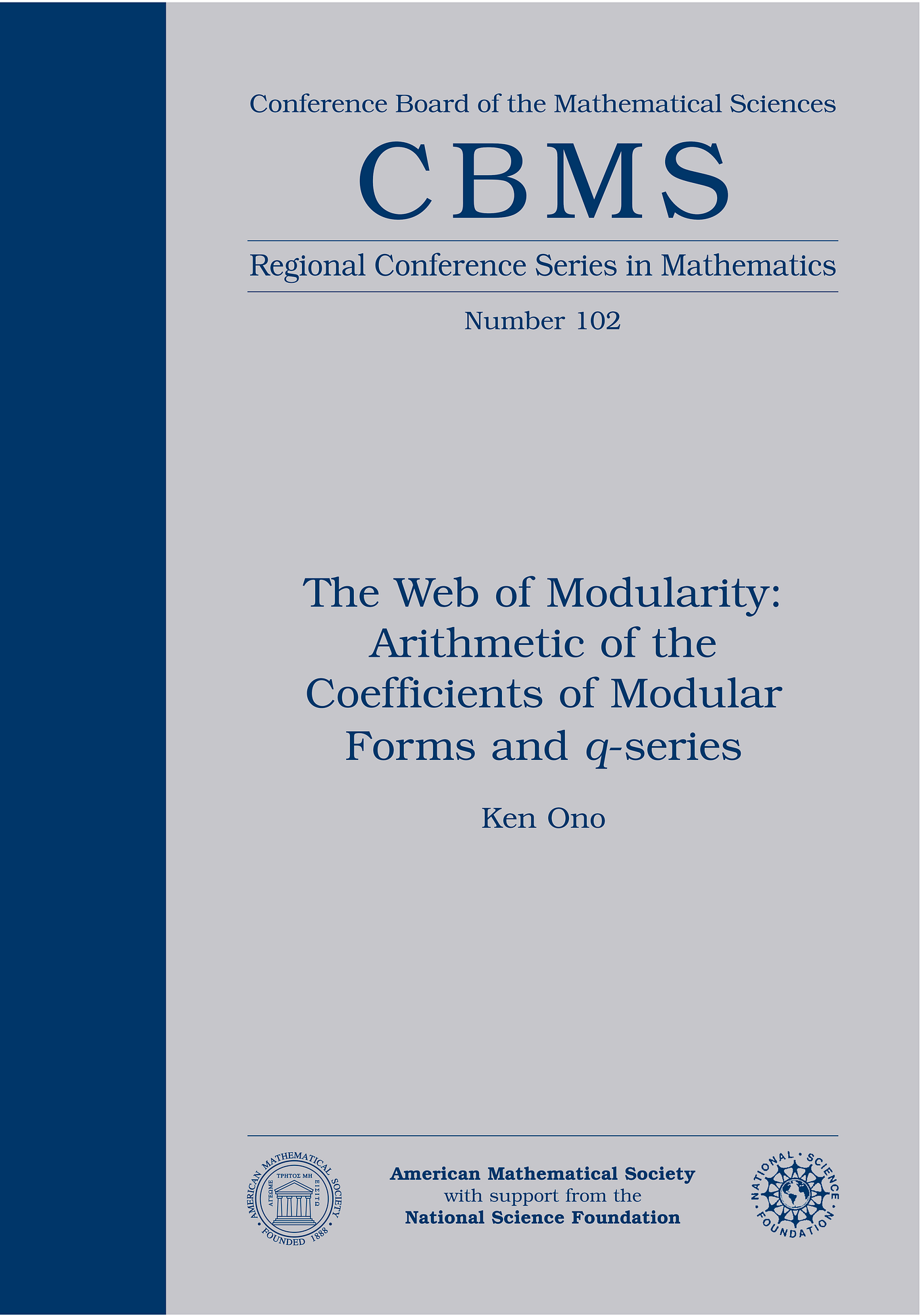
Ken Ono’s The Web of Modularity: Arithmetic of the Coefficients of Modular Forms and q-series is not a book that tries to build a single highway from definitions to theorems . It is a book of bridges. Its main claim, repeated in many disguises, is that modularity is a meeting place where different problems in number theory shake hands. This review is written for graduate students, enthusiasts, and researchers who want a guided reading that emphasizes ideas, connections, and taste, and that also highlights a Ramanujan-inspired viewpoint I will call Ramanujan’s angle.
A book that thinks in webs, not in walls
A few years ago, I received this wonderful book from Prof. George Andrews, a leading expert on Ramanujan’s work. Since then, it has been a constant companion in my research.
The title is a promise: you will not be given a single long story in one genre, but a network of shorter stories that keep sending you from one corner of mathematics to another. Ono takes modular forms and q-series as the central thread, but the real subject is the arithmetic hidden in their coefficients. The coefficients are treated like a stream of data produced by a deep symmetry. The goal is to explain why that data knows about partitions, quadratic fields, special values of zeta-like functions, elliptic curves, and even the arithmetic shadows of hypergeometric series.
This is also a book with a very clear audience and a clear tone. It belongs to the CBMS Regional Conference Series in Mathematics, and it reads like what it is: polished lecture notes that are willing to move quickly, explain motivation, and then jump to a striking result rather than fill every gap. It is designed for advanced graduate students and researchers, and it openly prefers flavor over encyclopedic completeness. One of its best habits is that many chapters end by pointing outward, ofering open problems and questions as an invitation to do research, not just absorb facts.
If you are a student who has learned modular forms in a “classical” way, perhaps from a first course that focuses on transformation properties, Fourier expansions, and Hecke operators, you might expect a neat progression: definitions, examples, theorems, applications. Ono gives you something diferent. He gives you a tour where every stop is chosen because it has doors leading to many other rooms. In my opinion, this is the book’s strongest feature and also its main challenge. The strength is that you learn what to pay attention to in modern number theory. The challenge is that the book does not try to be your first exposure to the subject; it assumes you are ready to carry some background and curiosity on your own.
A helpful way to read the book is to imagine modularity as an operating system. Many arithmetic problems run on it without knowing they do. Ono’s chapters are like diferent applications that, at first glance, look unrelated. But once you learn the system calls, you start seeing shared patterns: congruences that are not accidents, product expansions that are not miracles, and special values that are not isolated numbers but reflections of hidden symmetry.
What lives in the web
The book begins with a compact toolkit, and then it starts building bridges fast. The early material sets the language and the habits: work with modular forms as structured series; study how operators transform them; and treat congruences and divisibility as signals, not as curiosities. In the opening chapter, the reader meets congruence subgroups, integer weight modular forms, half-integral weight modular forms, and the Dedekind eta function. This matters because the eta function is a kind of “seed” object: it is simple to write down, but it grows into surprisingly rich arithmetic when you expand it into a power series. That theme, simple seed and rich harvest, repeats throughout the book.
Example: If you take a classic infinite product from q-series and expand it, the coefficients often count combinatorial objects. The same series, seen through modularity, also behaves like a highly symmetric analytic function. Ono uses this dual nature again and again: counting on one side, symmetry on the other, and arithmetic consequences in between.
A large portion of the early chapters is about how to interrogate modular forms. Hecke operators appear as a systematic way to probe arithmetic structure, to separate ‘noise” from ‘signal,” and to reveal multiplicative patterns in coefficients. Twists show how to change the arithmetic “lighting” of a modular form by mixing it with characters, often turning one set of coefficients into another set with new congruence properties. The theta operator and related operators show how diferentiation-like processes can push you into nearby spaces of modular objects, sometimes producing new series with controlled arithmetic.
Example: When you apply a Hecke operator to a modular form, you are not merely transforming a function. You are re-averaging its data in a way that makes multiplicative structure visible. If you come from algebra, think of it as a way to diagonalize hidden symmetries; if you come from analytic number theory, think of it as a way to filter a signal.
The book also takes congruences seriously. There is a strong modular reason why coefficients often satisfy divisibility patterns when reduced modulo primes or prime powers. Ono discusses modular forms “modulo primes” and uses results like Sturm’s theorem (in words: a finite amount of initial data can certify a congruence) as a practical tool. If you have ever wondered why experimental congruences in q-series are so often true, this part of the book provides a conceptual answer: modularity turns the infinite into the finitely checkable in a way that feels almost unfair.
After the foundation, the book starts showing what the word “web” means by moving through a sequence of major themes:
• Product expansions. There is a chapter on product expansions for modular forms for the full modular group, including Borcherds-type products and arithmetic information stored in the exponents of infinite products. The mood here is striking: a modular form can sometimes be rebuilt as an infinite product, and the exponents are not decorative. They often encode class numbers, traces, or other deep arithmetic invariants.
• Partitions. One chapter treats partitions, congruences, and distribution questions. This is where Ramanujan enters very naturally: partition congruences are among his most famous discoveries, and the modern explanation runs through modularity. Ono does not present partitions as a combinatorics-only topic. He treats them as a window into modular forms with poles, congruences, and the statistical behavior of coefficients modulo integers.
• Geometry on modular curves. The chapter on Weierstrass points on modular curves shows another face of modularity: geometry and arithmetic meeting at special points. The
connection to super-singular phenomena is a good example of a “web edge” that is hard to predict if you only think in one language.
• Singular moduli and class equations. Traces of singular moduli are treated as arithmetic data arising from special values of modular functions. Here you see modularity acting like a machine that produces algebraic numbers with controlled arithmetic, and you also see how taking traces packages that information into something that behaves like coefficients again.
• Class numbers of quadratic fields. Class numbers are among the most classical objects in algebraic number theory, and Ono emphasizes that modular forms can store class numbers as coefficients. This is one of the cleanest demonstrations of the book’s philosophy: the same kind of series you meet in a first modular forms course can contain refined algebraic invariants that measure the failure of unique factorization.
• Central values and generating functions for special values. The chapters on central values of modular L-functions and on hypergeometric generating functions for L-values show modularity as a bridge between analysis and arithmetic. If you like the idea that a special value of an analytic function can predict the size of an arithmetic group or the existence of rational points, this part of the book will feel like home.
• Gaussian hypergeometric functions and supercongruences. The final chapter brings in finite-field analogues of hypergeometric functions and connects them to traces of Hecke operators and striking congruence phenomena, including results related to Ap’ery-type numbers. This is a part of the web where modern arithmetic geometry, experimental computation, and classical congruences meet.
This list makes the book sound like a collection of unrelated topics. It is not. Ono’s guiding thread is always the same: coefficients are not just numbers; they are arithmetic signatures. The same techniques and viewpoints repeat, so the reader gradually learns a shared vocabulary. For a researcher, this is valuable because it trains intuition: you start to guess where modularity might be hiding next.
A personal opinion about the style: I think Ono’s choice to cover a wide range is correct. Many graduate texts teach modular forms as a closed subject with a boundary. This book teaches modularity as an engine that keeps turning up in places you did not expect. That is closer to how the field feels when you do research.

Ramanujan’s angle and the modular meaning of “mysterious coeffi- cients”
To talk about Ramanujan in a review of this book is not optional. It is almost forced. Ramanujan is one of the main reasons modularity feels like a living subject rather than a museum. He produced q-series identities and coefficient sequences with uncanny arithmetic behavior, long before the modern framework was fully built around them. Ono’s book can be read as a modern answer to a Ramanujan-style question: when you write down a beautiful q-series and its coefficients look structured, what is the hidden symmetry that explains the structure?
There are two Ramanujan stories that fit this book especially well.
Ramanujan’s partitions: congruences as footprints of modularity
Ramanujan observed that partition counts satisfy exact divisibility patterns along certain arithmetic progressions. If you say this casually, it sounds like magic. If you say it with modularity behind you, it becomes evidence. Ono’s chapter on partitions is, in efect, a lesson in how to turn congruence patterns into structural theorems: modular forms with poles, reduction modulo integers, and distribution questions about residues all become part of one picture.
Example in words. Instead of treating a congruence like “the count is always divisible by a fixed small prime on a certain progression” as an isolated trick, modularity explains it as a shadow of transformation symmetry. The symmetry forces the series to sit in a constrained space, and constrained spaces produce rigid arithmetic.
In my view, this is one of the cleanest entry points for enthusiasts: you can understand the question without heavy machinery, yet the answer leads directly into deep modular ideas.
Ramanujan’s angle: turning coefficients into geometry
Now to the phrase you asked for explicitly: Ramanujan’s angle. I will use it as a metaphor with a precise meaning.

There is a famous modular form whose coefficients define the Ramanujan tau function. One of Ramanujan’s conjectures, later proved by Deligne, says that the values of this coefficient at primes are bounded in a very rigid way. When you normalize the prime coefficient by dividing by its natural size, you get a real number between minus one and one. Any number in that range can be seen as the cosine of an angle. So, for each prime, you can attach an angle to the coefficient. The modular form stops looking like a list of integers and starts looking like a cloud of angles.
What is the point of this? The point is distribution. Once you have angles, you can ask whether they behave randomly, and if not, what law they follow. The Sato–Tate philosophy predicts a very specific bias: the angles are not uniformly spread, and the bias encodes deep arithmetic information. There are even plots and discussions of the distribution of these angles for the tau function in modern expository notes on Sato–Tate.
If you want a vivid mental image: each prime is like a musician, and the coefficient at that prime is like a note that must stay within a strict dynamic range. Ramanujan’s angle is the phase you assign to that note after normalizing its loudness. The web of modularity is then the claim that these phases are not random noise; they follow a law dictated by symmetry.
Example in words. Even at small primes, people have noticed “near coincidences” where a Ramanujan angle comes close to a familiar special angle. You do not need to believe these coincidences mean anything deep; the point is that the angle viewpoint gives you a natural geometric language for talking about coefficient behavior at primes.
How does this connect back to Ono’s book? The entire book is about the arithmetic of coefficients. Ramanujan’s angle is a particularly elegant way to see how many different kinds of information can sit inside one coefficient sequence:
• Congruences and divisibility patterns tell you about reductions modulo primes.
• Nonvanishing questions ask how often coefficients are zero, which is often related to deep arithmetic.
• Distribution questions ask what “typical” coefficient behavior looks like, which leads you toward Sato–Tate-type laws.
• Product expansions and traces show you that coefficients can encode class numbers, singular moduli, and more.
Ramanujan’s own work sits at the intersection of these themes: he found congruences (partitions), he defined striking coefficients (tau), and he produced identities that modern theory now recognizes as modular or nearly modular. Ono’s book does not merely mention Ramanujan as a historical figure; it treats Ramanujan-like phenomena as a recurring test of whether you truly understand modularity.
Verdict and a practical reading plan
I would summarize the book in one sentence like this: it teaches modularity as a way of thinking, not as a list of results. That makes it unusually valuable to researchers, because research is mostly about developing good guesses and good maps.
What it does exceptionally well.
• It shows breadth without becoming shallow. The topics are diverse, but they are tied together by one strong idea: the arithmetic meaning of coefficients.
• It normalizes the habit of asking good questions. The open problems at the ends of many chapters are not decorative; they train you to see what is unknown and why it is unknown.
• It connects classical objects to modern viewpoints. Partitions, class numbers, and special values are not presented as isolated landmarks; they are placed on the same map.
What readers sometimes find difficult.
• The pace can be fast, especially if you have not already seen modular forms beyond a first course. This is normal for lecture-note style books.
• The “web” structure means you will occasionally want to pause and build your own bridge: fill in details, check a reference, or learn a side topic more carefully.
A reading plan that respects the web idea. Here is a way to read the book without getting lost:
-
Read the opening chapter for the basic cast of characters, especially the eta function and the general philosophy that series encode arithmetic.
-
Skim the operator material (Hecke operators, twists, the theta operator) to learn what tools the rest of the book uses as “verbs.”
-
Choose one path and follow it deeply:
• If you enjoy combinatorics and congruences, go to partitions.
• If you enjoy geometry and arithmetic points, go to modular curves and Weierstrass points.
• If you enjoy class field theory and quadratic fields, go to singular moduli and class numbers.
• If you enjoy analytic and arithmetic bridges, go to central values and hypergeometric connections.
- At the end of each chapter, pick one open problem and translate it into your own words. Even if you do not solve it, this exercise is how the book turns into research training.
Final assessment. If you want a neat, linear, fully self-contained textbook, this is not that book. If you want a guide to how modularity moves through number theory and keeps showing up in the arithmetic of coefficients, then this book is one of the most efficient ways to build that intuition. Its lasting value is not only in the theorems it highlights, but in the mindset it teaches: treat q-series as evidence, treat coefficients as messages, and treat modularity as the grammar that lets you read them.
-K. Srinivasa Raghava-Mathematics Researcher.
메타데이터
- post_id
- d7fb03acf490
- slug
- a-walk-through-the-web-of-modularity-d7fb03acf490
- url
- https://medium.com/@srinivasaraghavak/a-walk-through-the-web-of-modularity-d7fb03acf490
- canonical_url
- https://medium.com/@srinivasaraghavak/a-walk-through-the-web-of-modularity-d7fb03acf490
- author_url
- https://medium.com/@srinivasaraghavak
- status
- ok
- fetched_at
- 2026-07-25 23:20:03