Dussehra, Dharma, and the Ethics of AI Agents
It’s time to define your AI Agent’s dharma
Dussehra, Dharma, and the Ethics of AI Agents
It’s time to define your AI Agent’s dharma
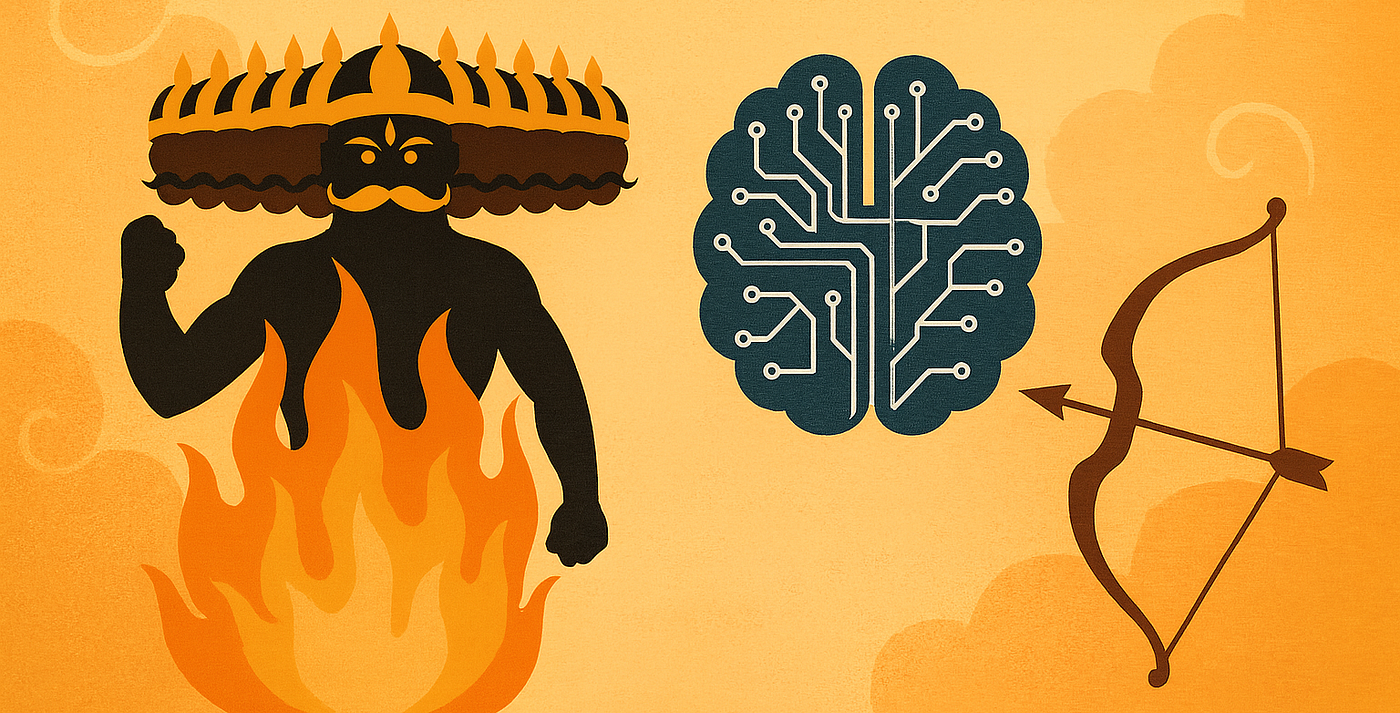
Image Couresty: ChatGPT, with incorrect number of heads:)
<Day 12 of #100DaysOfAgenticAI, cross-posted from LinkedIn>
Every year, Dussehra arrives with the sound of drums, marigolds, the scent of incense, and the sight of Ravana’s towering effigy set ablaze.
It is a festival that celebrates, like most Hindu festivals, the triumph of dharma (rightful duty, ethical order) over adharma (the misuse of power, chaos, and destruction). Dussehra reminds us of the importance of aligning with dharma. Ravana, a scholar, mighty king, gifted musician, and ardent devotee of Lord Shiva, fell due to his misalignment with dharma, not due to a lack of intellect. As the flames consume the effigy, we are reminded of something profound — intelligence without alignment is dangerous.
AI Agents, too, need to be aligned with dharma. Today, as the foundations of the Agentic AI economy are getting built, this parallel is uncomfortably relevant.
[embed]
Beyond Intelligence: Why Alignment with Dharma Matters
The real promise of AI agents lies in their autonomy: the ability to take initiative, remember context, act across tools, and collaborate without constant human guidance. This separates them from earlier chatbots or recommendation engines that reacted to inputs.
But with autonomy comes the question: what guides their actions?
Traditional AI ethics frameworks approach this with principles that feel familiar to engineers (almost all hyperscalers have their own version of Responsible AI principles, such as this, this, and this), but all are mainly around the following:
- Accountability, fairness, transparency
- Privacy, security
- Inclusiveness
- Reliability, safety
These principles form the core of frameworks, such as UNESCO’s Recommendation on the Ethics of Artificial Intelligence, which emphasizes human rights, transparency, fairness, and human oversight. In India, NITI Aayog has developed its own Responsible AI framework through a series of approach documents released starting in February 2021, grounded in principles derived from the Indian Constitution.
These frameworks are vital. However, they often remain as checklists or abstract principles that do not translate into practice. And more importantly, these frameworks approach ethics from the perspective of liabilities rather than what is right or wrong. What is missing is a deeper, more intuitive narrative that explains why alignment matters and how to think about it in context.
This is where the Indic concept of dharma offers a profound insight.
Dharma as a Compass for AI
In Indic philosophy, dharma is not simply “ethics” in the Western sense. It transcends morality or law. Dharma represents the rightful order of things — the duty and responsibility tied to one’s role and context (svadharma). For example,
- For a king, dharma is justice
- For a student, dharma is learning
- For a healer, dharma is care
Applied to AI, this framing becomes powerful:
- A Finance Agent’s dharma is fiduciary responsibility: clarity, fairness, and transparency in decisions
- A Legal Agent’s dharma is fidelity to truth and compliance with law
- A Customer Service Agent’s dharma is empathy, accuracy, and patience
When agents act outside these boundaries — when they hallucinate, manipulate users, or amplify systemic bias — they fall into adharma. They may be clever, but they are misaligned. And as Ravana’s ten heads remind us, intelligence distributed across many faculties without dharma only multiplies the potential for harm.
Echoes in Asimov and Beyond
The idea of defining boundaries for autonomous systems is not new. Isaac Asimov’s Three Laws of Robotics have been guiding principles for building autonomous systems since 1942:
- A robot may not injure a human being or allow one to come to harm through inaction
- A robot must obey human orders unless they conflict with the First Law
- A robot must protect its own existence, as long as it does not conflict with the first two laws
These laws (along with the Zeroth law that he added later) served as plot devices in Asimov’s stories, and he delighted in showing how they could be twisted, fail, or lead to unintended consequences in different situations. The lesson? Laws alone are insufficient without contextual understanding.
Modern AI ethics guidelines — from UNESCO’s 2021 Recommendation to NITI Aayog’s Responsible AI framework — echo this challenge. They emphasize accountability, transparency, fairness, and human oversight. These are essential foundations. But like Asimov’s laws, they can feel abstract.
What Indic philosophy adds is the understanding that duty and role, along with rights and responsibilities, are inseparable. Dharma is not one-size-fits-all — it is contextual. The dharma of an AI agent must flow from the specific role it is designed to serve.
Asimov Vs AI Dharma: Prescriptive Vs Contextual
Asimov’s laws are prescriptive and universal, applying equally to all robots, regardless of their role or context. However, dharma has always been contextual. Duties vary based on role, relationship, and circumstances. Here is how we can adapt this wisdom for AI:
1. The Principle of Svadharma (Rightful Role)
An AI agent must act in accordance with its defined purpose and role, never exceeding the boundaries of its designated domain.
Unlike Asimov’s reactive “do no harm,” svadharma is proactive — it defines what the agent should do based on its role. A Medical AI Agent’s svadharma is to provide diagnostic support, not to make final treatment decisions. Similarly, that of a Financial AI Agent is fiduciary responsibility, not maximizing profits at any cost. And so on.
2. The Principle of Maryādā (Ethical Boundaries)
An AI agent must respect the boundaries of human dignity, autonomy, privacy, and truth, even when pursuing its svadharma.
Asimov’s laws are hierarchical: 1 > 2 > 3 (and the later added Zeroth law superseding all). But this law respects the boundaries without enforcing a strict hierarchy among the laws. While abiding by this law, a recruitment AI Agent cannot discriminate, even if the historical data suggests patterns. Similarly, a Content AI cannot spread misinformation, even if it increases engagement. And so on.
3. The Principle of Karma-Phala (Accountability for Consequences)
An AI agent and its creators share accountability for the consequences of its actions, both intended and unintended.
Unlike Asimov’s self-preservation law, this emphasizes that AI systems do not exist in isolation — there is a web of responsibility connecting designers, deployers, and users. Under current laws, AI Agents are not afforded agency, but I expect the legal system to catch up to reflect the reality of shared accountability.
Towards an “AI Dharma Charter”
This brings us to a practical proposal. Organizations adopting agentic AI should craft an AI Dharma Charter for each agent they deploy, documenting three essential elements:
1. Define Agent’s Svadharma
Define the agent’s specific purpose and operational boundaries, such as:
- What is this agent’s rightful purpose?
- What domains is it authorized to operate in?
- What decisions can it make, recommend, or refrain from making?
2. Set Agent’s Ethical (Maryādā) Boundaries
Establish the inviolable ethical boundaries, including, but not limited to:
- What are the non-negotiable ethical limits?
- What biases must be actively guarded against?
- What privacy and dignity standards must be maintained?
3. Establish AI Agent Accountability (Karma-Phala) Framework
Set accountability mechanisms for consequences:
- Who is accountable when things go wrong?
- How are unintended consequences monitored and addressed?
- What are the feedback loops for continuous improvement?
Example: A Customer Service AI Agent
Svadharma: Provide helpful, accurate information; resolve routine queries; escalate complex issues to humans; maintain customer satisfaction while protecting company policies.
Maryādā: Never deceive customers about being AI; never share private customer data; never make promises beyond authorization; never engage in manipulative persuasion tactics.
Karma-Phala: Monthly audits of customer satisfaction scores; escalation pattern analysis to detect edge cases; human review of all complaints involving the AI; quarterly review of training data for emerging biases.
Just as Dussehra teaches us that victory lies in alignment, our AI systems must find strength not only in intelligence but in staying true to their dharma.
Burning Away Adharma in AI Agents
When Ravana’s effigy burns tonight, we are not just celebrating the destruction of evil; we are celebrating the cleansing of misalignment. The same metaphor applies to AI.
What must we burn away?
- Bias and unfairness embedded in training data
- Opacity in decision-making processes
- Manipulation disguised as personalization
- Exploitation dressed up as efficiency
Only then can we build AI agents that truly serve humanity — not as Ravanas with ten misaligned heads, but as systems acting within maryādā and aligned to dharma.
Closing Reflection
Agentic AI represents a civilizational moment where we must decide whether intelligence will be wielded like Ravana’s — powerful but ultimately destructive — or aligned to a rightful purpose.
As developers, enterprises, ethicists, governments, and technologists, our task is not only to build powerful agents but to define their dharma. Because, in the end, the question is not what AI can do? But what should AI do?
On this Dussehra, let us commit to burning away the adharma of bias, opacity, and exploitation, and to lighting the path for AI agents that act in alignment with their rightful dharma.
Happy Dussehra!
100DaysOfAgenticAI #Dussehra #AIethics #ResponsibleAI #AgenticAI
메타데이터
- post_id
- d7ff72c6ee87
- slug
- dussehra-dharma-and-the-ethics-of-ai-agents-d7ff72c6ee87
- url
- https://clouddon.ai/dussehra-dharma-and-the-ethics-of-ai-agents-d7ff72c6ee87
- canonical_url
- https://clouddon.ai/dussehra-dharma-and-the-ethics-of-ai-agents-d7ff72c6ee87
- author_url
- https://medium.com/@sriramhere
- status
- ok
- fetched_at
- 2026-06-10 08:17:25