Python Introduction
What is a Framework?
Python Introduction
What is a Framework?
A framework is a set of tools, libraries, and best practices that provide a foundation for developing software applications. It helps developers write code faster and with fewer errors by providing reusable components.
Examples:
- Django — Full-stack web framework for Python.
- Flask — Lightweight web framework for APIs
- Java
- .Net
What is a Programming Language?
A programming language is a set of instructions used to communicate with computers and create software. It provides rules and syntax for writing programs.
Examples:
- Python
- Java
- C++
- C#
What is Python?
Python is a high-level, interpreted programming language known for its simplicity, readability, and versatility.
Key Features:
- Easy-to-read syntax (similar to English)
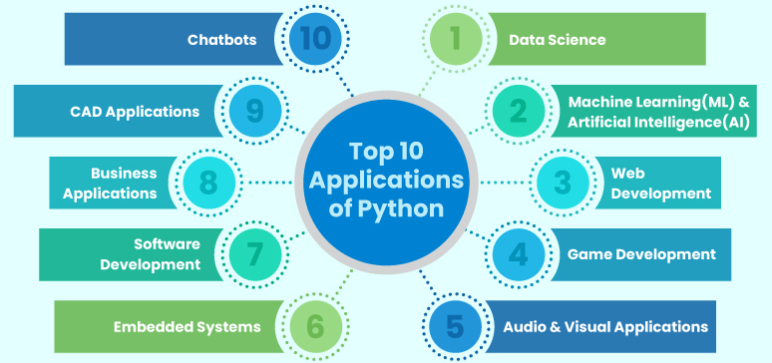
- Used in Web Development, Data Science, AI, Automation, Scripting
- Large community and tons of libraries
- Open-source and free to use
History of Python:
- Python was introduced by Guido van Rossum.
- First released in 1991
- Named after the TV show “Monty Python’s Flying Circus”
Python Applications:
Data Types:
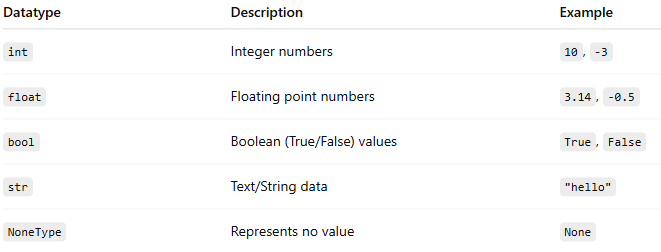
A datatype (or data type) is a classification that specifies what kind of value a variable can hold and what type of operations can be performed on it.
- Value Types (Primitive or Basic Data Types):
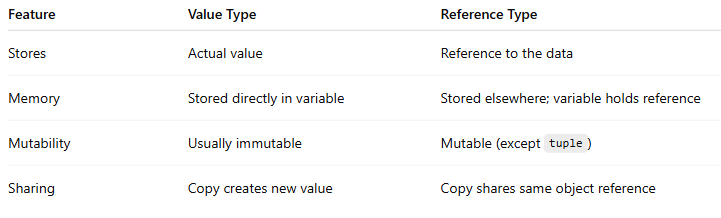
These store the actual value directly in memory, and each variable holds its own copy of the data. Changing one variable doesn’t affect others. These are immutable: once created, their value cannot be changed.
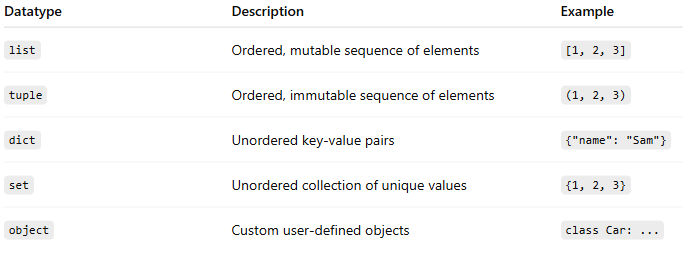
2. Reference Types (Non-Primitive Data Types):
These store references (or addresses) to the actual data in memory. If multiple variables refer to the same object, changing the object via one variable affects all others.
Differences Between Value Type and Reference Type:
Input / Output in Python:
input() — Take input from user
name = input(“Enter your name: “) print(“Hello ”, name)
print() — Output to screen.
print(“Hello, World!”) # Output: Hello, World! print(5 + 3) # Output: 8
**Type Conversion: *Used to convert* data from one type to another.
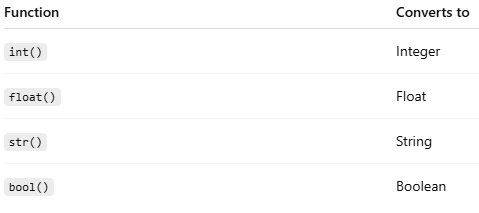
Example:
age = input(“Enter your age: “) # input as string age = int(age) # convert to integer print(“Next year, you will be”, age + 1) price = float(input(“Enter price: “)) print(“Total price with tax:”, price * 1.18)
Operators in Python:
An operator is a symbol that tells the interpreter to perform specific mathematical or logical operations on values (called operands).
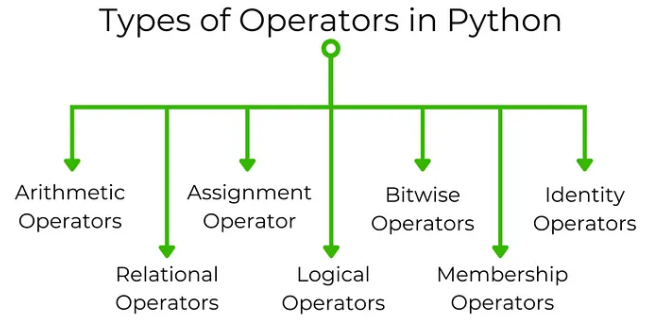
Why Use Operators?
- To compare values:
==,<,> - To perform calculations:
+,-,* - To combine logic:
and,or,not - To assign and modify values:
=,+=, etc.
**Arithmetic Operators: **Used for basic mathematical operations.
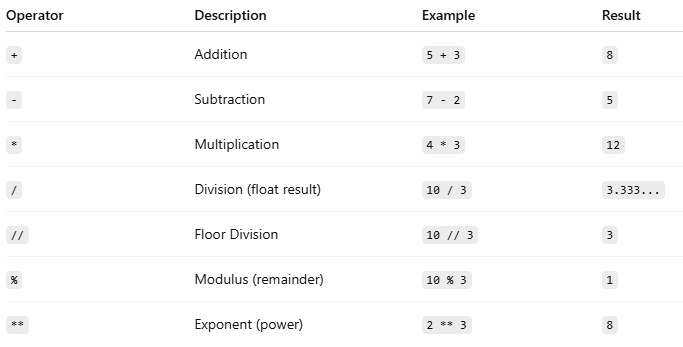
**Assignment Operators: **Used to assign or update values.
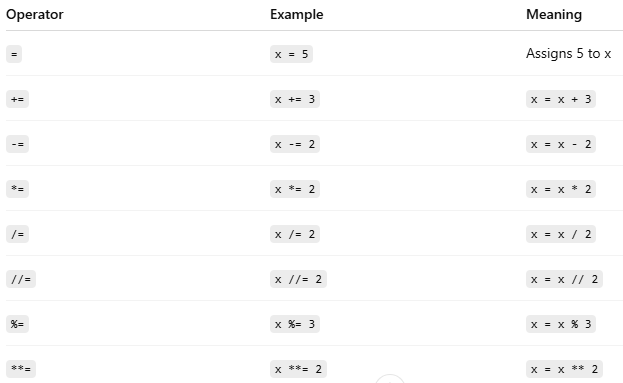
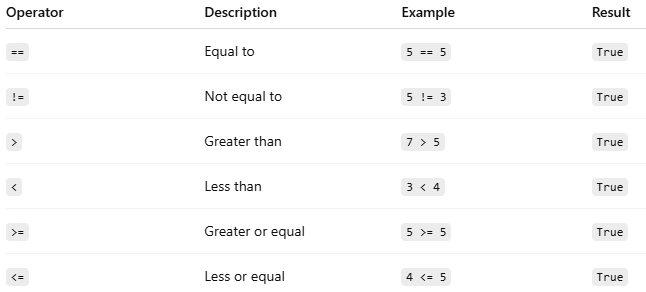
**Comparison Operators: **Used to compare two values.
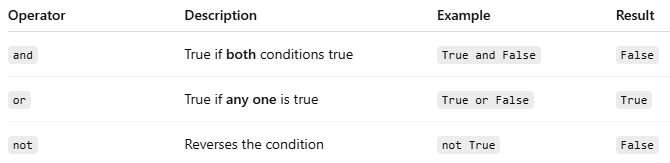
**Logical Operators: **Used to combine conditional statements.
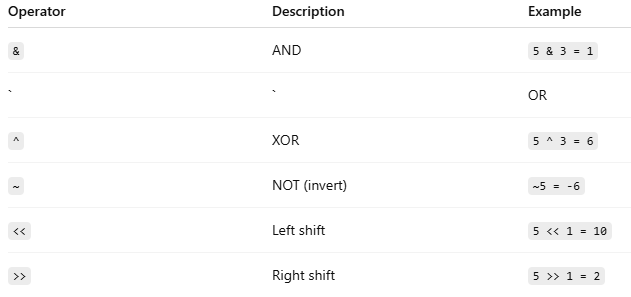
**Bitwise Operators: *Operate at the binary level*.
**Membership Operators: **Test for presence in sequences like lists, strings, etc.

**Identity Operators: *Check if two variables point to the same object* in memory.

메타데이터
- post_id
- d7ffdb29bbc4
- slug
- python-introduction-d7ffdb29bbc4
- url
- https://medium.com/@chaitanya4a3/python-introduction-d7ffdb29bbc4
- canonical_url
- https://medium.com/@chaitanya4a3/python-introduction-d7ffdb29bbc4
- author_url
- https://medium.com/@chaitanya4a3
- status
- ok
- fetched_at
- 2026-06-27 23:56:40