Where Does My Money Actually Go? The Expense Audit Changed Everything for Semi-Retirement Decision
Follow the money trail
Where Does My Money Actually Go? The Expense Audit That Changed Everything for Semi-Retirement Decision
Part 3 of my semi-retirement series. Part 2 covered how I gathered a full year of financial data — credit card statements, checking account records, and a shared household card with my wife that gave us one clean picture of our spending. This article is where we actually use it.
In the last article, I walked through collecting all the raw data — downloading statements, matching transactions to my expense list, and confronting the gap between what I thought I spent and what I actually spent. Now comes the part that turns that pile of numbers into something actionable.
This is the expense audit. And it’s where the picture gets uncomfortably clear.
The Tool Doesn’t Matter — The Honesty Does
I used Excel for this. You can use a notebook and a pen, Google Sheets, a notes app, whatever you’re comfortable with. The tool is irrelevant. What matters is that you sit down with every expense and make two decisions about it. That’s the whole exercise.

Compare expenses based on monthly payment
Decision 1: How Often Does This Expense Happen?
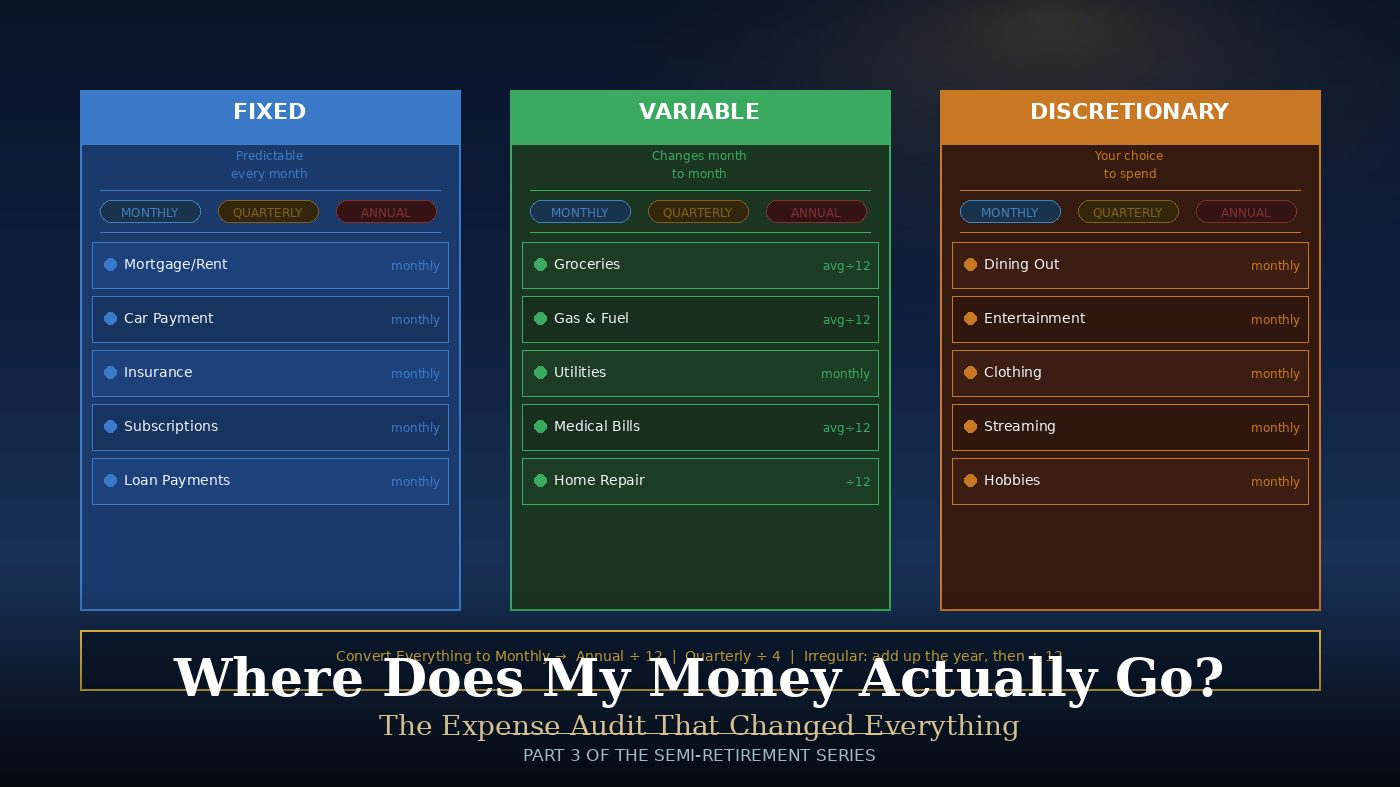
The first thing I did with each expense was classify it by frequency:
Monthly — mortgage, utilities, car payment, subscriptions, phone bill, insurance premiums. These are easy. They show up like clockwork, and you probably already know them cold.
Quarterly — some insurance bills, estimated tax payments, certain membership fees. Less visible, which is exactly why they get forgotten.
Annual — property taxes, annual subscriptions, vehicle registration, holiday spending, certain insurance policies. These are the ones that ambush you because they only show up once a year and feel like a one-time hit rather than a recurring cost.
As-needed / irregular — this is the category most people undercount. Pantry restocking runs, Costco hauls, car repairs, home maintenance, medical bills that don’t follow a schedule. These feel unpredictable, but over the course of a year they’re surprisingly consistent in aggregate.
The conversion rule: anything that isn’t monthly gets converted to a monthly equivalent.
- Annual expense ÷ 12 = monthly cost
- Quarterly expense ÷ 3 = monthly cost
- For irregular or as-needed expenses, add up everything you spent in that category over the past year and divide by 12
That last one is the most important. That Costco run that felt like a pantry investment? It’s a monthly expense. The car repair you paid cash for in March? Monthly expense. The moment you stop treating irregular costs as “exceptions” and start treating them as predictable monthly line items, your budget becomes real.
Decision 2: Need It or Want It?
Once every expense has a monthly number attached to it, I ran each one through a second filter: is this a have-to-have or an optional?
Have-to-Haves
These are the non-negotiables — the expenses that keep the lights on, the car running, and your health intact:
- Mortgage or rent
- Utilities (electric, gas, water)
- Groceries
- Car payment and fuel
- Home repair and maintenance
- Car repair and maintenance
- Healthcare premiums and medical bills
- Medications (for me, this is a significant line item given my chronic illness — not optional, full stop)
Optional
These are the expenses that exist because you chose them, not because life requires them:
- Streaming services
- Most clothing purchases (beyond basic replacement)
- Gym memberships
- Entertainment
- Subscriptions of all kinds — software, magazines, boxes, apps
- Dining out beyond what’s reasonable
The Gray Area
A few expenses sit in an honest middle ground, and I think it’s worth naming them directly rather than forcing them into one bucket or the other.
Internet — I put this in utilities because in 2024 it genuinely is one. But there’s a real conversation to be had about whether you need the 1-gig plan or whether the mid-tier option gets the job done for $30 less a month.
Cell phone — Having a cell phone is non-negotiable. What you pay for one is absolutely negotiable. The latest flagship device with an unlimited everything plan and a $60 case is not a have-to-have. A solid mid-range phone on a competitive carrier plan is. The difference can easily be $50–$80 a month when you account for device financing and premium plans, and that adds up to real money over four years.
The gray area is where most of the real savings hide. Not in eliminating things outright, but in asking whether the version of the thing you’re paying for is proportionate to what you actually need.

Pay attention to changes to these expenses over the year
Now the Real Work: The Trim Exercise
With every expense categorized and converted to a monthly number, I did three passes through the optional column.
Pass 1 — Eliminate the obvious. Some things on my list I couldn’t even remember signing up for. A subscription I’d trialed and forgotten to cancel. A membership I stopped using. These went away immediately and painlessly. No sacrifice, just clarity.
Pass 2 — Audit usage honestly. For everything that survived Pass 1, I asked: am I actually using this? Not “I might use it” or “I used it twice last year.” Am I getting regular value from this? If the answer wasn’t clearly yes, it went on the cut list.
Pass 3 — Can I pay less for the same thing? This is where the real money is. Some questions I asked myself:
- Do I really need the maximum internet speed tier, or would a lower plan be indistinguishable in practice?
- Is there another carrier offering the same cell coverage for significantly less?
- Are there two streaming services that largely overlap in what I watch?
- Is my gym membership priced appropriately for how often I go, and are there lower-cost alternatives?
You’re not cutting your quality of life — you’re right-sizing it. There’s a difference between eliminating a gym membership because you hate going and switching to a lower-cost fitness option because the premium gym isn’t delivering $80 of monthly value. One feels like deprivation. The other just feels like paying attention.
What This Exercise Actually Accomplishes
When you’re done, you have three things you didn’t have before:
A real monthly number. Not an estimate. Not a hope. An honest, defensible figure that accounts for every expense, including the ones that only show up occasionally.
A floor and a ceiling. Your have-to-haves define the minimum you need to sustain your life. Everything above that is negotiable, adjustable, or eliminable. Knowing the floor changes the anxiety level of a semi-retirement plan considerably.
An early warning system. Once you’ve done this audit, you know your numbers. That means when something changes — a utility bill creeps up, a subscription renews at a higher rate, a medical expense comes in above budget — you catch it. You’re not discovering in month six that your spending is $300 more than you planned. You notice it in month one.
For me, the eye-opener wasn’t any single expense. It was the aggregate of small things I’d stopped paying attention to — the streaming services, the auto-renewed subscriptions, the “enhanced” plans I’d upgraded years ago and never revisited. Getting rid of them didn’t transform my financial situation, but it reduced my monthly number in a way that bought me meaningful margin.
And in a four-year bridge plan where every month matters, margin is everything.
What’s Next: The Most Stressful Line Item
If you’re doing this audit in the context of a semi-retirement or early retirement plan, there’s one expense category that deserves its own article entirely. It’s the one that surprised me the most, that resists easy categorization, and that has the most variables attached to it.
Healthcare.
Specifically: what happens to your healthcare coverage when you leave a job, what COBRA actually costs when you’re paying the full freight, how the ACA marketplace works and when it makes more sense than COBRA, and what all of it means when you’re managing a chronic illness that requires ongoing medication.
That’s next.
Disclaimer
This article is intended for informational purposes only, and should not be considered financial, investment, business, tax, legal, or health advice. You should consult a relevant professional before making any major decisions.
Follow along with the series: Start with Part 1: Why I left my IT career in my mid-50s with four years to go before my retirement accounts unlock. Part 2 — The Money Reality Check: How I Audited My Finances Before Pulling the Trigger on Semi-Retirement
메타데이터
- post_id
- d80a63d764fc
- slug
- where-does-my-money-actually-go-the-expense-audit-changed-everything-for-semi-retirement-decision-d80a63d764fc
- url
- https://medium.com/financial-strategy/where-does-my-money-actually-go-the-expense-audit-changed-everything-for-semi-retirement-decision-d80a63d764fc
- canonical_url
- https://medium.com/financial-strategy/where-does-my-money-actually-go-the-expense-audit-changed-everything-for-semi-retirement-decision-d80a63d764fc
- author_url
- https://medium.com/@lenbarbsan
- status
- ok
- fetched_at
- 2026-07-16 16:02:15