UK growth flatlines as business exodus reaches 15-year high
Net migration of millionaire investors turned negative in 2025 for the first time on record, while 53% of households now rely on state…
UK growth flatlines as business exodus reaches 15-year high

Net migration of millionaire investors turned negative in 2025 for the first time on record, while 53% of households now rely on state support to meet daily costs.
The sound of one hand clapping
Walk into any boardroom in London’s Square Mile these days and you’ll hear the same conversation. It’s not about AI, or net zero, or the latest miracle cure for productivity. It’s about who’s leaving. The chief executive of a mid-cap engineering firm told me last week he’d lost three of his top five lieutenants to Dubai, Singapore and Switzerland in the past eighteen months. “They’re not angry,” he said, staring at his coffee. “They’re just done.”
The numbers back him up. According to data from UBS and the Henley Private Wealth Migration Report, the UK suffered a net loss of 9,500 high-net-worth individuals in 2025 — that’s people with investable assets above $1 million. For the first time since records began, more millionaires left than arrived. The exodus isn’t a trickle. It’s a haemorrhage.
The arithmetic of decline
Let’s get the obvious out of the way. The UK economy is not in “terminal decline” — that’s the language of Twitter doom-mongers who’ve never had to meet a payroll. But it is in a funk so deep and so stubborn that even the Office for Budget Responsibility looks optimistic. GDP per capita has grown by just 0.4% annually since 2016. That’s roughly one-third the rate of the United States, and barely half the OECD average.
Consider this: UK business investment has been flat in real terms since 2016. The International Monetary Fund now ranks the UK 26th in the world for productivity, behind Slovenia and just ahead of Cyprus. That’s not a blip. That’s a structural failure. And the usual suspects — Brexit, Covid, Ukraine — are only part of the story.
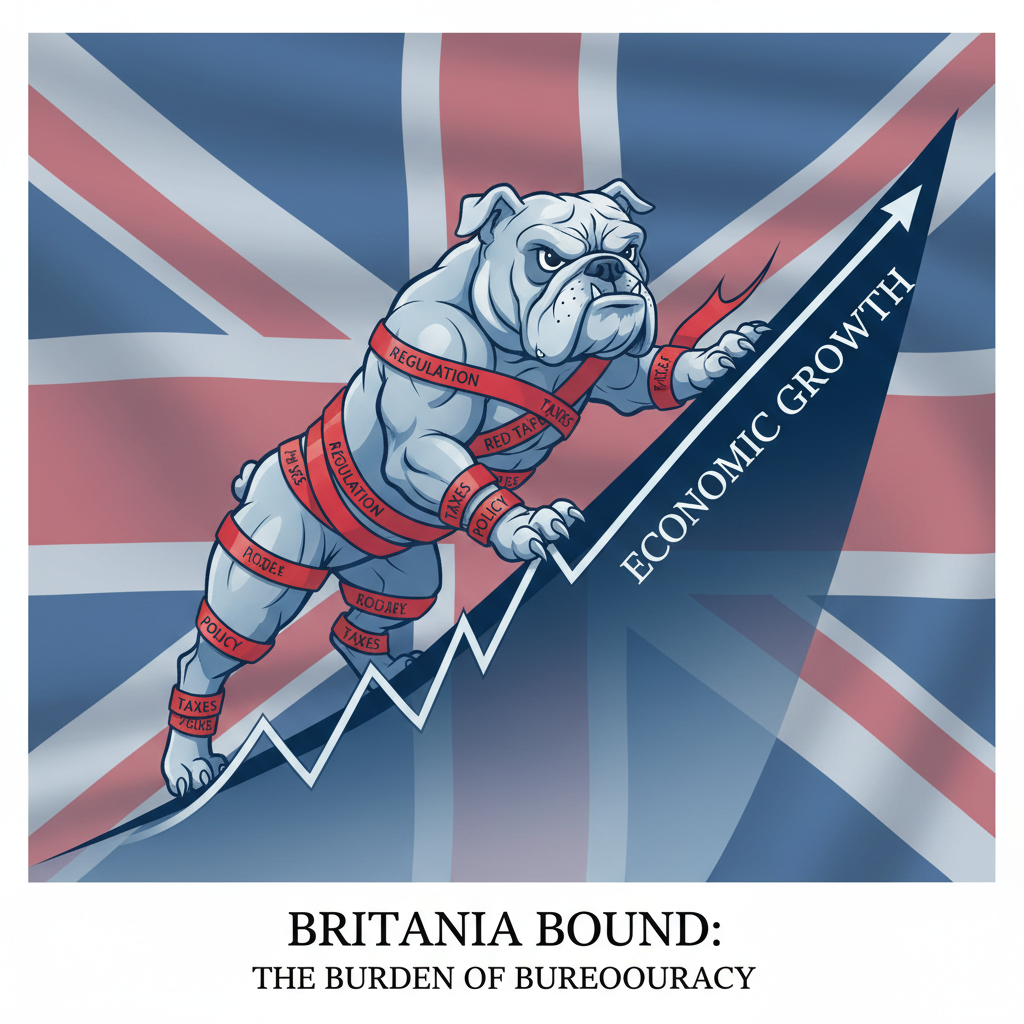
The real culprit is closer to home. Since 2020, the tax burden has risen to its highest peacetime level in history — 37.7% of GDP according to the Institute for Fiscal Studies. Corporation tax went from 19% to 25%. The inheritance tax threshold has been frozen since 2009. Capital gains tax allowances were slashed from £12,300 to just £3,000. The government has effectively declared war on the people who actually finance the state.
The welfare trap that eats growth
Here’s a statistic that should make any chancellor wince. The Resolution Foundation found that 53% of UK households now receive more in state benefits and services than they pay in tax. That’s up from 45% a decade ago. In-work benefits — universal credit, child benefit, housing support — now prop up millions of families who would otherwise be underwater.
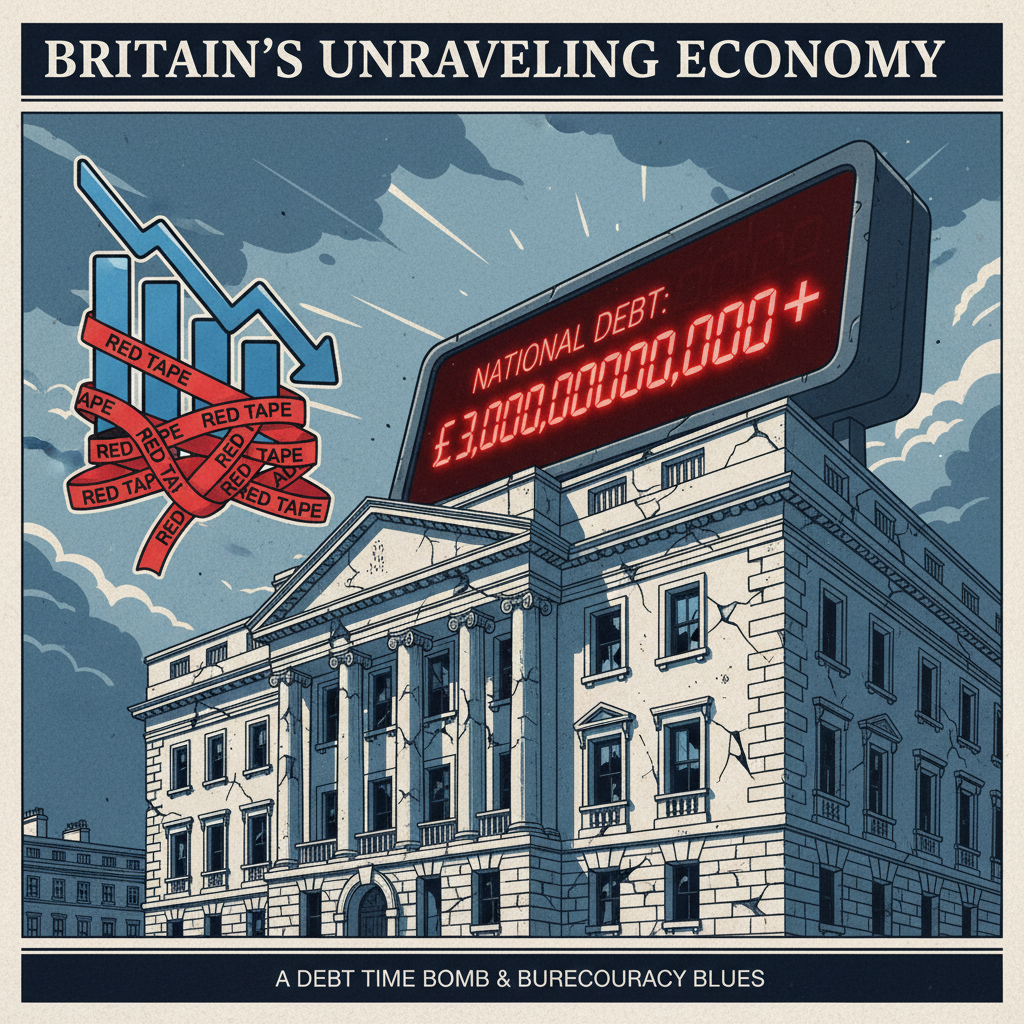
This isn’t a moral judgment. It’s an arithmetic one. When more than half the population is a net recipient from the state, the political incentives shift. Governments find it very hard to cut spending, because every cut hits a voter. They find it very hard to cut taxes, because there’s no money. So they borrow. UK public sector net debt now stands at 98% of GDP, up from 35% in 2007. Interest payments alone cost £110 billion a year — more than the defence budget.
Philip Booth, a senior academic at the Institute of Economic Affairs, put it bluntly in a recent paper: “The UK has a structural deficit that no amount of fiddling with fiscal rules can fix. The only honest answer is to shrink the state, reform welfare, and let private enterprise breathe.” He’s right. But no major party will say it.
A tale of two economies
Walk down Oxford Street and you’ll see the problem in microcosm. Half the shops are boarded up or turned into American candy stores that look like money-laundering fronts. The other half are betting shops and vape emporiums. Meanwhile, in Mayfair, private equity partners are billing £2,000 an hour and complaining they can’t find anyone to clean their second homes.
The City of London is still a global powerhouse — the UK remains the world’s second-largest financial centre after New York. But even there, the cracks are showing. The London Stock Exchange has lost listings worth over £100 billion in market capitalisation since 2021 as companies decamp to New York or go private. ARM Holdings, the crown jewel of British tech, chose Nasdaq over London. So did CRH, the building materials giant. So did Ferguson, the plumbing distributor.
The Financial Conduct Authority, under pressure, has finally started to reform its rulebook. But the damage is done. A survey by the Confederation of British Industry in March 2026 found that 62% of senior executives now view the UK regulatory environment as a net negative for doing business. That’s up from 34% in 2019.
The politics of denial
The current government talks about “stability” and “responsible fiscal management”. But the numbers tell a different story. Public spending is forecast to rise by 1.8% in real terms next year, even as growth limps along at 0.9%. The deficit is running at £48 billion above the OBR’s March forecast.
Rachel Reeves, the Chancellor, has pinned her hopes on planning reform and a “green industrial revolution”. She’s not wrong that Britain’s planning system is a disaster — it takes on average eight years to get a major infrastructure project approved. But the green agenda has its own problems. The government’s own Climate Change Committee admitted in January that the UK is not on track to meet its 2030 emissions targets, despite having spent £30 billion on subsidies.
The real question is whether any government can break the cycle. The answer, I suspect, is no — at least not until the bond market forces their hand. Remember 2022? The Truss mini-budget caused gilt yields to spike by over 100 basis points in a week. That was a warning shot. The next crisis may not be so forgiving.
What Milei can teach Whitehall
Javier Milei, Argentina’s libertarian president, has slashed public spending by 30% in eighteen months. His country, which was on the brink of hyperinflation, now posts monthly budget surpluses. The pound has stabilised. Markets cheer. Is that a model for Britain? Only if you believe the political class has the courage to try.
The UK doesn’t need a chainsaw. It needs a scalpel. But the direction is the same: cut the welfare bloat, deregulate housing and energy, lower corporate taxes, and stop treating wealth creation as a vice. The alternative is the slow, grinding decline that Twitter doom-mongers have been predicting for years — and which, for the first time, the data suggests may actually be happening.
One final number. In 2007, the UK ranked 5th in the world for ease of doing business, according to the World Bank. Today, it ranks 19th. That’s not a crisis. It’s a verdict.
메타데이터
- post_id
- d830b1dd2f67
- slug
- uk-growth-flatlines-as-business-exodus-reaches-15-year-high-d830b1dd2f67
- url
- https://medium.com/@worldnews99/uk-growth-flatlines-as-business-exodus-reaches-15-year-high-d830b1dd2f67
- canonical_url
- https://medium.com/@worldnews99/uk-growth-flatlines-as-business-exodus-reaches-15-year-high-d830b1dd2f67
- author_url
- https://medium.com/@worldnews99
- status
- ok
- fetched_at
- 2026-06-09 15:37:30