Candles: A Complete Guide to Wax Candles, Emergency Candles, Scented Candles & Wholesale Buying
Introduction: The Enduring Appeal of Candles
Candles: A Complete Guide to Wax Candles, Emergency Candles, Scented Candles & Wholesale Buying
Introduction: The Enduring Appeal of Candles
There are products that belong to a particular era.
And then there are products that simply refuse to become obsolete.
Candles belong firmly in the second category.
Modern homes may have LED bulbs, smart lighting, rechargeable lamps and automated illumination, yet the humble candle continues to hold its place. Sometimes it is practical. Sometimes decorative. Sometimes ceremonial. Sometimes, quite simply, atmospheric.
A candle can illuminate a room during a power cut, add warmth to a dining table, complement a celebration, or provide a subtle fragrance to an otherwise ordinary corner of the home.
The appeal lies in its simplicity.
Wax. Wick. Flame.
Yet behind that simplicity is a fascinating combination of material science, craftsmanship and everyday utility.
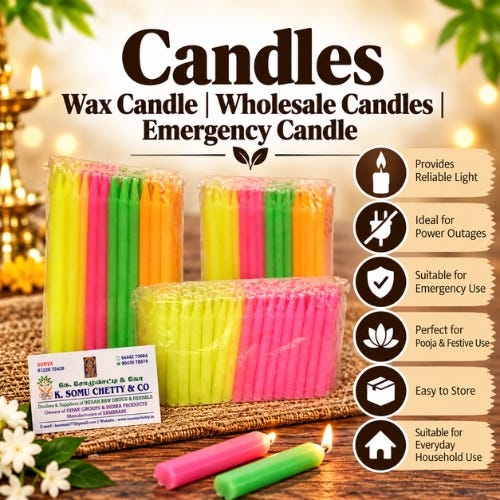
K. Somu Chetty & Co’s candle range caters to both retail and wholesale requirements, with candle products intended for everyday use, decorative applications and emergency illumination.
What Is a Candle?
A candle is essentially a fuel source designed to burn in a controlled manner through a wick.
The most familiar candles consist of wax surrounding a central wick. Once the wick is ignited, heat melts the wax near the flame. The melted wax then travels upward through the wick, where it becomes sufficiently hot to vaporise and combust.
Interestingly, the wick is not really the main fuel.
The wax is.
The wick acts more like a tiny transportation system, delivering the melted fuel to the flame.
That deceptively simple mechanism is what allows a candle to produce a relatively steady source of light without electricity.
Why Candles Remain Relevant in Modern Homes
The modern candle has evolved far beyond its original role as a source of illumination.
Today, candles can serve several purposes simultaneously.
Practical illumination
During electricity interruptions, a candle can provide immediate light without batteries or charging.
Decoration
Candles can become part of dining tables, shelves, centrepieces and festive arrangements.
Celebration
Birthday cakes, weddings, anniversaries and parties frequently incorporate candles.
Fragrance
Scented candles introduce aroma alongside soft illumination.
Traditional and ceremonial use
Candles are also associated with various religious, cultural and commemorative practices.
This versatility is one reason candles continue to maintain their relevance despite the proliferation of modern lighting technology.
The Basic Anatomy of a Candle
Although candles come in countless shapes and sizes, most share several fundamental components.
Wax
Wax forms the primary fuel reservoir.
Different waxes behave differently when heated, and the choice of wax can influence hardness, melting characteristics, appearance and burning behaviour.
Wick
The wick transports melted wax toward the flame.
Its dimensions and construction must be appropriate for the candle’s size and wax formulation.
Flame
The flame is the visible result of combustion.
Its size, colour and stability can vary depending on the wick, wax, airflow and other characteristics.
Fragrance and Colour
Decorative and scented candles may contain fragrance compounds and colourants.
These additions transform a purely utilitarian object into something more sensory and visually expressive.
How Does a Candle Work?
The science behind a candle is straightforward but elegant.
When a candle is lit, the flame generates enough heat to melt the surrounding wax.
The liquid wax enters the wick through capillary action. As it approaches the flame, it becomes increasingly hot and eventually vaporises.
Those wax vapours then combust.
This continuous cycle allows the candle to keep burning as long as there is sufficient wax and oxygen.
The phenomenon is a miniature combustion system operating on a remarkably modest scale.
Understanding Different Types of Candles
Not every candle is designed for the same purpose.
The ideal candle depends on the environment, expected burn duration and desired appearance.
Some are tiny and decorative. Others are substantial and designed for extended illumination. Some are fragrance-focused, while emergency candles prioritise practical performance.
Understanding these categories makes buying considerably easier.
Tea Light Candles for Compact Decorative Lighting
Tea light candles are among the most versatile small-format candles.
Their compact footprint makes them suitable for:
- Dining tables
- Festival decorations
- Party arrangements
- Decorative trays
- Wedding décor
- Home ambience
- Candle holders
Their small size also makes it easy to use several candles together, creating a constellation of small flames rather than relying on one large candle.
For event planners and retailers, tea lights can also be attractive bulk-purchase products because individual candles are relatively compact and easy to arrange.
Pillar Candles for Long-Lasting Illumination
Pillar candles are generally larger and freestanding.
Their substantial wax mass allows them to burn for longer periods than many smaller candle formats, depending on their dimensions and formulation.
They are especially suitable for decorative settings where the candle itself forms part of the visual composition.
A cluster of pillar candles at varying heights can create depth without requiring elaborate décor.
Votive Candles for Décor and Ambience
Votive candles are small candles commonly used with holders.
Their modest dimensions make them particularly useful for creating groups of lights.
A single votive can be subtle.
Several together can be transformative.
They are frequently associated with decorative settings, intimate dining arrangements and ceremonial environments.
Scented Candles for a Fragrant Home
Scented candles combine visual ambience with fragrance.
When the wax is heated, fragrance compounds are released into the surrounding environment. The resulting aroma can influence the perceived atmosphere of a room.
Scented candles are particularly popular in:
- Bedrooms
- Living rooms
- Dining areas
- Reading corners
- Personal relaxation spaces
The ideal fragrance intensity depends on room size, ventilation and personal preference.
A small room may require only a mild fragrance, whereas a larger space may benefit from a more substantial scent profile.
Emergency Candles for Power Cuts
Few household objects become more appreciated than a candle when the electricity suddenly disappears.
During a power cut, candles offer immediate illumination without requiring charging, batteries or electrical connections.
However, not every decorative candle is equally suited to emergency use.
An emergency candle should ideally provide:
- Stable illumination
- Predictable burning
- Adequate burn duration
- A stable base
- Easy handling
For households in areas where power interruptions are common, keeping a small emergency candle supply can be a sensible preparedness measure.
Long-Burning Candles and Their Practical Advantages
Burn duration matters when a candle is being used for illumination rather than decoration.
A candle that burns for a short period may be perfectly adequate for a dinner table but less suitable during an extended power outage.
Larger candles and certain formulations can provide substantially longer illumination.
K. Somu Chetty & Co’s candle information highlights long-burning candles as an option for emergency situations and discusses paraffin, liquid paraffin and beeswax candles in this context.
Understanding Candle Wax
Wax is arguably the most important material in a candle.
Different waxes possess different characteristics.
Common categories include:
- Paraffin wax
- Soy wax
- Beeswax
- Gel wax
The choice depends on the intended candle, manufacturing requirements, desired appearance and burn characteristics.
For candle makers, wax selection is particularly important because it influences everything from mould behaviour to finished appearance.
Paraffin Wax and Its Common Uses
Paraffin wax remains a widely used candle-making material because of its versatility.
It can be formulated for different candle applications and is commonly found in both decorative and practical candle products.
K. Somu Chetty & Co offers CPCL paraffin wax for candle-making requirements in retail and wholesale quantities.
For manufacturers, paraffin can be particularly useful when consistency, mouldability and predictable performance are important.
Soy Wax for Contemporary Candle Making
Soy wax is derived from soybean oil and has become particularly popular within contemporary candle-making.
It is commonly associated with scented candles and handcrafted candle products.
For buyers interested in plant-derived wax options, soy wax provides an alternative to petroleum-derived paraffin.
K. Somu Chetty & Co lists soy wax for candle-making in both retail and wholesale quantities.
As with any wax, the final performance depends on formulation, wick selection and manufacturing technique.
Beeswax and Its Natural Character
Beeswax is produced naturally by honeybees.
It has a distinctive appearance and characteristic aroma, making it particularly appealing to candle makers seeking a more natural aesthetic.
Beeswax candles can have a warm, organic visual quality that differs noticeably from many industrial wax formulations.
K. Somu Chetty & Co also lists beeswax within its wax range for candle-making applications.
Gel Wax for Decorative Candle Designs
Gel wax is visually distinctive because of its translucent appearance.
This characteristic allows candle makers to create designs with a glass-like or crystalline visual effect.
It can be particularly interesting for decorative candles where appearance is as important as illumination.
Gel wax can also be combined with suitable colours and decorative elements when formulated correctly.
Why the Candle Wick Matters
A candle’s wick may look insignificant.
It isn’t.
The wick controls the movement of melted wax toward the flame and therefore has a direct influence on combustion.
A wick that is too large can produce an excessively large flame, while a wick that is too small may struggle to maintain adequate combustion.
Wick selection therefore needs to correspond with:
- Candle diameter
- Wax type
- Fragrance load
- Desired flame behaviour
- Intended burn time
For professional candle manufacturing, wick selection is a technical consideration rather than a decorative afterthought.
What Determines Candle Burn Time?
Burn time is influenced by several variables.
Candle size
More wax generally means more available fuel.
Wick dimensions
A larger wick can consume wax more rapidly.
Wax formulation
Different waxes have different melting and combustion characteristics.
Air movement
Drafts can alter flame behaviour and burn rate.
Candle geometry
A wide candle and a narrow candle can behave differently even when they contain similar quantities of wax.
Consequently, candle size alone cannot accurately predict burn duration.
Candles for Home Décor
Candles can introduce an unusually soft visual texture into interior spaces.
Their illumination is dynamic rather than static.
The flame flickers. Shadows move. Reflective surfaces respond to changing light.
That makes candlelight particularly effective for creating warmth.
Tea lights can be arranged along a dining table. Pillar candles can frame a centrepiece. Decorative candles can add interest to shelves and side tables.
The result is often more atmospheric than conventional lighting alone.
Candles for Festivals, Religious Use and Traditional Occasions
Light has profound symbolic importance across cultures.
Candles may be used during festivals, religious observances, remembrance ceremonies and traditional gatherings.
In these situations, the candle is not merely a lighting object.
It can represent illumination, hope, devotion, celebration or remembrance.
For prolonged ceremonial use, stability and safe placement become particularly important.
Candles for Birthdays, Parties and Events
The birthday candle is perhaps one of the world’s most recognisable celebratory objects.
Yet candles extend well beyond cakes.
Event decorators frequently use candles to create:
- Table centrepieces
- Entrance displays
- Wedding décor
- Party arrangements
- Romantic dining setups
- Festive installations
For larger functions, purchasing candles in bulk can simplify event preparation while improving per-unit economics.
Candles for Restaurants, Hotels and Hospitality Spaces
Hospitality environments depend heavily on atmosphere.
Restaurants may use candles to create intimacy. Hotels may use them in decorative arrangements, dining spaces or events.
In these environments, consistency becomes important.
A business may require dozens or hundreds of identical candles rather than a handful of assorted pieces.
That is where wholesale purchasing becomes particularly relevant.
Buying Candles for Emergency Preparedness
Emergency preparedness does not need to be elaborate.
A basic household emergency kit can include essential lighting options alongside other supplies.
Candles can serve as a backup when electrical lighting becomes unavailable.
However, emergency candles should always be stored safely and used responsibly.
They should never be treated as a substitute for safe electrical or battery-powered emergency lighting where those options are available.
Retail Candles vs Wholesale Candles
The distinction is largely one of purchasing volume.
Retail purchasing
Suitable for:
- Homes
- Small events
- Personal décor
- Occasional use
- Gifting
Wholesale purchasing
Better suited to:
- Retailers
- Event planners
- Hotels
- Restaurants
- Institutions
- Resellers
- Large celebrations
Wholesale buying can also simplify inventory management for businesses that use candles continuously.
Why Businesses Buy Candles in Bulk
Buying candles individually may make sense for occasional household use.
For businesses, however, repeated small purchases can become cumbersome.
Bulk purchasing can provide:
- More predictable inventory
- Fewer procurement cycles
- Better unit economics
- Consistent product availability
- Easier event planning
For resellers, bulk procurement also provides an opportunity to maintain stock for customers rather than purchasing only after every sale.
How to Select Candles for Wholesale Purchasing
Wholesale purchasing should not be reduced to a simple price comparison.
Consider the following:
Product consistency
Are candle dimensions and quality consistent across batches?
Burn characteristics
Do candles perform reliably?
Packaging
Can the candles survive transportation and storage?
Supply capability
Can the supplier fulfil repeat requirements?
Intended use
Are the candles for resale, events, hospitality, décor or emergencies?
Overall value
The cheapest candle is not necessarily the least expensive choice if inconsistent quality results in waste or customer complaints.
How to Store Candles Correctly
Candles should generally be stored in a cool, dry place away from direct sunlight and heat.
This is especially important for large inventories.
Poor storage can lead to:
- Softened wax
- Warping
- Colour changes
- Surface imperfections
- Fragrance deterioration
Candles should also be protected from crushing and excessive pressure.
For wholesale buyers, proper warehouse storage can be just as important as choosing the right supplier.
Candle Safety: Essential Precautions
Candles involve an open flame.
That single fact should govern every aspect of their use.
Always place a candle on a stable, heat-resistant surface. Keep it away from curtains, paper, furniture and other flammable materials.
Never leave a burning candle unattended.
Children and pets should not have unsupervised access to lit candles.
Avoid placing candles in strong drafts, where airflow can destabilise the flame.
These are not complicated rules.
They are simply good habits.
How to Get a Better Burn from Your Candle
Several simple practices can improve candle performance.
Trim the wick
A properly trimmed wick can help maintain a more controlled flame.
K. Somu Chetty & Co recommends trimming the wick to approximately 1/4 inch before burning.
Keep the candle level
An uneven surface can affect stability and wax distribution.
Avoid strong airflow
Drafts can cause uneven burning.
Use appropriate holders
For candles that require holders, ensure the holder is stable and heat-resistant.
Extinguish carefully
A candle snuffer can be useful for extinguishing flames while reducing unnecessary smoke and wax splatter.
Common Candle-Burning Mistakes
Leaving a Candle Unattended
A lit candle should always remain under appropriate supervision.
Placing It Near Flammable Objects
Curtains, paper decorations and fabric can ignite rapidly.
Ignoring the Wick
A very long wick can alter flame behaviour.
Burning on an Unstable Surface
A candle should never be placed somewhere it can easily tip over.
Storing Candles Near Heat
Heat can deform wax before the candle is even used.
Using the Wrong Candle for the Job
A decorative tea light is not necessarily the ideal emergency candle.
Purpose matters.
How to Choose the Right Candle for Your Purpose
The easiest way to select a candle is to begin with the intended use.
Purpose Suitable Candle Consideration Power outage Long-burning emergency candle Dining décor Tea light or pillar candle Fragrance Scented candle Celebration Decorative or birthday candle Events Bulk tea lights, votives or pillar candles Retail resale Consistent wholesale candle supply Candle making Appropriate wax and wick combination
This simple approach prevents a common purchasing mistake: choosing based purely on appearance.
Why Quality Matters in Candle Selection
Quality becomes apparent once the wick is lit.
A well-made candle should have:
- Consistent construction
- Appropriate wick sizing
- Stable burning
- Good wax integrity
- Suitable packaging
- Predictable performance
For wholesale customers, consistency is even more important.
If one batch burns beautifully while another performs poorly, customer satisfaction can deteriorate quickly.
Reliable candle purchasing is therefore an exercise in both product selection and supplier evaluation.
Frequently Asked Questions About Candles
What are the main types of candles?
Common varieties include tea lights, votive candles, pillar candles, taper candles, jar candles, scented candles and emergency candles.
Which candle is best for a power cut?
A long-burning candle designed for emergency illumination is generally more appropriate than a small decorative candle.
What wax is commonly used for candles?
Paraffin, soy wax, beeswax and gel wax are among the commonly used candle waxes.
Are candles available for wholesale purchase?
Yes. K. Somu Chetty & Co provides candle products for both retail and wholesale purchasing.
How should candles be stored?
Keep them in a cool, dry location away from direct sunlight and heat.
Why does the wick matter?
The wick controls how melted wax reaches the flame and therefore has a significant effect on burning behaviour.
How should a candle wick be trimmed?
A commonly recommended starting point is approximately 1/4 inch, while the manufacturer’s specific care instructions should always take precedence.
Are scented candles suitable for home use?
Yes, provided they are used responsibly and in accordance with the product’s instructions.
Can candles be purchased in bulk for events?
Yes. Wholesale purchasing can be particularly useful for weddings, parties, restaurants, hotels and event-management requirements.
Conclusion: One Simple Product, Many Everyday Uses
Candles occupy a curious place in everyday life.
They can be practical without being mundane. Decorative without being extravagant. Traditional without feeling antiquated.
A small tea light can transform a table. A scented candle can change the atmosphere of a room. A pillar candle can become a centrepiece. A long-burning emergency candle can provide useful illumination when the power goes out.
And for businesses, wholesale candles can become a practical inventory product for resale, hospitality, events and regular commercial use.
The key is choosing the right candle for the right purpose.
For emergency preparedness, prioritise stability and burn duration. For décor, consider shape and presentation. For fragrance, consider the wax and scent profile. For wholesale purchasing, evaluate consistency, supply reliability and overall value.
K. Somu Chetty & Co’s candle range brings together options for everyday consumers and bulk buyers, while its wider wax selection caters to candle-making requirements as well. Explore Candles & Wax Products
A candle may be an uncomplicated object.
But its uses are remarkably expansive.
메타데이터
- post_id
- d841aec910eb
- slug
- candles-a-complete-guide-to-wax-candles-emergency-candles-scented-candles-wholesale-buying-d841aec910eb
- url
- https://medium.com/@ksomuchetty718/candles-a-complete-guide-to-wax-candles-emergency-candles-scented-candles-wholesale-buying-d841aec910eb
- canonical_url
- https://medium.com/@ksomuchetty718/candles-a-complete-guide-to-wax-candles-emergency-candles-scented-candles-wholesale-buying-d841aec910eb
- author_url
- https://medium.com/@ksomuchetty718
- status
- ok
- fetched_at
- 2026-08-23 00:21:03