When Space Bows and Time Falls Silent
Abdul Qadir al-Jilani, the throne of Bilqis, and the meaning of karamah
When Space Bows and Time Falls Silent
Abdul Qadir al-Jilani, the throne of Bilqis, and the meaning of karamah

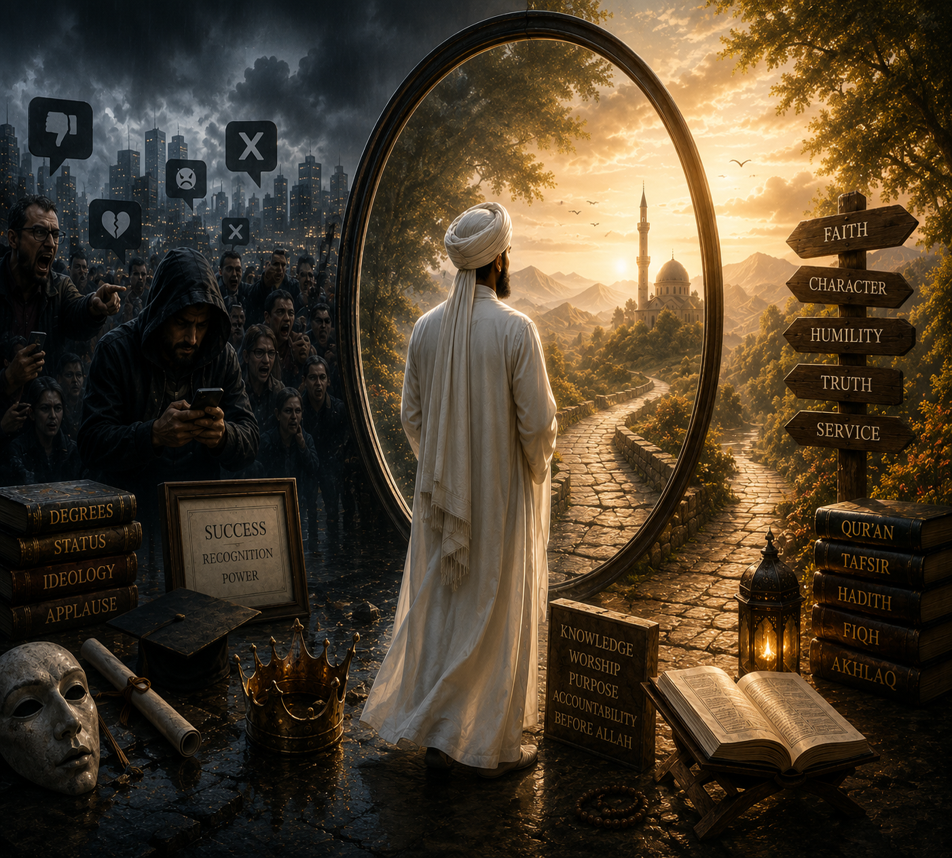
A student of knowledge reflects upon the throne of Bilqis, where divine permission, human understanding, and the limits of time and space meet. (Conceptual illustration by the Author)
The question first sounds like a physics challenge: can a human being exist in more than one place at the same time? Yet the question that stays with me is not about mechanism. It is about confidence. How much of reality are we entitled to define by the narrow range of conditions under which we happen to live?
A body occupies a location. A journey takes time. A person who leaves one city must cross the distance separating it from another. These are not naïve assumptions. They are part of the dependable order that makes human life intelligible. We build homes, keep appointments, bury the dead, and wait for travelers because the world usually behaves with continuity.
The difficulty begins when continuity is mistaken for sovereignty.
Islam does not ask the believer to deny the patterns of creation. It asks the believer to remember that those patterns are created. What we call a law of nature describes the regular way events unfold within our experience. It does not become a law imposed upon Allah. The universe is not an independent mechanism that the Creator set in motion and then became obliged to obey.
This is the theological setting in which Muslim scholars discussed karamah, an extraordinary favor granted by Allah to a righteous servant. A karamah does not mean that the servant possesses a private reserve of supernatural power. Classical scholars distinguished it from the evidentiary miracle of a prophet, the mu‘jizah, while insisting that both occur only by Allah’s will. The saint remains a creature. The event does not confer prophethood, suspend moral responsibility, or make the recipient an object of worship.
This distinction allows us to approach the traditions surrounding Abdul Qadir al-Jilani without choosing between mockery and credulity. One may accept the possibility of karamah while asking whether a particular story is historically well attested. Divine power and human reporting are not the same subject.
The Throne and the Question the Qur’an Actually Asks
The Qur’anic account of the throne of Bilqis is frequently cited when Muslims discuss extraordinary favors granted to people who were not prophets. Prophet Sulayman asks who can bring the queen’s throne before she arrives. A powerful jinn offers to bring it before Sulayman rises from his place. Then another figure speaks, described only as one who possessed knowledge from the Book. He promises to bring the throne before Sulayman’s glance returns. The throne appears before him.
The Qur’an does not name this person. Many commentators identified him as Asif ibn Barkhiya, a learned and righteous companion of Sulayman. Other interpretive discussions considered Sulayman himself as the speaker. The identity is less certain than popular retellings sometimes imply.
What interests me is the Qur’an’s silence about the mechanism. We are told neither how the throne crossed the distance nor what kind of knowledge made the event possible. There is no secret method to recover and no spiritual technology offered to the reader. The text turns at once to Sulayman’s response. He recognizes the event as a favor from his Lord and as a test of whether he will be grateful or ungrateful:
“This is from the favor of my Lord, to test me whether I will be grateful or ungrateful.”
The moral movement of the verse is more important than the transportation itself. Something astonishing occurs, and Sulayman refuses to make himself its center. The throne becomes a test because power, knowledge, and distinction can corrupt the person who receives them. Gratitude returns the gift to its source. Pride quietly converts reception into ownership.
This gives the verse unusual depth. It may support the possibility of karamah if the knowledgeable figure was a righteous servant rather than Sulayman, but it also places a restraint upon fascination with karamah. The purpose of the extraordinary is not to enlarge the reputation of the person through whom it occurs. The event reveals dependence upon Allah and exposes the moral condition of the witness.
The throne arrives before the eye can return. The Qur’an then asks whether the heart will return to its Lord.
What Would It Mean to Be in Two Places?
Later devotional literature sometimes portrays saints as assisting travelers, appearing to disciples, or intervening in distant places while their bodies remain elsewhere. Stories of this kind became attached to Abdul Qadir al-Jilani as his reputation spread across the Muslim world.
Before deciding whether such an event is possible, we should ask what kind of presence is being claimed. Bodily presence differs from a vision, a dream, a divinely created likeness, or an experience granted to the person who believes that he saw the saint. A report that someone appeared in two places tells us very little about the nature of the appearance.
If the claim is that an ordinary human being independently multiplied his body and acquired command over space, Islamic theology gives no reason to accept it. Created beings do not possess independent power. If the claim is that Allah caused a servant to be perceived at a distance, created a likeness, suspended an ordinary condition, or brought about an event for which we lack an adequate category, then the matter is different. The claim concerns divine action, not human autonomy.
Even then, possibility does not establish occurrence. Allah’s ability to do something cannot authenticate every report that attributes it to a saint. Otherwise, evidence would become unnecessary. A story would be accepted merely because it described an act within divine power, which would make almost any story immune to examination.
Historical inquiry asks when an account appeared, how it was transmitted, whether independent witnesses support it, and what interests may have shaped its retelling. Theology asks whether the event contradicts the nature of God, prophethood, or human servitude. Hagiography asks how a religious community imagined holiness and preserved the memory of a revered figure. These questions can illuminate one another, but they cannot replace one another.
The most careful answer to the question of appearing in several places is therefore modest. Islamic theology does not confine Allah to the spatial conditions familiar to us. Historical responsibility does not permit us to declare every account about al-Jilani true.
The Preacher Behind the Legends
Abdul Qadir al-Jilani was born around 1077 or 1078 in the region of Gilan and later settled in Baghdad. He studied Hanbali law, taught, preached, and became known for exhortations centered on repentance, sincerity, discipline, and reliance upon Allah. He died in Baghdad in 1166. The tradition associated with his name later extended across wide parts of the Muslim world.
This historical figure should not disappear behind the marvels attributed to him.
Some of the fullest collections of al-Jilani’s extraordinary deeds were compiled after his death. Bahjat al-Asrar, written roughly a century later, played a major role in shaping the image of a saint whose authority reached across distance and into the unseen. Modern scholarship has noted the difference between the relatively restrained portrait preserved in earlier sources and the expansive hagiographical figure found in later devotional works.
That difference should lead to caution, though not contempt. Hagiography is not simply an inaccurate biography. It serves another purpose. It shows how a community understands sanctity, which virtues it associates with nearness to Allah, and what kind of authority it regards as morally legitimate. A story may matter within a tradition even when its details cannot be established by the methods of critical history.
The mistake lies in reading every genre as though it were making the same kind of claim. The Qur’an, an early biographical notice, a sermon collection, and a saintly legend do not possess equal authority. Nor do they ask to be read in the same way. Devotional memory can preserve insight, exaggeration, history, symbolism, and communal longing within the same narrative.
I find that complexity more interesting than a simple verdict. It asks us to respect what a story means without pretending to know more than its transmission allows.
Time and the Limits of Human Measure
The idea of appearing in distant places also raises a question about time. Distance ordinarily requires duration. If a throne arrives before a glance returns, or if a saint is reported in two distant locations, the sequence through which we understand travel appears to have been interrupted.
The Qur’an does not present human time as the scale of every order of existence. It speaks of a day with Allah being like a thousand years by human reckoning, and elsewhere of a day measured as fifty thousand years. These verses should not be turned into speculative physics. Their theological force is enough: human measurement is not universal.
Our own experience already makes time less simple than the clock suggests. Fear can stretch a minute. Grief can make an afternoon almost immovable. Concentration can cause several hours to pass unnoticed. A dream may seem to contain a long journey while the sleeper remains in bed. None of this proves that a person can appear in two places, but it warns against treating our immediate experience as a complete account of time.
The unseen presents a still greater limit. Angels, jinn, dreams, revelation, and the life of the grave cannot be reduced to ordinary physical life with a few invisible features added. Revelation affirms these realities while withholding much of their mode of existence. The believer is therefore caught between two duties: to accept what has been disclosed and to resist inventing what has not.
Language about folded space or altered time may help us recognize the narrowness of our categories. It cannot explain the mechanism of a karamah. Once metaphor begins presenting itself as knowledge, wonder has become speculation.
The Girl, the Jinn, and the Danger of Borrowed Power
One popular account tells of a young girl troubled by jinn. When al-Jilani’s name or authority is invoked, the beings are unable to escape and are punished. The details vary across devotional retellings, and the account cannot be placed on the same level as Qur’anic testimony or authenticated hadith.
Still, the story raises a serious theological problem. Does a saint’s name possess power of its own?
If the answer is yes, the story has been read in a way that compromises divine sovereignty. No created name functions independently of Allah. A saint does not become a second source of command within the universe. Any help associated with a righteous servant must remain dependent upon Allah’s permission and action.
A more defensible interpretation treats the name as a sign of moral and spiritual authority. Within the story’s imagination, al-Jilani represents a servant whose life has been disciplined by obedience. The jinn encounter neither magic nor autonomous saintly power. They encounter divine judgment mediated through a servant whom the tradition regards as close to Allah.
That interpretation still requires restraint. Devotion can move from reverence into exaggeration, especially when the believer’s practical dependence shifts from Allah to the saint. The language of honor then begins to carry a theological burden it cannot bear.
The story becomes more valuable when read as a question about the kind of power we admire. Domination over unseen beings easily captures the imagination. Mastery over resentment, vanity, fear, and appetite is less dramatic, but it lies closer to the moral work of religion. A saint’s authority cannot be separated from the discipline of the self. Without that discipline, the miraculous becomes theater.
The Voice in the Darkness
The most penetrating narrative associated with al-Jilani is not a report of distant travel. It is the story of a deceptive light.
Later devotional biographies relate that, during spiritual solitude, al-Jilani encountered a radiant presence. A voice announced, “I am your Lord,” then claimed that certain prohibitions had been lifted from him because of his spiritual rank. Al-Jilani rejected the voice as satanic.
The details cannot be treated as historically certain, but the narrative contains a rigorous account of spiritual discernment. An experience does not prove its own truth. Intensity is not authority. Light may deceive, and a voice that seems to come from beyond the self may flatter what is most dangerous within it.
Al-Jilani’s reported response depends upon a clear principle. No private experience can overturn revealed moral obligation. A voice that authorizes disobedience has already exposed its source, however luminous the vision may appear. Nearness to Allah does not release a person from servitude. It makes servitude more conscious.
This is where the story acquires psychological force. Spiritual deception does not always invite a person to obvious wickedness. It may tell the seeker that the rules governing ordinary believers no longer apply. The temptation is dressed as distinction. The person is not asked merely to sin, but to interpret exemption as evidence of holiness.
The ego is capable of religious refinement. It may surrender wealth and still hunger for recognition. It may endure solitude and quietly build an identity around being exceptional. It may speak of annihilating the self while drawing nourishment from titles, followers, visions, and claims of access.
The voice offers al-Jilani a station beyond obedience. His refusal places servitude beyond every station.
For me, this is the decisive story. Appearing in several places challenges our concept of space. The deceptive voice challenges our ability to distinguish revelation from self-exaltation. The second danger is nearer. Most people will never face a claim that they appeared in two cities. Many will face the temptation to treat personal conviction as a license to evade moral scrutiny.
The Ethics of Karamah
Classical discussions of karamah were shaped by caution. Muslim scholars distinguished saintly marvels from prophetic miracles, magic, deception, and istidraj, an apparent favor that may draw a person deeper into error. They also warned that an extraordinary occurrence associated with someone who disregards divine law offers no reliable proof of sanctity.
This changes the question we should ask when hearing stories of wonders. The popular question is whether the saint crossed water, knew an unspoken thought, commanded a jinn, or arrived without traveling. The more demanding question concerns character. Did the experience produce gratitude? Did it deepen obedience? Did the person fear self-deception? Did the event remain subordinate to revelation?
A marvel becomes spiritually dangerous when attention settles upon the marvel-worker. Sulayman’s response to the throne prevents that movement. His recognition that the event came from his Lord is the act that gives the wonder its proper meaning.
The saint, on this account, is not someone who owns extraordinary power. He is someone who can stand near the extraordinary without claiming it.
Belief Without Credulity
There is a persistent temptation to force the subject into two positions. Either every story must be defended as literal history, or every story must be dismissed as superstition. Both responses avoid the harder work of distinction.
One may affirm that Allah grants karamat while remaining uncertain about a report of bilocation. One may revere Abdul Qadir al-Jilani while acknowledging that later admirers enlarged his biography. One may find theological truth in the story of the deceptive voice without claiming that its wording possesses canonical authority.
These are not evasions. They recognize different levels of knowledge.
The throne of Bilqis belongs to the Qur’anic revelation. The identification of the knowledgeable figure as Asif ibn Barkhiya belongs to tafsir and transmitted interpretation. Al-Jilani’s work as a preacher and teacher in Baghdad belongs to historical inquiry. The stories of jinn, distant appearances, and supernatural encounters belong mainly to hagiographical memory.
When these levels are confused, both faith and scholarship suffer. Treating every devotional account as certain makes legitimate historical questions appear hostile to religion. Dismissing every account that cannot be critically verified prevents us from understanding the moral imagination of the communities that preserved it.
Discernment asks us to honor two responsibilities at once. We should not claim more than the evidence permits, and we should not assume that factual verification is the only kind of meaning a religious narrative can carry.
The Greater Question
Can a person exist in more than one place at the same time?
Under the ordinary conditions of embodied life, a human body occupies one location. Islamic theology does not grant those ordinary conditions authority over Allah. Yet divine omnipotence alone cannot verify a specific story about al-Jilani. The question remains open at the level of particular reports.
A more personal question is harder to avoid. Are we present even where our bodies are?
A person can sit beside a child while living inwardly inside an old grievance. One can stand in prayer while rehearsing tomorrow’s conflict. The body remains in one place while attention scatters across regret, anticipation, resentment, and fantasy. We already inhabit several places, though not through karamah. We do so through inward division.
Perhaps this helps explain the attraction of saintly legends. We imagine the saint crossing the distance because we feel constrained by it. We imagine him mastering unseen beings because our own impulses are difficult to govern. We imagine knowledge arriving without instruction because the information we have accumulated has not necessarily made us wise.
The more serious tradition surrounding Abdul Qadir al-Jilani redirects that fascination. Its value does not depend upon proving that he escaped the conditions of human life. It lies in the image of a servant who remained conscious of dependence upon Allah even when confronted by wonder.
The throne arrives, and Sulayman speaks of gratitude.
A voice claims divine authority, and al-Jilani measures it against revelation.
A narrative magnifies a saint, and theology returns every power to Allah.
Mystery is preserved, but it is placed under discipline.
Time may not be exhausted by clocks. Space may not be exhausted by maps. The unseen may stand closer to ordinary life than our senses can register. Yet the religious importance of these possibilities lies neither in spectacle nor in escape. It lies in the humility they demand.
The greatest karamah may not be appearing in several places. It may be learning to stand in one place without inward division, to receive knowledge without claiming mastery, and to encounter the extraordinary without mistaking oneself for its source.
Author’s Note
Qur’an 27:40 describes the figure who brought the throne of Bilqis as “one who had knowledge from the Book.” The Qur’an does not name him. Many classical commentators identify him as Asif ibn Barkhiya, while some interpretive discussions consider Sulayman himself as the speaker.
Abdul Qadir al-Jilani lived in the eleventh and twelfth centuries and became known as a Hanbali preacher, teacher, and Sufi shaykh in Baghdad. The more elaborate miracle narratives associated with him are found largely in later hagiographical literature. This article does not claim to authenticate each of those reports. It examines their philosophical and theological meaning while distinguishing Qur’anic testimony, historical evidence, interpretive tradition, and devotional memory.
Sources and Further Reading
The Qur’an, 27:38–40, 22:47, and 70:4.
Bruce B. Lawrence, “ʿAbd al-Qādir al-Jīlānī,” Encyclopaedia Iranica.
Erik S. Ohlander, “Karāma,” Encyclopaedia Iranica.
Maʿarif al-Qur’an, commentary on Qur’an 27:40.
© 2026 Dr. Bekim Belica. All rights reserved.
메타데이터
- post_id
- d8713787fa7c
- slug
- when-space-bows-and-time-falls-silent-d8713787fa7c
- url
- https://medium.com/illumination-philosophy-and-metaphysics/when-space-bows-and-time-falls-silent-d8713787fa7c
- canonical_url
- https://medium.com/illumination-philosophy-and-metaphysics/when-space-bows-and-time-falls-silent-d8713787fa7c
- author_url
- https://medium.com/@drbekimbelica
- status
- ok
- fetched_at
- 2026-07-09 10:05:04