The Vidya of the Maha on Chinnamastā Jayanti
A Śāktopāya–Śāmbhavopāya reflection on Chinnamastā Jayanti — the lightning-thunderbolt Vidyā that transforms power, desire, and ego into…
The Vidya of the Maha on Chinnamastā Jayanti
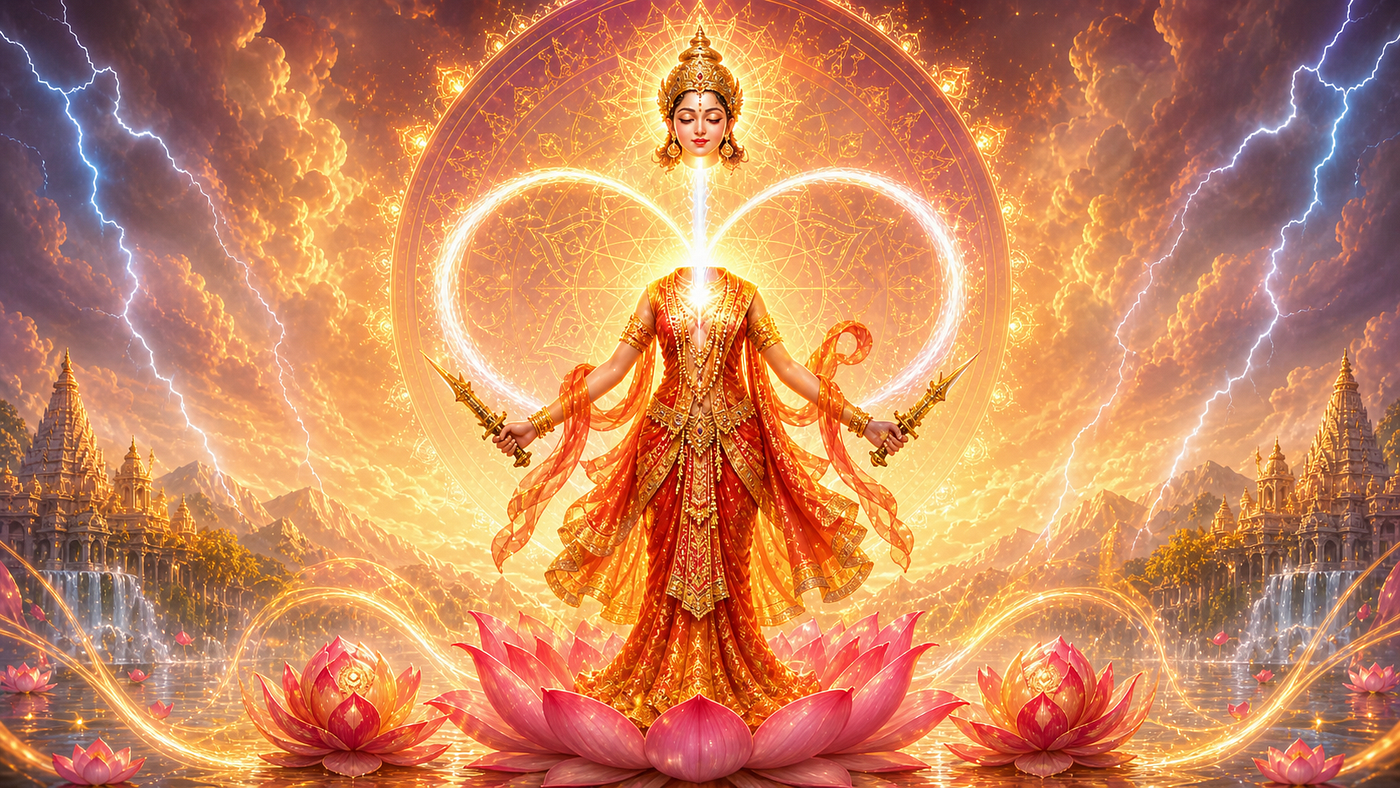
A Śāktopāya–Śāmbhavopāya reflection on Chinnamastā Jayanti — the lightning-thunderbolt Vidyā that transforms power, desire, and ego into recognition!
We call Her Mahāvidyā for a reason.
Yet often, our attention goes first to mantra, yantra, blessings, results, remedies, and desired outcomes. We may forget that at the heart of Mahāvidyā is Vidyā itself — the Knowledge, the insight, the living wisdom that must be contemplated, absorbed, and embodied.
Mantra and yantra are sacred vibration, but their purpose is not merely to produce outcomes. They are ways of gathering attention, refining awareness, and allowing the Vidyā to penetrate the whole being.
In this reflection, the aim is not to approach Chinnamastā through fear, superstition, or desire alone, but through awareness. Through dhāraṇā, dhyāna, and recognition, we ask:
What is Her Vidyā? What does She reveal? What does She cut? What does She transform in us?
For Chinnamastā, the answer is fierce and immediate:
Awakened power must cut the ego before the ego weaponizes awakened power.
In the Śākta understanding, the same divine power can appear as three primary movements:
icchā-śakti — the power of will and desire jñāna-śakti — the power of knowledge and clarity kriyā-śakti — the power of action and force
When these powers are universal, they are divine. But when they become contracted through mala, through limitation, they appear as egoic craving, partial knowledge, impulsive action, pride, compulsion, and suffering.
The unlimited powers of will, knowledge, and action become reduced into limited desire, limited understanding, limited agency, and energy trapped within repetitive cycles of unconscious habits, patterns, attitudes, tendencies, and behaviors.
The universal Śakti becomes the struggling individual when it identifies with limitation.
This is why one may say:
“Śakti to the unconscious is a curse.”
Śakti is never a curse in Herself. But Śakti moving through unconsciousness can feel like curse, obsession, possession, inflation, violence, lust, recklessness, or self-destruction.
Chinnamastā as the shock of the severed ego
Chinnamastā is not merely “fierce energy.” She is the image of power cutting off its own egoic head.
Her severed head is not merely violence. It is the interruption of the ordinary command-center: “I want, I need, I possess, I conquer, I consume.”
The blood feeding herself and her companions suggests that life-force is not hoarded for the ego. It circulates. The Mother’s vitality becomes nourishment.
Chinnamastā standing upon Kāma and Rati can represent mastery over sexual desire, self-surrender, fearlessness of death, and the willingness to give oneself for something greater. Another interpretation sees the erotic couple not as evil, but as raw vitality rising upward and being transformed into a higher circuit of energy.
The key is not suppression. The key is not indulgence. The key is transmutation.
Chinnamastā stands on Kāma and Rati, but does not hate them
This is subtle.
Chinnamastā is not puritanical. She does not deny erotic force. She stands upon it.
That means:
Desire becomes the pedestal, not the master.
Kāma and Rati represent the generative force of life: attraction, union, pleasure, reproduction, vitality, beauty, and rasa.
But Chinnamastā above them says:
“This current must rise into sacrifice, awareness, nourishment, and fearless offering.”
So the teaching is not:
“Sexuality is bad.”
The teaching is:
When subconscious, impulsive, or compulsive desire rules awareness and expression, that is bondage.
When awareness can comfortably contain and consciously leverage the energy and source of desire, that is yoga.
Psychological awakening is not the same as embodied maturity
Embodied life is composed of many layers:
intellect, mind, will, nervous system, senses, social identity, relationships, and physical body.
A person may have a real opening in mind or prāṇa and suddenly feel fearless, alive, radiant, charged, powerful, or almost invincible. But the body, nervous system, ethics, relationships, and social realities may still require careful integration.
This is why spiritual intensity can be misleading.
The mind may feel liberated before the bones, tissues, habits, and relational structures have caught up.
There is a difference between a flash of expanded consciousness and stabilized recognition. The meditative practices of Vijñāna Bhairava offer many gateways through breath, emotion, shock, sensation, sound, stillness, and the space between thoughts. But the purpose is not to act out the state. The purpose is to enter awareness through the state.
So when fierceness arises, the question is not simply:
“What do I feel like doing?”
The deeper questions are:
What is the north star of my life? What is the mission of this year, this month, this week, this day? What are my priorities? What framework helped me define them? What must I take along with me: bones, blood, ligaments, muscles, senses, nervous system, family, relationships, economic sustenance, law, and society?
Are these merely unnecessary coverings? Are they fundamental to life? Are they distractions, illusions, delusions, malas, or impurities obstructing growth? Or are they dharmic containers through which Śakti must learn to move gracefully?
If body, law, auspicious relationships, livelihood, and smooth coexistence with society must be respected, then the question becomes:
How do I express what is true while still honoring all that must be carried with me?
What is grace?
Let us take grace physically.
In culture, slow, patient, conscious, deliberate, non-jerky, non-reactive movement is often associated with refinement. There is respect in it. There is reverence. One does not want to damage or hurt anything, so one moves carefully through the external world.
Take that quality further and we approach the spirit of Tai Chi, Qigong, or Taoist-inspired movement: action without aggression, flow without violence, strength without harshness.
It is not violent, aggressive, rude, hostile, arrogant, or disrespectful toward the surrounding field.
One can have tremendous intensity within. But are the nāḍīs, nerves, muscles, and bodily vessels open enough to contain that force? Can the immense current move patiently through weak or fledgling pathways?
Sometimes restraint is needed.
One may feel strong in the mind and nerves, but the bones may be aging, the ligaments may be torn, and society may not be comfortable with abrupt movements. Therefore, intensity must learn grace. It must become patience, calmness, and accepting witness-awareness.
Then the force no longer has a compulsive need to express itself.
That witness-consciousness, that extraordinary perception, can remain with you even if no one else ever comes to know what you perceive.
Freedom is not impulsiveness
Often people feel:
“I am free, therefore I should do anything.”
But freedom is exactly the opposite of compulsiveness and impulsiveness.
Impulsiveness and compulsiveness arise from unconscious habit. A person acts not because they are fully awake, but because saṃskāra, vāsanā, habit, nature, tendency, and pattern have taken over. They are moving almost like a sleepwalker, driven by old momentum.
A powerful surge, if channeled through impulsiveness and unconscious tendencies, can destroy the body, relationships, family, friendship, reputation, finances, social trust, and spiritual steadiness if it is prematurely externalized.
The true yajña is the offering of egoic appropriation
One perspective is that the only possible application of intense power or Śakti is self-sacrifice and love for the greater good.
This is true, but it must be understood carefully.
The highest sacrifice is not necessarily damaging the body for others. The deeper yajña is the sacrifice of egoic ownership.
It is the sacrifice of compulsive gratification. The sacrifice of unconscious reaction. The sacrifice of “my power, my desire, my victory.” The sacrifice of the egoic head — the false center.
In Kashmir Śaivism, life is not rejected. Body, emotion, desire, creativity, and relationship are all movements of Śakti. But they must be recognized as Śiva’s own expression, not hijacked by the limited “me.”
The path is integration. Ordinary experience, emotions, body, creativity, mantra, meditation, and daily life all become part of sādhana when they are recognized as movements of Śakti.
So this offering is not self-hatred. It is not martyrdom. It is consecration to the Deity, to Dharma, and to whatever greater social, public, civilizational, ecological, or compassionate good lies within one’s practical reach of influence.
A practical map for fierce Śakti
When this kind of force arises, it can be understood in four stages.
1. Raw Śakti
Heat, intensity, desire, power, alertness, aggression, fearlessness, vitality.
2. Egoic capture
“I must act. I must possess. I must dominate. I must indulge. I am special.”
3. Auspicious channeling
Pause. Breathe. Sit. Feel the force in the body. Do not immediately express it through speech, sexuality, confrontation, spending, risk, or heroic physical action.
4. Recognition and offering
“This is Śakti. This is not mine. Let it rise to the Heart. Let it become clarity, compassion, mantra, service, and disciplined action.”
That is Chinnamastā Mā’s grace in essence:
The awakened force must decapitate ego before ego weaponizes awakened force.
Why meditation and Yoga Nidrā are safer containers
Meditation and Yoga Nidrā can become safer containers for this ferocity because, established in āsana or Śavāsana, the mind, nervous system, and intellect are less pressured by immediate outward action.
The body is not being asked to perform. The senses are not being asked to chase. Speech is not being asked to declare. Relationships are not being asked to absorb the voltage. Society is not being asked to respond to every inner movement.
If the body is too weak or incapable, even a seated āsana may not be the right container. Sitting on a chair may be better. The point is not heroic posture. The point is a vessel that can safely hold the current.
Society, family, friends, and relationships need not be burdened with every inner movement of sādhana. Yet the fruits of practice must eventually make one more ethical, gentle, responsible, and relationally sane.
In stillness, one has time.
Time to tone the force down into an auspicious, respectful, reverential, humble, patient Śrīṃ style of dissemination, rather than a Hūṃ, Krīṃ, or Phaṭ style of cutting and severing.
In that stillness, the energy can burn patterns: old conditioning, saṃskāras, vāsanās, obsessions, ṣaḍ-ripus, kleśas, and vikāras, without becoming physical, relational, or social damage.
In outward action, the same force may become harshness, sexual compulsion, reckless exercise, argument, domination, or “truth-telling” without compassion.
Inwardly, it becomes silent tapas.
It becomes the capacity to refine one’s own field through thought, feeling, willing, prayer, mantra, and sankalpa, without needing to impose anything outwardly.
It may also become the power of perception, through which one gains clarity at various levels, without anyone else in the world needing to know what one can see, hear, feel, touch, perceive, or know beyond the ordinary channel of the senses.
It may feel as though the subtle current of suṣumṇā begins to carry forms of perception that the ordinary senses alone cannot channel.
Spanda: not being dragged by every pulse
Spanda can be understood as vibration: the living pulsation of consciousness present in every movement of mind, perception, and life.
But the yogic task is not to be dragged by every pulse.
The task is to recognize the divine vibration within the pulse.
This gives us a simple test.
If the force makes you more graceful, loving, loved, humble, clear, patient, truthful, and capable of restraint, then it is being digested.
If it makes you impatient, grandiose, sexually reckless, cruel, contemptuous, physically reckless, or convinced you are beyond consequence, then it is not yet digested. The egoic-asuric tendency is attempting to hijack Śakti.
The awakened force must decapitate ego
Chinnamastā is not only a terrifying deity before whom one bows. She is also a Vidyā, an inner revelation of how awakened force must be handled.
Her teaching is direct:
The awakened force must decapitate ego before ego weaponizes awakened force.
That is why She is both terrible and compassionate.
Terrible to the false head. Compassionate to the deeper life.
She cuts what would misuse power. She feeds what must live.
So the mantra of this understanding could be:
May the ability to desire become offering for her will! May power become protection. May intensity become awareness. May my egoic head fall before my heart is harmed. May Śakti not serve my unconsciousness, impulsiveness, inauspiciousness. May this life serve Her recognition!
메타데이터
- post_id
- d8840fcfd73c
- slug
- the-vidya-of-the-maha-on-chinnamastā-jayanti-d8840fcfd73c
- url
- https://medium.com/@rajkcar/the-vidya-of-the-maha-on-chinnamast%C4%81-jayanti-d8840fcfd73c
- canonical_url
- https://medium.com/@rajkcar/the-vidya-of-the-maha-on-chinnamast%C4%81-jayanti-d8840fcfd73c
- author_url
- https://medium.com/@rajkcar
- status
- ok
- fetched_at
- 2026-07-10 21:44:25