“How a Simple Classroom Conversation Inspired My First UX Case Study”
It Started With a Simple Question
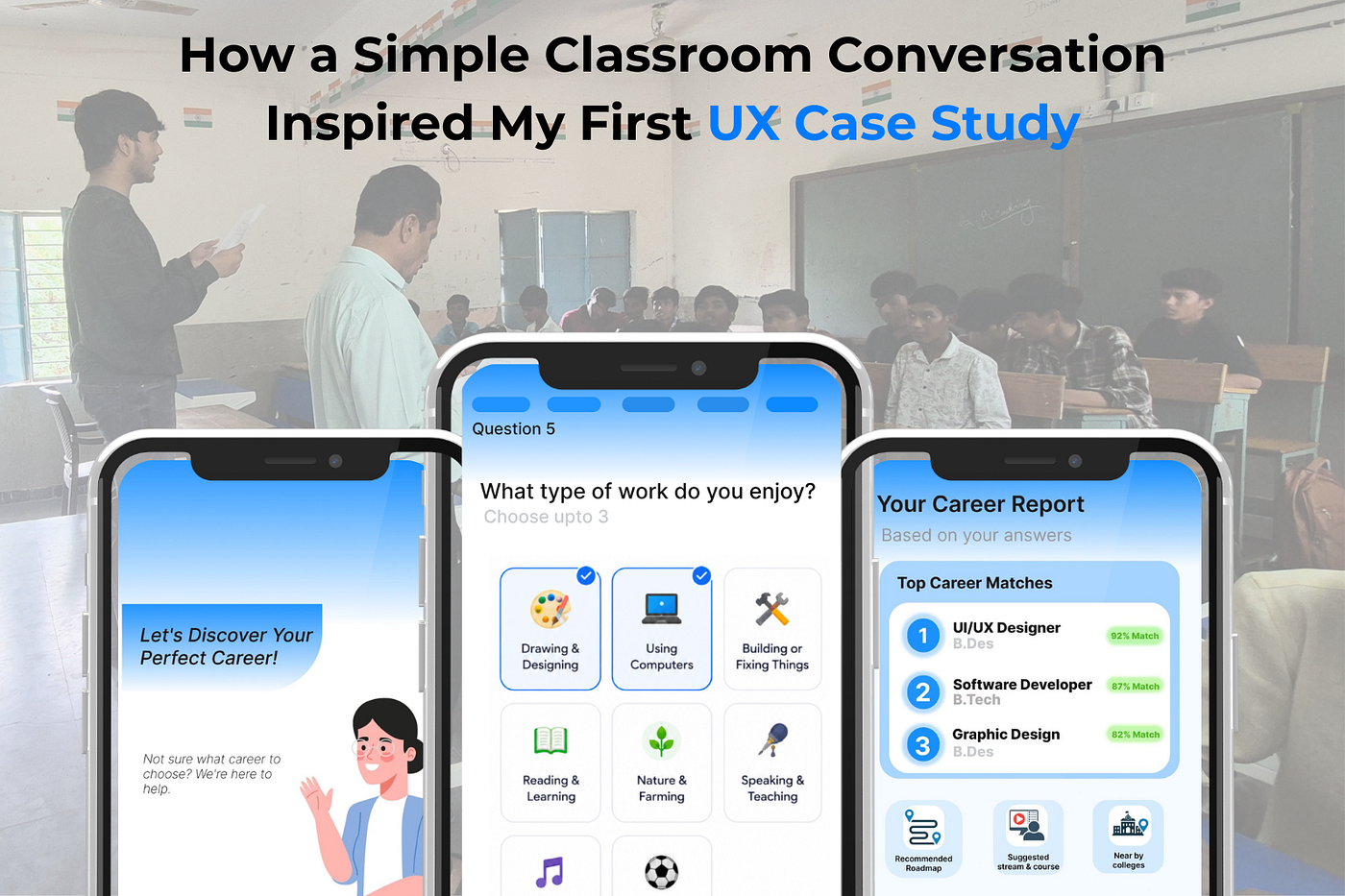
“How a Simple Classroom Conversation Inspired My First UX Case Study”
It Started With a Simple Question
What should I do after 12th?”
That question stayed with me throughout 2025.
In 2025, after completing my 12th grade and entrance examinations, everyone around me seemed to have a plan. Some were preparing for Engineering, some for Medicine, while others had already decided to pursue a degree or management courses.
But I was different.
I knew one thing with certainty — I wanted to build a career that allowed me to be creative. The problem was, I had no idea what that career looked like or where to begin.
Like thousands of students, I started searching online.
spent weeks searching for colleges, scholarships, courses, and career options. The information was scattered, confusing, and often overwhelming.
Coming from a rural background, I didn’t have mentors or career counselors to guide me.
There were moments when I wished someone could simply tell me:
“Based on your interests, here’s the career path that’s right for you.”
Eventually, I discovered Bachelor of Design (B.Des), and it completely changed my perspective.
I thought my journey had ended. In reality, it was just the beginning.
When My Story Became Their Story
A year after beginning my Bachelor of Design (B.Des) journey, I returned to my hometown during my summer break.
One of my relatives, the Principal of a Government School in my village, invited me to speak with students who had recently completed their 10th grade. His goal was simple:
“Help them understand that there are career opportunities beyond Engineering and Medicine.”
As I shared my own journey — from struggling to choose a career after my 12th grade to discovering the world of design — I noticed something unexpected.
Most students had never heard of careers like UI/UX Design, Product Design, Animation, or Filmmaking. Even those who were passionate about technology, sports, photography, or hospitality didn’t know where to begin, which course to choose, or how to turn their interests into a career.
At that moment, I saw my younger self in that classroom
The problem wasn’t a lack of ambition — it was a lack of awareness, guidance, and access to the right opportunities.
That single conversation became the inspiration behind Career Discovery Toolkit — a platform designed to help rural students discover careers based on their interests and confidently navigate their future.
The Problem I Couldn’t Ignore
As I listened to the students, I realized the challenge wasn’t just about choosing a career.
Many students had dreams, interests, and ambitions, but they didn’t know where to begin. They were unaware of career opportunities beyond traditional paths, didn’t know which courses matched their interests, where to study, or how to find scholarships.
That day, I left the classroom with one question in my mind:
Research Goal
The objective of this research was to understand how rural students explore career opportunities, identify the factors that influence their career decisions, and uncover the challenges they face while planning their future.
“The research also aimed to understand students’’ awareness of career opportunities beyond traditional paths such as Engineering and Medicine, and identify gaps in access to career guidance, educational resources, and reliable information..
Research Overview
The classroom conversation gave me an idea of the problem, but I didn’t want to make assumptions based on just one interaction. I wanted to understand whether other students had similar experiences and what challenges they actually faced while exploring their future.
To learn more, I visited the school multiple times, spoke with students, conducted surveys, and observed how they talked about careers and their aspirations.
Who did I speak with?
Rural government school students with different interests, talents, and career aspirations.
Why this students?
During the classroom session, I noticed that most students were familiar only with traditional careers like doctor, engineer, police officer, or teacher. At the same time, many of them had unique interests in sports, arts, creativity, and technology but didn’t know what career opportunities existed around those interests.
Many students also came from families with limited financial resources and depended on government scholarships to continue their education. While scholarships and educational support were available, several students were unaware of how to access them or where to find reliable information.
This made me curious to understand how students explore career opportunities, what influences their decisions, and the challenges they face while planning their future.
How did I conduct the research?
Survey Questionnaire
One-to-one Conversations
Classroom Observation
What was I trying to understand?
- How students explore career opportunities.
- What influences their career decisions.
- Their interests, aspirations, and goals.
- The challenges they face while planning their future.
- The gaps in career awareness and guidance.
What I Wanted to Find Out
To guide my research, I framed a few key questions that would help me better understand the students, their experiences, and the challenges they face while exploring career opportunities
- How do rural students currently explore career opportunities?
- How aware are rural students of careers beyond traditional paths?
- What factors influence their career decisions?
- Where do rural students currently seek career guidance and information?
- What challenges do they face while planning their future?
- How aware are they of scholarships, financial aid, and educational support available to them?
Primary Research in the Field
Once I had a clear understanding of what I wanted to learn, I visited a government school and spent time interacting with rural students in their classrooms.
Rather than making assumptions, I wanted to hear directly from the students about their aspirations, the careers they knew, the guidance they received, and the challenges they faced while planning their future.
To capture both qualitative and quantitative insights, I conducted face-to-face conversations and distributed a simple survey questionnaire to 25 -30 students.
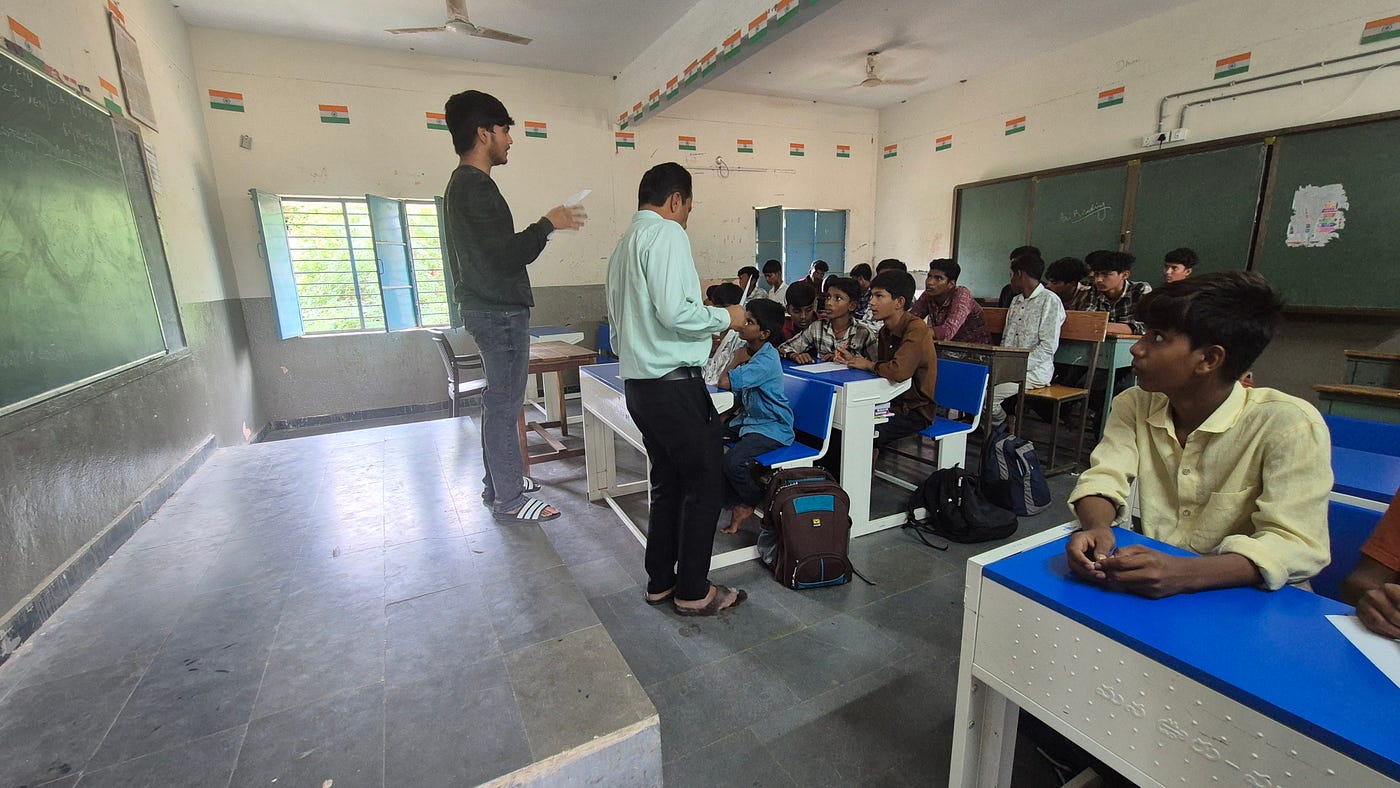
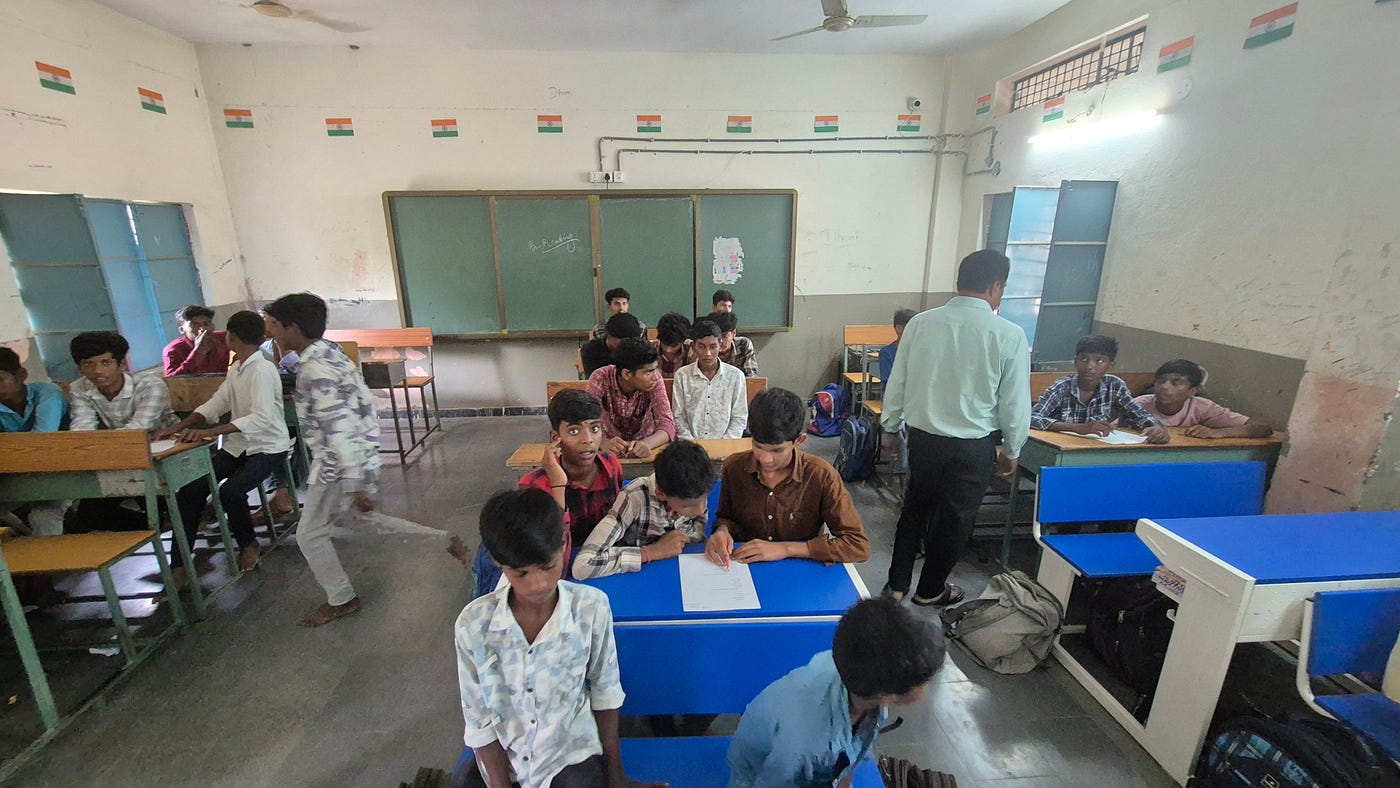
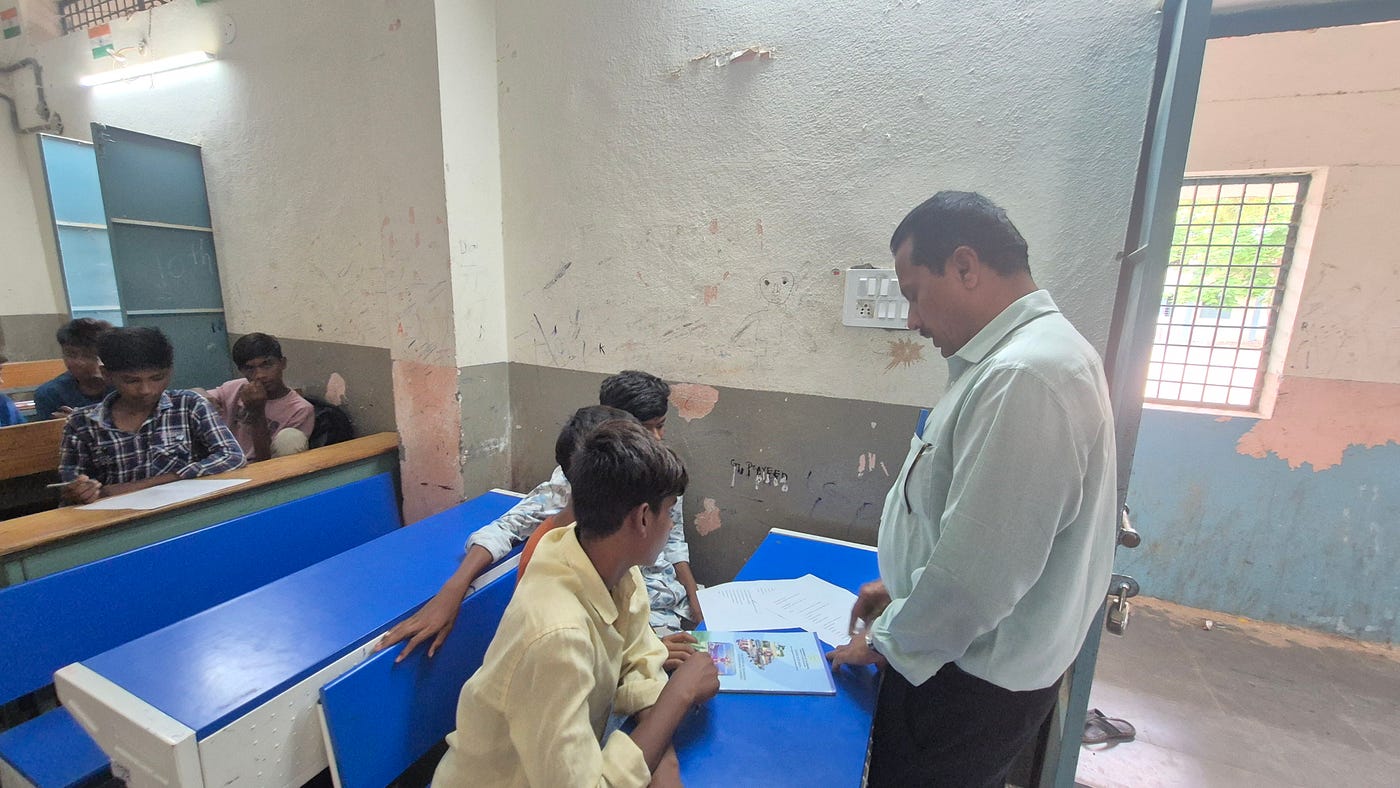
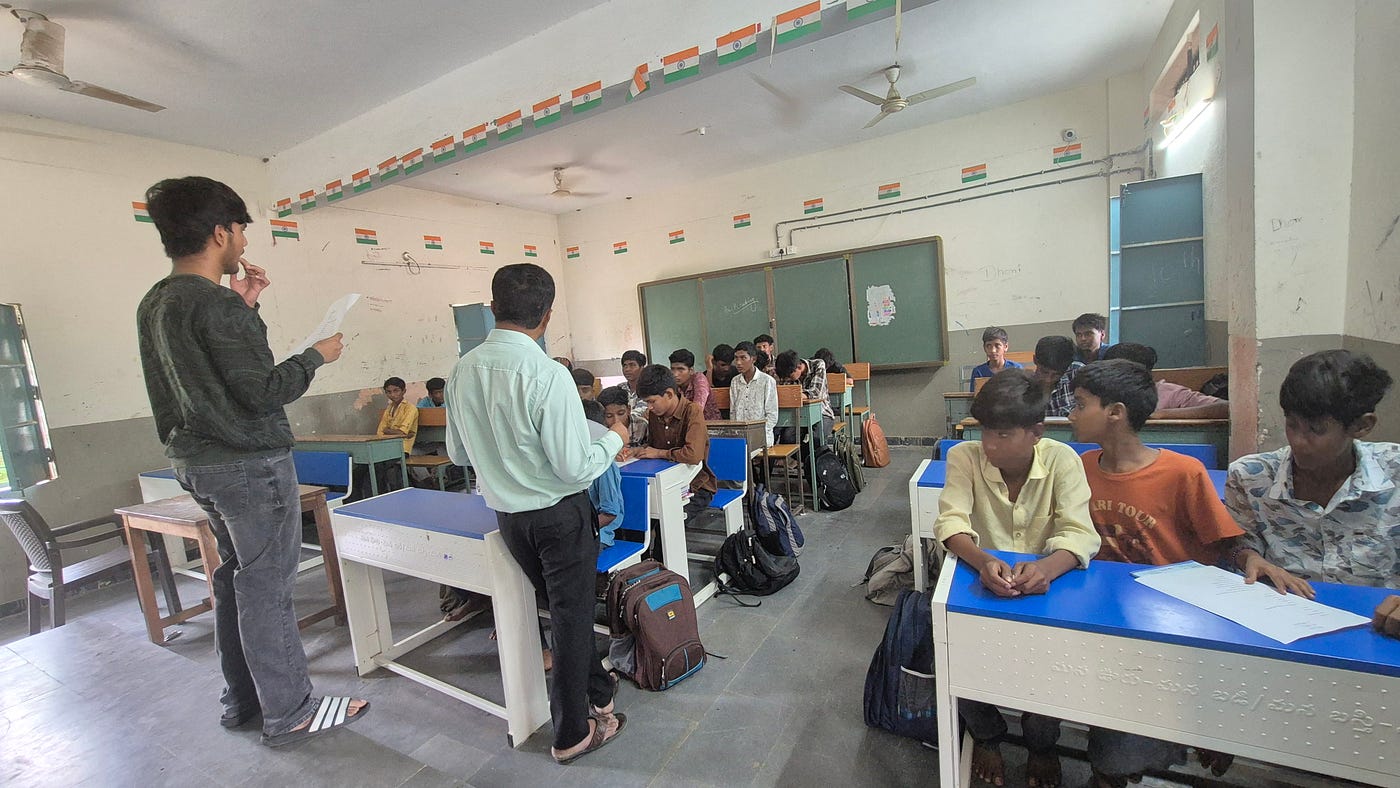
Conducting primary research through classroom observations, conversations, and survey activities.
Survey Questionnaire
To understand how students explore careers and what influences their decisions, I designed a questionnaire focusing on:
- Career aspirations
- Career awareness
- Decision-making confidence
- Sources of career guidance
- Challenges in choosing a career
- Scholarship awareness and financial concerns
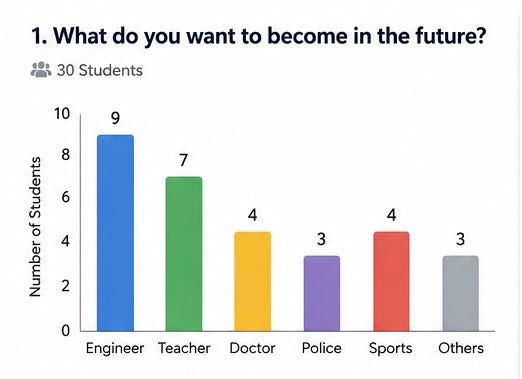
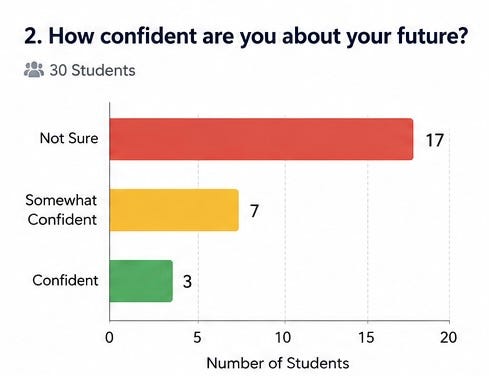
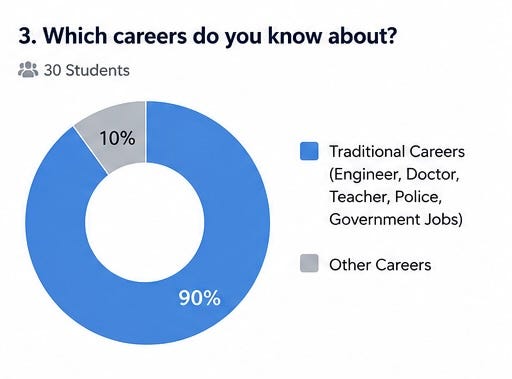
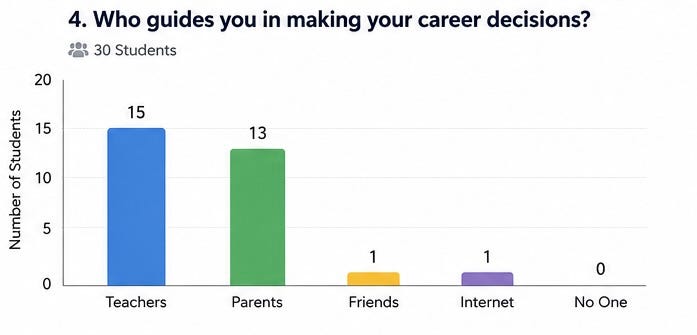
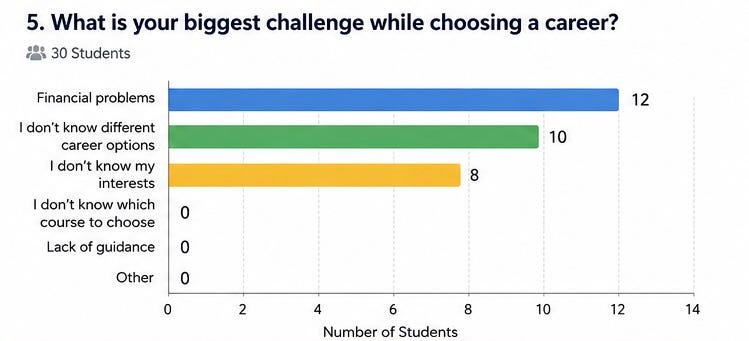
Key Insights
The survey revealed five key patterns that helped define the problem.
Students aspire to traditional careers
Most students wanted to become engineers, teachers, doctors, or police officers, with very few considering other career options.
Insight: Students’ aspirations are limited by the careers they know.
Many students are unsure about their future
More than half of the students were not confident about their career choices.
Insight: Students need guidance to make informed decisions.
Career awareness is limited
Most students were familiar only with traditional professions.
Insight: Exposure to diverse career opportunities is missing.
Parents and teachers are the main guides
Students relied primarily on parents and teachers for career advice.
Insight: Accessible career guidance resources are largely unavailable.
Financial concerns influence career decisions
Financial problems and limited awareness of scholarships were among the biggest challenges students reported.
Insight: Students need both career guidance and financial support information.
Rural Students: Research Snapshot
- 30 survey participants
- 9 aspiring Engineers
- 17 unsure about their future career
- 90% aware of only traditional careers
- Parents & Teachers were the primary guides
- Finance, career awareness & scholarships were the top challenges
The Moment Everything Started Making Sense
As I looked back at the survey responses and the conversations I had with the students, I realized the problem was much bigger than I had initially imagined.
It wasn’t that students lacked dreams. In fact, almost every student had one.
The challenge was that their dreams were shaped by what they had seen around them. Most knew only a few familiar careers, relied on parents and teachers for guidance, and had little exposure to other possibilities. Even those who had clear ambitions were unsure about the path to achieve them. For many, financial concerns and limited awareness of scholarships made higher education feel even more uncertain.
At that moment, I understood that the real problem wasn’t helping students choose a career — it was helping them discover one.
I especially like the last line:
“The real problem wasn’t helping students choose a career — it was helping them discover one.”
Looking Beyond the Classroom (for secondary research)
While my primary research helped me understand the experiences of rural students firsthand, I also wanted to understand the broader landscape of career guidance in India. I explored existing career guidance platforms, articles, and educational resources to see how students currently receive career support.
What I Found
- Most career guidance platforms are designed for students who already have some career awareness.
- Many platforms focus on aptitude tests but provide limited guidance on scholarships, colleges, and career pathways.
- Rural students receive very little attention compared to urban students.
- Career guidance is often fragmented, requiring students to search across multiple sources.
Learning from Existing Platforms (for competitive analysis)
o better understand the existing solutions, I explored a few career guidance platforms, including:
- Mindler
- Univariety
- CareerGuide
- iDreamCareer
After trying these platforms, I noticed a few common patterns:
- Most platforms are designed for students who already have some level of career awareness.
- Many require users to purchase a premium plan to unlock detailed career reports or counselling.
- The focus is often on aptitude tests and career recommendations, with limited guidance on colleges, scholarships, or the complete career journey.
- Very few platforms specifically address the needs of rural government school students, who may have limited career exposure and access to guidance.
Opportunity
This revealed an opportunity to design a solution that is simple, accessible, and tailored to students who are just beginning to explore their future — especially those from rural backgrounds.
The Design Challenge
After synthesizing insights from classroom observations, student surveys, secondary research, and competitive analysis, one challenge became clear:
Rural students have aspirations for their future, but they often lack awareness of career opportunities, access to reliable guidance, and a clear roadmap to turn those aspirations into reality.
How might we help students discover career opportunities based on their interests while providing clear guidance on courses, colleges, scholarships, and the steps needed to achieve their goals — all in one accessible platform?
Design Exploration
With a clear problem statement in place, I began exploring how the experience could simplify career discovery and make guidance more accessible for rural students.
Instead of adding unnecessary features, I focused on designing an experience that answered students’ most important questions at the right time. Every design decision was driven by the research insights — from helping students discover careers based on their interests to providing a clear roadmap with colleges and scholarship information.
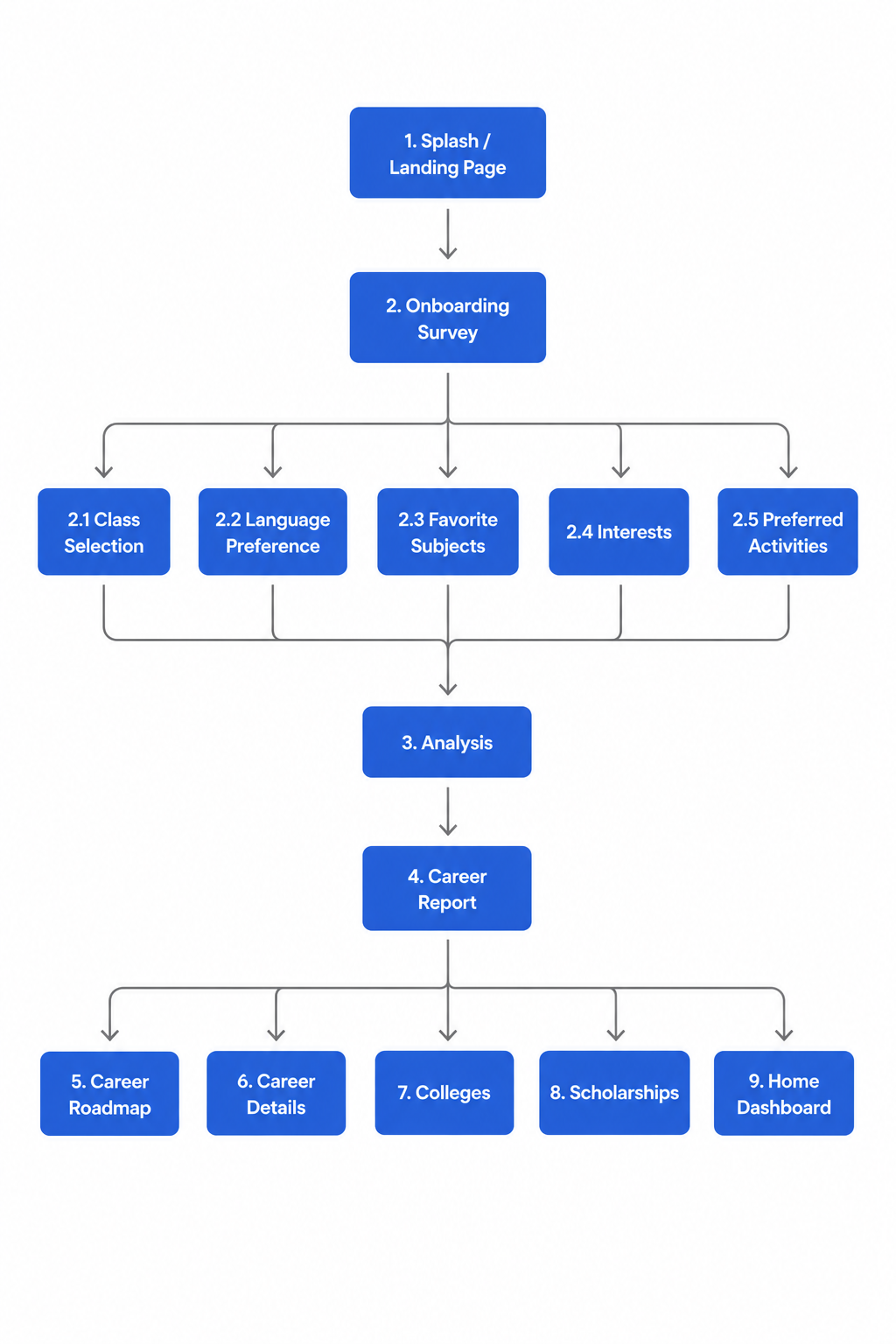
Information Architecture
Information architecture helped me organize the app around the students’ real needs. Instead of presenting everything at once, I structured the content into a simple journey — from discovering suitable careers to exploring colleges and scholarships — making the experience easy to understand and navigate for rural students.
Wire Framing/Paper Sketches
Before focusing on visual design, I created low-fidelity wireframes to explore layouts, information hierarchy, and navigation. This allowed me to iterate quickly and validate the overall experience before investing time in high-fidelity designs
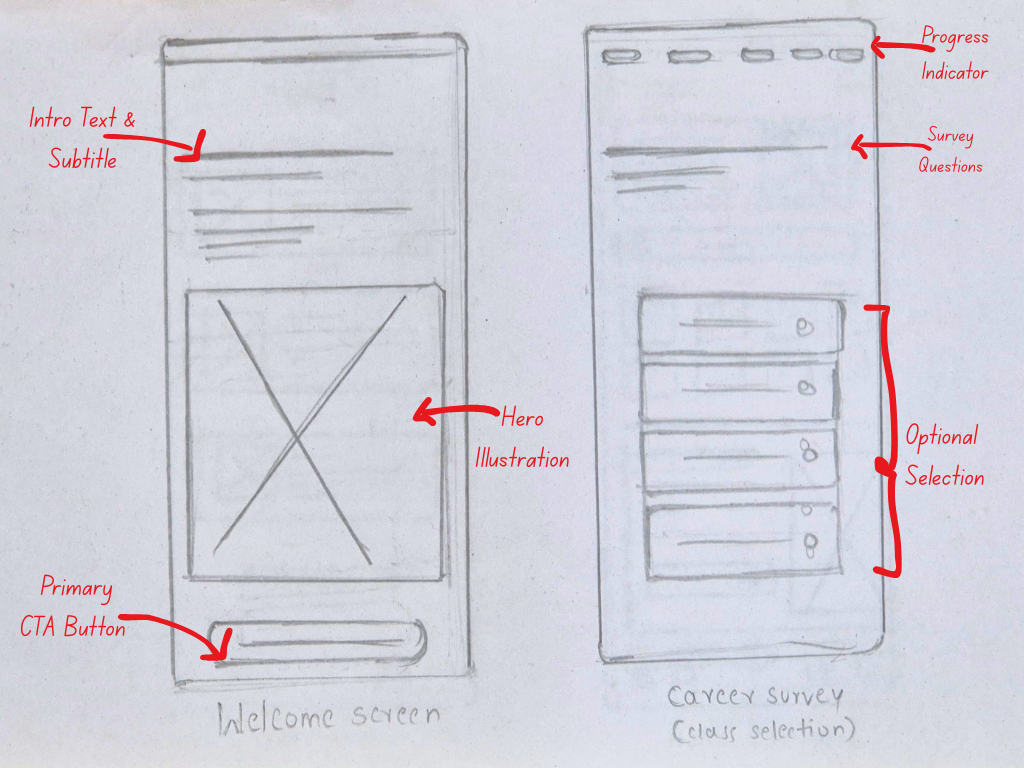
Welcome Screen & Career Survey (1)
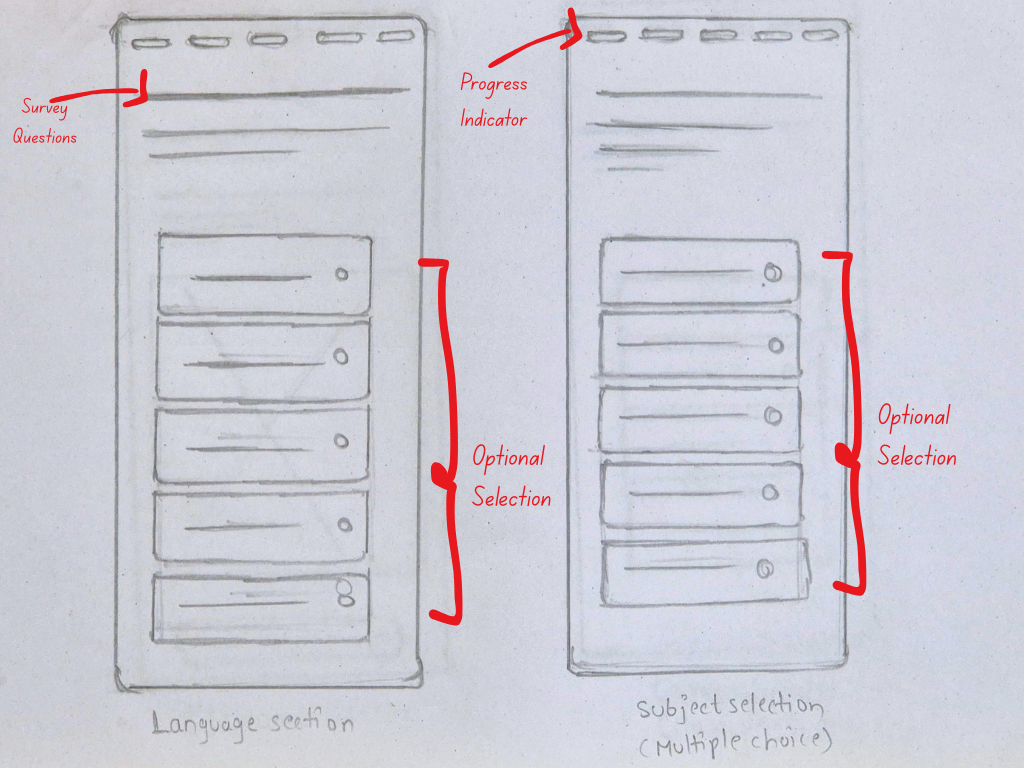
Career Survey (2,3)
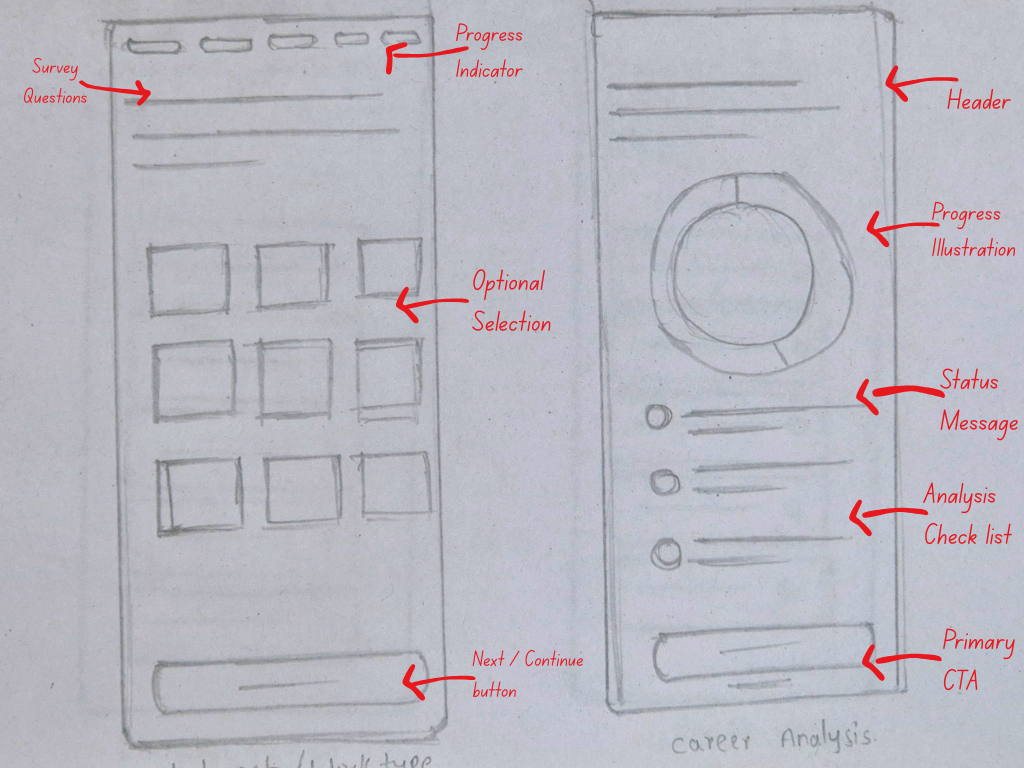
Career Survey(4) & Career Analysis
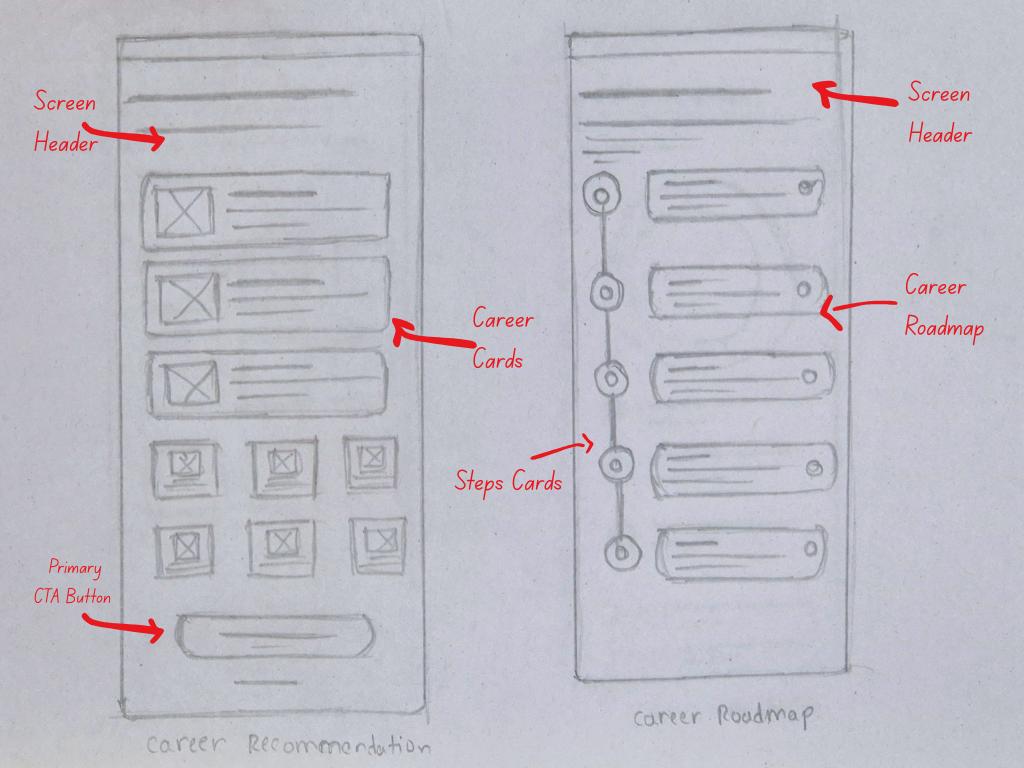
Career Recommendation & Career Road Map
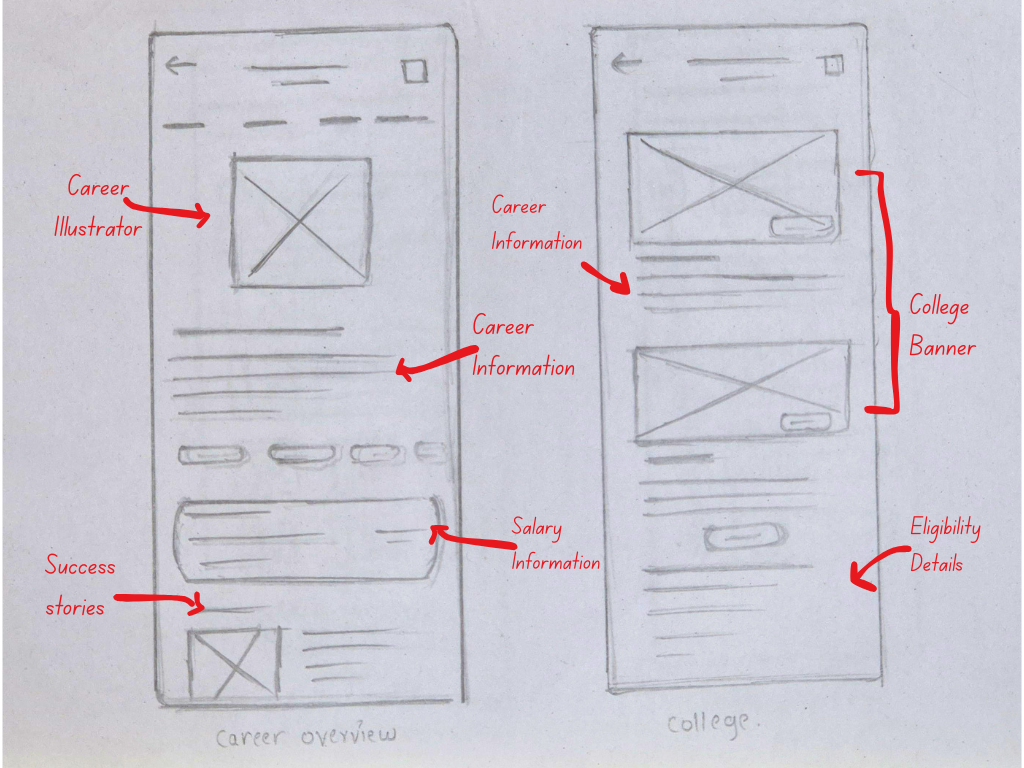
Career Overview & College Information
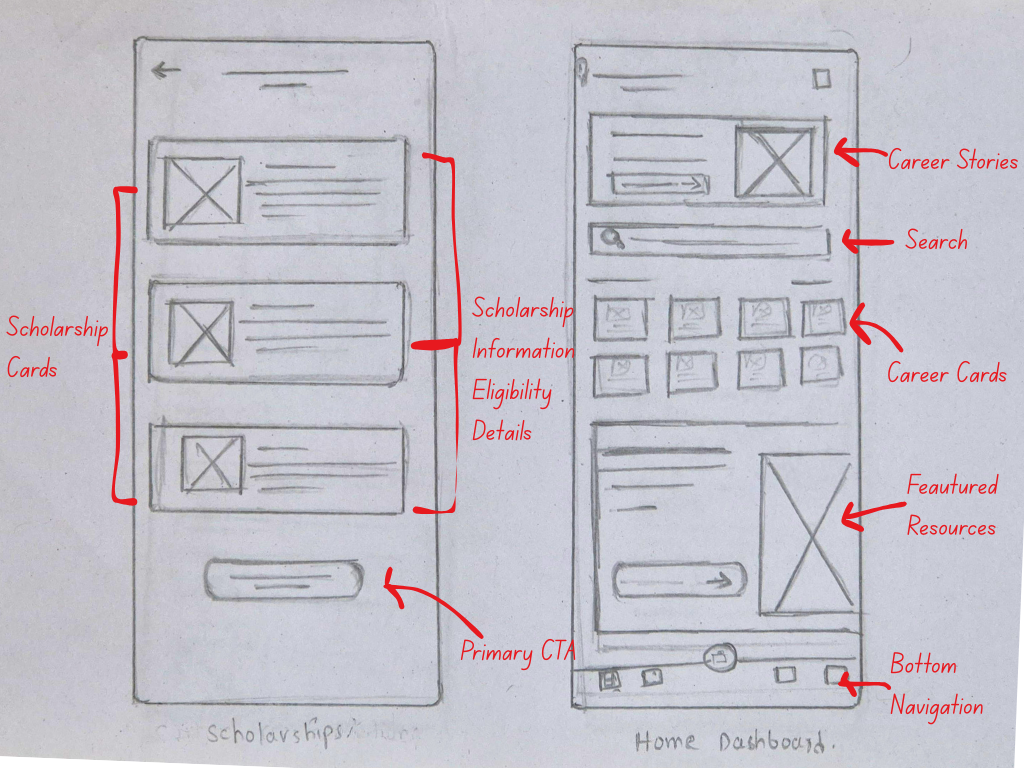
Scholarships Information & Home Dashboard
Final UI Screens
These are the final high-fidelity screens of the Minimum Viable Product (MVP), bringing together the essential features required to help students discover careers, explore educational opportunities, and make informed decisions through a user-friendly experience.
Here’s how the MVP guides rural students from career discovery to informed decision-making through a simple and personalized experience.
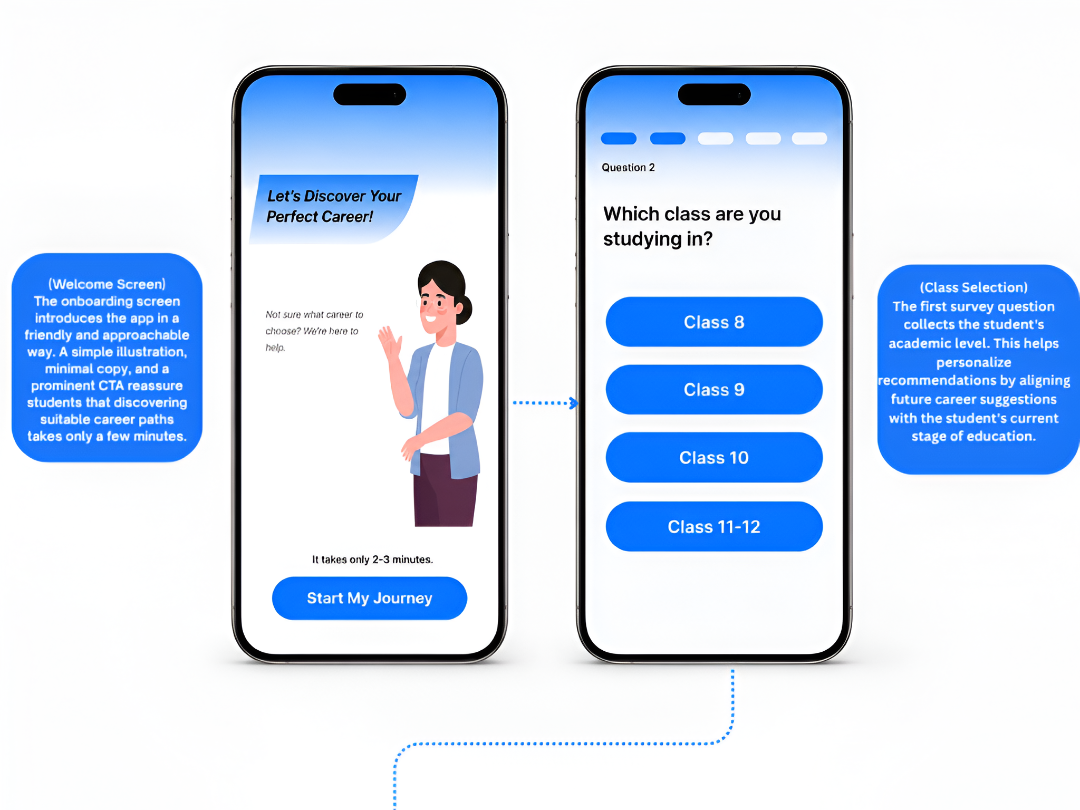
Welcome → Class Selection
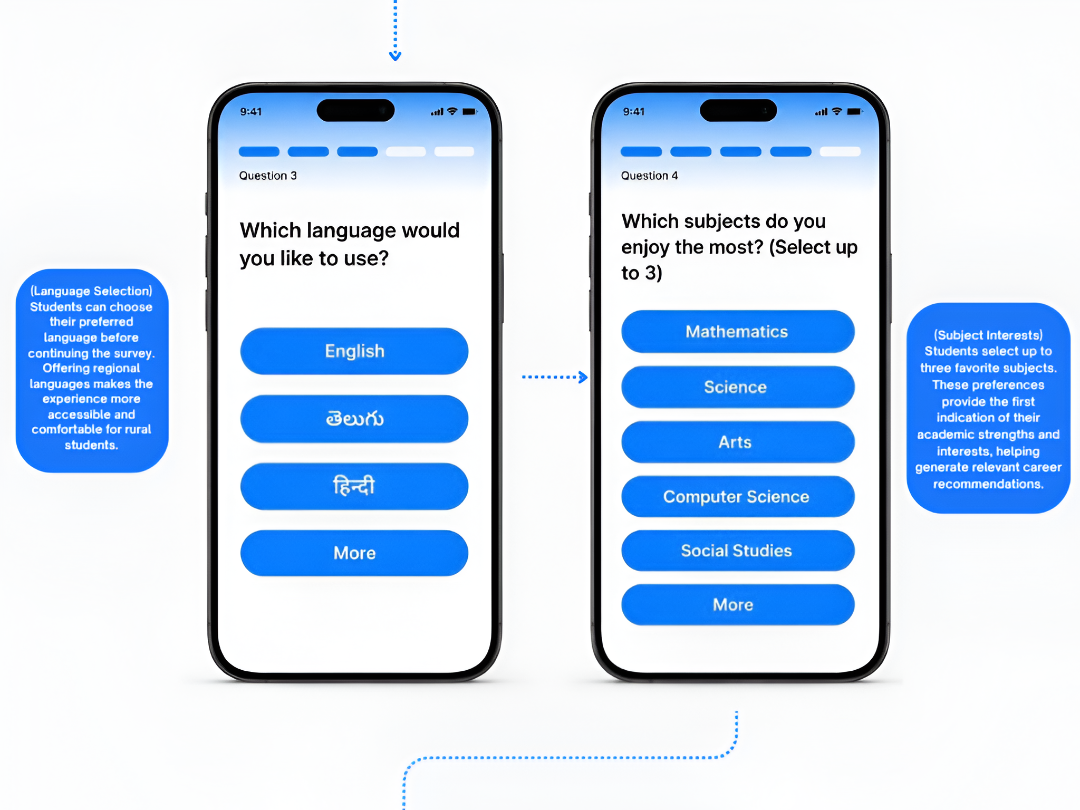
Language Selection → Subject Interests
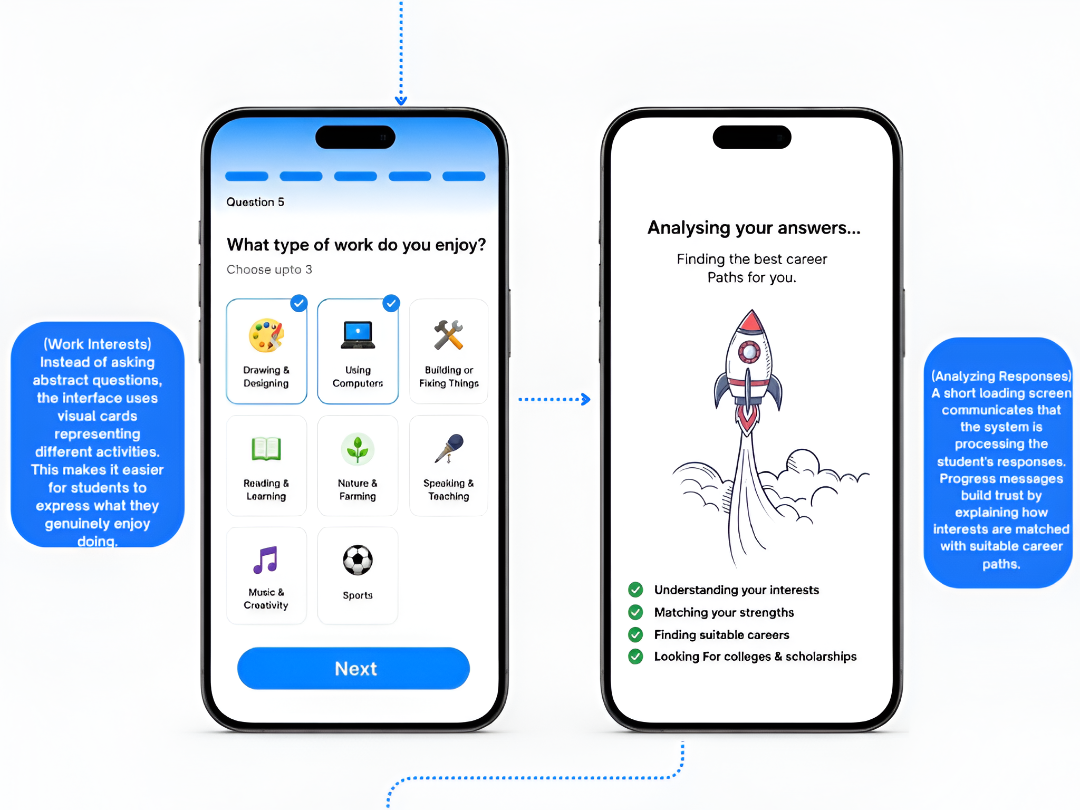
Work Interests → Analysis Screen
So… How Did We Find Your Career?
How Career Recommendations Work
Once students complete the assessment, the app analyzes their responses using a rule-based recommendation system. Each answer contributes to career categories based on interests, preferred subjects, skills, and work preferences. The system then ranks the most suitable career paths and generates a personalized career report. This approach was designed as an MVP to provide simple, transparent, and easy-to-understand recommendations. In future iterations, the recommendation engine can be enhanced using AI to deliver more personalized career guidance.
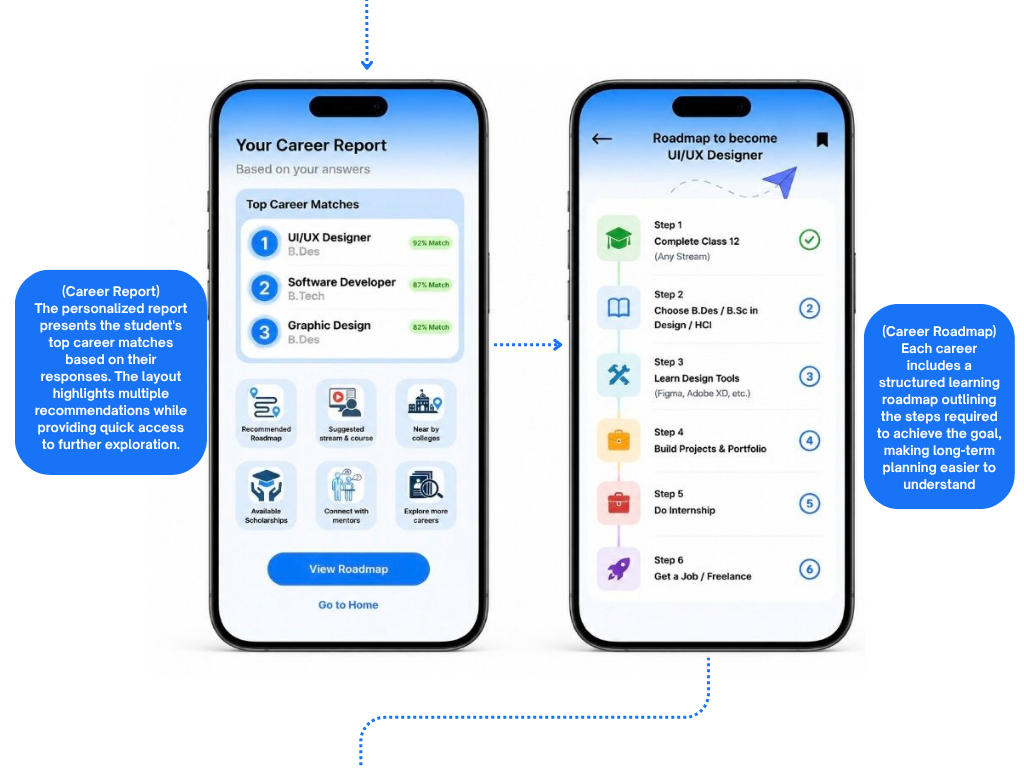
Career Report → Career Roadmap
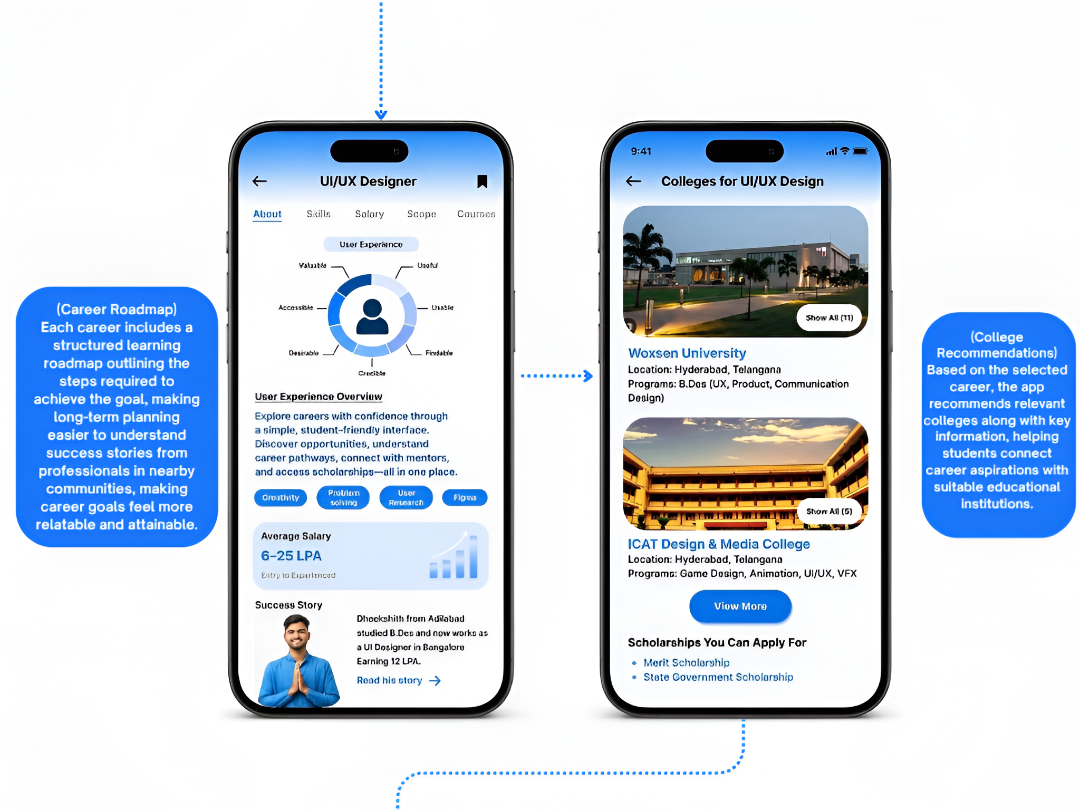
Career Details → Colleges
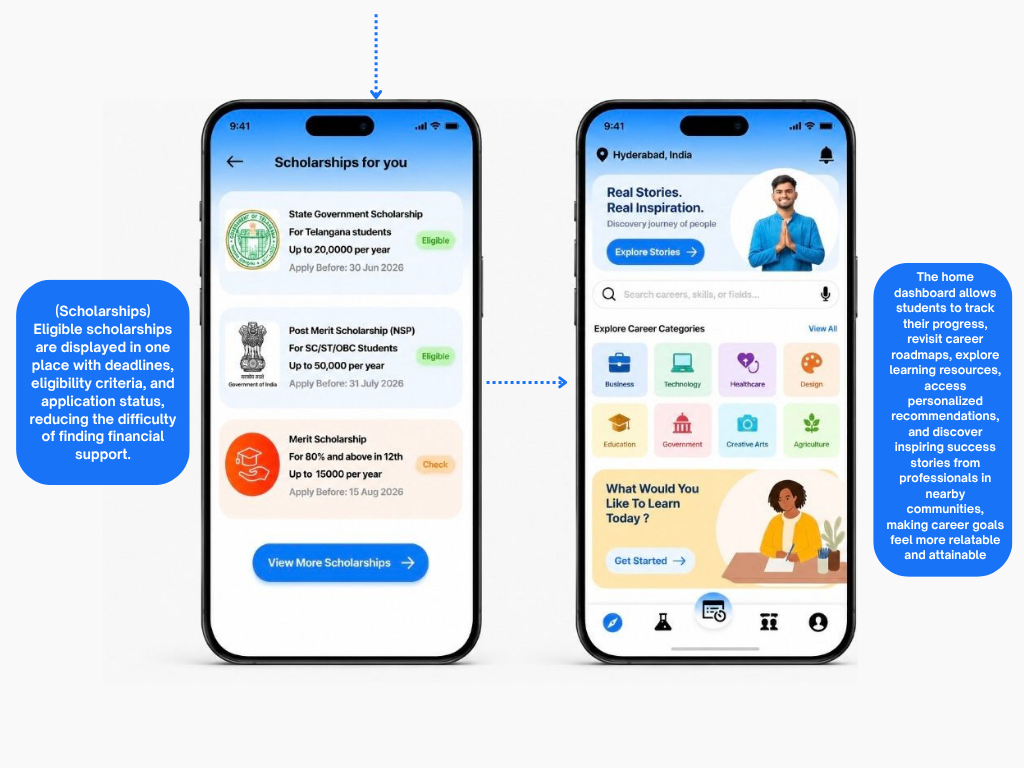
Career Details → Colleges
Design Decisions
Designing with Intent, Not Assumptions
Every design decision was driven by research findings and focused on reducing complexity for rural students. Rather than adding more features, I prioritized clarity, accessibility, and guided decision-making to create an experience that feels simple, supportive, and easy to navigate.
01. Simplifying Decision Making
Students often felt overwhelmed by the number of career choices available. Instead of presenting excessive information at once, the experience breaks the journey into smaller, manageable steps, allowing users to make one decision at a time.
02. Progressive Disclosure
Rather than displaying all information on a single screen, content is introduced gradually throughout the journey. This reduces cognitive load and helps students stay focused on the current task.
03. Personalization Over Generalization
Every student has different interests, strengths, and aspirations. The experience adapts recommendations based on individual responses instead of offering generic career suggestions.
04. Reducing Cognitive Load
Simple layouts, familiar components, and minimal visual distractions allow students to focus on understanding career options rather than figuring out how to use the interface.
05. Guiding Instead of Assuming
Many existing platforms assume students already know what career they want. This experience instead guides users from self-discovery to career exploration, helping them build confidence throughout the process.
06. Accessibility & Inclusivity
The interface uses clear language, visual cues, and an intuitive flow to ensure students from diverse educational and digital backgrounds can comfortably navigate the experience.
Closing Line
Every design decision was rooted in user research, ensuring that each interaction addressed a real user need while keeping the experience simple, accessible, and meaningful.
User Feedback
To gather initial feedback on the concept and overall experience, I presented the UI screens in Figma presentation mode to rural government school students. I walked them through the complete journey — from completing the career assessment to receiving career recommendations, exploring the roadmap, colleges, and scholarship information.
I also explained how the recommendation system works, where the app analyzes students’ responses using a rule-based matching system based on their interests, preferred subjects, skills, and work preferences to generate personalized career recommendations. This discussion helped me understand how students perceived the recommendation process, whether they understood the system behavior, and what improvements they expected from the experience.
Areas for Improvement
- “I wanted to know why these careers were recommended based on my answers.”
- “It would be helpful if I could compare two recommended careers before making a decision.”
- “Some career names were unfamiliar, so I needed simpler explanations.”
- “I wanted to retake the assessment after changing my interests.”
- “It would be nice if the app explained which answers influenced each recommendation.”
Positive Feedback
- “The questions were simple and easy to answer.”
- “I liked that the recommendations were based on my interests instead of random career suggestions.”
- “The career roadmap clearly explained what I should do next.”
- “Having colleges and scholarships in one place made the process easier.”
- “The recommendation system felt logical after understanding how it worked.”
Better Future Scope
AI Career Mentor Uses AI to understand student conversations, explain career recommendations, and answer career-related questions in simple language.
Adaptive Career Recommendations Continuously improves recommendations by learning from student interests, feedback, and changing career trends instead of relying only on predefined rules.
Personalized Learning Path Recommends courses, certifications, and learning resources based on the student’s chosen career and skill gaps.
Intelligent Scholarship Alerts Automatically notifies students about scholarships, entrance exams, and deadlines that match their profile and eligibility.
AI Communication Coach Provides English speaking practice, resume feedback, and mock interview sessions to improve career readiness.
Mentor Connect Allows students to connect with mentors, professionals, and college seniors for guidance and real-world advice.
Career Market Insights Shows salary trends, future job demand, required skills, and emerging career opportunities using real-time market data.
Smart College Comparison Compares colleges based on placements, fees, scholarships, rankings, and eligibility to simplify decision-making.
Voice-Based AI Assistant Supports regional languages through voice interaction, making the app more accessible for rural students.
Career Progress Tracker Tracks completed milestones, acquired skills, and learning progress while updating career guidance as students grow.
My Learnings
This project taught me that UX design is much more than creating visually appealing screens. It begins with understanding users, identifying real problems, asking the right questions, and transforming insights into meaningful solutions.
Throughout this journey, I learned the value of conducting research, simplifying complex information, and designing experiences that are intuitive, accessible, and user-centered. I also realized that every design decision should be backed by purpose rather than assumptions.
Most importantly, I learned that good design is an iterative process. There is always something to improve, and every project is an opportunity to learn and grow as a designer.
This case study marks the beginning of my journey as a UX Interaction Design student. As I continue my second year of Bachelor of Design, I look forward to taking this project beyond the MVP by exploring future enhancements, conducting further usability testing, and continuously refining the experience based on user feedback. My goal is to create a solution that empowers rural students to confidently discover careers, access the right opportunities, and make informed decisions about their future. I hope this is just the first of many meaningful experiences I get to design.
Finally, It’s time to celebrate !!!
-Vaibhav Rao Vaddineni
Why?
Because I’ve completed my first UX case study and you’ve completed reading it
Thanks a lot for scrolling this far!
메타데이터
- post_id
- d890820f64d4
- slug
- how-a-simple-classroom-conversation-inspired-my-first-ux-case-study-d890820f64d4
- url
- https://medium.com/design-bootcamp/how-a-simple-classroom-conversation-inspired-my-first-ux-case-study-d890820f64d4
- canonical_url
- https://medium.com/design-bootcamp/how-a-simple-classroom-conversation-inspired-my-first-ux-case-study-d890820f64d4
- author_url
- https://medium.com/@vaddinenivaibhavrao7
- status
- ok
- fetched_at
- 2026-07-31 15:47:04